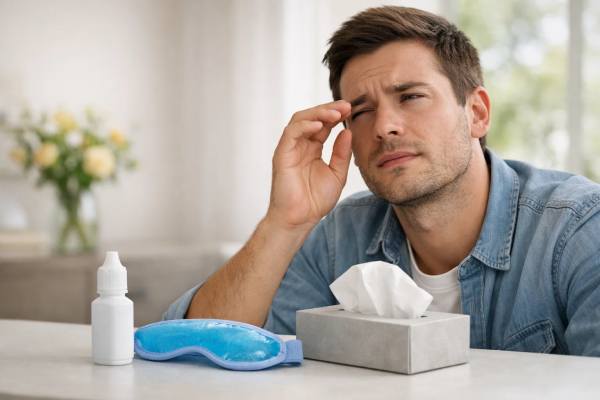
Rubbing your eyes can feel like the quickest way to quiet an itch, clear a blur, or relieve fatigue. But the eye’s surface and the cornea beneath it are built for gentle blinking—not repeated pressure, knuckle friction, or twisting. Over time, frequent rubbing can worsen dryness and allergy symptoms, inflame the eyelids, and in susceptible people, may contribute to corneal shape changes linked to keratoconus. The right approach is not willpower alone. It is replacing rubbing with relief that actually treats the reason you want to rub in the first place.
This article explains what rubbing does to the eye, how strong the keratoconus connection appears to be, and which people should be especially cautious. You will also get a practical set of safer alternatives—simple steps you can use the same day—plus clear guidance on when to get an eye exam to protect vision.
Key Insights
- Reducing eye rubbing often improves redness, burning, and eyelid irritation within 1–2 weeks when paired with better dryness and allergy control.
- Frequent rubbing can worsen dry eye and allergic inflammation, creating a cycle where itching feels constant.
- In people with risk factors, chronic rubbing is associated with higher keratoconus risk and may accelerate progression.
- Sudden pain, light sensitivity, or vision loss should not be managed at home and needs urgent evaluation.
- Use a “hands-off itch protocol”: preservative-free tears, cool compress for 5–10 minutes, then targeted allergy or dry eye care.
Table of Contents
- What eye rubbing actually does to your eye
- Does eye rubbing cause keratoconus: what we know
- Signs you should get checked for keratoconus
- Why your eyes itch and how to stop the trigger
- Safer alternatives to rubbing that actually work
- If you have keratoconus: how to protect your vision
What eye rubbing actually does to your eye
Eye rubbing is not a single behavior. A quick gentle swipe at the inner corner is very different from deep knuckle pressure into a closed lid, or repetitive “polishing” when you are tired. The risk is less about one moment and more about the combination of force, frequency, and inflammation.
Here is what rubbing can do, in practical terms:
- Micro-irritation of the surface: The clear outer layer of the eye (the cornea) and the surrounding conjunctiva are delicate. Rubbing can create tiny surface disruptions that sting, tear, and feel gritty. Even when there is no obvious scratch, a mildly irritated surface often becomes more sensitive to wind, smoke, screens, and contact lenses.
- More inflammation and more itching: If your itch is allergic, rubbing can trigger more release of inflammatory chemicals. That can temporarily feel satisfying, then rebound into worse itching and redness. Many people get stuck in this loop: itch → rub → brief relief → stronger itch.
- Worsened dry eye and unstable vision: Rubbing and frequent wiping can disturb the tear film and encourage reflex tearing (watery eyes that still feel dry). The result is often fluctuating blur that clears after blinking, then returns—especially during screen use.
- Eyelid margin disruption: The eyelids contain oil glands that help keep tears from evaporating too fast. Rubbing can inflame the lid margin, worsen blepharitis (eyelid inflammation), and contribute to faster tear evaporation. The symptom feels like burning or “hot” eyes late in the day.
- Contact lens problems: If you rub with contact lenses in, you can shift the lens, trap debris under it, or irritate the cornea. The danger is not only discomfort; it is that you may miss early signs of corneal injury because the lens temporarily masks the sensation.
A useful mental model is that rubbing is a “symptom amplifier.” It does not just respond to itch; it can make the underlying drivers—dryness, allergy, eyelid inflammation—more intense and more persistent. That is why the best strategy is to treat the itch source and use a safer replacement behavior when you feel the urge to rub.
Does eye rubbing cause keratoconus: what we know
Keratoconus is a condition where the cornea gradually thins and bulges forward into a cone-like shape, leading to irregular astigmatism and vision distortion. It often begins in the teens or early adulthood and may progress for years before stabilizing. The most important point for readers is this: keratoconus is multifactorial—genes, biomechanics, and environment interact—so “cause” is rarely one single thing. However, eye rubbing stands out because it is a modifiable behavior that repeatedly stresses corneal tissue.
What the evidence most consistently supports:
- Strong association: Studies repeatedly find that people with keratoconus report higher rates of chronic eye rubbing than people without it. Meta-analyses combining multiple studies show an increased odds of keratoconus in those who rub frequently.
- Mechanistic plausibility: The cornea behaves like a living material. Repeated mechanical force may alter corneal collagen structure, trigger inflammatory signaling, and change corneal biomechanics over time. This is not proof of cause by itself, but it helps explain why rubbing is taken seriously in clinical practice.
- Not everyone who rubs gets keratoconus: This is critical. Many people rub occasionally and never develop keratoconus. Risk appears higher when rubbing is frequent and forceful, and when other vulnerabilities exist (family history, atopy, chronic eye allergy, connective tissue tendencies, or an already thin cornea).
- Rubbing plus itch conditions may be the most risky combination: Allergic eye disease can drive persistent itch and habitual rubbing. In other words, the “itch condition” may be important partly because it fuels the behavior.
Who should be especially cautious about eye rubbing:
- People with a family history of keratoconus or “very high astigmatism” at a young age
- Teens and young adults with persistent eye allergy or eczema and frequent rubbing
- People with progressive astigmatism or rapidly changing glasses prescriptions
- Anyone told they have a thin cornea, corneal irregularity, or early keratoconus features
A practical takeaway: you do not need certainty about “cause” to act. If a behavior is linked to higher risk and you can replace it with safer relief, it is worth doing—especially if you have any of the risk factors above.
Signs you should get checked for keratoconus
Keratoconus can be subtle early on, and many people assume they simply need a stronger prescription. The goal of screening is not to label you unnecessarily. It is to catch progression early—when interventions can protect vision.
Common early clues
- Astigmatism that keeps changing: If your glasses prescription changes frequently, especially the astigmatism component, it is worth asking whether corneal shape changes are being considered.
- Ghosting or double images in one eye: Letters may look shadowed or smeared even with your usual correction.
- Night driving problems: Halos, glare, streaks around lights, or difficulty judging distance can show up early.
- “Good days and bad days” vision: Fluctuating clarity that feels worse with fatigue, allergy flares, or dry air can occur because irregular optics are harder for the brain to compensate for.
- One eye clearly worse than the other: Keratoconus can be asymmetric, so one eye may feel normal while the other struggles.
When to prioritize an exam sooner
Consider booking an eye evaluation promptly if you have any of the following:
- New or worsening distortion that is not corrected well by glasses
- Increasing headaches or eye strain tied to vision tasks
- A teen or young adult with strong allergy symptoms and frequent rubbing
- Any history of keratoconus in a close relative
- A contact lens wearer who suddenly cannot get comfortable or cannot achieve stable vision
What tests typically clarify the picture
An eye clinician may use corneal mapping (topography or tomography) to measure curvature and thickness patterns. This can detect early changes long before you “feel” them. They may also evaluate tear film stability and allergy signs, because those often drive rubbing and discomfort.
Red flags that are not “wait and see”
Seek urgent evaluation for:
- Sudden vision loss, a new curtain-like shadow, or flashes and many new floaters
- Significant light sensitivity with deep eye pain
- Contact lens–associated pain and redness that does not settle quickly after removal
- Chemical exposure to the eye
If you are worried but not sure, it is reasonable to treat rubbing as a protective habit change while you arrange a routine eye exam. Stopping the mechanical stress now is never wasted effort.
Why your eyes itch and how to stop the trigger
Most people rub because something feels wrong: itch, burn, a gritty sensation, watery eyes, or “tired” heaviness. If you only fight the rubbing, you may end up clenching your jaw and feeling miserable. The more durable approach is to identify what is feeding the urge.
Allergy-driven itch
Allergy itch is usually intense and comes with watery eyes and redness. It often tracks seasons, pets, dust exposure, or cleaning. The key problem is that rubbing becomes part of the allergic response. The more you rub, the more inflamed the surface becomes, and the itch cycle strengthens.
What helps reduce the trigger:
- Minimize exposure when possible (especially in high pollen periods).
- Use cool compresses and lubricating drops to dilute allergens on the surface.
- Consider targeted allergy drops if itching is frequent (especially if you are rubbing daily).
Dry eye and evaporation
Dry eye can cause burning and a “need to rub” that is not classic itch. Screens, air conditioning, heating, wind, and contact lenses are common amplifiers. Many people have normal-looking eyes but an unstable tear film, so the discomfort is real even when redness is mild.
What helps reduce the trigger:
- Preservative-free artificial tears used consistently for a week (not just once when desperate).
- Better blinking during screens and fewer long, unbroken near-work blocks.
- Warm compresses if symptoms worsen late in the day or if eyelids feel irritated.
Eyelid margin inflammation
Blepharitis and meibomian gland dysfunction can create a gritty, burning urge to rub, especially on waking or late afternoon. It can also cause crusting or a “dirty lash line” feeling.
What helps reduce the trigger:
- Gentle eyelid hygiene and regular warm compresses.
- Minimizing eye makeup during flares and removing it carefully.
Contact lens and solution sensitivity
If rubbing happens mostly when lenses are in, consider that the lens itself, debris under it, or the cleaning solution may be the trigger. In that case, “powering through” can lead to more irritation.
What helps reduce the trigger:
- Remove lenses when burning or itch spikes.
- Review fit, replacement schedule, and solution choice with an eye professional.
- Use preservative-free lubrication compatible with lens wear if recommended.
A key insight: if you reduce the itch and burn inputs, stopping rubbing becomes dramatically easier. Most people do not need perfect comfort; they need discomfort low enough that their hands stay off their eyes without constant self-control.
Safer alternatives to rubbing that actually work
The best substitute for rubbing is one that gives your brain a similar feeling of relief—cooling, pressure release, or “reset”—without mechanical stress on the cornea. Use the options below as a menu and build a default response you can repeat automatically.
The hands-off itch protocol
When the urge hits, do this in order:
- Pause and keep hands away from the eye surface. If you need a physical cue, place your hands flat on your thighs or desk for five seconds.
- Lubricate first: Use preservative-free artificial tears. This can flush irritants and reduce friction on the surface.
- Cool compress for 5–10 minutes: A clean, cool compress over closed lids often reduces itch quickly, especially for allergy.
- Target the cause:
- If itching is the main symptom, use an allergy-focused drop as directed.
- If burning and end-of-day discomfort dominate, prioritize tear support, blinking, and airflow changes.
- If eyelids feel inflamed, add warm compresses later in the day (cool for itch now, warm for oil glands later).
“Pressure without rubbing” if you need a sensory reset
Some people crave the pressure sensation. A safer option is gentle, broad pressure over closed eyelids using the flat pads of clean fingers for 2–3 seconds—no knuckles, no side-to-side motion, no digging into the inner corner. Think “resting,” not “scrubbing.” If this becomes frequent, treat it as a signal you need more active allergy or dry eye control.
Behavior tricks that reduce unconscious rubbing
- Create friction for the habit: Keep tissues nearby and use them as a barrier if you must touch near the eye.
- Change the trigger context: If you rub most at the computer, increase text size, lower screen glare, and schedule short breaks.
- Replace the motion: Massage the temple, press the bridge of the nose, or stretch the neck and shoulders—many people rub in response to fatigue and tension, not only eye itch.
Kids and teens: make the alternative easy
Children often rub automatically. Helpful swaps include:
- Cool compress “eye rest” breaks after outdoor play or screen time
- Preservative-free tears with adult supervision if appropriate
- Treating allergy triggers early in the day, before the itch peak
The goal is not to shame rubbing. It is to reduce the itch load and give the body a safer, repeatable relief pathway that protects the cornea over the long run.
If you have keratoconus: how to protect your vision
If you have keratoconus—or you have been told you have early signs—the priorities are clear: slow or stop progression, optimize vision quality, and reduce triggers that may worsen biomechanical stress, including chronic rubbing.
Stop progression early when possible
Corneal collagen cross-linking is widely used to stabilize progressive keratoconus by strengthening corneal tissue. It is not designed to “cure” keratoconus or fully normalize the cornea, but it can reduce the chance of continued steepening and the need for more invasive procedures later. Timing matters: cross-linking is typically most effective when performed during documented progression rather than after years of advanced change.
Vision correction is often a stepwise process
Many people do well with glasses early on, but as irregular astigmatism increases, standard glasses may not fully correct the distortion. Options may include specialty contact lenses designed to create a smoother optical surface, which can significantly improve functional vision. Comfort and eye surface health still matter, so dry eye and allergy management remain part of keratoconus care.
Rubbing avoidance becomes non-negotiable
If you have keratoconus, treat rubbing like a known hazard:
- Assume that repeated force is not “neutral,” even if it feels relieving.
- Build a default itch plan (cool compress, lubricating drops, allergy treatment when relevant).
- Address the root itch drivers aggressively, because willpower alone rarely holds up during flares.
What to monitor between visits
Without turning your life into a surveillance project, watch for:
- Increasing ghosting, glare, or night vision problems
- A noticeable drop in clarity in one eye
- More frequent prescription changes
- Rising contact lens intolerance
If changes appear, do not wait months hoping it settles. Keratoconus management is most protective when adjustments happen early.
Protect the whole ocular surface
Keratoconus often coexists with dryness and allergy. If the surface is irritated, you are more likely to rub and more likely to have fluctuating vision. A stable tear film and calm eyelids are not “extras.” They are part of protecting your outcomes.
With the right plan—progression monitoring, timely stabilization when indicated, vision optimization, and a strict no-rubbing approach—many people maintain strong functional vision for work, driving, and daily life.
References
- Eye rubbing in the aetiology of keratoconus: a systematic review and meta-analysis 2021 (Systematic Review and Meta-analysis)
- Non-genetic risk factors for keratoconus 2023 (Systematic Review and Meta-analysis)
- The association between keratoconus and allergic eye diseases: A systematic review and meta-analysis 2023 (Systematic Review and Meta-analysis)
- Corneal Ectasia Preferred Practice Pattern® 2024 (Guideline)
- Allergic Conjunctivitis Management: Update on Ophthalmic Solutions 2024 (Review)
Disclaimer
This article is for educational purposes and does not replace personalized medical advice, diagnosis, or treatment. Eye rubbing, itching, and burning can be linked to dry eye disease, allergic conjunctivitis, eyelid inflammation, contact lens complications, infections, injuries, and corneal conditions such as keratoconus, and different causes require different care. Seek urgent evaluation for chemical exposure to the eye, sudden or significant vision changes, severe pain or light sensitivity, or contact lens–associated pain and redness. For ongoing symptoms or concern about keratoconus, an eye care professional can assess corneal shape and thickness and guide appropriate prevention and treatment.
If you found this helpful, please consider sharing it on Facebook, X (formerly Twitter), or any platform you prefer. Your support through sharing helps our team continue producing high-quality health content.