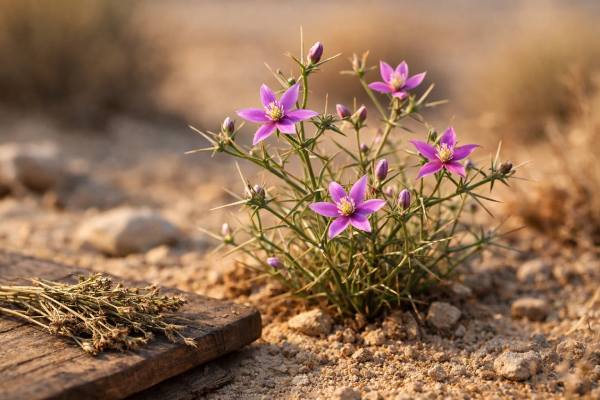
Fagonia, usually identified here as Fagonia cretica, is a thorny desert herb with a long reputation in Ayurveda, Unani, and regional folk medicine. It has been used for fever, skin complaints, urinary discomfort, inflammatory conditions, digestive trouble, and as a general “blood-purifying” plant. In recent years it has attracted much more scientific attention because its aerial parts contain saponins, flavonoids, tannins, alkaloids, triterpenoids, and other compounds that may help explain its antioxidant, anti-inflammatory, antimicrobial, and cytotoxic effects in laboratory studies.
Still, this is a herb that deserves careful interpretation. Fagonia is not a simple wellness tea, and it is not supported by strong human clinical trials for most of its major claims. Some of the most exciting work involves cancer-cell studies, enzyme modulation, and metabolic signaling, but those findings are not the same as proven treatment in people. There are also real safety questions, especially during pregnancy and when the herb is combined with medicines. The most useful way to understand Fagonia is as a traditional herb with meaningful pharmacology, promising preclinical data, and a need for much more clinical proof.
Key Insights
- Fagonia shows the strongest modern promise for antioxidant and anti-inflammatory activity, but the best evidence is still preclinical.
- Traditional use centers on fever, urinary irritation, skin problems, digestive complaints, and general inflammatory patterns.
- A traditional decoction range is about 10 to 20 g dried whole herb, but this should be treated as clinician-guided rather than casual self-use.
- Avoid Fagonia during pregnancy because traditional use and older research raise abortifacient concerns.
- People with diabetes, liver disease, kidney disease, or regular prescription medicines should not self-treat with it.
Table of Contents
- What is Fagonia and what’s in it?
- What can it realistically help with?
- Fagonia for inflammation and oxidative stress
- What about liver, blood sugar, and cancer claims?
- How is Fagonia used and dosed?
- Side effects, interactions, and who should avoid it
- What the evidence actually says
What is Fagonia and what’s in it?
Fagonia is a small, spiny, drought-tolerant shrub from the Zygophyllaceae family. It grows across arid and semi-arid landscapes, especially in parts of North Africa, the Mediterranean region, the Middle East, and South Asia. In India and Pakistan it is often called Dhamasa or Dhanvayasah, and it appears in traditional systems as a whole-plant remedy rather than as a refined extract. That traditional identity matters because Fagonia was not historically used like a modern capsule standardized to one active compound. It was used as dried whole herb, decoction, powder, or topical preparation, often in a context where constitution, season, and symptom pattern shaped the choice.
The plant’s chemistry is more impressive than its modest appearance suggests. Review papers and newer profiling studies identify several major classes of compounds in Fagonia cretica:
- Triterpenoid saponins and sapogenins.
- Flavonoids and phenolic compounds.
- Alkaloids.
- Tannins.
- Glycosides.
- Coumarin-type and related secondary metabolites.
More recent metabolic profiling has expanded that picture even further, detecting multiple triterpenoid, flavonoid, and related constituents in the aerial parts. That matters because the herb’s pharmacology is unlikely to come from one “hero compound.” Fagonia behaves more like a multi-constituent medicinal plant whose effects depend on the whole extract, the solvent used, and the dose.
This is also where realism becomes important. Some articles describe Fagonia as if it were already a proven antidiabetic, anticancer, liver-protective, and anti-inflammatory herb all at once. The chemistry does make those research directions plausible. But chemistry alone does not prove clinical outcomes. A plant can contain impressive molecules and still lack dependable human evidence.
Another nuance is species overlap. The genus Fagonia includes multiple medicinally used species, and some older literature or folk use reports blur those boundaries. That means readers should be cautious when they see sweeping claims credited to “Fagonia” without a clear species name, voucher specimen, or preparation method. With this herb, exact identity matters more than casual summaries imply.
In practical herbal terms, Fagonia is best understood as a desert bitter with a clearing, drying, and pharmacologically active profile. It is not a gentle culinary herb and not a typical daily tonic. Its traditional uses suggest a plant chosen when symptoms are troublesome, inflammatory, feverish, or congestive rather than when someone simply wants general wellness support.
That framing also helps with comparisons. If you are looking for a mild, food-like herb for routine use, Fagonia is usually too strong and too uncertain. If you are studying traditional herbs with broad pharmacological potential, it becomes much more interesting. Its value lies in that middle ground: not a casual tea, not a proven medicine, but a plant with enough chemistry and history to deserve careful attention.
What can it realistically help with?
Fagonia has a long list of traditional uses, but the realistic benefits are narrower than popular summaries suggest. In folk medicine it has been used for fever, abdominal discomfort, skin eruptions, mouth problems, piles, urinary complaints, diabetes, inflammation, and wound-related issues. That broad history is one reason the plant became so popular in desert and semi-desert medical traditions. But once you compare that history with modern evidence, a clearer picture emerges.
The most realistic benefits fall into a few buckets.
The first is short-term inflammatory support. Traditional use and lab studies both point in this direction. This does not mean the herb is a substitute for medical care in infections, autoimmune disease, or severe inflammatory pain. It means the plant has enough pharmacological activity to make anti-inflammatory use believable, especially in traditional decoctions.
The second is antioxidant support. Fagonia extracts show measurable antioxidant activity in several studies, and newer extraction work has focused specifically on recovering antioxidant-rich flavonoids from the herb. This helps explain why the plant is often described as “blood-purifying” or “cooling” in older systems, even if those phrases do not map perfectly onto modern biochemistry.
The third is support for certain urinary and heat-type complaints in traditional use. Fagonia has a reputation as a mild diuretic and clearing herb, especially when a person feels hot, inflamed, or congested. Still, this is one of those uses where people often overreach. A plant with a traditional diuretic role is not automatically a safe answer for modern urinary pain, kidney issues, or swelling. When symptoms point toward dehydration, infection, or kidney disease, self-treatment can make the situation worse. If your goal is gentler urinary support, corn silk for urinary comfort and mild fluid balance is much easier to place in modern self-care.
The fourth is topical and skin-related support. Traditional use includes skin complaints, boils, minor wounds, and inflammatory eruptions. That kind of use is plausible because plants with tannins, flavonoids, and antimicrobial activity often end up in the topical category. But again, the evidence here is traditional and preclinical, not based on large human trials.
What Fagonia does not realistically offer is a proven cure for cancer, diabetes, hepatitis, or chronic inflammatory disease. It may turn out to become relevant in some of these areas, but the current evidence does not justify those claims in ordinary consumer language.
A helpful way to think about the herb is to ask not “what has it ever been used for?” but “what does the evidence most reasonably support today?” The answer is modest but still meaningful: Fagonia appears most credible as a traditionally used antioxidant and inflammation-oriented herb with possible urinary, skin, and supportive metabolic roles. The farther a claim moves into high-stakes disease treatment, the more the certainty falls away.
That distinction is important because Fagonia’s real value lies in informed restraint. People often trust a herb more when its limits are stated clearly. In Fagonia’s case, realistic benefits are exactly what keep the discussion useful.
Fagonia for inflammation and oxidative stress
If there is one modern research area where Fagonia looks consistently interesting, it is inflammation and oxidative stress. Several studies on Fagonia cretica extracts report antioxidant activity, nitric oxide suppression, and enzyme effects related to inflammatory signaling. More recent profiling work has also linked these actions to a mix of flavonoids, triterpenoids, and saponin-rich fractions rather than to a single isolated constituent.
This matters because many traditional herbs become easier to understand when you connect old symptom language with modern mechanisms. In older systems, Fagonia is often described in ways that imply “heat clearing,” fever reduction, irritation relief, or blood purification. In laboratory terms, those traditions may partly reflect the plant’s ability to counter oxidative stress and dampen inflammatory pathways.
That does not mean the herb behaves like a modern anti-inflammatory drug. Instead, it seems to act through broader biochemical modulation. In vitro work has shown inhibition of COX-related pathways and nitric oxide production, while antioxidant testing has demonstrated scavenging potential in standard assays. Those results help explain why the herb has been explored for skin irritation, feverish states, inflammatory discomfort, and general tissue stress.
There are several practical reasons this matters.
First, oxidative stress is not a disease by itself. It is a process that can worsen inflammation, tissue damage, and recovery problems. A plant that helps reduce oxidative stress may support healing or comfort without directly “treating” a diagnosis.
Second, inflammation is a broad label. Fagonia may have meaningful anti-inflammatory activity in models and still fail to provide strong symptom relief in real-world chronic disease. That gap between mechanism and outcome is where many herbal claims become misleading.
Third, dose and extract type matter a great deal. A saponin-rich fraction, alcoholic extract, or flavonoid-focused preparation can behave differently from a weak household tea. This is one reason people often get confused by the literature. They read about strong cell-based effects and assume a small cup of herb tea works the same way.
It is also helpful to compare the herb with better-known inflammation-focused botanicals. If someone wants a more established herb for inflammation-related discomfort, boswellia for inflammation-focused support generally has a clearer clinical profile and better-defined extract standards. Fagonia is interesting, but it is not yet in the same evidence class.
The best takeaway is that Fagonia’s anti-inflammatory reputation has real scientific support, but it remains preclinical support for the most part. That means it may be reasonable to describe the herb as anti-inflammatory and antioxidant in character, but not reasonable to treat it as a validated stand-alone remedy for arthritis, autoimmune disease, or long-term pain disorders.
A careful reader should also notice that this is one of the herb’s strongest modern evidence zones. When a Fagonia claim goes beyond inflammation and oxidative stress into more dramatic territory, the burden of proof rises quickly. Here, at least, the pharmacology and the tradition point in the same direction. That does not settle the clinical question, but it does make this one of the herb’s most credible medicinal profiles.
What about liver, blood sugar, and cancer claims?
This is the section where Fagonia most often gets oversold. Online articles and promotional pages regularly present it as a liver cleanser, blood sugar regulator, and anticancer herb. The problem is not that there is no research. The problem is that the research is still mostly early-stage, species-sensitive, and not a substitute for human clinical proof.
Start with liver claims. Some animal and experimental work suggests hepatoprotective potential, and traditional medicine has used Fagonia in ways that imply benefit in hot, congestive, or toxic states. These signals are meaningful, but they are not the same as having a validated liver-support supplement with established outcomes in people. If your interest is specifically liver-centered support, milk thistle and liver-support strategies have a much clearer place in modern herb literature.
Blood sugar claims are also intriguing but still tentative. Traditional use includes diabetes-related applications, and newer work has explored how Fagonia cretica extracts affect hepatic drug-metabolizing enzymes in diabetic animal models. That does not prove it lowers glucose effectively in humans. It does suggest the herb is biologically active in metabolic settings, which is precisely why unsupervised use can be risky. A plant that may influence metabolism may also influence medication handling. For readers who mainly want a better-known glucose-focused herb, bitter melon for blood sugar support is easier to compare, even though it too has meaningful precautions.
Cancer claims are the most sensitive. Fagonia has a strong folk reputation in some regions as an herb used in early cancer stages, and several modern studies report cytotoxic or antiproliferative effects against cancer cell lines. Recent papers describe activity against liver, breast, intestinal, colorectal, and prostate cancer cell lines, along with mechanisms involving apoptosis, oxidative stress, topoisomerase inhibition, and DNMT1 downregulation. Scientifically, that is important. Clinically, it is still preliminary.
There are three reasons the cancer story needs restraint:
- Most of the evidence is in vitro or in silico, not human treatment data.
- Cytotoxicity against tumor cells in a lab does not automatically translate into safe or effective treatment in the body.
- Older Fagonia cancer literature is complicated by species confusion within the genus, which means some widely repeated findings may not apply cleanly to Fagonia cretica itself.
This does not make the herb irrelevant. It makes it investigational. A researcher can reasonably say Fagonia deserves more study as a source of bioactive compounds. A patient should not hear that as “this herb treats cancer.”
The same caution applies to “blood purifier” or “detox” language. These phrases often persist because a plant has anti-inflammatory, antioxidant, or liver-related associations. But when translated into modern consumer wording, they can sound more certain than the evidence allows.
So what is the honest bottom line? Fagonia has credible early data in liver, metabolic, and cancer-related research, but these remain research areas, not established consumer indications. The plant may someday justify more confident recommendations in one or more of these fields. Right now, it mainly justifies careful interest.
How is Fagonia used and dosed?
Fagonia is traditionally used as the whole herb or the aerial parts, usually in decoction, powder, or topical application rather than as a standardized capsule. That is important because a lot of confusion begins when readers assume the herb behaves like a modern extract supplement. Historically, it was a preparation herb, not a convenience-product herb.
The most classical form is a decoction. The dried whole plant or aerial herb is simmered in water long enough to pull out the more stubborn constituents. This fits its traditional use in Ayurveda and folk medicine, where stronger herbal teas often serve conditions involving fever, urinary irritation, inflammatory heat, or skin complaints. Some traditions also use powders, external washes, or pastes, especially for skin or wound-related use.
Official Ayurvedic pharmacopoeial guidance for Dhanvayasah, the whole plant of Fagonia cretica, gives a decoction-style dose of about 10 to 20 g of dried herb. That is useful as a traditional benchmark, but it should not be mistaken for a casual home recommendation. Traditional pharmacopoeial doses assume the right plant identity, the right preparation, and the right clinical context. They do not guarantee that a person self-treating at home is using the herb wisely.
In practical modern terms, Fagonia is used in a few main ways:
- Decoction of the dried herb for internal use.
- Powdered herb in smaller measured portions.
- External wash or paste for localized skin or wound support.
- Occasionally as part of compound traditional formulas rather than alone.
Because the herb is pharmacologically active and safety data are incomplete, the best dosing principle is not “take the highest traditional amount.” It is “use the least amount that makes sense, for the shortest time, with the clearest reason.”
A cautious way to think about dosing is:
- Traditional decoction range: 10 to 20 g dried herb.
- Best reserved for practitioner-guided use.
- Short-term use is more defensible than long daily courses.
- Standardized extracts are not yet well enough defined to replace traditional whole-herb judgment.
This is also where comparison helps. If someone mainly wants a gentler daily herb with mild diuretic and digestive use, dandelion for mild daily herbal support is far easier to place in everyday practice. Fagonia belongs more clearly in the “therapeutic herb” category than in the “daily tonic” category.
Timing depends on purpose. For feverish or inflammatory patterns, decoctions may be used during the symptomatic phase. For skin or mouth issues, topical or rinse-style use may matter more than systemic dosing. For urinary discomfort, internal use is traditional, but symptoms should always be interpreted carefully because infection, stones, or dehydration may need more than an herb.
One more practical point matters: quality control. Fagonia sold in bulk herb markets may vary in species, age, cleanliness, and drying quality. Since the genus itself can be taxonomically messy, this is not a small issue. Identity and preparation are part of dosage safety.
So while it is possible to name a traditional dose, the more useful lesson is how to interpret it. Fagonia is not a herb to improvise with. It is a herb to approach as a serious traditional medicine, not just as another plant powder.
Side effects, interactions, and who should avoid it
The most important safety point with Fagonia is pregnancy. Older traditional descriptions and review literature associate the herb with abortifacient potential, and that alone is enough to make pregnancy a clear no-use category outside specialized medical supervision. This is not a minor footnote. It is one of the herb’s most important real-world safety issues.
Beyond pregnancy, several other concerns deserve attention.
The first is gastrointestinal irritation. Herbs with bitter, saponin-rich, and tannin-containing chemistry can sometimes cause nausea, stomach discomfort, loose stools, or an overly drying effect, especially when decoctions are concentrated. Traditional use also describes emetic and laxative potential in some contexts, which means the wrong dose or the wrong constitution may turn a medicinal effect into plain intolerance.
The second is dehydration or over-clearing. Because Fagonia is often described as a diuretic or clearing herb, it may be a poor fit for people who are already depleted, overheated, or fluid-sensitive. A person with poor oral intake, diarrhea, fever-related dehydration, or kidney compromise is not a good candidate for casual experimentation.
The third is drug interaction potential. This is where modern research adds an especially useful caution. A 2023 study found that Fagonia cretica extracts modulated CYP3A4 and UGT2B7 activity in a diabetic animal model. That does not automatically translate into a dangerous interaction in every person. But it is a meaningful flag. It suggests the herb may alter how the body handles certain drugs, especially in people with metabolic disease or polypharmacy.
That leads to the main interaction watch-list:
- Diabetes medicines, because the herb is already used in metabolic contexts.
- Drugs with narrow therapeutic windows that depend on liver metabolism.
- Diuretics and other medicines that affect fluid balance.
- Blood-thinning or bleeding-sensitive regimens if the person is already medically fragile.
- Multi-supplement protocols where several herbs are used at once.
Who should avoid Fagonia or use it only under qualified supervision?
- Pregnant people.
- Breastfeeding people, because safety data are too thin.
- Children.
- People with diabetes on medication.
- People with kidney or liver disease.
- Anyone taking multiple prescription medicines.
- People with ongoing vomiting, diarrhea, or dehydration.
- Anyone with suspected infection, serious urinary pain, or unexplained weight loss.
This is not a herb that should delay diagnosis. If someone has blood in the urine, persistent fever, a suspicious skin lesion, jaundice, or a new lump, Fagonia is not the first step.
It also helps to compare Fagonia’s safety profile with better-known daily herbs. Many people assume that because it is a plant, it belongs in the same risk class as something like mint or chamomile. It does not. Fagonia belongs with herbs that have a more medicinal, directional, and potentially disruptive profile. That does not make it unusable. It makes it more serious.
The safest overall rule is simple: the broader the claim and the more medical the person’s situation, the less appropriate self-treatment becomes. With Fagonia, caution is not a lack of confidence. It is part of using the herb responsibly.
What the evidence actually says
Fagonia’s evidence base is promising, but it is still much thinner than its reputation suggests. That is the most useful conclusion to leave with the reader.
The strongest evidence is preclinical. Laboratory and animal studies support antioxidant, anti-inflammatory, cytotoxic, metabolic, and enzyme-modulating effects. Newer work has confirmed that Fagonia cretica contains a substantial mix of bioactive metabolites, including triterpenoid saponins and flavonoids. This gives the herb real pharmacological credibility. It is not just a folk remedy floating free of chemistry.
The weakest part of the evidence is human clinical validation. There are no robust, widely accepted human trials showing that Fagonia reliably treats cancer, diabetes, chronic liver disease, urinary problems, or inflammatory disorders in everyday practice. That gap matters. Without it, the herb remains interesting and potentially useful, but not clinically established.
There is also a second limitation that careful readers should know about: taxonomic and species overlap. Some older Fagonia literature and popular retellings blur multiple species together, while one influential cancer line of research was later reassigned from Fagonia cretica to Fagonia indica. That does not erase the value of Fagonia research. It does mean the evidence for Fagonia cretica specifically has to be read more carefully than many articles admit.
A balanced evidence summary looks like this:
- Strong enough to justify phytochemical and pharmacological interest.
- Strong enough to support traditional anti-inflammatory and antioxidant framing.
- Not strong enough to justify disease-treatment certainty.
- Too species-sensitive to treat all Fagonia findings as interchangeable.
This is where comparison becomes useful again. If your goal is a polyphenol-rich herb with much better human evidence, green tea and its better-established polyphenols are easier to place in evidence-based wellness. Fagonia is more experimental, more medicinal, and more dependent on preparation and identity.
That does not mean Fagonia should be dismissed. In fact, some of the most interesting herbal leads begin exactly where Fagonia stands now: strong ethnomedical background, good compound diversity, encouraging preclinical results, and limited human proof. The right conclusion is not “it does nothing.” The right conclusion is “it may do meaningful things, but we do not yet know enough to use it casually for major conditions.”
For a reader trying to decide whether the herb is worth knowing, the answer is yes. It is worth knowing because it represents a real medicinal tradition and a real pharmacological profile. For a reader trying to decide whether it is worth self-prescribing aggressively, the answer is no. The evidence is not ready for that.
In other words, Fagonia is a plant best approached with interest, respect, and restraint. That combination is often the mark of the most honest herbal guidance.
References
- Chemical composition and medicinal significance of Fagonia cretica: a review 2016 (Review)
- Metabolic Profiling and Investigation of the Modulatory Effect of Fagonia cretica L. Aerial Parts on Hepatic CYP3A4 and UGT2B7 Enzymes in Streptozotocin-Induced Diabetic Model 2023
- Validating anti-inflammatory and cytotoxic properties of Fagonia cretica L. through metabolic, in vitro, and in silico profiling 2024
- Green Extraction of Antioxidant-Rich Flavonoids from Fagonia cretica Using Deep Eutectic Solvents 2025
- THE AYURVEDIC PHARMACOPOEIA OF INDIA 2001 (Official monograph)
Disclaimer
This article is for educational purposes only and is not medical advice. Fagonia is a traditional medicinal herb with meaningful pharmacological activity and limited human clinical evidence. It should not replace diagnosis, treatment, or specialist care for cancer, diabetes, liver disease, urinary problems, or persistent inflammatory conditions. Avoid medicinal use during pregnancy, and speak with a qualified healthcare professional before using it if you are breastfeeding, taking prescription medicines, or managing kidney, liver, metabolic, or blood-related conditions.
If this article helped you, please share it on Facebook, X, or any platform your readers prefer.