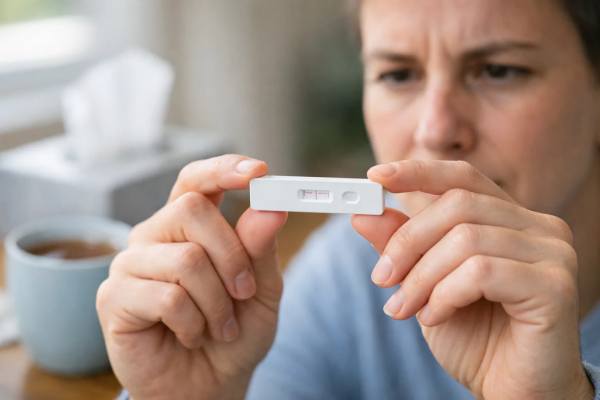
A home COVID test can feel reassuringly simple—swab, swirl, wait—but the moment a faint second line appears, many people freeze. Is it real? Is it “basically negative”? Did you do something wrong? Understanding what a faint line means can protect your health and the people around you, especially because early action can reduce spread and help higher-risk people seek time-sensitive treatment.
This guide explains how to interpret a faint line safely, how timing and technique influence results, and what steps make sense next depending on symptoms, exposure, and risk factors. You will also learn how to avoid common misreads like evaporation lines, what to do if the control line is missing, and when a follow-up lab test or medical evaluation is the best next move.
Essential Insights
- Any visible test line that appears within the stated read-time window should be treated as a positive result.
- Line darkness does not reliably measure how contagious you are, so act on the result rather than the shade.
- Reading results after the allowed time window increases false “ghost line” confusion and should not guide decisions.
- If you are high-risk or symptoms are worsening, contact a clinician promptly because some treatments work best early.
Table of Contents
- Does a faint line count as positive
- How antigen tests create lines
- Read the test at the right time
- Common reasons for faint lines
- What to do after a faint positive
- Negative test but symptoms or exposure
- When to call a clinician or go to urgent care
Does a faint line count as positive
In most at-home antigen tests, a faint test line still counts as positive if it appears within the time window listed in the instructions and the control line is present. The test is designed to answer a yes-or-no question: was viral protein detected at a level the test can register? If the answer is yes—even faintly—your safest next step is to behave as if you are infected and potentially contagious.
Two details matter more than the line’s darkness:
- Was the control line clearly present? If there is no control line, the test is invalid, even if you think you see a second line.
- Did the faint line appear within the official read time? A line that shows up late (after the allowed window) should not be used to make decisions.
It is tempting to treat a faint line as “almost negative,” but that approach often backfires. A faint line can happen early in infection, late in infection, or anytime your sample contains less detectable viral material. None of those scenarios guarantees low risk to others. In real life, contagiousness depends on multiple moving parts—your stage of illness, your immune response, your behavior around others, and the environment—so the most practical rule is simple: a visible in-window test line means you should take precautions.
If your situation makes a positive result surprising—no symptoms, no known exposure, and low local transmission—consider confirmatory testing with a more sensitive lab method. But do not ignore the faint line while you wait. A cautious response for 24–48 hours is usually less disruptive than accidentally exposing someone at high risk.
Finally, if you cannot confidently decide whether a line is present, treat the result as uncertain rather than negative. In that case, repeat the test with a new kit (ideally a different brand) and base decisions on symptoms, exposure risk, and repeat results.
How antigen tests create lines
At-home rapid tests are typically antigen tests, which detect specific viral proteins rather than viral genetic material. They use a lateral flow format—similar in concept to a pregnancy test—where a liquid sample moves across a strip and interacts with antibodies.
Here is the simplified mechanism:
- You collect a sample from your nose (or sometimes saliva, depending on the test).
- You mix the sample with a buffer that helps release proteins and carries the sample along the test strip.
- If viral antigen is present, it binds to labeled antibodies that travel with the liquid.
- The complex is captured at the test line, creating a visible colored band.
- A separate control line appears if the liquid flowed correctly and the reagents functioned.
A faint test line can occur when the amount of detectable antigen is near the lower limit of what the test can reliably show. That does not automatically mean you are “barely infected.” It often means one of these things is true:
- The virus is present but at a lower concentration in the sampled area at that moment.
- The sample collection was lighter than ideal.
- You are early in illness and antigen levels are still rising.
- You are later in illness and antigen levels are declining.
It is also important to know what a rapid test is not designed to do. Most are not calibrated to measure viral load precisely, and the human eye is a poor instrument for comparing shade intensity. Lighting, angle, and even the color of the surface under the cassette can change how dark a line looks. That is why the safest interpretation focuses on presence versus absence, not darkness.
If you want more certainty, serial testing is often more informative than staring at a barely-there line. A repeat test taken 24–48 hours later can clarify whether you are seeing the beginning of infection (lines often become clearer) or a borderline result near the end (lines may fade or disappear). Either way, your behavior should remain cautious until you have a clearer pattern.
Read the test at the right time
Most “faint line” confusion is not about the immune chemistry—it is about timing. Every rapid test has a specified window when results are considered valid, often something like read at 15 minutes and do not read after 30 minutes (exact numbers vary by brand). Reading too early can miss a line that is still developing. Reading too late can invite evaporation artifacts that look like a line but do not represent a true positive.
Use this process to reduce misreads:
- Start a timer the moment the instructions say to start. Do not rely on guessing.
- Place the test on a flat surface and avoid moving it while it develops.
- Use bright, neutral lighting (daylight or a bright white lamp). Dim lighting makes faint lines harder to judge.
- Look straight down rather than at an angle, which can create reflections.
- Read once at the recommended minute and once more within the allowed window if the instructions permit.
If you are tempted to check the test repeatedly, set boundaries. Frequent peeking can lead to decision fatigue and “seeing what you hope to see.” Instead, aim for one careful read at the correct time.
It also helps to know the difference between in-window faint positives and late-appearing marks:
- A true positive line is usually colored (often pink, purple, or blue depending on the test) and sits where the test line is labeled.
- An evaporation or indentation mark is often grayish, colorless, or uneven, and it is more likely to appear or become noticeable after the test dries.
If you want to document the result—for work, school, or family planning—take a photo during the valid window with the cassette label visible and the timer nearby. Avoid image filters, “night mode,” or heavy contrast adjustments, which can exaggerate shadows and confuse interpretation. A photo is a record, not a diagnostic tool, but it can help you communicate the result clearly to others.
Finally, store and use tests correctly. Excess heat, freezing temperatures, humidity, or using an expired kit can increase invalid or confusing results. If the control line is weak, smeared, or absent, consider the entire test invalid and repeat with a new kit.
Common reasons for faint lines
A faint positive line can be real for several reasons, and most are not “user error.” Understanding the common scenarios helps you choose the right next step without overreacting—or underreacting.
1) Early infection (rising antigen levels)
In the first days of symptoms, antigen levels can increase quickly. A test taken very early—especially on day one of mild symptoms—may show a faint line or even be negative, then become clearly positive 24–48 hours later. This is one reason repeat testing is widely recommended when symptoms are present.
2) Late infection (declining antigen levels)
Later in illness, the immune system may be clearing the virus, and antigen becomes harder to detect. A faint line can appear as you are improving. Importantly, improvement does not guarantee you are non-contagious, so use symptoms and risk context to guide precautions.
3) Sample variability
Nasal antigen is not evenly distributed. One swab can pick up more material than another depending on technique, nasal congestion, timing, and even which nostril had more secretions. Swabbing both nostrils as directed and using the full rotation time can reduce this variability.
4) Testing conditions and technique
Small deviations can change line intensity:
- Not swirling or mixing long enough
- Too little buffer or incorrect drop count
- Letting the swab sit too long before inserting into the solution
- Reading in poor light
5) Non-infectious causes of confusion
Some faint “lines” are not positives:
- Evaporation lines: more likely after the allowed read window
- Indent lines: a faint groove where dye might settle, usually colorless
- Dye runs or smears: uneven color spread that does not form a crisp band
- Contamination: touching the strip area, reusing components, or using an unclean surface
6) True positives that feel surprising
A faint line can still reflect a real infection in people without symptoms. Asymptomatic infections happen, and early asymptomatic infection can progress to symptoms a day or two later.
If you are stuck between “maybe” and “definitely,” do not force certainty from one borderline test. Treat it as actionable, reduce contact with others, and repeat testing to see whether a consistent pattern emerges.
What to do after a faint positive
If you see a faint test line within the valid time window and the control line is present, treat it as a positive result and take practical steps right away. The goal is to protect others while also protecting your own health.
Start with these immediate actions:
- Stay away from others as much as possible, especially people at higher risk of severe illness. If you live with others, increase ventilation, clean shared surfaces, and consider wearing a well-fitting mask when you must be in shared indoor space.
- Notify people you were recently close to, particularly if you were indoors, unmasked, or in prolonged contact. You do not need perfect certainty to give someone a heads-up; you can share that you had a positive home test and they may want to monitor symptoms or test.
- Track symptoms and timing. Write down the day symptoms began (if any), the day of the test, and any high-risk exposures. This timeline matters if you need medical advice or time-sensitive treatment.
- Avoid strenuous exercise for a short period if you feel unwell. Returning to heavy training immediately during an acute viral illness can worsen fatigue and prolong recovery in some people.
Deciding whether to confirm with a lab test
Confirmation can be useful if your result is unexpected or if a work, travel, or medical policy requires it. A lab-based molecular test is typically more sensitive than an antigen test. Even if you plan to confirm, act cautiously in the meantime.
What about returning to normal activities?
Many modern respiratory illness recommendations focus on symptom improvement rather than a fixed number of isolation days. A practical approach is:
- Stay home while symptoms are clearly active or worsening.
- Return to normal activities after at least 24 hours of overall symptom improvement and no fever without fever-reducing medicine.
- Take added precautions for the next several days, especially around high-risk people.
If you are high-risk or eligible for treatment
If you are older, pregnant, immunocompromised, or have certain chronic conditions, contact a clinician promptly after a positive test—even a faint one—because some antiviral treatments are most effective when started early in the illness.
Finally, do not try to “outsmart” the test by taking multiple tests back-to-back immediately. If your first test is positive, repeating right away rarely changes the safest plan. Focus on the actions that reduce spread and support recovery.
Negative test but symptoms or exposure
A single negative rapid test does not always rule out COVID, especially if you tested early or your symptoms are just starting. This is one of the most common ways people get misled: they feel sick, test once, see “negative,” and assume they are in the clear—then they test positive a day or two later.
Why false negatives happen with rapid tests:
- Timing: Antigen tests are more likely to be positive when viral antigen levels are higher. Testing too soon after exposure or on the first day of symptoms can miss infection.
- Sampling: A light swab, heavy congestion, or a rushed technique can reduce antigen capture.
- Variant and individual differences: People produce and shed virus differently, and symptoms do not always match detectability on the same schedule.
A practical retesting plan
When symptoms are present or exposure risk is meaningful, serial testing improves reliability. A common schedule is:
- Test as soon as symptoms start or when you learn about exposure.
- If negative, test again 48 hours later.
- If you have no symptoms but remain concerned, consider a third test another 48 hours later.
If symptoms are significant and you need a clearer answer quickly—because of a vulnerable household member, a medical appointment, or work responsibilities—consider a lab-based molecular test rather than relying on multiple rapid tests.
What to do while results are uncertain
If you feel ill, act like you might be contagious even before you have a confirmed diagnosis:
- Reduce close contact and improve indoor air quality.
- Avoid visiting high-risk people.
- Consider masking in shared indoor spaces.
What if you have a faint line one day and negative the next?
This can happen due to borderline antigen levels, technique differences, or late reading errors. If the faint line was in-window and clearly colored, treat it as a positive and consider confirmatory testing if the pattern becomes confusing.
The bottom line is that rapid tests are most helpful when you use them as a series and interpret them alongside symptoms and risk context—not as a single, definitive verdict.
When to call a clinician or go to urgent care
Most people with COVID recover at home, but some situations deserve timely medical advice—especially if you have risk factors for severe disease or your symptoms are escalating. A faint line does not automatically mean a mild infection. It only indicates the test detected antigen at the time you sampled.
Contact a clinician promptly (same day if possible) if:
- You are older, pregnant, immunocompromised, or have chronic conditions that raise risk.
- You want to discuss time-sensitive antiviral treatment options.
- You have persistent fever, worsening cough, or symptoms that are not improving after several days.
- You have significant dehydration, poor oral intake, or ongoing vomiting or diarrhea.
- You have worsening sinus, ear, or chest symptoms that could represent complications.
Seek urgent care or emergency evaluation if you have:
- Trouble breathing, shortness of breath at rest, or difficulty speaking full sentences
- Chest pain or pressure that is persistent or severe
- New confusion, inability to stay awake, fainting, or bluish lips or face
- Signs of low oxygen if you use a home pulse oximeter, especially if the reading is persistently low or trending downward
- Rapid worsening over hours, particularly in someone with known risk factors
Situations that deserve extra caution
Even “moderate” symptoms can become risky in certain settings:
- If you are caring for an infant or medically fragile person
- If you live far from medical care
- If you have a history of asthma or chronic lung disease and breathing symptoms are increasing
How to prepare for a medical visit
Bring your timeline and testing details:
- When symptoms started
- When you tested and what brand you used
- Whether the line appeared within the read window
- Any known exposures and household risk factors
This information helps clinicians decide whether confirmatory testing is needed and whether treatment is appropriate. If you are unsure whether your symptoms are urgent, it is reasonable to call a local nurse line, urgent care, or primary care office for guidance. When breathing is affected, err on the side of evaluation.
References
- Testing for COVID-19 | Covid | CDC 2025 (Guidance)
- Preventing Spread of Respiratory Viruses When You’re Sick | Respiratory Illnesses | CDC 2025 (Guidance)
- How accurate are rapid antigen tests for diagnosing COVID-19? | Cochrane 2025 (Systematic Review)
- Comparison of diagnostic accuracy of rapid antigen tests for COVID-19 compared to the viral genetic test in adults: a systematic review and meta-analysis – PMC 2024 (Systematic Review and Meta-Analysis)
- abbott-binaxNOW-Instructions For Use 2023 (Instructions for Use)
Disclaimer
This article is for educational purposes and does not replace medical advice, diagnosis, or treatment from a licensed clinician. Home tests can be used incorrectly or read outside the valid time window, and no single test result should override severe or worsening symptoms. If you have trouble breathing, chest pain, confusion, fainting, blue or gray lips, or rapidly worsening illness, seek emergency care immediately and call your local emergency number (such as 911 or 112). If you are at higher risk for severe illness, contact a clinician promptly after a positive test because some treatments work best early.
If you found this article helpful, please consider sharing it on Facebook, X (formerly Twitter), or any platform you prefer so others can interpret home test results more safely.