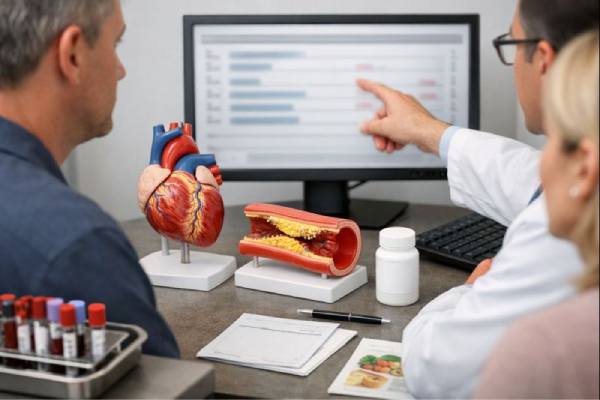
Familial hyperlipoproteinemia is a family-linked tendency to have unusually high levels of blood fats that travel through the body. These fats are carried in lipoproteins (fat-and-protein particles that move cholesterol in blood). Some people inherit changes that make these particles build up, while others inherit a “loaded deck” of smaller genetic effects that add up over time. The result can be very high cholesterol, very high triglycerides (a blood fat used for energy), or both—sometimes starting in childhood, sometimes not showing up until adulthood.
Because the pattern can look different from one relative to another, families often miss the connection until someone has pancreatitis or early heart disease. This guide explains how the condition works, what types exist, what symptoms to watch for, and how treatment and day-to-day management can protect health across the whole family.
Table of Contents
- How it affects the body
- Genetic causes and inheritance
- Understanding the main types (I–V)
- Risk factors that worsen levels
- Symptoms, complications, and red flags
- How it’s diagnosed and monitored
- Treatment and everyday management
How it affects the body
Your bloodstream is a delivery highway. Cholesterol and triglycerides cannot dissolve in blood, so the body packages them into lipoproteins. Different “carriers” do different jobs:
- LDL particles mainly deliver cholesterol to tissues. Too many LDL particles can slip into artery walls and help form plaque.
- VLDL particles mainly deliver triglycerides from the liver. As VLDL unloads triglycerides, it can leave behind smaller, cholesterol-rich remnants that may also contribute to plaque.
- Chylomicrons carry fat absorbed from meals. Normally, they clear quickly. When they don’t, the blood can look milky and triglycerides can soar.
In familial hyperlipoproteinemia, one or more steps in this shipping system runs poorly. That can happen because the body:
- makes too many lipoproteins (overproduction),
- removes them too slowly (impaired clearance),
- or struggles to break down triglyceride-rich particles after meals.
Why it matters depends on what is high:
- When LDL cholesterol is high for years, risk rises for early atherosclerosis (plaque buildup in arteries), leading to heart attack, stroke, and peripheral artery disease.
- When triglycerides are extremely high, the immediate danger is pancreatitis—painful inflammation of the pancreas that can become life-threatening.
A key practical point: a single lab value is not the whole story. Two people in the same family may share the same inherited tendency but show different numbers because diet, weight, alcohol, diabetes, thyroid disease, medications, and even menopause can change lipid levels. That’s why clinicians look at the pattern over time, not just a one-time result.
Genetic causes and inheritance
“Familial” does not always mean “one gene, one outcome.” Familial hyperlipoproteinemia is often used as an umbrella term for inherited lipid disorders that cluster in families. There are two broad genetic stories:
Single-gene (monogenic) disorders
These are less common but can be dramatic. A single pathogenic variant disrupts a key protein, such as a receptor that clears LDL or an enzyme that breaks down triglycerides. Features that can hint at a monogenic disorder include:
- very high lipid levels from a young age,
- similar severe patterns across multiple relatives,
- physical findings like tendon lumps or certain skin lesions,
- pancreatitis episodes triggered by high triglycerides,
- early cardiovascular events in close family members.
Inheritance is often autosomal dominant (each child has a 50% chance if one parent is affected), but some severe triglyceride disorders are autosomal recessive (both parents are carriers; the child must inherit two affected copies).
Many-gene (polygenic) risk
This is more common. Instead of one “broken part,” a person inherits many small genetic effects that, together, raise LDL, triglycerides, or both. The family pattern can look messy:
- one sibling has mostly high LDL,
- another has high triglycerides,
- another is “normal” until weight gain or diabetes appears.
This variability is why family history is important but not always obvious. A relative may have “normal cholesterol” on paper yet still have high particle numbers or a pattern that worsens under stressors (weight gain, menopause, alcohol, uncontrolled blood sugar).
Family screening is part of care
Because the condition can be silent for years, screening relatives is not an optional extra—it is one of the most effective prevention tools. In practical terms, families often benefit from:
- a clear list of who should be tested (first-degree relatives first),
- repeating tests when life stages change (puberty, pregnancy, menopause),
- and avoiding false reassurance from a single normal result.
Understanding the main types (I–V)
Many clinicians still describe familial hyperlipoproteinemia using a classic phenotype pattern (often called the Fredrickson/WHO classification). These types describe what is elevated, not necessarily which gene is involved. That matters because the same “type” can arise from different genetic backgrounds plus lifestyle triggers.
Type I: chylomicronemia pattern
- Main feature: extremely high triglycerides, often >1,000 mg/dL and sometimes far higher.
- Typical risk: pancreatitis, especially with added triggers.
- Often appears early in life when truly monogenic; may also appear later with secondary causes layered on.
Type IIa: LDL pattern
- Main feature: high LDL cholesterol, triglycerides usually normal.
- Typical risk: early atherosclerosis if untreated.
- May come with tendon thickening or lumps in some inherited forms.
Type IIb: combined LDL + VLDL pattern
- Main feature: high LDL cholesterol and high triglycerides.
- Typical risk: atherosclerosis risk is often high because both cholesterol-rich particles and triglyceride-rich remnants can be elevated.
- This pattern is common in families where genetics and insulin resistance overlap.
Type III: remnant (dysbetalipoproteinemia) pattern
- Main feature: build-up of cholesterol-rich remnants; cholesterol and triglycerides may both be moderately high.
- Typical clues: unusual cholesterol-to-triglyceride ratios, sometimes characteristic skin findings, and high vascular risk when untreated.
- Often needs both genetic susceptibility and a trigger (such as diabetes or thyroid disease) to fully show itself.
Type IV: VLDL (hypertriglyceridemia) pattern
- Main feature: high triglycerides driven by VLDL; LDL may be normal.
- Typical risk: pancreatitis risk rises as triglycerides climb, while cardiovascular risk depends on the broader metabolic picture.
Type V: mixed chylomicrons + VLDL pattern
- Main feature: very high triglycerides with both fasting and post-meal particles elevated.
- Typical risk: pancreatitis, fatty liver disease, and symptoms from very high triglycerides.
- Often worsened by alcohol, uncontrolled diabetes, and certain medications.
A useful way to remember this: LDL-heavy patterns (Type II) threaten arteries over years; chylomicron-heavy patterns (Type I and V) can threaten the pancreas quickly. Many families live somewhere in between, shifting types as life circumstances change.
Risk factors that worsen levels
Genes load the gun, but exposures often pull the trigger. Many people with a familial tendency do not reach dangerous levels until a second factor appears. Knowing these “amplifiers” helps families prevent sudden worsening.
Metabolic and medical amplifiers
- Weight gain and insulin resistance: often raises triglycerides and lowers HDL, and can also change LDL particle quality.
- Type 2 diabetes: uncontrolled blood sugar commonly pushes triglycerides higher and increases remnant particles.
- Hypothyroidism: can raise LDL and sometimes triglycerides; treating thyroid disease can improve lipids.
- Kidney disease and nephrotic syndrome: can raise LDL and triglycerides.
- Liver conditions (including fatty liver disease): often travel alongside high triglycerides and insulin resistance.
Lifestyle amplifiers
- Alcohol: can sharply raise triglycerides, especially in those predisposed to Type IV or V patterns.
- High refined-carbohydrate intake: sugary drinks, sweets, and highly processed starches can raise triglycerides in susceptible people.
- Very high saturated fat intake: may raise LDL in genetically sensitive individuals, even when weight is stable.
- Sedentary lifestyle: reduces triglyceride clearance after meals.
Medication-related amplifiers (common examples)
Some drugs can raise triglycerides or LDL. Examples include certain:
- oral estrogens,
- corticosteroids,
- atypical antipsychotics,
- retinoids,
- and some HIV therapies.
This doesn’t mean these medications should never be used. It means lipid monitoring should be more intentional when a familial pattern is present.
Life stages that change risk
- Puberty: lipid patterns can shift; some inherited disorders become clearer.
- Pregnancy: triglycerides naturally rise; in predisposed people, levels can become dangerous.
- Menopause: LDL often rises, and triglycerides may also increase.
A practical family strategy is to treat lipid testing like blood pressure checks: not a one-time event, but a recurring measurement that becomes more frequent during high-change periods.
Symptoms, complications, and red flags
Many people feel completely well—even with very abnormal lipid numbers. That silence is part of the risk. Still, some symptoms and signs can occur, especially when levels are extremely high or have been elevated for many years.
Possible physical signs
- Tendon thickening or firm lumps near the Achilles tendon or on hands can appear in some high-LDL inherited disorders.
- Yellowish skin deposits around eyelids or on elbows/knees can occur in certain lipid patterns.
- Eruptive bumps on the skin (small, yellowish-red papules) can appear when triglycerides are very high.
- A white or pink “milky” look to blood drawn for labs can suggest severe triglyceride elevation.
Complications linked to high LDL and remnants
Long-standing elevation of LDL and cholesterol-rich remnants can accelerate plaque buildup. Complications include:
- chest pain with exertion (angina),
- heart attack,
- stroke or transient ischemic attack,
- leg pain when walking (claudication),
- and, in some cases, valve disease later in life.
Families should take particular note if multiple relatives had:
- heart attacks or strokes before age 55 (men) or 65 (women),
- bypass surgery or stents at young ages,
- or sudden cardiac death.
Complications linked to very high triglycerides
When triglycerides are extremely high, pancreatitis becomes the urgent risk. Warning signs include:
- sudden, severe upper abdominal pain that may radiate to the back,
- nausea and vomiting,
- fever or rapid heart rate,
- pain that worsens after eating.
This is an emergency. People with known very high triglycerides should have a clear plan for what to do if these symptoms appear.
Emotional and practical impact
Familial disorders also affect daily life: food choices, medication routines, pregnancy planning, and worry about children. It often helps to name the goal clearly: not “perfect labs,” but lowering the risk of specific outcomes—pancreatitis now and cardiovascular disease over decades.
How it’s diagnosed and monitored
Diagnosis usually begins with a standard lipid panel, but good evaluation goes further than a single fasting test.
Step 1: Confirm the pattern
Clinicians often repeat labs to confirm stability and rule out short-term spikes from illness, alcohol, or recent diet changes. Depending on the pattern, they may order:
- fasting lipid panels (especially when triglycerides are high),
- non-fasting panels for routine monitoring when triglycerides are not extreme,
- and additional markers such as apolipoprotein B in selected cases to estimate the number of atherogenic particles.
Step 2: Look for secondary causes
Because thyroid disease, diabetes, kidney disease, and medications can dramatically change lipid levels, a typical workup includes:
- blood sugar testing (often including A1C),
- thyroid function tests,
- kidney and liver function tests,
- and a medication and alcohol review.
Correcting a secondary driver can sometimes shift a person out of a dangerous range—even when genetics remain.
Step 3: Assess personal and family risk
This includes:
- a detailed family history (ages of heart disease, strokes, pancreatitis),
- physical exam for lipid-related findings,
- and consideration of imaging or cardiac testing in higher-risk adults.
A helpful, concrete approach is to build a three-part snapshot:
- How high are the numbers, and which particles are elevated?
- How long has the pattern likely been present?
- Are there signs of target-organ risk already (arteries or pancreas)?
Step 4: Consider genetic testing when it changes care
Genetic testing can be valuable when:
- lipid levels are extremely high or begin very early,
- pancreatitis occurs with severe triglycerides,
- the family pattern suggests a single-gene disorder,
- or confirming a diagnosis would improve screening in relatives.
Even when genetic testing is not definitive, families can still act on a phenotype-based diagnosis: treat the levels, reduce triggers, and screen relatives.
Monitoring over time
Monitoring frequency depends on severity and treatment changes, but a common rhythm is:
- every 4–12 weeks after starting or changing medication,
- then every 3–12 months once stable,
- with closer monitoring during pregnancy, major weight change, new diabetes, or new medications.
Treatment and everyday management
Treatment depends on whether the main threat is artery disease (LDL/remnants) or pancreatitis (very high triglycerides). Many people need a blended plan that targets both.
Nutrition and lifestyle foundations
Rather than “one perfect diet,” aim for the pattern that matches the risk:
- For high LDL: emphasize unsaturated fats (olive oil, nuts, seeds, fish), higher fiber foods (beans, oats, vegetables), and reduce saturated fat sources that strongly raise LDL for you.
- For high triglycerides: reduce alcohol (often to zero if triglycerides are very high), cut sugary drinks and refined carbs, and focus on protein, vegetables, and controlled portions of starches.
- For chylomicronemia-level triglycerides: a medically supervised very-low-fat approach may be needed to prevent pancreatitis.
Movement helps across types. A realistic target for many adults is 150 minutes/week of moderate activity, plus strength training twice weekly, adjusted for health status.
Medications for LDL-driven risk
Common tools include:
- Statins to reduce LDL production and cardiovascular risk.
- Ezetimibe to reduce cholesterol absorption.
- PCSK9-targeting therapies and other newer options for those who remain above goal or have very high inherited risk.
People with lifelong high LDL often need earlier and more intensive therapy than standard risk calculators suggest, because the body has been exposed longer.
Medications for triglyceride-driven risk
Depending on level and context, clinicians may use:
- fibrates for significant triglyceride lowering,
- prescription omega-3 formulations in selected cases,
- and focused management of diabetes, thyroid disease, and alcohol intake.
When triglycerides are extremely high, the short-term priority is pancreatitis prevention. That can mean rapid dietary tightening, strict alcohol avoidance, and medication adjustment.
Apheresis and specialty therapies
For a small subset of severe inherited disorders, specialty treatments may be considered in lipid clinics, including procedures that remove particles from blood and disease-specific medications. These decisions usually rely on severity, response to standard therapy, age, pregnancy plans, and access.
Day-to-day management checklist for families
- Keep a written record of lipid results and medication changes.
- Identify personal triglyceride triggers (alcohol, refined carbs, missed diabetes meds).
- Plan family screening: first-degree relatives first, then extend outward.
- Discuss pregnancy planning early if triglycerides run high or LDL is severe.
- Have a clear emergency plan if pancreatitis symptoms occur.
When to seek urgent care
Seek urgent evaluation for:
- severe, persistent abdominal pain (especially with vomiting),
- chest pressure, shortness of breath, fainting,
- one-sided weakness, face droop, or speech difficulty.
Familial hyperlipoproteinemia is manageable, but it responds best to steady, long-term attention—especially when the whole family treats it as shared information rather than a private problem.
References
- 2021 ACC Expert Consensus Decision Pathway on the Management of ASCVD Risk Reduction in Patients With Persistent Hypertriglyceridemia: A Report of the American College of Cardiology Solution Set Oversight Committee 2021 (Guideline)
- 2022 ACC Expert Consensus Decision Pathway on the Role of Nonstatin Therapies for LDL-Cholesterol Lowering in the Management of Atherosclerotic Cardiovascular Disease Risk: A Report of the American College of Cardiology Solution Set Oversight Committee 2022 (Guideline)
- 2023 Update on European Atherosclerosis Society Consensus Statement on Homozygous Familial Hypercholesterolaemia: new treatments and clinical guidance 2023 (Guideline/Consensus)
- Familial Combined Hyperlipidemia: Myth or Reality? 2025 (Review)
- Rare dyslipidaemias, from phenotype to genotype to management: a European Atherosclerosis Society task force consensus statement 2020 (Consensus Statement)
Disclaimer
This article is for general educational purposes and does not replace medical advice, diagnosis, or treatment from a licensed clinician. Familial lipid disorders can raise the risk of serious events such as heart attack, stroke, or pancreatitis, and care should be individualized based on your labs, medical history, medications, and family history. If you have severe abdominal pain, chest pain, trouble breathing, fainting, or stroke-like symptoms (face droop, weakness, speech changes), seek emergency care immediately.
If you found this article helpful, please consider sharing it on Facebook, X (formerly Twitter), or any platform you prefer, and follow us on social media. Your support through sharing helps our team continue producing reliable, high-quality health content.