Femoral artery embolism is a sudden blockage in a major thigh artery caused by material that traveled from elsewhere in the body. Most often, that material is a blood clot that formed in the heart and then moved downstream. When the femoral artery is blocked, the leg can lose blood supply quickly, and the difference between recovery and permanent damage can be measured in hours. Acute limb ischemia means “sudden loss of blood flow to a limb.” If you know the early warning signs and understand what the emergency team is trying to do—restore flow, protect tissue, and prevent another event—you can act faster and make more informed decisions. This article explains how femoral artery embolism happens, who is at risk, what symptoms matter most, how doctors confirm the diagnosis, and what treatment and long-term prevention usually involve.
Table of Contents
- What it is and why it is urgent
- Common causes and risk factors
- Symptoms and complications
- How it is diagnosed
- Treatment options and what to expect
- Prevention, recovery, and when to seek care
What it is and why it is urgent
Femoral artery embolism means the femoral artery (a main “highway” artery in the groin and upper thigh) becomes blocked by an embolus—material that formed in one place and traveled to another. In most cases, the embolus is a blood clot that formed in the heart, broke free, and lodged where the artery narrows or branches. The result is a sudden drop in blood flow to the leg, which can threaten the limb if flow is not restored quickly.
Embolism vs thrombosis: why the distinction matters
Doctors often separate acute limb ischemia into two broad categories:
- Embolism: sudden, “bolt-from-the-blue” blockage by traveling material. Symptoms typically begin abruptly, often in a person who previously walked normally.
- Thrombosis in place: a clot forms on top of long-standing plaque disease in the leg. Symptoms can still be sudden, but many patients have a history of leg pain with walking, known artery disease, or prior stents/bypass.
The distinction matters because embolism often involves a cleaner artery segment with a single plug, which can respond well to clot removal, while thrombosis-in-place may require broader repair of diseased vessel segments.
Why time is so important
Muscle and nerve tissue tolerate low oxygen poorly. The most severe forms of acute limb ischemia can produce irreversible injury in a matter of hours. Clinicians assess limb threat by looking at pain, sensation, movement, and blood flow signals. A common memory aid is the “six Ps”:
- Pain (often severe and sudden)
- Pallor (paleness)
- Pulselessness (absent pulses)
- Paresthesia (numbness/tingling)
- Poikilothermia (cool limb)
- Paralysis (weakness or inability to move)
Not everyone has all six, and early cases may show only pain and coolness. If weakness or loss of feeling appears, doctors treat it as a limb emergency. The goal is rapid decision-making: stabilize the person, start immediate protective measures, identify where the blockage sits, and restore flow before tissue injury becomes permanent.
Common causes and risk factors
Femoral artery embolism usually begins upstream. Understanding the source is not academic—it guides long-term prevention, especially the choice between anticoagulants (blood thinners that prevent clot formation) and antiplatelet drugs (which reduce platelet “stickiness” on plaque).
Heart-related causes
The heart is the most common origin for emboli that block large leg arteries. Typical sources include:
- Atrial fibrillation (AF): irregular rhythm that allows blood to pool and clot in the left atrium, especially the left atrial appendage.
- Recent heart attack: damaged heart muscle can develop a clot along the inner wall (mural thrombus).
- Heart valve disease or prosthetic valves: altered flow and surfaces can promote clot formation.
- Infective endocarditis: infection on a valve can shed infected debris (a medical emergency with different antibiotic needs).
- Severe heart failure with very weak pumping: slower flow can increase clot risk.
Artery-related causes
Sometimes the clot forms on diseased artery lining and then breaks off:
- Plaque in the aorta or iliac arteries that releases cholesterol-rich debris or clot
- Aneurysms (bulging arteries) that trap clot and shed fragments downstream
- Prior vascular grafts or stents that develop clot or narrowing
Paradoxical embolism and other less common pathways
A clot that forms in the veins can reach the arterial system if it crosses through a heart opening (such as a patent foramen ovale). This is uncommon but may be considered when there is no obvious heart or arterial source.
Other contributors can include:
- Recent major surgery or trauma (temporary high clot risk)
- Cancer and certain inflammatory disorders (pro-thrombotic states)
- Severe dehydration or prolonged immobility
- Tobacco use, uncontrolled diabetes, and high blood pressure (vascular injury and plaque instability)
Who is most at risk
Risk rises when a person has both a clot source and conditions that favor clot formation. The most common high-risk profile is an older adult with atrial fibrillation—especially if anticoagulation is not used, has been interrupted, or has been ineffective. Another high-risk scenario is someone with known vascular disease plus dehydration, infection, or a recent procedure that triggers clotting.
A practical takeaway: when a femoral embolism is diagnosed, clinicians usually treat it as a “two-part problem”—restore leg blood flow now, then find and treat the source so it does not happen again.
Symptoms and complications
Femoral artery embolism typically presents with sudden symptoms in one leg. Because pain from musculoskeletal injuries is common, it helps to know what makes arterial blockage feel different: the pattern is often abrupt, disproportionate, and paired with coldness, numbness, or color change.
Common early symptoms
Symptoms vary by how complete the blockage is and whether the leg has backup circulation. Common early features include:
- Sudden severe pain in the leg, thigh, calf, or foot
- A leg or foot that becomes noticeably cooler than the other side
- Pale or bluish skin tone in the foot or toes
- New numbness or tingling, especially in the foot
- Sudden weakness, clumsiness, or inability to move the ankle or toes normally
- A sense that the foot is “dead,” “asleep,” or not responding
Some people experience a short period of intense pain that later lessens. This can be misleading; pain may decrease because nerves are losing function, not because the problem is improving.
Signs clinicians treat as limb-threatening
In the emergency setting, doctors focus on whether the limb is still viable. Worrisome findings include:
- Loss of sensation beyond mild tingling
- Weakness or paralysis
- A very cold, mottled limb
- No detectable signals with a handheld Doppler device
These features suggest more severe ischemia and a narrower window for successful salvage.
Complications to understand
Femoral artery embolism is dangerous because it can trigger complications even after blood flow is restored:
- Tissue loss and amputation risk: prolonged ischemia can kill muscle and skin.
- Compartment syndrome: swelling in the leg after revascularization can raise pressure inside muscle compartments, choking off microcirculation. It causes severe pain, tightness, and worsening nerve symptoms and may require urgent fasciotomy.
- Reperfusion injury: when blood returns, damaged tissue can release acids and electrolytes, stressing the heart and kidneys.
- Kidney injury: severe muscle breakdown can strain the kidneys, especially if the ischemia was prolonged.
- Systemic risk: the same clotting tendency can raise the risk of stroke or other embolic events, especially if the heart is the source.
A helpful self-check is to compare legs side-by-side. A sudden difference in temperature, color, sensation, or strength—especially with severe pain—should be treated as an emergency rather than a “wait-and-see” symptom.
How it is diagnosed
Diagnosis is built around speed and certainty. In suspected femoral artery embolism, clinicians often begin treatment steps while confirming the diagnosis, because delay can cost tissue.
Bedside assessment: what happens first
Doctors start with a focused history and exam:
- Exact time symptoms began (helps estimate tissue risk)
- Prior walking symptoms (suggests chronic plaque disease)
- Atrial fibrillation, recent heart attack, valve disease, or missed anticoagulant doses
- Comparison of pulses, temperature, and capillary refill between legs
- Sensation and movement testing, including toe and ankle strength
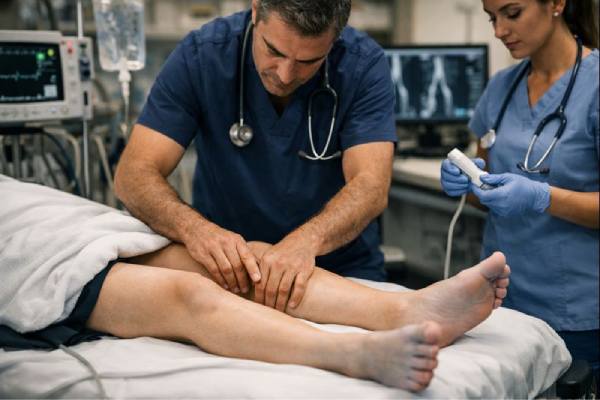
A handheld Doppler assessment is often done immediately. Even if a pulse cannot be felt, Doppler can detect blood flow signals and help localize the level of blockage.
Imaging: confirming the blockage and planning treatment
Common tests include:
- Duplex ultrasound: fast and noninvasive; shows flow and can identify where the artery is blocked. It is especially useful when CT contrast is risky.
- CT angiography (CTA): frequently used because it maps the blockage, shows vessel anatomy, and helps surgeons or interventionalists choose the best approach.
- Catheter angiography: sometimes performed as the first detailed test when the team expects to treat during the same procedure (for example, thrombectomy or thrombolysis).
The priority is to locate the occlusion, assess the runoff vessels below the knee (important for limb recovery), and identify any underlying arterial disease that might change the repair plan.
Tests to find the embolic source
Once the limb is stabilized—or sometimes in parallel—clinicians evaluate the origin:
- ECG and rhythm monitoring to detect atrial fibrillation
- Echocardiography to look for heart clots, valve disease, or low pumping function
- Additional vascular imaging if aneurysm or aortic plaque is suspected
Important look-alikes
Several conditions can mimic femoral artery embolism:
- Acute thrombosis on chronic plaque disease
- Arterial dissection (tear in the artery wall)
- Severe spasm or trauma-related vessel injury
- Deep vein thrombosis (usually swelling and pain, but pulses remain and the limb is not cold in the same way)
A practical point: in true emergencies, diagnosis and treatment often move together. The safest approach is “confirm fast, treat faster”—especially when weakness, sensory loss, or marked coolness is present.
Treatment options and what to expect
Treatment has two goals: restore blood flow to the leg and prevent another embolus. The best approach depends on how threatened the limb is, where the blockage sits, and whether the person can safely receive certain therapies.
Immediate actions in the emergency setting
Clinicians typically act quickly with measures that protect the limb while a definitive plan is made:
- Urgent vascular surgery or interventional consultation
- Pain control and careful hydration as appropriate
- Keeping the limb warm and in a neutral position (not elevated high, which can reduce arterial flow)
- Starting anticoagulation when appropriate, often with intravenous heparin, unless there is a clear reason not to
Because cases vary, medication choices and timing are individualized, especially if there is active bleeding, recent major surgery, or suspected infected emboli.
Revascularization: how flow is restored
Common options include:
- Surgical embolectomy: a surgeon removes the clot using a balloon catheter introduced through an artery incision. This can be very effective for a large, fresh embolus in a relatively healthy artery.
- Endovascular thrombectomy: mechanical devices remove or break up clot through catheters, sometimes combined with aspiration.
- Catheter-directed thrombolysis: clot-dissolving medicine is delivered directly into the clot over hours. This approach can be useful when clot extends into smaller arteries or when surgery is less suitable, but it carries bleeding risk and is not ideal when the limb is immediately threatened by paralysis or profound sensory loss.
- Bypass or additional arterial repair: if the artery has severe underlying plaque disease, the team may need to repair narrowed segments or perform bypass to keep flow durable.
Selection is often guided by limb severity:
- If there is motor deficit or profound sensory loss, teams usually move toward the fastest definitive restoration strategy.
- If the limb is painful but still has preserved sensation and movement, there may be time for catheter-based approaches in selected patients.
Monitoring after flow returns
After revascularization, teams watch closely for:
- Recurrent blockage or persistent downstream emboli
- Compartment syndrome signs (increasing pain, tight compartments, worsening nerve function)
- Electrolyte and kidney stress related to reperfusion
- Heart rhythm issues, especially atrial fibrillation
Some patients need ICU monitoring, particularly after prolonged ischemia, major surgery, or significant medical comorbidities.
Preventing the next event
Long-term therapy depends on the source:
- If atrial fibrillation or a heart clot source is identified, long-term anticoagulation is often central.
- If plaque disease is a major contributor, antiplatelet therapy, statins, and aggressive risk-factor control become essential.
- If an aneurysm is shedding clot, repair or surveillance may be needed based on location and risk.
Many patients recover well when flow is restored promptly, but rehabilitation may be needed for strength, walking tolerance, and wound care.
Prevention, recovery, and when to seek care
Recovery does not end when the clot is removed. Femoral artery embolism is often a warning that the body has a clot source or vascular condition that must be managed long-term.
Secondary prevention: the long game that protects the limb and brain
The most effective prevention plan targets the embolic source and vascular health together:
- Rhythm and heart-source management: If atrial fibrillation is present, consistent anticoagulation (when safe) is often the most powerful prevention step. If the clot source is a valve problem or recent heart attack, therapy is tailored to that cause.
- Atherosclerosis risk reduction: Many patients benefit from a statin, blood pressure control, diabetes management, and structured exercise once cleared.
- Smoking cessation: stopping tobacco lowers vascular event risk substantially and improves healing.
- Medication adherence strategy: missed doses matter. People do best with a clear routine, refill planning, and a written medication list after discharge.
Follow-up and surveillance
Follow-up typically includes:
- Vascular review of leg circulation and wound healing (if surgery occurred)
- Repeat imaging when needed to ensure the artery stays open
- Cardiology follow-up if atrial fibrillation, heart failure, valve disease, or a heart clot was involved
- Evaluation for other aneurysms or vascular disease when clinically appropriate
A practical tip is to keep a personal “event summary”:
- Date and time symptoms began
- Which artery was blocked
- Which procedure was performed
- The identified source (if known)
- Current antithrombotic plan (what to take, when, and for how long)
This makes future emergency care safer and faster.
When to seek urgent help
Treat these symptoms as emergency warning signs:
- Sudden severe leg or foot pain, especially with coldness or color change
- New numbness or weakness in the foot or leg
- A leg that becomes pale, mottled, or markedly cooler than the other side
- Fainting, chest pain, or sudden shortness of breath (could signal a broader clot event)
- Rapid swelling and severe pain after revascularization (possible compartment syndrome)
If you have atrial fibrillation or a prior embolic event, do not ignore “minor” changes in limb sensation or temperature. Early care can prevent progression to a limb-threatening event.
References
- 2024 ACC/AHA/AACVPR/APMA/ABC/SCAI/SVM/SVN/SVS/SIR/VESS Guideline for the Management of Lower Extremity Peripheral Artery Disease: A Report of the American College of Cardiology/American Heart Association Joint Committee on Clinical Practice Guidelines – PubMed 2024 (Guideline)
- Treatment Strategies and Prognostic Outcomes in Acute Limb Ischemia: A Systematic Review and Meta-Analysis Comparing Thrombolytic Therapy and Open Surgical Interventions – PubMed 2025 (Systematic Review)
- Acute limb ischemia – PMC 2023 (Review)
- Editor’s Choice – European Society for Vascular Surgery (ESVS) 2020 Clinical Practice Guidelines on the Management of Acute Limb Ischaemia – PubMed 2020 (Guideline)
Disclaimer
This article is for educational purposes and does not replace medical advice, diagnosis, or treatment from a qualified clinician. Femoral artery embolism is a medical emergency that can threaten limb viability and may signal a serious underlying heart rhythm problem or vascular disease. Seek emergency care immediately for sudden severe leg pain, a cold or pale foot, new numbness or weakness, or rapidly worsening symptoms—especially if you have atrial fibrillation or recent heart disease. Treatment choices depend on timing, limb findings, bleeding risk, and the suspected source of the embolus, so individualized evaluation by emergency and vascular specialists is essential.
If you found this article helpful, please share it on Facebook, X (formerly Twitter), or any platform you prefer, and follow us on social media. Your support through sharing helps our team continue producing quality health content.