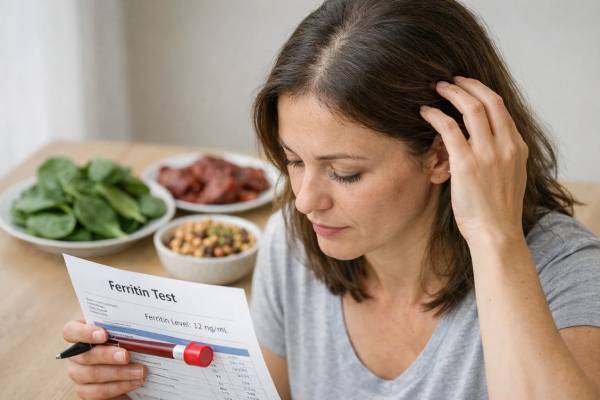
Ferritin often enters the hair-loss conversation quietly. A person notices more strands in the shower, the part looks wider, and routine labs come back “normal” except for a ferritin result near the low end of the range. That single number can seem like either the missing answer or a distraction. The truth is more useful than either extreme. Ferritin is not a hair-growth switch, but it is one of the most practical clues to iron stores, and iron stores matter for many people with diffuse shedding, chronic telogen effluvium, and recovery after illness, blood loss, or restrictive dieting.
What makes ferritin so important is that it can fall well before anemia becomes obvious. A normal hemoglobin does not rule out iron depletion, and hair may be one of the first places that low reserve shows up. At the same time, chasing ferritin alone can waste time if the real issue is thyroid disease, androgen-related thinning, scalp inflammation, or a recent trigger. The most helpful approach is precise: understand what ferritin means, test it in context, and raise it with a plan that is effective, measured, and safe.
Quick Facts
- Ferritin helps estimate iron stores, and low stores can contribute to increased shedding even before anemia appears.
- Hair-focused ferritin targets are higher than the classic deficiency cutoff in many clinics, but there is no single universal number that guarantees regrowth.
- Ferritin can read falsely high during infection or inflammation, so results should be interpreted with symptoms and other iron markers when needed.
- Oral iron usually works best when the cause of loss is addressed at the same time, such as heavy periods, low intake, or poor absorption.
- Rechecking ferritin after roughly 8 to 12 weeks is often more useful than checking it too early or changing supplements every few days.
Table of Contents
- What ferritin can and cannot tell you
- Target levels and why they vary
- When to test and what to order
- Why ferritin runs low in hair loss
- How to raise ferritin safely
- Retesting, timelines, and when to look beyond iron
What ferritin can and cannot tell you
Ferritin is the body’s storage form of iron. In practical terms, it gives a better sense of iron reserve than hemoglobin alone. That distinction matters in hair medicine because a person can have enough circulating red blood cells to avoid anemia while still having iron stores too low to comfortably support high-turnover tissues. Hair follicles are metabolically active, and when iron stores are depleted, shedding can increase or recovery after a shedding event can drag on longer than expected.
This is why ferritin is often included in the workup for diffuse hair loss. It is especially relevant when the pattern sounds like chronic shedding rather than purely patterned thinning. A person with telogen effluvium may say, “My ponytail feels thinner,” “I am losing hair all over,” or “This started two to three months after a stressful event.” That pattern is different from slow miniaturization over the crown, and understanding the difference between hair shedding and hair loss helps explain why ferritin gets attention in some cases more than others.
What ferritin can tell you:
- whether iron stores are likely depleted,
- whether low iron may be contributing to shedding,
- whether treatment has started to rebuild iron reserve over time.
What ferritin cannot tell you on its own:
- whether iron deficiency is the only reason for hair loss,
- whether hair regrowth is guaranteed once the number rises,
- whether a “normal” result means iron is fully optimized for that patient,
- whether inflammation is distorting the result.
That last point is easy to miss. Ferritin is also an acute-phase reactant, which means it can rise during infection, inflammatory disease, liver problems, or other physiologic stress. In those settings, a ferritin result that looks acceptable can mask depleted iron stores. That is one reason a skilled workup sometimes includes transferrin saturation and, in selected cases, inflammation markers rather than treating ferritin as a standalone truth.
Another useful distinction is ferritin versus hemoglobin. Hemoglobin tells you whether anemia is present. Ferritin tells you whether the reserve tank is running low. For hair, that reserve tank often matters earlier. Someone may feel tired, notice brittle nails, exercise intolerance, restless legs, or increased shedding long before the CBC becomes dramatically abnormal.
Still, ferritin should not be turned into a scapegoat for every brush full of hair. Many common problems can cause shedding or thinning with normal iron stores, including thyroid shifts, recent fever, restrictive dieting, scalp disease, medication changes, postpartum hormone changes, and androgen-sensitive follicle miniaturization. Ferritin is valuable because it is actionable, not because it explains everything. The most accurate view is that ferritin is a clue with weight, but not a verdict.
Target levels and why they vary
The most confusing part of ferritin is rarely the test itself. It is the question that comes next: what level is actually good for hair growth? The honest answer is that there is no single universally agreed target. There is a difference between the cutoff used to diagnose iron deficiency in general medicine and the practical range many hair specialists prefer to see during recovery from shedding.
In broad adult care, ferritin below 30 ng/mL, numerically the same as 30 µg/L, is commonly treated as iron deficiency. That threshold is useful and evidence-based. But hair specialists often pay attention before ferritin gets that low, especially in women with diffuse shedding or chronic telogen effluvium. In clinical practice, several ferritin ranges tend to guide discussion:
- Below 15 to 30 ng/mL: clear depletion or strong concern for deficiency, depending on the clinical setting.
- Around 30 to 40 ng/mL: often borderline for people with ongoing shedding, heavy menstrual loss, or symptoms of low iron reserve.
- Around 40 to 60 ng/mL: a common practical target range in hair clinics during regrowth efforts.
- 50 ng/mL and above: often a reasonable treatment goal when oral iron is being used, especially when the person is symptomatic or still shedding.
- Higher targets in some medical settings: sometimes used when IV iron is given or when rapid re-depletion is expected.
Why does this vary so much? Because ferritin is context-sensitive. A lab range is designed to identify disease across a broad population, not to answer a hair-specific question. Hair care, by contrast, is often trying to optimize reserve, not merely avoid anemia. A ferritin value at the low end of “normal” may be enough for one person and insufficient for another who is menstruating heavily, recovering from illness, or trying to regrow after months of shedding.
Inflammation complicates things further. In a healthy adult, a low ferritin usually means low iron stores. But in someone with inflammation, ferritin can be pushed upward. In that case, a ferritin that looks respectable may still coexist with functional iron deficiency, and transferrin saturation becomes more important for interpretation.
It is also worth resisting a popular myth: very high ferritin does not mean faster hair growth. More is not always better. Once iron stores are adequate, pushing ferritin higher without a reason can create risk without adding visible benefit. Iron is not a cosmetic supplement in the way people sometimes imagine. It is a tightly regulated mineral, and excess matters.
The most useful way to talk about targets is this: aim to correct true deficiency, move out of the low-reserve zone, and match the goal to the person’s history. For many people with hair shedding, that means not settling for barely normal if symptoms, menstrual loss, and ongoing shedding suggest iron stores are still too thin. It also means not obsessing over one precise number when the larger picture is clearly improving.
When to test and what to order
Ferritin testing makes the most sense when the hair story suggests a systemic trigger, not just a styling problem. Diffuse shedding, a sudden drop in ponytail density, prolonged shedding after illness, fatigue, heavy periods, low dietary iron intake, blood donation, or a history of restrictive eating all make ferritin more relevant. So does hair loss that seems out of proportion to what the scalp exam alone explains.
A focused iron workup often starts with:
- Ferritin
- CBC
- Sometimes transferrin saturation and iron studies
- Additional tests guided by symptoms
CBC and ferritin together answer two different questions. CBC looks for anemia. Ferritin looks for depleted reserve. That pairing is why it is possible to feel “not right” and shed more hair even while the hemoglobin still falls within range.
Transferrin saturation becomes more useful when ferritin may be misleading, especially in the setting of inflammation, infection, autoimmune disease, chronic illness, or liver abnormalities. If the history suggests that ferritin might be artificially elevated, iron studies help fill in the picture. This is also why a normal ferritin drawn during a recent viral illness may deserve a second look rather than instant reassurance.
Ferritin itself is not meaningfully affected by what you ate that morning, but iron studies are more sensitive to recent intake, which is why clinicians often prefer those in a fasting state. Timing also matters in another way: a person who has just started iron a few days earlier or recently had IV iron may produce numbers that are harder to interpret cleanly.
Depending on the history, a broader hair-loss workup may also include thyroid testing, vitamin B12, folate, vitamin D, zinc, or hormone studies. The keyword is “depending.” More testing is not always better. It is often more useful to order the right next test than a giant panel. Someone with cold intolerance, menstrual shifts, and eyebrow thinning may need a closer look at thyroid-related hair loss and labs. Someone with low animal-food intake, numbness, or fatigue may need B12 reviewed alongside iron.
Good timing for ferritin testing includes:
- unexplained diffuse shedding lasting more than several weeks,
- chronic shedding without a clear trigger,
- postpartum shedding that feels unusually prolonged,
- recurrent hair loss after heavy periods or blood donation,
- slow recovery after illness, dieting, or surgery.
Testing is less helpful when the problem is clearly shaft breakage from bleach, traction from hairstyles, or an unmistakable patterned thinning picture that has been stable for years. In those cases, ferritin can still be checked, but it is less likely to be the main answer.
The most common testing mistake is to chase ferritin without investigating why it is low. A second common mistake is to dismiss borderline levels because the CBC is normal. Both miss the point. The goal is not just to collect data. It is to connect the lab result to the type of hair problem, the likely cause, and a treatment plan that can actually change the course of shedding.
Why ferritin runs low in hair loss
When ferritin is low, the next question should not be “Which supplement do I buy?” It should be “Why did this happen?” That is where durable progress starts. Low ferritin is usually the result of one of four forces: not enough iron coming in, too much iron going out, poor absorption, or a period of high demand that outpaced intake.
Heavy menstrual bleeding is one of the most common reasons ferritin drops in women with hair shedding. A cycle can be regular and still be heavy enough to gradually drain stores. People often normalize long, clot-heavy, or highly fatiguing periods without realizing how much they matter. Pregnancy and the postpartum period also shift iron demand sharply. A person may enter pregnancy borderline and come out depleted, even if the hemoglobin recovers faster than the reserve tank does.
Diet matters too, though often in quieter ways than people expect. Ferritin may fall with low total intake, highly restrictive dieting, very low-calorie plans, or plant-based eating patterns that are not carefully structured around iron, protein, and absorption. None of this means vegetarian or vegan diets are inherently bad for hair. It means they require intention. Iron intake, vitamin C pairing, and sufficient protein all matter.
Poor absorption is another major category. Ferritin may stay low despite “taking iron” when the gut is not absorbing well. Common examples include:
- celiac disease,
- inflammatory bowel disease,
- gastritis,
- reduced stomach acid,
- bariatric surgery,
- medications that interfere with absorption.
Blood loss outside menstruation also deserves attention. Frequent blood donation can lower ferritin substantially. So can gastrointestinal bleeding from ulcers, hemorrhoids, polyps, inflammatory bowel disease, or other digestive conditions. In adults, especially when menstrual loss does not explain the number, persistent low ferritin should not be brushed off as a cosmetic issue.
Hair loss itself can also be a clue to recent physiologic stress. A person recovering from fever, major illness, or infection may develop telogen effluvium whether or not ferritin is low. If ferritin is also depleted, recovery can feel slower and more incomplete. That overlap matters in people with lingering shedding after viral illness, including scenarios similar to a post-viral telogen effluvium timeline.
A final point that deserves more attention is mixed causes. Many people do not have a single clean explanation. They have moderately heavy periods, a low-protein diet during a stressful year, and shedding after illness. Or they have early female pattern thinning layered on top of low iron stores. Mixed cases are common, and they are the reason hair improves fastest when the plan is not overly narrow.
Finding the cause changes treatment. A person with low intake may improve with diet plus oral iron. A person with malabsorption may need IV iron. A person with heavy periods may keep relapsing until the bleeding issue is addressed. Ferritin is not just a number to correct. It is often a signpost pointing toward the deeper reason the hair has become less resilient.
How to raise ferritin safely
The safest way to raise ferritin starts with confirming that it actually needs to be raised. Iron should not be taken in high doses indefinitely just because hair feels thinner. Once low ferritin is documented, treatment usually combines three levers: improve intake, improve absorption, and reduce ongoing losses where possible.
Food matters, but diet alone is often too slow when ferritin is clearly low. Heme iron from red meat, shellfish, and dark poultry is absorbed more efficiently than non-heme iron from beans, lentils, tofu, pumpkin seeds, spinach, and fortified grains. Non-heme iron still counts, especially when paired with vitamin C-rich foods. A practical eating pattern can include:
- one to two consistent iron-rich meals most days,
- vitamin C at the same meal,
- enough total protein to support regrowth,
- fewer meal patterns built around tea, coffee, or calcium right next to iron-rich foods.
For oral supplements, ferrous salts such as ferrous sulfate, ferrous gluconate, and ferrous fumarate are usually first-line because they are effective, familiar, and less costly. Many clinicians now favor once-daily or alternate-day dosing rather than multiple daily doses, especially when side effects are a problem. That is not because alternate-day dosing works like magic. It is because some people absorb it well and tolerate it better.
A practical oral-iron approach often looks like this:
- Start with a standard ferrous preparation chosen for tolerance.
- Take it on an empty stomach if possible.
- If nausea or cramping is a problem, move it away from trigger foods or try a lower-dose or alternate-day plan.
- Avoid taking it at the same time as calcium supplements, antacids, tea, coffee, or certain medications that interfere with absorption.
- Stay consistent for weeks, not days, before judging it.
Ferritin usually rises more slowly than people expect. Symptoms may improve before the hair does, and the hair may improve long after the lab number starts climbing. If the supplement causes constipation, nausea, or abdominal discomfort, it is better to adjust the regimen than to quit silently. The best iron supplement is often the one a person can actually keep taking.
Diet remains part of the strategy even with supplements. Someone correcting low ferritin with oral iron still benefits from a pattern built around iron-rich meals and enough protein. This is where guidance on hair-friendly, higher-protein meals can support the lab plan rather than replace it.
IV iron enters the picture when oral iron fails, causes intolerable side effects, works too slowly, or is unlikely to succeed because of ongoing losses or malabsorption. It is also considered when anemia is more significant or when rapid replenishment matters. IV iron is effective, but it should be used for the right reasons rather than as a shortcut around a fixable oral regimen.
One safety rule matters above all: keep iron supplements away from children and never assume “more” means “faster.” Iron overdose can be dangerous. A careful, measured plan builds ferritin more reliably than aggressive self-dosing ever does.
Retesting, timelines, and when to look beyond iron
Once treatment starts, the biggest mistake is usually impatience. Ferritin can improve before hair does, and hair can improve before a person fully trusts what they are seeing. That lag is normal. Hair follicles work on a cycle, so rebuilding iron stores does not instantly translate into visible fullness.
For oral iron, a repeat CBC and ferritin check after about 8 to 12 weeks is often reasonable. That window is long enough to show whether the plan is working and short enough to catch poor response early. If the person is severely deficient, highly symptomatic, or dealing with ongoing blood loss, the follow-up may come sooner. If IV iron was used, ferritin should not be rechecked too quickly because the result can look misleadingly high in the first few weeks.
What improvement usually looks like:
- energy and exertional tolerance may improve first,
- shedding may slow next,
- visible regrowth and density often take several months,
- the part line and ponytail usually change more slowly than the brush count.
This is why photos help. Memory is unreliable when hair loss is emotional. The person often feels no progress until they compare the part or hairline under similar lighting three months apart.
Just as important is knowing when ferritin is not the whole answer. If ferritin normalizes and shedding continues, possibilities include:
- a second nutrient deficiency,
- persistent thyroid or hormonal issues,
- chronic telogen effluvium from ongoing stress or illness,
- female pattern hair loss,
- scalp inflammation or scarring alopecia,
- medication-related shedding.
In those cases, normal ferritin is good news, not failure. It means one barrier has been removed. The next step is to widen the lens. Someone with continued heavy shedding, scalp symptoms, widening of the central part, or clearly progressive thinning may need more than iron. They may need topical or oral hair-loss treatment, scalp diagnosis, or a broader internal medicine workup.
A useful rule is this: ferritin correction should make the overall story easier, not more confusing. If the number rises but the hair pattern still looks wrong, trust the pattern. It may be time to look into other triggers or to review when a dermatologist should evaluate ongoing hair loss.
Longer-term monitoring depends on the cause. A person with low ferritin from a one-time blood donation may not need much beyond correction and a recheck. A person with heavy periods, celiac disease, distance running, or recurrent postpartum depletion may need ongoing surveillance because relapse is common. In those cases, success is not just reaching a target once. It is keeping iron stores stable enough that the hair cycle is not repeatedly disrupted.
Ferritin is worth taking seriously because it is both biologically important and fixable. But it works best as part of a full interpretation. The goal is not just a higher number on paper. The goal is steadier shedding, stronger reserve, and a treatment plan that fits the reason the number fell in the first place.
References
- Diagnosis and management of iron deficiency in females 2025 (Review)
- Iron Deficiency and Nonscarring Alopecia in Women: Systematic Review and Meta-Analysis 2021 (Systematic Review)
- Diagnosis and treatment of female alopecia: Focusing on the iron deficiency-related alopecia 2023 (Clinical Review)
- Alternate day versus consecutive day oral iron supplementation in iron-depleted women: a randomized double-blind placebo-controlled study 2023 (RCT)
- WHO guideline on use of ferritin concentrations to assess iron status in individuals and populations 2020 (Guideline)
Disclaimer
This article is for educational purposes only and is not a substitute for medical advice, diagnosis, or treatment. Ferritin results should be interpreted in context, especially if you have infection, inflammation, heavy menstrual bleeding, digestive symptoms, pregnancy, or a history of anemia. Iron supplements and IV iron should be used with medical guidance when deficiency is significant, persistent, or unclear, because both under-treatment and unnecessary iron use can cause harm.
If you found this article useful, please consider sharing it on Facebook, X, or another platform you use so others dealing with hair shedding and low ferritin can find clear, evidence-based guidance.