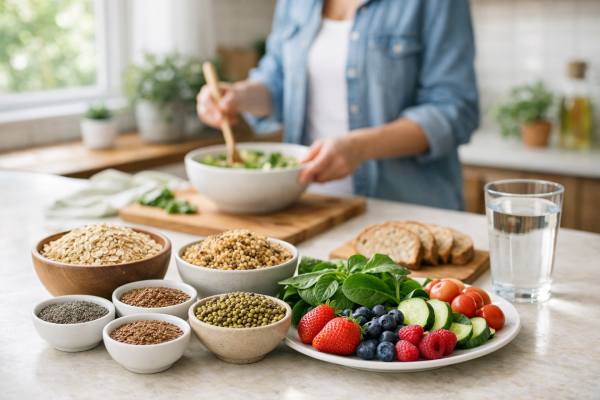
Fibermaxxing has become shorthand for a simple idea: intentionally raising your daily fiber intake to support digestion and long-term health. Done well, it can make stools softer and easier to pass, reduce straining, and help you feel more steadily satisfied after meals. It also supports the gut ecosystem by providing fuel for beneficial microbes that produce compounds linked to healthy bowel function.
Done poorly, it can feel like a mistake—bloating, loud gas, and even worse constipation. That does not mean fiber is “not for you.” It usually means the jump was too fast, the fiber type was too fermentable for your current tolerance, or hydration and meal timing were not keeping up with the new bulk.
This guide shows how to increase fiber with precision: choosing the most tolerable fibers, building them into meals, and using a ramp plan that protects comfort while still delivering results.
Core Points
- Gradual increases in fiber can improve stool consistency and regularity, especially if your baseline intake is low.
- Rapid increases or highly fermentable fibers can trigger bloating and gas, particularly in the first 1–2 weeks.
- Hydration and meal timing determine whether added fiber softens stool or makes it feel more backed up.
- Aim for a mix of soluble and insoluble fiber, with an emphasis on gel-forming options if constipation is the main issue.
- Increase by small, repeatable steps for 10–14 days before chasing a high daily number.
Table of Contents
- What fibermaxxing really means
- How much fiber is enough
- Choose fibers your gut tolerates
- A two-week ramp that feels good
- Best high-fiber foods and smart swaps
- Fix bloating and constipation during the ramp
What fibermaxxing really means
Fibermaxxing is not a contest to see who can eat the most chia seeds. At its best, it is a method: you raise fiber intake in a way your gut can adapt to, and you choose fiber sources that fit your symptoms. The “max” is personal. For one person, it means moving from a low-fiber pattern to a steady, comfortable middle range. For another, it means learning how to include legumes and whole grains without daily bloating.
Fiber matters because it changes stool physics and gut biology at the same time. It can increase stool bulk, hold water in the stool, and support the rhythmic contractions that move stool forward. It also becomes fuel for microbes that produce short-chain fatty acids, which influence motility and the health of the gut lining.
The benefits people notice first tend to be practical:
- Less straining and less “rabbit pellet” stool
- More predictable timing (often morning or after meals)
- A fuller sense of completion after a bowel movement
- Less cycling between constipation and urgent, loose stools
The benefits that build more slowly include steadier appetite, improved meal-to-meal blood sugar patterns for some people, and better tolerance of a wider range of plant foods over time.
The most important concept is that fiber has two “costs” your gut must pay during an increase:
- Adaptation cost: microbes ferment fiber and produce gas as they adjust to a higher supply.
- Hydration cost: fiber needs enough water to soften stool; otherwise it can increase bulk without improving passage.
When fibermaxxing goes wrong, it is usually because one of those costs was ignored. People add big fiber doses in a few days, keep fluid intake the same, and then wonder why they feel swollen or stuck.
A helpful mindset is to treat fiber like strength training: small increases, recovery time, and consistent form. Your gut responds better to a steady plan than to dramatic pushes followed by quitting.
How much fiber is enough
The right amount of fiber depends on two things: the general intake range linked to health benefits and normal laxation, and your starting point. If you are already eating plenty of plants, your next step is usually refinement (types and timing). If you are far below typical targets, the biggest gains often come from simply getting into a consistent baseline.
A practical benchmark used in many nutrition frameworks is about 14 grams of fiber per 1,000 calories. In everyday terms, many adults aim for something like the mid-20s to high-30s grams per day, adjusted for body size, energy intake, and appetite. Some guidelines describe 25–30 grams per day as a useful general target for adults. These numbers are not meant to create pressure; they are meant to show how common it is to fall short without noticing.
Instead of guessing, do a quick audit of a typical day. Ask:
- Did I eat fruit more than once?
- Did I include legumes, whole grains, or seeds?
- Were vegetables present at two meals, or only as a token side?
If the answer is mostly “no,” your current fiber may be low enough that even a small increase will help. If the answer is mostly “yes,” but constipation or bloating persists, the issue may be fiber type, hydration, meal size, or an underlying gut pattern.
Use a “fiber ceiling” that protects comfort
Fibermaxxing fails when the number becomes the goal and symptoms become collateral damage. Your personal fiber “ceiling” is the highest daily intake that:
- Improves stool softness and ease
- Does not create persistent bloating or cramping
- Fits your routine without forcing extreme meals
For many people, the sweet spot is not a single number; it is a range that feels stable. It may also shift across seasons, travel, stress, and medication changes.
Give fiber time to work
Some people expect a dramatic change within 24 hours. Fiber often works more like this:
- Days 1–3: stool volume increases or gas increases, sometimes both
- Days 4–10: stool softness and timing become more predictable if hydration is adequate
- Weeks 2–4: the “comfort cost” often drops as your gut adapts
That timeline is why a controlled ramp matters. You want the benefits of higher fiber without spending every day in the adaptation phase.
Choose fibers your gut tolerates
The label “high fiber” hides a crucial truth: fiber types behave differently in the gut. Two foods can have the same fiber grams and produce very different results. If your goal is more fiber without bloating or constipation, you need to understand three properties: viscosity, fermentability, and particle size.
Viscosity: the stool-softening advantage
Viscous, gel-forming fibers hold water and create a softer, more cohesive stool. They are often the most reliable for constipation because they improve passage without relying only on bulk. Examples include psyllium and the beta-glucans in oats and barley. Chia can also create a gel when soaked.
These fibers are often well suited for people who strain, pass hard stools, or feel incomplete evacuation.
Fermentability: the gas risk and the microbiome benefit
Fermentable fibers are broken down by gut microbes, producing gases and other byproducts. This fermentation is not inherently bad; it is part of how fiber supports gut health. The problem is dose and timing. If you go from low fiber to high fermentable fiber quickly, gas can spike.
Fibers that are often more fermentable include inulin-type fibers and some prebiotic blends. Many legumes are also highly fermentable, although preparation and portion size can change tolerance.
If you tend to bloat easily, start with less fermentable fibers and add fermentable ones later, in smaller doses.
Particle size and “roughness”
Coarse insoluble fibers can be helpful for some people, but they can feel irritating or “too bulky” for others, especially if stool is dry or transit is slow. A large bowl of raw bran-heavy cereal may increase stool volume without adding enough water-holding capacity, which can worsen the feeling of being backed up.
If you are sensitive, choose cooked vegetables over huge raw salads, and choose oats, chia, and well-cooked whole grains over aggressive bran-heavy approaches.
A balanced fiber portfolio
A comfortable fibermaxxing plan usually includes:
- A base of gel-forming or gently soluble fibers (oats, chia, psyllium if needed)
- Moderate insoluble fiber from vegetables and whole grains (often better cooked at first)
- Carefully sized portions of fermentable fibers (legumes, certain prebiotics), added later
If you have IBS tendencies, this balance matters even more. Many people with IBS do better with soluble fiber and modest fermentable loads than with an abrupt shift to large amounts of wheat bran, raw crucifers, and high-prebiotic powders. The point is not to avoid these foods forever; it is to introduce them in an order your gut can handle.
A two-week ramp that feels good
A ramp plan succeeds when it has clear steps and built-in “pause points.” The goal is to increase fiber while keeping stool water and transit moving in the right direction. For most people, the gentlest approach is adding 2–3 grams of fiber every few days, not 10–15 grams overnight.
Before you start, set two supports:
- Water: keep a steady baseline. If you increase fiber, you are increasing water demand.
- Movement: a 10–15 minute walk after one meal per day often helps gas clearance and bowel rhythm.
Then choose one “anchor” fiber food you tolerate well and repeat it daily for the first week. Repetition reduces variables.
Week 1: build a stable base
Days 1–3: add one small fiber upgrade
Choose one:
- Add 1 tablespoon ground flax to yogurt, oatmeal, or soup
- Add 1 fruit serving that you digest well (berries, kiwi, or a pear)
- Swap one refined grain for a whole grain you tolerate (oats are a common easiest starter)
Hold everything else steady. If you feel a mild increase in gas, do not escalate yet.
Days 4–7: add a second small upgrade
Choose one additional change:
- Add 2 tablespoons chia, ideally soaked into oats or yogurt
- Add a second vegetable serving, preferably cooked
- Add a half-portion of legumes (start smaller than you think you need)
Your goal by the end of week 1 is not a dramatic number. It is stable stools and minimal discomfort.
Week 2: expand variety without overload
Days 8–10: increase the most tolerable item
Pick the upgrade that felt best and increase slightly. For example:
- Add a second tablespoon of flax on some days, or
- Increase oats portion modestly, or
- Increase vegetables by one cooked serving
Days 11–14: add one fermentable fiber carefully
If bloating has been mild and stools are moving well, this is a good window to add a more fermentable source, such as beans or lentils. Start with a small portion and keep it consistent for several days.
If bloating is still prominent, keep week 2 focused on the gentler fibers and delay the fermentable jump. You are not failing; you are matching the ramp to your gut’s current capacity.
When to pause
Pause the ramp for 48–72 hours if:
- Gas or bloating becomes uncomfortable and persistent
- Stools become hard or infrequent
- You feel “full” and backed up despite eating more fiber
A pause is not a setback. It is how you prevent the common pattern of pushing too hard, feeling bad, and quitting completely.
Best high-fiber foods and smart swaps
Fibermaxxing becomes easy when you stop trying to “add fiber” and start building meals that naturally contain it. The best foods are the ones you will eat often, in portions that feel normal.
High-impact fiber foods worth repeating
These staples make it easier to reach a meaningful daily intake without extreme meals:
- Oats and barley: gentle soluble fiber that tends to be well tolerated
- Chia and ground flax: compact fiber boosts that also add texture and satiety
- Beans and lentils: powerful fiber sources, best introduced slowly
- Berries and kiwis: high fiber for their size, often easier than large raw salads
- Potatoes and sweet potatoes with skin: supportive bulk plus comfort food practicality
- Cooked vegetables: especially carrots, zucchini, squash, spinach, and green beans for many people
Smart swaps that add fiber without feeling dramatic
Instead of creating a separate “fiber project,” use swaps:
- Choose whole grain bread that you actually like, rather than forcing the densest option.
- Replace some refined grains with oats or brown rice in one meal per day.
- Add a half cup of cooked vegetables to meals you already eat (eggs, soups, stir-fries).
- Add seeds to meals you already have (oatmeal, yogurt, smoothies, salads).
Meal templates that protect the gut
If bloating is a concern, structure matters as much as ingredients. These patterns often work well:
- Breakfast: oats cooked soft with chia or flax and berries
- Lunch: rice or quinoa bowl with cooked vegetables and a modest legume portion
- Snack: fruit plus a small handful of nuts, or yogurt with flax
- Dinner: potatoes with skin, cooked greens, and a protein source
Cooking methods are not a minor detail. Cooking breaks down plant cell walls, often making fiber easier to tolerate. If you tend to bloat, start with cooked vegetables and gradually add more raw textures later.
What to watch in packaged “high-fiber” foods
Many packaged foods add isolated fibers to increase fiber grams. Some people tolerate these well, but others notice gas, urgency, or a “swollen” feeling. If you are troubleshooting symptoms, keep your early fibermaxxing plan mostly food-based and single-ingredient, so you can identify what works.
A good rule is simple: if a product makes you gassy every time, it is not your foundation food. Save it for later, or skip it entirely.
Fix bloating and constipation during the ramp
If fiber causes bloating or constipation, the solution is rarely “stop all fiber.” More often, it is a targeted adjustment: reduce fermentable load, improve stool water, or fix timing. Think of it as tuning three dials: dose, type, and support habits.
If bloating increases
Bloating usually means fermentation and gas are outpacing your gut’s ability to move and clear them. Try this sequence:
- Hold your current fiber level for 3 days. Do not keep increasing.
- Reduce the most fermentable new item by half. Often this is legumes, inulin-type fibers, large raw salads, or fiber gummies with added sweeteners.
- Shift fiber earlier in the day. Late high-fiber dinners can increase overnight distension.
- Add a short post-meal walk. Even 10 minutes can improve gas clearance.
If you want one practical strategy, keep a gentle base (oats, chia, cooked vegetables) and limit fermentable additions until the bloating settles.
If constipation worsens
This is a common surprise: people add fiber and feel more stuck. It is usually one of these:
- Fiber increased, but fluid did not
- Bulk increased, but gel-forming fiber is low
- Constipation is driven by slow transit or pelvic floor coordination, not lack of fiber
Try the simplest fix first:
- Add consistent water intake and keep it steady for several days.
- Shift your fiber mix toward gel-forming sources (oats, chia, psyllium if appropriate).
- Reduce very coarse, bran-heavy additions temporarily.
- Spread fiber across meals instead of concentrating it in one sitting.
If stools are hard and dry, think “more water-holding fiber,” not “more roughage.”
Where supplements fit without backfiring
Supplements can be useful when food changes are hard to maintain. If you use one, start low and increase slowly. Gel-forming supplements can be especially effective for stool form, but they require water and timing consistency. If you take multiple medications, keep a predictable gap between fiber supplements and medication doses.
Also avoid treating supplements as a way to skip food. Food-based fiber is easier to distribute through the day and comes with minerals, potassium, and hydration-friendly volume.
When to stop experimenting and get evaluated
Do not keep escalating fiber if you have:
- Severe or escalating abdominal pain
- Vomiting, fever, blood in stool, or black stools
- Unintentional weight loss or persistent anemia
- A new, major change in bowel habits lasting weeks
- Constipation that does not improve after several weeks of a stable, tolerable plan
In those situations, the priority is diagnosing the cause, not continuing dietary trial and error.
Fibermaxxing should feel like your digestion is becoming more predictable, not more complicated. When you keep the ramp gentle and your supports strong, the benefits tend to accumulate without daily discomfort.
References
- The Effect of Fiber Supplementation on Chronic Constipation in Adults: An Updated Systematic Review and Meta-Analysis of Randomized Controlled Trials – PMC 2022 (Systematic Review and Meta-Analysis)
- American Gastroenterological Association-American College of Gastroenterology Clinical Practice Guideline: Pharmacological Management of Chronic Idiopathic Constipation – PMC 2023 (Guideline)
- ACG Clinical Guideline: Management of Irritable Bowel Syndrome – PubMed 2021 (Guideline)
- Dietary management of irritable bowel syndrome: considerations, challenges, and solutions – PMC 2024 (Review)
- WHO updates guidelines on fats and carbohydrates 2023 (Guideline Update)
Disclaimer
This article is for educational purposes and does not provide medical advice, diagnosis, or treatment. Digestive symptoms can have many causes, including medication effects, pelvic floor dysfunction, endocrine or neurologic conditions, and gastrointestinal disease. Increasing fiber too quickly or without adequate fluid can worsen bloating, gas, and constipation, and fiber supplements may be inappropriate for people with swallowing difficulties or a history of bowel obstruction or intestinal narrowing. Seek medical care promptly if you have severe or worsening abdominal pain, vomiting, fever, blood in stool, black stools, unexplained weight loss, anemia, or a new and persistent change in bowel habits.
If you found this guide useful, please consider sharing it on Facebook, X (formerly Twitter), or any platform you prefer.