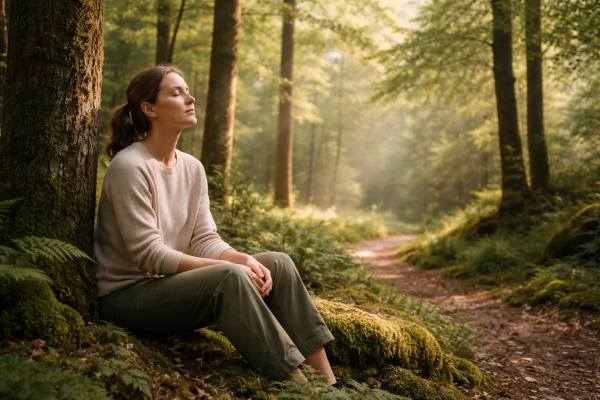
Forest bathing—often called shinrin-yoku—is a simple idea with surprisingly deep effects: spend unhurried time in a natural setting and let your senses do the work. It is not about distance, pace, or fitness. It is about attention and nervous-system state. When you slow down among trees, water, and living textures, your brain receives a steadier stream of sensory input—less sharp, less demanding, and easier to process than screens and traffic. For many people, that shift shows up as a quieter mind, easier breathing, and a body that stops bracing for the next demand.
What makes forest bathing especially useful is its accessibility. You do not need special equipment, and you do not need to “be good at meditation.” With a few practical steps, nature time can become a reliable reset for stress, rumination, and mental fatigue—without turning it into another performance goal.
Quick Summary
- Regular nature exposure can reduce perceived stress and support calmer mood and steadier attention.
- Even short sessions can help the nervous system shift out of “high alert,” especially when you move slowly and engage the senses.
- Benefits vary by person and setting, and research quality is mixed; treat it as supportive care, not a cure-all.
- Start with one 45–90 minute session per week, plus two 10–15 minute “green breaks” on busy days.
- Use basic safety planning (weather, footing, allergies, ticks, and phone accessibility) so relaxation does not become risk.
Table of Contents
- What forest bathing is and is not
- How nature shifts your nervous system
- What the research suggests so far
- How to do a forest bathing session
- Urban nature and micro-breaks that work
- Make it sustainable without pressure
What forest bathing is and is not
Forest bathing is best understood as slow, sensory immersion in a natural environment. The goal is not to “achieve” relaxation. It is to create conditions where your nervous system can downshift on its own. You walk slowly, pause often, and pay attention to simple inputs—light through leaves, wind on skin, the smell of damp soil, the uneven rhythm of birds and insects. When you do that, you give your brain fewer urgent signals and more restorative ones.
What it is
- A practice of attention: You are training your mind to stay with direct experience rather than scanning for the next problem.
- A gentle nervous-system cue: You reduce sympathetic activation (the body’s “mobilize” state) and support parasympathetic activity (the body’s “restore” state).
- A form of active rest: You are awake and engaged, but not pushing or optimizing.
What it is not
- Not hiking for speed or mileage: Those can be excellent too, but the internal state is different.
- Not a substitute for therapy or medical care: Nature can support recovery, but it does not replace targeted treatment when symptoms are severe or persistent.
- Not a purity test: You do not need a remote wilderness. A quiet park with mature trees can work for many people.
- Not constant mindfulness: Minds wander. The practice is simply returning—again and again—without judgment.
A common misconception is that forest bathing must be “perfect” to count: the right forest, the right weather, the right mindset. That mindset can actually block the benefits by turning the practice into another performance task. Instead, aim for a workable definition: unhurried time outdoors, with your senses turned on and your phone turned down.
Another helpful distinction is between exposure and engagement. Exposure is being in nature while mentally elsewhere (planning, scrolling, worrying). Engagement means you are noticing, listening, touching bark, watching patterns. The more engagement you add—without forcing it—the more likely you are to feel the calm that people associate with forest bathing.
How nature shifts your nervous system
When people say nature “calms the nervous system,” they are usually describing a shift in three linked systems: autonomic balance, stress hormones, and attention.
Autonomic balance and the body’s “stance”
Your autonomic nervous system constantly adjusts your heart rate, breathing, digestion, and muscle tone. Under chronic stress, many people live in a mild state of bracing: shallow breathing, tight jaw, tense shoulders, scanning attention. Nature environments can support a counter-shift toward parasympathetic activation—slower breathing, softer muscle tone, and a steadier internal pace. For some people, this shows up as warmth in the hands, a deeper exhale, or the sense that thoughts slow down.
Stress chemistry and recovery signaling
Stress hormones are not “bad.” They help you mobilize. The problem is when the dial stays high. Nature time can support recovery by reducing the stream of threat-like cues and giving the brain a clear message: “Nothing urgent is required right now.” In that state, people often notice fewer stress spikes and easier emotional regulation later in the day.
Attention restoration and rumination relief
Urban environments demand directed attention: watch for cars, read signs, filter noise, resist distraction. That constant effort is mentally expensive. Natural settings often offer what psychologists call “soft fascination”—stimuli that are interesting but not demanding, like moving branches or rippling water. Soft fascination can reduce the need for tight executive control, which helps the mind recover from decision fatigue. Many people experience this as less rumination: the same worries may still exist, but they feel less sticky and less loud.
Sensory patterning that is easier to process
Natural soundscapes are typically less abrupt than digital alerts and traffic noise. Visual patterns in nature often repeat with gentle variation. Even the smell of plants and soil can create a sense of context and safety. These are not magic ingredients; they are a sensory environment that asks less of your threat-detection system.
A grounded way to summarize the mechanism is this: forest bathing reduces “high-alert inputs” and increases “recovery inputs.” The calmer you feel is not a single switch flipping; it is a coordinated shift across breathing, heart rhythm, attention, and emotion. That is why forest bathing often improves sleep quality and next-day clarity—especially when it replaces late-day screen time or stress-filled errands.
What the research suggests so far
The research on forest bathing and related forest-based interventions has grown quickly, and the overall pattern is encouraging: many studies find improvements in stress-related physiology and mood. At the same time, study quality varies, and results are not uniform across outcomes.
What tends to improve most reliably
Across reviews and meta-analyses, psychological outcomes often look stronger than physiological ones. People commonly report:
- Lower anxiety and depressive symptoms
- Improved mood (less tension, anger, and confusion; more vitality)
- Reduced perceived stress and rumination
These outcomes make sense because mood and perceived stress are closely tied to attention and autonomic state—two areas nature exposure can influence quickly.
Physiological outcomes: promising but mixed
Physiology is harder to study because it is sensitive to timing, sleep, caffeine, temperature, activity level, and measurement methods. Some studies show changes in markers such as cortisol, heart rate variability, and blood pressure after forest exposure. Others show smaller or inconsistent effects. One important nuance is that the “forest effect” can be diluted if the comparison condition is also restorative (for example, quiet walking) or if participants are already relatively calm.
Forest versus walking: why the comparison matters
A key question is whether benefits come from nature itself or from gentle movement and time away from work. Well-designed comparisons often match walking duration and intensity in forest versus urban settings. In some trials, forest walking improves mood and stress markers more than urban walking, suggesting the environment adds something beyond exercise alone. However, effects can depend on the person, the site, and the study design.
Who may benefit most
Forest bathing is often most noticeable when baseline stress is high. People who report mental fatigue, sleep disturbance, or persistent “wired” feelings may experience a clearer contrast. That does not mean it only works for stressed people; it means the change is easier to feel when there is more tension to release.
Limitations worth knowing
- Many studies are short-term, and long-term follow-up is less common.
- Intervention styles vary widely (guided, self-guided, group-based, single session, multi-week program).
- Cultural context and expectations can influence outcomes.
- Not all natural spaces are equal. Noise, crowding, and safety concerns can reduce benefits.
A balanced interpretation is this: forest bathing is a low-risk, potentially high-reward supportive practice for stress and mood, with stronger evidence for psychological outcomes than for any single biomarker. If you treat it as a repeatable reset—rather than a one-time cure—you are more likely to see meaningful changes over time.
How to do a forest bathing session
A good forest bathing session has three parts: a gentle arrival, slow sensory immersion, and a closing that helps you bring the calm back into daily life. You do not need special training. You do need a plan simple enough that you will use it.
1) Choose a setting that feels safe
Pick a place where you can slow down without feeling watched or rushed. Look for:
- Low traffic noise
- A clear path with options to stop and sit
- Enough privacy to relax your posture
- Predictable footing if you are prone to injury
If safety is a concern, bring a friend, go during daylight, and choose a familiar route.
2) Set a light intention
Keep it practical, not lofty. Examples:
- “I’m here to let my body settle.”
- “I’m here to notice what I usually miss.”
- “I’m here to practice one calm hour.”
Avoid using the session to solve problems. If solutions come, fine. If not, you still succeeded.
3) Slow the pace below “exercise mode”
Walk at a speed that feels almost too slow at first. If you can comfortably breathe through your nose, you are usually in the right range. Pause often—especially when something naturally catches your attention.
4) Use the five-sense cycle
Repeat this loop for 20–40 minutes:
- Sight: notice patterns, color gradients, distance
- Sound: locate near sounds and far sounds
- Smell: take one slow inhale, then let the next breath be normal
- Touch: feel bark texture, a leaf surface, air temperature
- Body: scan jaw, shoulders, belly, and soften one area
This cycle keeps you engaged without forcing mindfulness.
5) Add one stillness stop
Sit or stand quietly for 5–10 minutes. Stillness helps the nervous system consolidate the downshift. If your mind races, gently return to one anchor: sound, breath, or the feeling of your feet.
6) Close with a simple transition
Before leaving, name one thing you want to carry back:
- “I can slow down without losing momentum.”
- “My body relaxes when I stop scanning.”
- “Calm is available in small moments.”
A typical session length is 45–90 minutes, but even 20–30 minutes can be meaningful when attention is protected. The most important ingredient is not duration—it is the quality of unhurried presence.
Urban nature and micro-breaks that work
If you live in a city or have limited access to forests, you can still practice nervous-system calming through “nearby nature.” The goal is to create a brief sensory environment that is less demanding than your default day.
Use the “three layers” approach
You can improve nature quality by adjusting:
- Visual layer: trees, sky, plants, water, distance, natural light
- Sound layer: fewer abrupt noises, more steady ambient sound
- Pace layer: slower movement, fewer tasks, fewer decisions
Even if the visual layer is limited, improving sound and pace can still help.
Micro-break formats that are realistic
Try one of these 10–15 minute resets:
- Green loop walk: walk one small loop in a park or tree-lined street with no phone use and one slow pause per block.
- Sit spot: sit near a tree or patch of plants and do the five-sense cycle once.
- Sky reset: look at the horizon or the sky for two minutes, then take a slow walk for eight minutes, then end with one minute of stillness.
- Commute downgrade: get off one stop early and walk slowly through the greenest available route.
These micro-breaks work best when they are scheduled, not “when you have time.” Many people benefit from pairing them with transitions: after lunch, after work, or before dinner.
When indoor or limited-mobility options help
If outdoor access is limited by weather, mobility, or safety, you can still use nature cues:
- Sit near a window with a view of trees or sky
- Use indoor plants and natural light during a calm break
- Listen to steady natural sound while you rest your eyes for a few minutes
These are not identical to outdoor immersion, but they can still reduce cognitive load and support a calmer state—especially when they replace high-stimulation content.
The key is consistency. A weekly longer session is powerful, but many people feel the biggest day-to-day difference when they add short nature contact during stress peaks—before the nervous system ramps into overload.
Make it sustainable without pressure
Forest bathing works best when it becomes a gentle habit rather than an occasional rescue. Sustainability comes from removing friction, setting realistic expectations, and matching the practice to your life stage and nervous system.
Start with a “minimum effective dose”
A workable starting plan for many people is:
- One 45–90 minute nature session per week
- Two 10–15 minute green breaks on weekdays
If that feels too big, cut it in half. Consistency matters more than intensity.
Protect the practice from perfectionism
A common trap is turning nature time into another metric: steps, photos, productivity, performance. If you notice that happening, make one rule that protects the nervous-system goal:
- No photos during the session
- Phone stays on silent and out of sight
- No problem-solving for the first 20 minutes
These boundaries keep the practice restorative.
Use gentle tracking, not obsession
Once or twice a week, note a few simple signals:
- Sleep quality
- Stress reactivity (how quickly you get tense)
- Rumination intensity
- Mood stability
If you see improvement, you have motivation. If you do not, you can adjust the “dose,” the setting, or the time of day.
Adapt to your nervous system, not an ideal
If you are highly anxious, silence can feel uncomfortable at first. You may do better with a gentle structure: slow walking, then one short stillness stop, then walking again. If you are burned out, you may need more stillness and less distance. If you are grieving or depressed, nature time may initially bring emotion to the surface; that is not failure, but it is a reason to go gently and seek support if it feels overwhelming.
Safety and accessibility essentials
Plan for:
- Weather changes and hydration
- Footwear that supports stable walking
- Allergy triggers and insect protection
- Ticks in high-risk areas
- A simple check-in plan if you go alone
Forest bathing should reduce threat signals, not increase them. When your body feels safe, the calming response is much easier to access.
References
- The effects of forest bathing on psychological well-being: A systematic review and meta-analysis 2023 (Systematic Review and Meta-Analysis)
- Does Forest Therapy Have Physio-Psychological Benefits? A Systematic Review and Meta-Analysis of Randomized Controlled Trials 2022 (Systematic Review and Meta-Analysis)
- Randomized controlled trial on the efficacy of forest walking compared to urban walking in enhancing mucosal immunity 2025 (RCT)
- The Psychological and Physical Effects of Forests on Human Health: A Systematic Review of Systematic Reviews and Meta-Analyses 2021 (Review of Reviews)
Disclaimer
This article is for general educational purposes and does not provide medical advice. Nature-based practices can support stress regulation and wellbeing, but they are not a substitute for professional care. If you have persistent anxiety, depression, panic symptoms, trauma-related distress, severe insomnia, or medical symptoms that interfere with daily functioning, consider speaking with a licensed healthcare professional for assessment and personalized support. If you feel unable to stay safe or are in immediate danger, contact your local emergency services right away.
If you found this article helpful, consider sharing it on Facebook, X (formerly Twitter), or any platform you prefer.