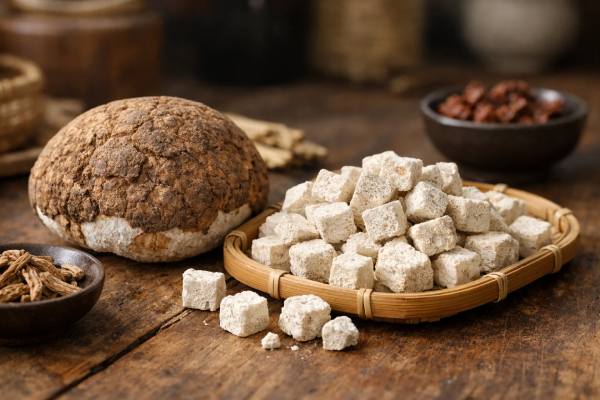
Fu Ling is a medicinal fungus used for centuries in East Asian herbal practice, especially in Traditional Chinese Medicine. Unlike familiar culinary mushrooms with caps and stems, Fu Ling is the dried sclerotium, a dense underground storage mass that forms around pine roots. It is valued for a broad but gentle profile: support for fluid balance, digestive steadiness, and a calmer, more settled state when stress or restless sleep are part of the picture. Modern research focuses mostly on its polysaccharides and triterpenes, compounds linked to immune signaling, inflammation control, and metabolic effects.
What makes Fu Ling especially interesting is its balance. It is not usually treated as a strong stimulant, harsh diuretic, or knockout sedative. Instead, it is more often used as a steadying herb that fits easily into formulas for edema, loose stools, poor appetite, palpitations, and sleep disruption. That mildness is part of its appeal, but it also means expectations should stay realistic. Fu Ling is best understood as a supportive ingredient, not a stand-alone cure.
Quick Overview
- Fu Ling is best known for supporting fluid balance, digestion, and a calmer nervous system.
- Its main studied compounds are polysaccharides and triterpenes, including pachymic acid and poricoic acids.
- Common adult ranges are 9 to 18 g/day as a decoction or 1.6 to 3.6 g/day of dried extract, depending on form.
- Mild diuretic effects and occasional allergy are possible, and product quality matters.
- Pregnant or breastfeeding people, children, and anyone using multiple medicines should avoid self-prescribing.
Table of Contents
- What is Fu Ling
- Key compounds and actions
- Fu Ling benefits and uses
- How to use it
- How much to take
- Fu Ling side effects and warnings
- What the evidence says
What is Fu Ling
Fu Ling refers to the dried sclerotium of Wolfiporia extensa, a fungus long discussed in the literature under names such as Poria cocos, Wolfiporia cocos, poria, hoelen, Indian bread, and tuckahoe. In practical herbal use, “Fu Ling” usually points to the pale inner mass rather than a typical mushroom fruiting body. That distinction matters, because its medicinal identity is tied to this dense, underground storage tissue, not to the cap-and-stem form many people picture when they hear the word mushroom.
In Traditional Chinese Medicine, Fu Ling is classically described as sweet, bland, and neutral. In plain language, that points to an herb seen as gentle, broadly compatible, and useful when the body seems to be holding excess fluid or struggling with sluggish digestion. Practitioners have long used it to promote urination, support appetite, reduce loose stools, and calm a restless mind. It is especially common in multi-herb formulas rather than as a solo remedy.
A helpful detail that many overviews skip is that related materials from the same fungus may be used a bit differently. Fu Ling Pi refers to the outer peel and is often emphasized more specifically for edema and water retention. Fu Shen includes part of the pine root at the center and is traditionally associated more strongly with calming the spirit. Standard Fu Ling sits between those poles, covering fluid handling, digestive support, and mild emotional settling.
Another reason Fu Ling stands out is how often it appears in classical formulas. It is not a niche herb reserved for rare conditions. It shows up in digestive formulas, sleep formulas, formulas for dizziness with phlegm-fluid patterns, and prescriptions meant to ease a heavy, puffy, or “waterlogged” feeling. That wide use has helped it maintain relevance in modern practice, including in granules, capsules, powdered extracts, and functional-food products.
For modern readers, the simplest way to think about Fu Ling is this: it is a medicinal fungus with a reputation for helping the body manage fluid and settle down without pushing too hard in any one direction. That gentle profile is why it is often chosen for people who feel puffy, sluggish after meals, or tense and tired at the same time. It is also why people sometimes underestimate it. Fu Ling is rarely dramatic, but it is often strategically placed in formulas because it helps other ingredients work in a steadier, more balanced way.
Key compounds and actions
Fu Ling’s medicinal reputation rests mainly on two major groups of compounds: polysaccharides and triterpenes. These are the best-studied constituents and the reason modern papers often describe the fungus as both a traditional remedy and a functional food. The polysaccharide fraction is especially important by weight, and much of the current research on immune, gut, and metabolic effects centers on these large carbohydrate molecules. Many readers compare them with the broader family of mushroom-derived beta-glucan compounds, although Fu Ling has its own distinct structures and not all products deliver the same profile.
Polysaccharides
Polysaccharides are long chains of sugar molecules that can influence immune signaling, barrier function, and gut ecology. In Fu Ling, these compounds are studied for immunomodulatory effects rather than simple “immune boosting.” That difference matters. Immunomodulation means they may help shape how the immune system responds instead of merely turning it up. In preclinical research, Fu Ling polysaccharides are also linked to antioxidant activity, inflammation control, liver support, and changes in gut microbiota.
Their structure matters. Water-soluble and alkaline-soluble fractions may behave differently, which is one reason product labels can be misleading. A capsule labeled “poria extract” may not tell you which fraction was used, how it was extracted, or whether the finished material resembles what was tested in a paper. This is why two Fu Ling supplements can feel quite different in practice.
Triterpenes
The second major class is triterpenes, including pachymic acid and various poricoic acids. These compounds are often used as quality markers because they are more chemically distinctive. Triterpenes are studied for anti-inflammatory, metabolic, renal, and neuroactive effects. Some research suggests they may play a meaningful role in the calming and sleep-related activity associated with Fu Ling, while others may contribute to fluid regulation and tissue-protective effects.
A useful way to picture the herb is as a two-part system. The polysaccharides are often discussed in terms of immune and gut effects, while the triterpenes are more often highlighted for targeted signaling effects, including inflammation and cellular protection. In a whole-herb preparation, both groups likely matter, along with smaller amounts of sterols and other minor constituents.
This chemistry also explains why Fu Ling is broader than its traditional labels suggest. An herb once described simply as “draining dampness” now looks, under modern analysis, like a complex medicinal fungus that may influence immune pathways, sleep physiology, gastrointestinal tone, and metabolic balance. Still, the chemistry is not a guarantee of clinical benefit. A promising compound profile only tells you what the herb might do, not what it reliably does in people taking real-world doses. That distinction becomes important later when the research is weighed more carefully.
Fu Ling benefits and uses
The most practical way to understand Fu Ling is through its main use patterns. While the herb is sometimes marketed for immunity, stress, or blood sugar, its day-to-day traditional roles are more grounded: moving excess fluid, steadying digestion, and helping a person feel less restless and internally “swamped.”
One of its most established traditional uses is fluid balance. Fu Ling is often chosen when there is mild puffiness, scanty urination, a sense of heaviness, or fluid accumulation tied to digestive sluggishness rather than a pure kidney or urinary problem. It is not a harsh flush. Instead, it is usually viewed as a gentler support for the body’s normal handling of fluids. If your main goal is straightforward urinary comfort, an herb more directly compared with it is corn silk, but Fu Ling is broader because it also addresses digestion and composure.
Its digestive role is equally important. In traditional practice, Fu Ling is often used when appetite is low, stools are loose, or the stomach feels burdened after rich, cold, or overly damp foods. In modern terms, that translates to a supportive herb for people who feel bloated, tired after eating, or prone to soft stools when stress and poor food tolerance overlap. It is not a bitter digestive stimulant like gentian, and it does not warm the gut like ginger. Its effect is quieter: it helps stabilize rather than push.
Fu Ling is also widely used when sleep feels light and unrefreshing, especially if worry, palpitations, or a “tired but unsettled” feeling is part of the picture. It is better thought of as calming than sedating. On its own, it is not likely to feel like a strong sleep medicine. In a formula, though, it may help reduce inner agitation and improve sleep quality over time.
A fourth area is metabolic and immune support. This is where marketing often gets ahead of the evidence. Preclinical studies suggest anti-inflammatory, antioxidant, microbiome-modulating, and glucose-related effects. Some formula-based human data are promising too. But the realistic claim is that Fu Ling may be a useful adjunct, especially inside formulas, not that it can independently manage diabetes, chronic inflammation, or immune disorders.
Realistic outcomes from Fu Ling usually sound like this:
- less heaviness and puffiness
- steadier digestion and appetite
- fewer loose stools in the right person
- better quality of sleep rather than instant sedation
- broader support when combined with other herbs for metabolic or inflammatory concerns
That pattern reveals the herb’s character. Fu Ling tends to help systems communicate and regulate better, especially when fluid stagnation, digestive weakness, and nervous tension overlap. When used for the right person and the right reason, that can be surprisingly helpful. When used for the wrong reason, it may feel too mild to notice.
How to use it
Fu Ling is available in several forms, and the best choice depends on why you are taking it. Traditional use relies heavily on decoctions and formula granules, while modern supplement users often choose capsules or powdered extracts. The form matters because whole sliced material, concentrated extract, and blended formulas do not behave exactly the same way.
Common forms
Decoction pieces are the most classical option. The dried slices are simmered in water, usually along with other herbs, for 20 to 30 minutes or longer depending on the formula. This format is common in professional herbal practice because it allows dose flexibility and pairing with complementary ingredients.
Granules are concentrated powders made from decocted herbs. They are practical, easy to mix into hot water, and often preferred when someone wants the logic of traditional formula use without home simmering. Quality varies by manufacturer, so consistency matters.
Capsules and tablets are the simplest modern format. These work well for people who want convenience, but labels can be vague. A product may say “poria mushroom” without stating whether it uses sclerotium, mycelium, or a standardized extract. It may also fail to list polysaccharide content or the extraction method. That makes comparison difficult.
Tinctures exist, though they are less traditional for Fu Ling than decoctions or powders. They can be useful, but alcohol extraction may emphasize different compounds than water-heavy preparations.
Practical use cases
Fu Ling is often used in three practical ways:
- as part of a fluid-balance formula when someone feels puffy, heavy, or water-retentive
- inside a digestive formula when poor appetite, loose stools, and fatigue overlap
- in a calming formula when light sleep, tension, and digestive discomfort show up together
If sleep is your main target, Fu Ling is better seen as a supporting ingredient than a direct sedative. People often compare it with more obviously calming herbs such as passionflower. That comparison is useful: passionflower is more directly soothing for anxious, wakeful evenings, while Fu Ling tends to be steadier and more indirect, especially when digestion or fluid imbalance is part of the picture too.
When choosing a product, look for clear sourcing, the plant or fungal part used, standardized testing when available, and third-party quality checks. Because some reviews have raised concerns about processing methods, sulfur fumigation, and heavy-metal contamination in poorly controlled materials, quality is not a minor issue here. A well-made product is part of safe use.
Fu Ling is one of those herbs that often works best when the choice is specific. The more clearly your symptoms match its pattern, the more likely you are to notice a benefit.
How much to take
Fu Ling dosing depends heavily on form. A decoction dose, a granule dose, and a capsule dose should never be assumed to be interchangeable. The most practical adult range from an official monograph is 9 to 18 grams per day of dried cultured mycelium or sclerotium when used as a decoction, and 1.6 to 3.6 grams per day for certain dried extract forms. Those numbers are for adults and should be adjusted to the exact product format.
A good working guide looks like this:
- Decoction: 9 to 18 g/day, usually divided across one or two servings
- Dried extract or powder forms covered by monograph guidance: 1.6 to 3.6 g/day
- Sleep-focused extract studies: some products have been tested at 800 mg nightly, but that does not automatically translate to other extracts
Timing also matters. Traditional guidance suggests taking it before meals. In practice, that often fits its digestive role well. If the goal is fluid balance or digestive steadiness, earlier in the day may make more sense, especially for people who do not want increased urination at night. If the product is part of a calming or sleep-supportive formula, an evening dose may be reasonable.
Duration depends on purpose. A short course may be enough for temporary puffiness or digestive sluggishness after a dietary shift. For chronic patterns, people often use it for weeks rather than days, but prolonged use is best reviewed with a qualified clinician. This is especially important because chronic swelling, persistent diarrhea, or insomnia may signal a condition that needs proper diagnosis.
The safest way to start is at the lower end of the range, then reassess after several days. Increasing slowly makes it easier to notice whether the herb is actually helping. More is not always better. Because Fu Ling is often included in formulas, the total daily amount can add up quickly if you are also taking other products with poria in them.
A few dosing mistakes are common:
- treating a concentrated extract as if it were raw herb
- copying the dose from a sleep study for a different product
- assuming all “poria” supplements contain the same chemistry
- taking it late in the evening when urinary frequency is already a problem
- using it for months without rechecking whether the reason for use still exists
Used thoughtfully, Fu Ling dosing is fairly straightforward. The real challenge is not the number itself, but matching the dose to the form, the goal, and the person taking it.
Fu Ling side effects and warnings
Fu Ling is generally considered fairly well tolerated, especially compared with harsher stimulant herbs or strong diuretics. Still, “gentle” does not mean risk-free. The most realistic adverse effects are increased urination, mild digestive upset, and hypersensitivity reactions in people who do not tolerate the fungus well.
Possible side effects
The official monograph notes that a diuretic effect may occur and advises stopping use if hypersensitivity or allergy appears. In real life, that may show up as more frequent urination, a dry feeling if fluid intake is too low, mild stomach discomfort, or a rash. If a product causes itching, swelling, wheezing, or clear allergic symptoms, it should be stopped right away.
Another safety issue is product quality. Fu Ling is a fungus-based material, and sourcing matters. Reviews have discussed problems such as sulfur fumigation and heavy-metal contamination in lower-quality supply chains. That means the herb’s safety profile depends partly on the manufacturing standard, not just the fungus itself.
Who should be cautious
Several groups should be more careful:
- pregnant or breastfeeding people, because human safety data are limited
- children, unless guided by a qualified clinician
- people with fluid restrictions, dehydration, or significant kidney or heart disease
- anyone taking multiple prescription medicines, especially diuretics or glucose-lowering drugs
- people with known mushroom or fungal allergies
Formal herb-drug interaction studies are limited, but caution is sensible. Because Fu Ling may have a mild diuretic effect, combining it with prescription diuretics could increase fluid or electrolyte problems in sensitive people. Because some formula-based research touches blood sugar outcomes, extra care is wise if you already use diabetes medication. If a sleep formula also contains stronger calming herbs, sedative overlap becomes more relevant than Fu Ling itself.
Traditional sources also include pattern-based cautions that sound unusual in modern supplement language. The monograph advises professional guidance for people with yin deficiency, sunken spleen qi, or cold from deficiency with spermatorrhea. Even if those terms are not part of your medical vocabulary, the practical message is simple: Fu Ling is not ideal for every constitution, especially if someone is already dry, depleted, or fragile.
Seek medical evaluation rather than self-treatment if you have swelling with shortness of breath, new ankle edema, severe insomnia, persistent diarrhea, major weight change, or palpitations. Fu Ling can be supportive, but those symptoms need more than an herb label and a guess.
What the evidence says
Fu Ling’s evidence base is promising but uneven. The chemistry and preclinical literature are broad. Human evidence exists, but much of it involves formulas containing Fu Ling rather than the herb used alone. That means the science supports interest, not hype.
Promising signals
One of the clearest human signals is sleep. In a small 2023 clinical study, 21 adults with poor sleep took a Poria cocos extract nightly. Total sleep time increased by roughly 29 minutes on average, nighttime arousal fell, and questionnaire-based sleep severity improved. That is encouraging because it lines up with long-standing traditional use for restlessness and insomnia. Still, it was a small study using a specific extract, so it should not be treated as proof that every Fu Ling product will improve sleep.
Another notable area is metabolic support through formulas. A 2022 systematic review and meta-analysis pooled 73 randomized controlled trials involving 6,489 participants with type 2 diabetes. Formulas containing Fuling, combined with standard glucose-lowering treatment, were associated with improvements in fasting glucose, post-meal glucose, and HbA1c. The important caution is that most studies were judged to have notable bias and heterogeneity. This is a signal worth taking seriously, but not a license to market Fu Ling as a stand-alone diabetes treatment.
Important limits
Outside those areas, much of the literature remains preclinical. Reviews describe anti-inflammatory, antioxidant, immune-modulating, gut-microbiota, liver-protective, renal, and even antitumor actions. But most of those findings come from cell studies, animal models, extracted fractions, or chemically modified polysaccharides. They tell us what Fu Ling might be capable of, not what has been firmly shown in patients.
There is also a standardization problem. Different studies use raw sclerotium, cultured mycelium, ethanol extracts, water extracts, isolated polysaccharides, or triterpene-rich fractions. When people read that “Poria cocos helps with X,” they are often looking at results from a preparation very different from the one sitting in a supplement bottle.
Compared with better-known medicinal mushrooms such as reishi, Fu Ling’s human evidence is still less mature and less standardized. That does not make it weak. It makes it early. The strongest current conclusion is that Fu Ling deserves attention as a traditional fungus with credible mechanisms, modest human data for sleep, interesting formula-based data for metabolic support, and a clear need for larger, better-designed trials using well-characterized products.
The bottom line is balanced: Fu Ling is more than folklore, but it is not yet a fully settled evidence-based intervention for most modern health claims. It is best used with precise goals, realistic expectations, and good product selection.
References
- Poria – Wolfiporia extensa 2019 (Monograph). ([webprod.hc-sc.gc.ca][1])
- Chemical structures, extraction and analysis technologies, and bioactivities of edible fungal polysaccharides from Poria cocos: An updated review 2024 (Review). ([PubMed][2])
- A multidimensional perspective on Poria cocos, an ancient fungal traditional Chinese medicine 2025 (Review). ([ScienceDirect][3])
- Efficacy of Poria Cocos Extract on Sleep Quality Enhancement: A Clinical Perspective with Implications for Functional Foods 2023 (Clinical Study). ([PubMed][4])
- Benefits of herbal formulae containing Poria cocos (Fuling) for type 2 diabetes mellitus: A systematic review and meta-analysis 2022 (Systematic Review). ([PubMed][5])
Disclaimer
This article is for educational purposes only and is not a substitute for medical advice, diagnosis, or treatment. Fu Ling may affect fluid balance, digestion, sleep, and medication response, and it may not be appropriate for everyone. Speak with a qualified healthcare professional before using it if you are pregnant, breastfeeding, managing a chronic illness, or taking prescription medicines. Seek prompt medical care for persistent swelling, severe insomnia, allergic reactions, chest symptoms, or unexplained digestive changes.
If this article helped you, please share it on Facebook, X (formerly Twitter), or any other platform you prefer.