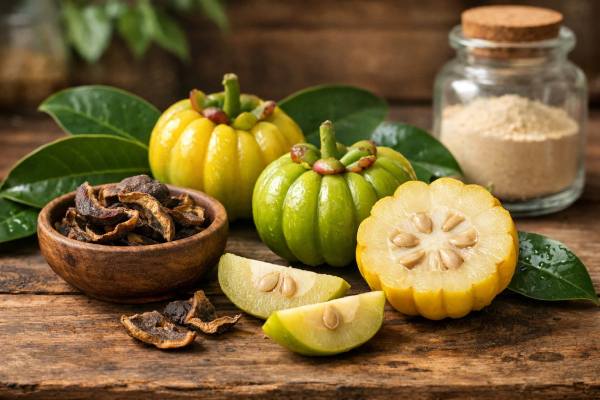
Garcinia cambogia, now more properly identified as Garcinia gummi-gutta, is a small tropical fruit whose dried rind has long been used in South Indian cooking and traditional medicine. In supplements, however, it is known for one reason above all others: weight loss. That reputation comes mainly from hydroxycitric acid, or HCA, a rind compound promoted for reducing appetite and limiting fat production. The idea is appealing, but the evidence is far more restrained than the marketing.
This plant is not useless, yet it is also not the effortless fat-burning shortcut many labels suggest. Some trials and meta-analyses report small short-term reductions in body weight, waist size, or appetite markers. Others find little or no meaningful advantage over placebo. At the same time, safety deserves more attention than it usually gets. Garcinia products have been linked to liver injury in rare but serious cases, and reports of serotonin-related complications and mood changes have added to the concern.
The most helpful way to understand Garcinia cambogia is as a weight-management supplement with modest potential, uncertain real-world value, and a clearer safety burden than many buyers expect.
Essential Insights
- Garcinia cambogia’s main active compound is hydroxycitric acid, which may modestly affect appetite and short-term weight measures.
- The best-case benefit is usually small, and many people notice little practical difference beyond diet and activity changes.
- Common label ranges are about 500 to 1,000 mg standardized extract, taken 2 to 3 times daily, usually before meals.
- Avoid Garcinia cambogia if you have liver disease, take serotonin-affecting medicines, or are pregnant or breastfeeding.
- Any new fatigue, nausea, dark urine, yellowing of the eyes, or abdominal pain after use should prompt immediate medical evaluation.
Table of Contents
- What is garcinia cambogia
- Key ingredients and active compounds
- Does garcinia cambogia help weight loss
- How to use garcinia cambogia
- How much garcinia cambogia per day
- Safety side effects and interactions
- What the research really shows
What is garcinia cambogia
Garcinia cambogia is the older commercial name for Garcinia gummi-gutta, a sour tropical fruit native to parts of South and Southeast Asia. The fruit is small, ridged, and pumpkin-like in shape, with a rind that turns yellow to orange when mature. In culinary traditions, the dried rind has been used as a souring agent, especially in fish curries and preserved dishes. In supplement culture, though, the rind is valued less for flavor and more for its concentration of hydroxycitric acid.
That difference matters. Traditional food use and modern supplement use are not the same thing. A cook using the dried rind in small amounts is making a culinary choice. A person swallowing concentrated extract capsules is taking a standardized botanical product intended to alter appetite, metabolism, or body weight. Those are very different exposures, with very different expectations.
Most commercial Garcinia cambogia supplements are made from the fruit rind rather than the pulp or seed. Labels often emphasize the percentage of hydroxycitric acid, usually written as HCA, which is treated as the plant’s “active ingredient.” Standardized extracts may contain 50 to 60 percent HCA, and some products advertise even higher amounts. This has helped shift Garcinia from a traditional food plant into the world of weight-loss pills, powders, and blends.
It is also important to understand that Garcinia cambogia rarely appears in a neutral market setting. It is commonly sold in categories such as:
- weight loss
- appetite control
- fat metabolism
- belly fat support
- carb-blocking or fat-blocking formulas
That marketing context shapes how people see it. Very few buyers are taking Garcinia because they want a traditional sour fruit rind. Most are looking for a metabolic shortcut. That is exactly why careful interpretation matters.
Botanically, Garcinia belongs to a broader plant group that contains several bioactive organic acids, xanthones, and phenolic compounds. But in practice, the entire commercial conversation narrows down to HCA. This can create the false impression that Garcinia is a one-compound supplement with a predictable outcome. In reality, extraction method, salt form, dose, co-ingredients, and user expectations all influence what happens.
A useful comparison is green tea extract in weight-management products. Both are heavily marketed for body composition, both have a more modest real effect than advertising implies, and both require more respect for safety than casual supplement shoppers often give them.
So the basic identity of Garcinia cambogia is straightforward: it is a traditionally used sour fruit whose rind became a modern weight-loss supplement. The more important point is that its commercial reputation is much larger than its proven clinical impact.
Key ingredients and active compounds
The main compound associated with Garcinia cambogia is (-)-hydroxycitric acid, or HCA. This organic acid is concentrated in the fruit rind and is the reason the supplement became popular in the first place. HCA is often promoted as a compound that blocks fat production by inhibiting an enzyme called ATP-citrate lyase, which helps convert carbohydrate-derived citrate into acetyl-CoA, a building block for fatty acid synthesis. In theory, that mechanism could reduce lipogenesis and shift calorie handling in a favorable direction.
That theory is attractive, but theory and real-world outcomes are not the same. In humans, the metabolic effect appears far less dramatic than supplement marketing suggests. Even when HCA has measurable biochemical effects, that does not always translate into meaningful weight loss or lasting appetite reduction.
Still, HCA remains the key ingredient readers should understand. Commercial products often standardize to:
- 50 to 60 percent HCA
- sometimes higher standardized extracts
- calcium, potassium, or mixed mineral salts of HCA
- multi-ingredient formulas where Garcinia is only one part of the blend
These salt forms matter because they may affect absorption, tolerability, and label interpretation. Two products may list similar extract weights but provide different actual HCA amounts. That is why “1,000 mg Garcinia cambogia” tells only part of the story. A better question is how much standardized HCA the serving actually provides.
Beyond HCA, Garcinia rind contains other phytochemicals, including:
- xanthones
- benzophenones
- flavonoids
- tannins
- phenolic acids
- garcinol-like compounds in related phytochemical discussions
These compounds contribute to the plant’s broader antioxidant and traditional-medicine profile, but they are not what made Garcinia famous. HCA is still the commercial center of gravity.
Some supplement claims go further and suggest that HCA may:
- reduce appetite through serotonin-related pathways
- limit de novo fat synthesis
- support lipid balance
- reduce cravings for sweets or refined carbohydrates
This is where the chemistry becomes more speculative. Appetite-related claims are especially difficult to pin down because human eating behavior is shaped by habit, reward, sleep, stress, and meal composition, not by one compound alone. A slight biochemical influence does not guarantee a noticeable reduction in hunger.
Another key issue is that standardized extracts do not always reflect a whole-plant experience. The closer a product gets to a concentrated HCA delivery system, the more it should be judged like a supplement, not like a food. That shift matters because concentrated products can produce adverse effects that traditional culinary use would never reveal.
So the active-ingredient story is clear enough: Garcinia cambogia is primarily an HCA supplement with a supporting cast of secondary phytochemicals. The practical question is not whether HCA is biologically interesting. It is whether that interest becomes a benefit that a person can actually feel, measure, and sustain without creating more risk than value.
Does garcinia cambogia help weight loss
This is the question nearly everyone asks first, and the most honest answer is: sometimes a little, often not much, and rarely enough to change the bigger picture on its own.
Garcinia cambogia became famous because HCA was proposed to reduce appetite and slow fat formation. Some clinical trials and pooled analyses do report small benefits in body weight, body mass index, waist circumference, or body-fat measures. But the average effect is modest, and not all trials agree. Some of the better-known randomized studies found no significant advantage over placebo. That split result is one reason Garcinia remains controversial rather than clearly effective.
A realistic interpretation of the evidence looks like this:
- short-term weight changes, when present, are usually small
- effects vary by dose, preparation, trial length, and diet background
- studies are often short, with many lasting only 8 to 12 weeks
- the clinical relevance of the weight change is uncertain for many users
In practical terms, that means Garcinia may help a little at the margins, but it does not reliably produce the kind of result that advertising implies. A person who tightens calorie intake, improves protein distribution, walks daily, and sleeps better may lose weight with or without Garcinia. The supplement may add a small nudge for some users, but it is rarely the main driver.
What about appetite? Some users report less hunger or fewer cravings, and there is a plausible mechanistic basis for that. But hunger is a noisy outcome. It changes with sleep debt, stress, meal timing, fiber intake, emotional cues, and caffeine use. In real life, that makes Garcinia’s appetite effect hard to isolate. Even when it works, it may feel subtle rather than dramatic.
There is also some interest in related outcomes such as:
- lipid support
- mild improvements in triglycerides or LDL in selected users
- possible effects on leptin or other metabolic signals
- slight reductions in waist circumference
These are not impossible, but they are not strong enough to make Garcinia a first-line cardiometabolic supplement. Readers exploring blood-sugar or appetite-centered botanicals often get more grounded value by comparing options such as bitter melon for glucose-oriented support, where the intended use is clearer even if the evidence is still mixed.
What Garcinia does not reliably do is:
- melt fat without dietary change
- override a high-calorie eating pattern
- create large weight losses in a few weeks
- act as a long-term weight-maintenance solution by itself
So yes, Garcinia cambogia may help with weight loss in a limited, short-term, and inconsistent way. But the size of the benefit is usually smaller than the marketing, and many people will notice no meaningful difference at all. That gap between promise and lived result is the single most important thing readers need to understand.
How to use garcinia cambogia
Garcinia cambogia is used very differently in the kitchen than in the supplement aisle. Traditional use relies on the dried rind in cooking, where it adds acidity and depth to savory dishes. Modern health use relies almost entirely on capsules, tablets, powders, or liquids standardized for HCA.
For most readers, supplement use is the relevant form. The most common commercial formats are:
- capsules with standardized extract
- tablets taken before meals
- powders mixed into drinks
- combination fat-loss formulas that include caffeine or other stimulants
That last category deserves special caution. Multi-ingredient products often make it harder to know what caused a benefit or a side effect. When a person takes Garcinia alongside caffeine, green tea extract, synephrine, or other appetite agents, the product is no longer really “just Garcinia.” It becomes a blend with more moving parts and often more risk.
If someone still wants to try Garcinia cambogia, a more careful use pattern looks like this:
- Choose a product that states the extract amount and HCA percentage clearly.
- Avoid proprietary blends that hide the exact dose.
- Start with the low end of the label range.
- Use it for a defined short trial rather than indefinitely.
- Stop if no clear benefit appears after several weeks.
It also helps to define the goal before starting. Are you hoping for reduced appetite, slower snacking, or a mild boost to an already structured plan? Or are you hoping it will compensate for an unsustainable diet? Garcinia is much more likely to disappoint in the second scenario.
A practical mistake many users make is treating the supplement as the entire strategy. Garcinia works, if it works at all, in the background. It does not replace:
- protein-forward meals
- consistent meal timing
- enough dietary fiber
- resistance training
- adequate sleep
- realistic calorie control
In that sense, Garcinia is better understood as an optional adjunct, not a foundation. Readers comparing plant-based metabolic tools sometimes do better by first tightening food structure with approaches that resemble fenugreek in appetite and meal-composition support, where satiety can come from fiber-rich meal design rather than faith in a single capsule.
Timing is usually built around meals. Many labels suggest using the supplement shortly before eating, often with water. Some people with sensitive stomachs do better taking it with food rather than before it. Either way, it should not be used casually, stacked with multiple stimulant products, or taken without checking the full ingredient list.
The best use case for Garcinia cambogia is narrow: a short, measured experiment inside an already sensible weight-management plan. The worst use case is chasing fast fat loss with high doses and multiple overlapping supplements. That is where hype turns into risk quickly.
How much garcinia cambogia per day
There is no single universally accepted dose of Garcinia cambogia because products differ in extract strength and HCA standardization. That said, most label directions and many clinical regimens cluster in a fairly recognizable range.
Common commercial patterns include:
- 500 to 1,000 mg standardized extract per dose
- taken 2 to 3 times daily
- usually before meals
- often standardized to 50 to 60 percent HCA
That means a typical total daily intake may fall somewhere around:
- 1,500 to 3,000 mg of extract per day
- or roughly 750 to 1,800 mg of HCA daily, depending on standardization
Some human trials have used approximately 1,500 mg HCA per day, while other studies and products go higher. But higher is not the same as better. The evidence does not show a clear line where more HCA reliably delivers better real-world weight loss. In fact, pushing the dose upward may raise the chance of side effects without producing a more meaningful outcome.
A sensible dosing approach is usually:
- start at the low end
- assess appetite, stomach comfort, and mood over 1 to 2 weeks
- avoid escalating just because a label allows it
- reassess after 8 to 12 weeks rather than taking it indefinitely
The 8-to-12-week window matters because most of the supportive research, when it exists, falls into that short-term range. If there is no noticeable change in appetite control, snacking behavior, or body-weight trend by then, continuing out of habit is hard to justify.
Timing deserves a small nuance. Labels often recommend taking Garcinia before meals because the intended mechanism is partly appetite-related. But a person with nausea, reflux, or a sensitive stomach may do better using it with meals. That may slightly blunt the intended “pre-meal” theory, but tolerability is more important than perfect supplement choreography.
A few dosing mistakes are common:
- assuming extract weight equals HCA amount
- stacking Garcinia with multiple appetite suppressants
- taking the maximum label dose immediately
- staying on it for months without re-evaluating
- ignoring side effects because the product is marketed as natural
The best dosage advice is therefore conservative. Garcinia cambogia does not have the kind of evidence base that justifies aggressive dosing. If a user chooses to try it, the most defensible plan is a modest, clearly labeled product, used for a short defined period, with realistic expectations and a willingness to stop.
Safety side effects and interactions
Safety is where Garcinia cambogia becomes much more serious than its marketing tone suggests. Many people think of it as just a fruit-derived slimming aid, but concentrated Garcinia supplements have been linked to rare yet sometimes severe adverse effects, especially liver injury. This does not mean every product will cause harm, but it does mean the risk profile is real and should not be minimized.
Common side effects are usually milder and may include:
- nausea
- stomach upset
- headache
- dry mouth
- dizziness
- loose stools or digestive discomfort
The more concerning issues are less common but far more important. Case reports and safety reviews have linked Garcinia-containing products to:
- acute liver injury
- jaundice
- marked elevations in liver enzymes
- hospitalization
- rare cases requiring liver transplantation
- serotonin-related complications
- mood changes, including mania in susceptible users
Not every case proves Garcinia alone was responsible, especially when multi-ingredient supplements were involved. But newer safety analyses have made the liver question harder to dismiss than it once was. That is why people with current or past liver disease should generally avoid Garcinia supplements altogether.
Interaction risk also matters. Use extra caution with:
- antidepressants and other serotonin-affecting medicines
- diabetes medicines or insulin
- psychiatric medications
- stimulant-heavy weight-loss formulas
- any supplement stack aimed at rapid fat loss
The serotonin point is especially important because Garcinia is sometimes sold as a simple appetite suppressant, yet its interaction profile may be more complex. A person taking SSRIs, SNRIs, or other serotonergic medicines should not assume a “natural” supplement is harmless.
Who should avoid Garcinia cambogia unless specifically guided by a clinician?
- pregnant or breastfeeding individuals
- children and adolescents
- anyone with liver disease
- people with bipolar disorder or a history of mania
- those taking serotonin-related drugs
- people already using several weight-loss supplements at once
Warning signs that need prompt medical attention include:
- unusual fatigue
- nausea that does not settle
- dark urine
- yellowing of the skin or eyes
- right upper abdominal pain
- intense agitation, confusion, or mood changes
There is also a behavior-based safety issue: Garcinia tends to attract people who are frustrated with their weight and tempted by quick solutions. That psychological context can lead to dose escalation, supplement stacking, or prolonged use without much thought. In practice, those choices may be riskier than the ingredient itself.
So while Garcinia cambogia is often sold like a light wellness product, it should be treated more like a supplement with genuine adverse-event potential. It is not a casual add-on for everyone, and it is certainly not a supplement to ignore once symptoms appear.
What the research really shows
The research on Garcinia cambogia is best described as mixed, modest, and overshadowed by safety concerns. That combination explains why the ingredient remains popular in marketing but still fails to earn broad clinical enthusiasm.
The strongest positive reading of the evidence is that Garcinia may produce small short-term improvements in some obesity-related measures. Some meta-analyses suggest modest decreases in body weight, BMI, waist circumference, or body-fat measures compared with placebo. That is enough to say the supplement is not completely inert.
But the negative reading is just as important:
- not all trials show benefit
- the size of the effect is usually small
- many studies are short and methodologically limited
- the real-world significance of the change is uncertain
- long-term benefit data are weak
This means two statements can both be true at once:
- Garcinia cambogia may work a little.
- That little may not matter very much for many users.
This is an uncomfortable place for a supplement because it is enough evidence to fuel advertising, but not enough to make the supplement dependable. If someone loses 8 kilograms by improving diet, adding walks, and cutting alcohol, Garcinia may get the credit even if it only contributed a tiny fraction of the result.
The safety literature also changes the interpretation. A supplement with modest upside might still be attractive if the downside were negligible. Garcinia is harder to justify because the upside is limited while the downside includes rare but serious liver injury and other notable adverse events. That shifts the benefit-risk balance in a less favorable direction than many weight-loss buyers realize.
From an evidence standpoint, the most defensible conclusions are:
- Garcinia is not a miracle fat burner.
- HCA has plausible biological activity, but the human effect is inconsistent.
- Any benefit is likely to be small and short-term.
- Product quality and composition matter.
- Safety deserves equal attention to efficacy.
That balanced view is more useful than either extreme. Calling Garcinia useless ignores the small positive findings. Calling it an effective weight-loss aid ignores the weak magnitude, trial inconsistency, and safety burden. The truth sits in the middle: it is a biologically active supplement with limited clinical payoff.
For readers, that leads to a practical decision rule. If you want the most predictable return on effort, diet structure, sleep, activity, and meal composition will usually do more than Garcinia. If you still choose to try it, do so as a cautious short-term experiment, not as a foundation of your strategy. That is what the evidence really supports.
References
- Hepatotoxicity of dietary supplements containing Garcinia gummi-gutta (L.) N. Robson 2025 (Review)
- Garcinia gummi-gutta: Phytochemicals and pharmacological applications 2023 (Review)
- Risks Associated with the Use of Garcinia as a Nutritional Complement to Lose Weight 2021 (Review)
- Effect of Garcinia cambogia supplement on obesity indices: A systematic review and dose-response meta-analysis 2020 (Systematic Review and Meta-Analysis)
- The Use of Garcinia Extract (Hydroxycitric Acid) as a Weight loss Supplement: A Systematic Review and Meta-Analysis of Randomised Clinical Trials 2011 (Systematic Review and Meta-Analysis)
Disclaimer
This article is for educational purposes only and is not a substitute for personal medical advice, diagnosis, or treatment. Garcinia cambogia supplements may interact with medicines and have been linked to rare but serious liver injury. Anyone who is pregnant, breastfeeding, has liver disease, takes antidepressants or diabetes medicines, or is considering Garcinia for weight loss should speak with a qualified clinician before use.
If this article helped you, please share it on Facebook, X, or your preferred platform so others can find balanced, evidence-based information.