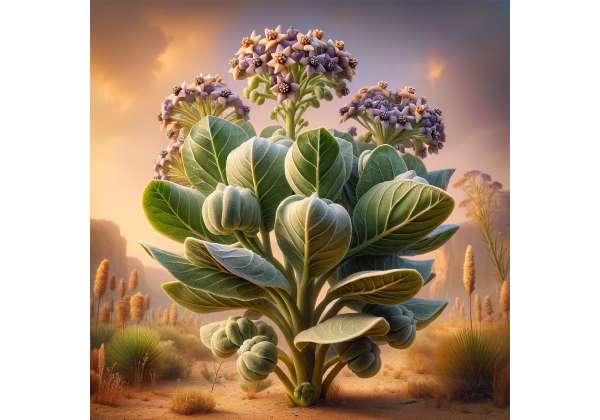
Giant milkweed, Calotropis gigantea, is a striking shrub with silvery green leaves, waxy lavender-white flowers, and a thick milky latex that immediately signals it is not an ordinary garden herb. Across South and Southeast Asia, it has a long place in traditional medicine, ritual use, and village-level remedies for pain, swelling, skin problems, cough, fever, digestive complaints, and wound care. Modern phytochemical work helps explain that history. The plant contains cardiac glycosides, flavonoids, triterpenes, and proteolytic enzymes that show anti-inflammatory, antimicrobial, wound-related, and cytotoxic activity in laboratory and animal studies.
That promise comes with an equally important warning. Giant milkweed is not a gentle self-care botanical. Its latex can injure the eyes and irritate the skin, while internal exposure can affect the stomach, nervous system, and heart. The smartest way to read this herb is not as a “natural cure,” but as a potent medicinal plant whose risks are as real as its pharmacology. That balance shapes every meaningful discussion of its benefits, uses, dosage, and safety.
Quick Facts
- Giant milkweed shows anti-inflammatory, antimicrobial, and wound-related activity in early research, but most evidence is still preclinical.
- Its best-known active compounds include cardenolides such as calotropin and calotoxin, which help explain both medicinal interest and toxicity.
- No evidence-based safe oral self-care dose is established; experimental topical preparations have been studied at 0.5% to 2% w/w, not as home-use standards.
- The latex can irritate skin and may cause serious eye injury if splashed into the eye.
- Pregnant or breastfeeding people, children, and anyone with heart disease or heart-rhythm medication should avoid medicinal use.
Table of Contents
- What is giant milkweed
- Key ingredients and medicinal properties
- What benefits is it known for
- How giant milkweed is used
- Is there a safe giant milkweed dose
- Side effects, interactions, and who should avoid it
- What the evidence actually says
What is giant milkweed
Giant milkweed is a perennial shrub in the Apocynaceae family, a plant family known for species that often contain potent latex and biologically active glycosides. Its botanical name is Calotropis gigantea, and it is commonly called crown flower, giant swallow-wort, or giant milkweed. It grows widely across India, Sri Lanka, Bangladesh, Thailand, Malaysia, and other tropical or subtropical regions, and it is easy to recognize once you know its habits: broad opposite leaves, clusters of starry flowers, and a white latex that appears quickly when the stem or leaf is broken.
The plant’s long medicinal history helps explain why it remains so widely discussed. In traditional systems, different parts of the plant have been used for very different purposes. Leaves have been warmed and applied externally to painful joints or swollen areas. Latex has been used in folk settings for skin lesions, tooth pain, and parasite-related complaints. Root bark has been used in formulas for digestion, respiratory complaints, fever, and sometimes as a stronger medicinal stimulant. Flowers have appeared in remedies for cough or digestive weakness. The important point is that giant milkweed has never been just one herb with one use. It is a multi-part medicinal plant whose applications vary sharply by region and tradition.
That variety, however, can create a false sense of familiarity. Many readers assume that if a plant has been used in so many ways for so long, it must also be broadly safe. With giant milkweed, that is not the right conclusion. Traditional use shows that the plant is pharmacologically active, not that it is gentle. In fact, its persistent use may reflect the opposite: people kept returning to it because it is strong enough to cause noticeable effects.
There is also an important botanical distinction to keep in mind. Giant milkweed is often discussed alongside Calotropis procera, a close relative with overlapping chemistry and many shared traditional uses. The two are not identical, and older papers sometimes treat them together or blur the distinction. For practical reading, that means some safety concerns, especially those involving latex and cardenolides, are relevant across the genus even when one paper focuses more heavily on the sister species.
The simplest modern description is this: giant milkweed is a potent traditional medicinal plant with genuine bioactive compounds, notable ethnomedical uses, and a safety profile that rules out casual, unsupervised self-treatment. It is a plant to understand carefully, not one to experiment with casually because it is natural.
Key ingredients and medicinal properties
Giant milkweed’s medicinal reputation is rooted in an unusually forceful chemical profile. The compounds most often discussed are cardenolides, a class of cardiac glycosides that includes calotropin, calotoxin, calactin, uscharin, and related molecules. These are the compounds that make the plant medically intriguing and medically risky at the same time. They occupy the same broad pharmacologic territory as foxglove-derived compounds: strong effects on ion transport, cardiac physiology, and cell signaling. That similarity does not make giant milkweed a usable heart herb. It is the reason it demands caution.
Beyond cardenolides, Calotropis gigantea contains flavonoids, triterpenoids, sterols, alkaloids, phenolics, tannins, saponins, and proteolytic enzymes. Different plant parts emphasize different groups. The latex is especially rich in proteins, enzymes, and irritant-active material. Leaves and flowers carry polyphenols, flavonoids, and glycosides. Root and bark preparations often concentrate compounds that make the plant feel “stronger” in traditional medicine.
These constituents support the plant’s most commonly described medicinal properties:
- Anti-inflammatory activity. Extracts from leaves, latex, flowers, and roots have shown inflammation-modulating effects in preclinical studies.
- Analgesic or antinociceptive activity. Some animal studies report reduced pain-related behavior after selected extracts.
- Antimicrobial activity. Latex and solvent extracts have shown activity against selected bacteria and fungi in laboratory testing.
- Wound-related activity. Some topical experimental preparations appear to support contraction, epithelization, or local tissue recovery in animal models.
- Cytotoxic and antiproliferative effects. Cardenolides such as calotropin are being studied for their activity against cancer cell lines.
- Enzyme-related activity. Certain extracts show inhibitory effects on enzymes tied to oxidation, pigmentation, or metabolic processes.
A practical nuance matters here: “medicinal properties” describe what the plant can do in biological systems, not what it is proven to do safely in people. A compound that suppresses a cell-signaling pathway in a lab can still be too toxic, too unstable, or too poorly studied to become a sensible household remedy.
Giant milkweed is also a reminder that whole-plant traditional medicine and isolated-compound pharmacology are not the same thing. A villager using a warmed leaf externally is not using the same intervention as a lab isolating calotropin or applying concentrated latex to cultured cells. When herbal articles blur those differences, they often make the plant sound safer or more clinically established than it really is.
In plain terms, giant milkweed contains compounds that can reduce inflammation, affect microbes, alter tissue response, and interact with the same kind of ion-pump biology involved in cardiac glycoside action. That is impressive chemistry. It is also why this plant cannot be approached like a mild tea herb or common culinary remedy.
What benefits is it known for
The benefits most often associated with giant milkweed come from traditional use first and from laboratory or animal evidence second. That order matters. It means the herb has a long ethnomedical story, but much less human clinical proof than readers often assume when they search for “benefits.”
Traditionally, giant milkweed has been used for several recurring complaint clusters. One is pain and swelling, especially when leaves are warmed and placed externally over joints or localized discomfort. Another is skin and wound care, where latex or leaf preparations have been used in highly traditional settings for sores, lesions, insect-related complaints, or delayed healing. A third is respiratory and digestive use, where flowers, root bark, or mixed formulas have been given for cough, feverish illness, indigestion, or sluggish bowels. These patterns suggest that people historically saw giant milkweed as a strong external herb and, in more controlled hands, as an internal stimulant or corrective.
Modern research gives some support to parts of that picture. Extracts of Calotropis gigantea have shown antioxidant, antimicrobial, anti-inflammatory, and wound-related effects in preclinical studies. Some leaf extracts have also shown enzyme inhibition and polyphenol-related antioxidant activity. These findings make the plant scientifically interesting and help explain why old uses kept recurring.
Even so, it is important to be realistic about what “benefits” means in practice. Giant milkweed is not a proven modern remedy for arthritis, infected wounds, asthma, ulcers, cancer, or digestive disorders. In many cases, gentler options would be the more rational first choice. For example, if the goal is mild topical soothing or barrier support, a herb such as calendula is usually a safer place to start than a latex-bearing plant with known eye and cardiac risks.
There is also growing scientific interest in giant milkweed’s cardenolides as research compounds, especially in oncology. Calotropin and related molecules have shown cytotoxic effects against cancer cell lines and are being examined for pathway-specific mechanisms. This is real research value, but it belongs in the lab and drug-development conversation, not in consumer claims that the herb “treats cancer.” That leap is far too large.
The same caution applies to wound healing. A topical animal study showing improved wound contraction with a defined extract is not the same as proving that household latex or leaf paste is safe or effective on human skin. With giant milkweed, home use can shift from “traditional remedy” to chemical injury more quickly than many readers realize.
The most honest summary is that giant milkweed is known for potential anti-inflammatory, antimicrobial, wound-related, and cytotoxic effects, with traditional uses for pain, swelling, skin complaints, and cough. But nearly all of those benefits need to be filtered through one larger fact: this is a toxic medicinal plant, so plausible benefit does not automatically justify self-use.
How giant milkweed is used
Giant milkweed has been used in far more ways than most people expect, and that diversity is part of what makes it difficult to describe responsibly. Different traditions use different plant parts, and the route of use changes the risk profile dramatically.
Historically, the plant has appeared in several main forms:
- Fresh leaves for external application. In some traditions, leaves are warmed, softened, or lightly oiled and then placed over painful joints, swellings, or localized discomfort.
- Latex for folk topical use. The white sap has been applied to skin lesions, tooth problems, or other very specific complaints, often in tiny amounts.
- Flowers in powders or mixtures. These have been used in selected traditional formulas for cough, digestive complaints, or feverish illness.
- Root bark or whole-plant extracts. These are among the stronger forms and appear in classical medicinal systems, not casual home use.
- Processed extracts in research. Modern studies often use standardized solvent extracts, purified fractions, or isolated compounds rather than the raw plant.
The form matters enormously because the plant’s risk changes with concentration and route. A leaf used externally is not the same as internal latex. A solvent extract studied in a lab is not the same as a home decoction. An isolated cardenolide is not the same as the whole herb. With giant milkweed, confusion between these forms is one of the quickest ways for benefit claims to become unsafe advice.
In a strictly practical sense, most modern readers should view giant milkweed as a plant better studied than self-used. Decorative cultivation, botanical interest, and careful handling are reasonable. Home medicinal experimentation is not the default recommendation. That is especially true with latex. The sap can irritate skin and may cause serious ocular injury if it contacts the eye. For simple household skin comfort, many people are better served by a gentler plant such as aloe vera rather than a potent latex-bearing species.
Researchers remain interested in giant milkweed because it offers a concentrated source of biologically active compounds. That is why you see studies on wound models, cytotoxicity, antioxidant assays, and antimicrobial activity. But research utility should not be confused with everyday suitability. A plant can be scientifically valuable and still be a poor candidate for unsupervised self-care.
Another important point is cultural context. In many regions, giant milkweed is not used alone. It appears in compound formulas, ritual settings, or practitioner-guided preparations where the dose, plant part, and intended outcome are more tightly defined by tradition. Removing the herb from that context and turning it into a generic supplement idea can be misleading.
So how is giant milkweed used? Traditionally, in many ways. Sensibly, today, with restraint. Its safest modern use for most people is not as a homemade remedy but as a plant whose pharmacology is better appreciated than casually copied.
Is there a safe giant milkweed dose
This is the key practical question, and the most responsible answer is straightforward: there is no established evidence-based oral self-care dose of giant milkweed that can be recommended for general use. That is not because the plant is inactive. It is because it is active in ways that create too much uncertainty and too much potential harm.
Traditional systems do contain dosage language for different parts of the plant, but those doses are not reliable self-care guidance for modern readers. They vary by plant part, preparation, practitioner tradition, and intended indication. More importantly, they do not solve the core problem of giant milkweed: different parts can contain different levels of cardenolides and other strong constituents, and those levels may vary with geography, season, and processing.
Modern research offers only limited practical numbers. In one animal wound-healing study, topical leaf extract preparations were tested at 0.5% and 2% w/w. Those numbers are useful because they show the concentration range used in a controlled experimental setting, but they are not a consumer dosage guide and should not be interpreted as a safe home recipe. Experimental concentrations are not the same thing as validated human use.
A sensible dosage framework for giant milkweed therefore looks very different from that of milder herbs:
- For internal use: no routine medicinal oral dose can be responsibly recommended.
- For raw latex: no safe home-use dose should be assumed.
- For topical self-use: caution is still required because skin and eye exposure can be harmful, especially with fresh latex.
- For research or practitioner-guided use: only standardized products and clear supervision would make dose discussion meaningful.
Timing and duration do not rescue the dose problem. A small amount of a strong plant is not automatically safe simply because it is used briefly. Nor does external use eliminate risk, since contact injuries can happen quickly and unexpectedly.
A better way to think about giant milkweed dose is to invert the usual supplement question. Instead of asking, “How much should I take?” ask, “Is this a plant that belongs in self-directed dosing at all?” For most people, the answer is no. Giant milkweed is closer to a practitioner herb or research plant than to an everyday botanical.
This conclusion may feel unsatisfying, especially in an article that promises “dosage.” But it is exactly the kind of clarity readers need. Not every medicinal plant can be reduced to a neat mg-per-day rule. Some plants fail the self-care dose test because the risk, variability, and lack of human trial data are too great. Giant milkweed is one of them.
The most useful dosage advice, then, is not a number. It is a boundary: do not treat traditional potency as permission for modern self-prescribing.
Side effects, interactions, and who should avoid it
Giant milkweed’s safety profile is the part readers most need to understand. The plant is not simply “strong.” It can be irritating, toxic, and clinically significant depending on the route and amount of exposure.
The best-known immediate risk is latex injury. The milky sap can irritate skin and is especially dangerous to the eyes. Ocular exposure has been associated with pain or burning, photophobia, conjunctival congestion, corneal edema, folds in Descemet’s membrane, epithelial injury, and temporary reduction in vision. Even when vision recovers, this is not a minor inconvenience. It is a genuine chemical injury scenario.
Internal exposure raises a different set of concerns. Because giant milkweed contains cardenolides with digoxin-like behavior, larger exposures may cause nausea, vomiting, abdominal pain, salivation, weakness, dizziness, rhythm problems, cardiovascular collapse, and other toxic effects. Traditional poisoning reports across the genus describe a pattern that looks less like “herb intolerance” and more like plant toxin exposure.
Likely or documented adverse effects include:
- Skin irritation, burning, or contact dermatitis.
- Eye injury after latex exposure.
- Nausea, vomiting, abdominal cramping, or diarrhea after ingestion.
- Dizziness, weakness, or confusion in more serious toxicity.
- Irregular heartbeat, conduction problems, or cardiovascular collapse in severe cases.
Interaction data are not robust, but the mechanism gives several strong reasons for caution. Because the plant contains cardiac glycosides, anyone taking digoxin, antiarrhythmic medication, potassium-wasting diuretics, or drugs that alter cardiac conduction or electrolyte balance should avoid medicinal use. The same is true for people with known heart disease, conduction disorders, or a history of arrhythmia. The risk here is not hypothetical hand-waving. It follows directly from the chemistry that makes the plant noteworthy in the first place.
Certain groups should avoid giant milkweed altogether in medicinal contexts:
- Pregnant or breastfeeding people.
- Children and adolescents.
- Anyone with cardiovascular disease.
- Anyone taking digoxin, antiarrhythmics, or complex medication regimens.
- Anyone with severe liver or kidney disease.
- Anyone handling fresh plant material near the face or eyes without protection.
Pregnancy deserves special emphasis. Traditional use patterns include uterine and reproductive applications, which is exactly why medicinal use is inappropriate during pregnancy. Here again, historical use is not reassurance. It is a warning sign.
One useful comparison is this: many household herbs allow a cautious “start low and see” approach. Giant milkweed does not belong in that category. Unlike more forgiving plants such as ginger, its chemistry and case-based toxicity demand a much stricter threshold for use.
For most readers, the safest interpretation is simple. Appreciate giant milkweed as a potent medicinal plant. Handle it carefully. Do not self-prescribe it internally, and never treat its latex as harmless because it is plant-based.
What the evidence actually says
The evidence for giant milkweed is broad in topic but shallow in clinical certainty. There is no shortage of traditional claims, phytochemical papers, cell studies, animal experiments, and toxicology reports. What is missing is the kind of high-quality human trial evidence that would justify routine self-care recommendations.
What the research supports strongly is chemical richness. Giant milkweed contains a wide range of cardenolides, polyphenols, triterpenes, sterols, and enzyme-active components. That point is not controversial. It is one of the clearest findings across the literature.
What the research supports moderately is preclinical biological activity. Leaf and latex extracts show antioxidant, antimicrobial, enzyme-inhibitory, and wound-related effects in laboratory and animal settings. Isolated constituents such as calotropin have shown cytotoxic and pathway-specific effects in cancer research. This is more than folklore. The plant is clearly doing something biologically measurable.
What the research supports weakly is direct clinical use in humans. There are very few meaningful human therapeutic studies, and those that do exist are nowhere near enough to establish safe, effective, standardized use for most indications. Compared with botanicals that have accumulated stronger human trial data, giant milkweed remains early-stage.
What the research supports very clearly is safety concern. Case reports and ophthalmology series show that exposure to Calotropis latex can injure the eye. Toxicology reports show that ingestion can produce serious systemic effects, especially cardiovascular ones. This is one reason the evidence picture around giant milkweed feels different from that of many herbs. Safety is not a side note. It is part of the core evidence.
The most balanced summary of current knowledge looks like this:
- Traditional use: extensive and historically important.
- Phytochemistry: strong and well documented.
- Preclinical benefit signals: real, especially for inflammation, antimicrobial activity, wound-related effects, and cytotoxic research.
- Human therapeutic evidence: limited and not strong enough for routine recommendations.
- Human harm evidence: meaningful and highly relevant.
That balance leads to a practical conclusion. Giant milkweed may be a valuable source of future drug leads and a meaningful ethnomedical plant, but it is not a well-established modern self-care herb. Its profile is much closer to “promising but hazardous” than to “useful daily botanical.”
This is exactly why articles on giant milkweed can go wrong if they focus only on pharmacologic potential. The compound story is exciting. The clinical story is much more restrained. The toxicology story is too important to push aside. When all three are read together, the message becomes much clearer: giant milkweed deserves respect, research, and caution in equal measure.
References
- Phytochemical Investigations and Pharmacological Potential of Organic Extracts of Calotropis gigantea L. Leaves 2025
- Evaluation of the Phytochemical, Antioxidant, Enzyme Inhibition, and Wound Healing Potential of Calotropis gigantea (L.) Dryand: A Source of a Bioactive Medicinal Product 2021
- An updated pharmacological insight into calotropin as a potential therapeutic agent in cancer 2023 (Review)
- Demographics and clinical profile of patients with ocular Calotropis poisoning in India 2021
- Calotropis poisoning with severe cardiac toxicity A case report 2020 (Case Report)
Disclaimer
This article is for educational purposes only and is not a substitute for medical advice, diagnosis, or treatment. Giant milkweed is a potent plant with meaningful toxicology concerns and should not be used to self-treat heart problems, wounds, eye exposure, skin disease, cancer, or unexplained digestive or respiratory symptoms. Seek guidance from a qualified healthcare professional before using any medicinal preparation involving Calotropis gigantea, especially during pregnancy or breastfeeding, if you take prescription medicines, or if you have a heart condition or other chronic illness.
If this article was helpful, please share it on Facebook, X, or any other platform you prefer.