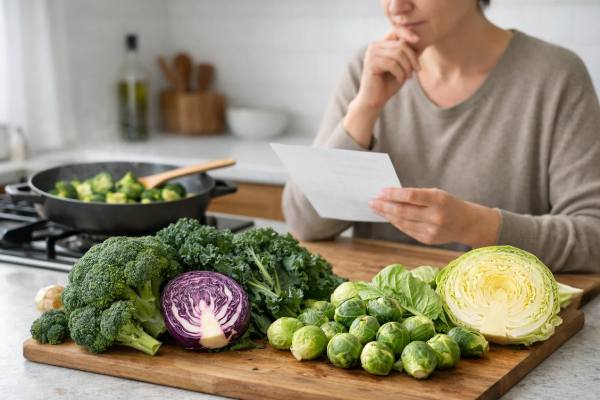
The phrase “goitrogen foods” sounds more alarming than it usually needs to. Many people hear that broccoli, kale, cabbage, or cauliflower can “hurt the thyroid” and assume they should avoid them entirely. That fear is understandable, especially if you already have hypothyroidism, Hashimoto’s, or a family history of thyroid disease. But the real story is more nuanced and far more practical than the internet often makes it seem.
Goitrogens are compounds that can interfere with thyroid hormone production under certain conditions. The key phrase is under certain conditions. For most people eating normal portions in a balanced diet, cruciferous vegetables are not a thyroid hazard. In fact, they are some of the most nutrient-dense foods on the plate. What matters most is context: iodine status, total intake, whether the food is raw or cooked, and whether someone is relying on extreme habits like large daily raw smoothies or juices.
Key Insights
- Normal meal-sized portions of cruciferous vegetables are usually safe for thyroid function when iodine intake is adequate.
- Cooking lowers the goitrogenic effect of many cruciferous vegetables and often makes them easier to tolerate.
- The biggest concern is not occasional broccoli or kale but very high raw intake, especially in people with low iodine intake or existing thyroid disease.
- Taking extra iodine on your own is not a smart fix, because too little and too much iodine can both create problems.
- If you have thyroid disease and eat cruciferous vegetables often, make most servings cooked rather than raw and watch lab trends instead of food myths.
Table of Contents
- What goitrogen foods do
- Which foods matter most
- How cooking changes the picture
- Who should be more careful
- How to eat these foods wisely
- Common myths and straight answers
What goitrogen foods do
A goitrogen is a substance that can reduce the thyroid’s ability to use iodine or make thyroid hormone efficiently. The word comes from “goiter,” which means enlargement of the thyroid gland. That name alone explains why the topic gets so much attention. People naturally assume a goitrogenic food is dangerous, but that is not what the term means in everyday life.
In food, the issue is mostly about potential effect, not guaranteed harm. Cruciferous vegetables contain natural compounds called glucosinolates. When the plant is chopped, chewed, blended, or crushed, these compounds are broken down into other substances, including thiocyanates and goitrin-related compounds. In theory, these can compete with iodine uptake or make thyroid hormone production less efficient. In practice, the effect depends heavily on dose and the person eating the food.
That is why it helps to think in layers instead of labels. A food can contain a goitrogenic compound and still be health-promoting overall. Broccoli, kale, cauliflower, Brussels sprouts, cabbage, bok choy, collards, mustard greens, turnips, and radishes also provide fiber, vitamin C, folate, potassium, and many phytonutrients linked to broader metabolic and cellular health. So the correct question is not “Are these foods bad?” It is “When do they become a meaningful thyroid issue?”
For most adults with a stable thyroid and adequate iodine intake, the answer is: not often. The more realistic concern appears when several factors stack together, such as low iodine intake, untreated hypothyroidism, heavy use of raw cruciferous vegetables, restrictive diets, or very large daily intakes. That is a very different situation from eating roasted Brussels sprouts with dinner or adding cooked cabbage to soup.
It also helps to separate food from supplements and concentrates. A whole plate of vegetables behaves differently from a highly concentrated powder, capsule, or daily liter of raw green juice. The body is responding to total exposure, frequency, and background nutrition, not to a scary label on one food group. So while goitrogen foods and thyroid function are genuinely connected, the connection is conditional, not automatic. That distinction is where most myths begin and where most confusion can be cleared up.
Which foods matter most
When people search for goitrogen foods, they are usually thinking about cruciferous vegetables, and that makes sense. These are the best-known examples and the ones most often blamed online. The main cruciferous vegetables include broccoli, cauliflower, kale, cabbage, Brussels sprouts, bok choy, collards, mustard greens, turnips, rutabaga, radishes, arugula, and watercress. These are the foods at the center of the thyroid conversation.
Among them, the practical issue is not that one vegetable is uniquely dangerous. It is that some people eat a lot of them in raw, repeated, concentrated forms. A salad with mixed greens is not the same as a daily oversized raw kale smoothie plus raw slaws plus green juice. The food pattern matters more than the single ingredient.
There are also other foods with goitrogenic relevance, though they are usually less central to day-to-day discussions in many countries. Soy is often included in this category, though the practical concerns there usually relate more to iodine status and medication timing than to ordinary tofu or edamame intake by itself. Millet and cassava are also classic examples in the medical literature, especially in settings where diets are limited and iodine deficiency is more common. In other words, the strongest goitrogen story historically has often been about vulnerable populations, not about varied diets with good access to iodine.
This is why it is misleading to put all “goitrogen foods” into one basket and tell everyone to avoid them. The real hierarchy looks more like this:
- Highest practical concern: very large, frequent raw crucifer intake in someone with low iodine intake or untreated thyroid disease
- Moderate concern: repetitive food patterns with limited variety, especially when non-iodized salts and low-iodine diets are involved
- Lower concern: mixed meals with cooked cruciferous vegetables in someone whose iodine status is adequate
Another important point is that cruciferous vegetables are not just “thyroid foods.” They are foods with many effects, and most of those effects are beneficial. That is why blanket avoidance can backfire. People may cut out fiber-rich vegetables, eat fewer nutrient-dense meals, and replace them with more refined foods based on a misunderstanding.
So which foods matter most? Cruciferous vegetables matter most because they are common and often misunderstood. But they matter in a specific way: not as foods that must be feared, but as foods whose thyroid effect becomes meaningful mainly when intake is very high, iodine is low, or thyroid function is already vulnerable. That is a narrower and more useful message than the usual warning.
How cooking changes the picture
Cooking is where the thyroid discussion becomes much more practical. If you understand one point about goitrogen foods and thyroid health, make it this one: raw and cooked cruciferous vegetables are not metabolically identical.
When cruciferous vegetables are chopped or chewed raw, an enzyme called myrosinase becomes active and helps convert glucosinolates into breakdown products. Some of these are linked to the goitrogen conversation. Heat changes that process. Cooking can reduce the formation of certain compounds that are more likely to interfere with thyroid function. That is one reason cooked cruciferous vegetables are generally considered the lower-risk choice for people who already have thyroid concerns.
But the cooking story is not as simple as “cook them hard and the problem disappears.” Different methods change different outcomes. Light steaming or other gentle cooking tends to reduce goitrogenic potential while still preserving many of the vegetables’ useful plant compounds. Longer, harsher cooking can reduce even more of the reactive compounds, but it can also lower some of the nutritional and phytochemical benefits people want from these foods in the first place.
That means cooking is a tool, not a purity test. You do not need to obsess over the “perfect” method. In real life, these are the main takeaways:
- Raw forms create more of the active breakdown products after chopping and chewing
- Gentle cooking usually lowers the goitrogen concern
- Long boiling may reduce more reactive compounds, but it can also blunt flavor and some beneficial plant chemistry
- Very large raw smoothies and juices deserve more caution than a side of cooked broccoli
This is why many thyroid-aware eating plans suggest shifting the balance rather than banning the foods. If you eat cruciferous vegetables often, making most of them cooked is a sensible compromise. That may mean steamed broccoli, sautéed bok choy, roasted cauliflower, braised cabbage, or soup-based greens instead of repeated large raw servings every day.
Cooking also changes tolerability. Some people with thyroid disease feel bloated or overly full with large raw salads and do better with cooked vegetables, even aside from any thyroid issue. That matters, because a food you tolerate well is easier to keep in a balanced routine. The goal is not to strip these foods of everything active. The goal is to lower unnecessary thyroid stress while keeping their broader health value intact.
So yes, cooking changes the picture, and often for the better. It turns a food category that gets unfairly feared into one that most people can continue to enjoy with far less concern.
Who should be more careful
Not everyone needs to think about goitrogen foods in the same way. The people who benefit most from caution are the ones whose thyroid function is already more exposed to stress.
The first group is people with low iodine intake. Thyroid hormone production depends on iodine, so when iodine is already borderline or low, the thyroid has less room to compensate. In that setting, high intake of raw cruciferous vegetables can matter more. If you are unsure whether your overall intake is adequate, it is worth understanding the basics of iodine intake and thyroid health before blaming broccoli alone.
The second group is people with untreated or unstable hypothyroidism, goiter, or autoimmune thyroid disease. If you have known Hashimoto’s thyroiditis, that does not mean cruciferous vegetables are off limits. It means context matters more. A person with stable labs on treatment and normal iodine intake is very different from someone newly diagnosed, symptomatic, and also eating a highly repetitive raw diet.
The third group is people with extreme intake patterns. The dramatic stories that circulate online usually do not involve ordinary meals. They involve unusual amounts of raw cruciferous vegetables consumed daily for long stretches, often as juices, cleanses, or oversized smoothies. That is not how most people eat, and it should not be treated as the normal reference point.
A fourth group includes people on restrictive diets or those who avoid iodized salt, dairy, seafood, eggs, or other common iodine sources. This does not mean those diets are automatically harmful. It means the background nutrition matters. A plant-heavy pattern can be thyroid-supportive, but only if key nutrients are still covered.
Who usually does not need much worry? People with normal thyroid function, good overall iodine intake, and ordinary servings of mixed meals. For them, cruciferous vegetables are much more likely to be helpful than harmful.
There is also an important caution in the opposite direction: do not react to fear about goitrogens by taking large iodine supplements on your own. Both iodine deficiency and iodine excess can create thyroid problems. The thyroid likes adequacy more than extremes.
So the right question is not “Should everyone avoid goitrogens?” It is “Is this person iodine-replete, clinically stable, and eating normal amounts?” For many readers, that answer will be yes. And if the answer is no, the next step is usually adjustment and balance, not elimination.
How to eat these foods wisely
For most people, the smartest approach is not avoidance. It is a practical middle path that protects thyroid function without cutting out excellent vegetables.
Here is what that usually looks like:
- Make cooked cruciferous vegetables your default if you eat them often.
Roasted cauliflower, steamed broccoli, sautéed kale, braised cabbage, and cooked bok choy are all reasonable choices. This is especially useful if you have known hypothyroidism, goiter, or low iodine intake. - Be more cautious with concentrated raw forms than with whole meals.
A raw kale salad once in a while is not the same as large daily raw smoothies, juicing, or cleanses built around cruciferous vegetables. Concentration and repetition are what move the needle. - Keep iodine intake adequate, but do not chase it aggressively.
Many people assume the answer to goitrogens is “more iodine.” That is too simplistic. The better goal is consistency: an overall diet that supplies enough iodine without sliding into excess. - Protect your thyroid medication routine.
Food myths often distract from more common reasons thyroid control goes off track. Timing mistakes with supplements can matter more than broccoli. If this is an issue for you, review the basics of levothyroxine, iron, and calcium timing rather than focusing only on vegetables. - Use your labs and symptoms as the reality check.
If your thyroid levels are stable, your symptoms are controlled, and your eating pattern is balanced, there is little reason to fear normal crucifer intake. The body’s real response matters more than a rule copied from social media.
A wise approach also leaves room for variety. You do not need every salad to be kale and every dinner to be broccoli. Rotating vegetables naturally lowers the chance of overdoing any one food while improving overall nutrient coverage.
This is also where common sense beats food anxiety. If a person with thyroid disease eats cooked crucifers a few times a week in normal portions and has stable labs, that pattern is hard to call harmful. On the other hand, if someone is under-eating iodine, avoiding all animal products, using only non-iodized gourmet salt, and drinking large raw green juices every day, that pattern deserves a closer look.
In other words, the thyroid-friendly strategy is simple: avoid extremes, prefer cooked when intake is frequent, keep iodine adequate, and pay more attention to consistent habits than to single ingredients.
Common myths and straight answers
The goitrogen conversation is full of confident claims that collapse under closer inspection. A few myths account for most of the confusion.
Myth: Anyone with hypothyroidism should avoid broccoli, kale, and cabbage.
Not true. Most people with hypothyroidism can still eat cruciferous vegetables, especially cooked forms, as part of a balanced diet. What matters is overall iodine status, the amount eaten, and whether thyroid function is actually stable.
Myth: Raw cruciferous vegetables are always dangerous.
Also not true. Raw crucifers are not inherently dangerous. The concern rises when intake becomes excessive and repetitive, especially in people with low iodine intake or existing thyroid disease. Normal raw portions are very different from daily concentrated blends.
Myth: Cooking removes all the benefits.
No. Cooking changes the chemical profile, but it does not erase the value of these vegetables. In fact, cooked crucifers may be the most practical option for people who want the benefits with less thyroid concern.
Myth: If you have a thyroid problem, every symptom is caused by food.
Usually not. Many people focus on kale while overlooking bigger issues such as undertreatment, inconsistent medication use, supplement timing mistakes, poor sleep, or misread lab results. If your numbers seem off, it is often more useful to review how to prepare for thyroid blood tests than to ban whole food groups.
Myth: “Goitrogen” means toxic.
No again. It means a compound has the potential to affect thyroid hormone production in certain settings. Potential is not the same as everyday harm.
The straight answer is this: for most people, the thyroid question around cruciferous vegetables is not about prohibition. It is about proportion. These foods become a more meaningful concern when they are eaten in very large raw amounts, when iodine intake is poor, or when thyroid disease is not well controlled. Outside those situations, the old blanket warning does more to create fear than to improve health.
That is why the most useful thyroid nutrition advice tends to sound less dramatic than internet myths. Eat a varied diet. Favor cooked crucifers if you eat them often and have thyroid disease. Do not assume more iodine is always better. And judge your plan by symptoms, labs, and clinical context, not by a single scary word.
References
- Do Brassica Vegetables Affect Thyroid Function?—A Comprehensive Systematic Review. 2024 (Systematic Review) ([PMC][1])
- Cooking Methods for Preserving Isothiocyanates and Reducing Goitrin in Brassica Vegetables. 2023 (Experimental Study) ([PMC][2])
- Thyroid function and iodine intake: global recommendations and relevant dietary trends. 2024 (Review) ([PubMed][3])
- Iodine Deficiency and Iodine Prophylaxis: An Overview and Update. 2023 (Review) ([PMC][4])
- The Role of Nutrition on Thyroid Function. 2024 (Narrative Review) ([PMC][5])
Disclaimer
This article is for educational purposes only and is not a diagnosis, treatment plan, or substitute for medical care. Thyroid symptoms, lab changes, and nutrition needs can differ widely based on the cause of thyroid disease, medication use, pregnancy status, and iodine intake. If you have hypothyroidism, hyperthyroidism, Hashimoto’s, Graves’ disease, a goiter, or changing thyroid labs, discuss diet changes and supplements with a qualified clinician.
If this article helped you, please share it on Facebook, X, or any platform your friends, family, or patients use.