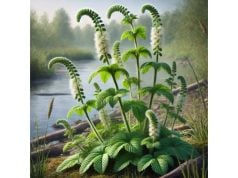
Gou Teng, the hooked stem of Uncaria rhynchophylla, is a classic East Asian medicinal herb best known in traditional Chinese medicine for calming “internal wind,” easing tremors, and settling symptoms linked with rising blood pressure, irritability, dizziness, and headache. Modern research has focused less on those traditional phrases and more on what the herb appears to do biologically: influence vascular tone, modulate inflammatory pathways, and deliver a distinctive group of indole alkaloids with possible neuroprotective effects.
That makes Gou Teng an herb with real pharmacological interest, but also one that is easy to overstate. Laboratory and animal studies support effects on hypertension-related pathways, seizure models, neuroinflammation, and endothelial function. Human evidence, however, remains limited and is often tied to formulas rather than Gou Teng alone. In practice, it is better seen as a traditional neurologic and cardiovascular support herb with promising mechanisms, selective real-world use, and a need for more rigorous clinical validation.
Used carefully, Gou Teng is most meaningful when tradition and evidence are kept in balance.
Key Facts
- Gou Teng is traditionally used for dizziness, headache, tremor, and hypertension-related symptoms, with modern research focusing on vascular and neuroprotective pathways.
- Its most studied compounds are rhynchophylline and isorhynchophylline, which may help explain calming, antihypertensive, and anti-inflammatory effects.
- A traditional decoction range is about 3 to 12 g per day, often added late in boiling to preserve active constituents.
- People with low blood pressure, heavy sedative use, or complex medication regimens should be cautious.
- Avoid Gou Teng during pregnancy, breastfeeding, and unsupervised use in children unless guided by a qualified clinician.
Table of Contents
- What is Gou Teng
- Key ingredients and active compounds
- What Gou Teng may help with
- How to use Gou Teng
- How much Gou Teng per day
- Safety side effects and interactions
- What the evidence really shows
What is Gou Teng
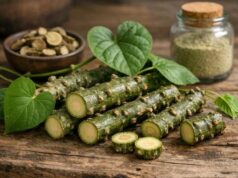
Gou Teng is the medicinal hook-bearing stem of Uncaria rhynchophylla, a climbing plant in the coffee family, Rubiaceae. In traditional Chinese medicine, it belongs to the class of herbs used to pacify internal wind and calm rising Liver Yang. In ordinary language, that means it has long been used for patterns involving tremor, dizziness, headache, restlessness, high blood pressure, spasms, and convulsion-like symptoms. The herb is not usually taken as a single culinary plant. It is a medicinal material, most often used in decoctions and multi-herb formulas.
The plant itself is native to parts of China, Japan, and neighboring regions, where several related Uncaria species have also been used medicinally. That botanical overlap matters. In modern practice, Gou Teng is often discussed as if all Uncaria herbs are interchangeable, but chemical profiles can vary. That is one reason authentication and quality control remain important.
Unlike many popular herbs that entered modern wellness culture through supplements or teas, Gou Teng comes from a formal traditional medical system. Its uses are shaped by pattern diagnosis, not only by single symptoms. A practitioner may choose it for hypertension with headache and irritability, for tremor with dizziness, or for formula-based support in certain neurologic presentations. That broader context helps explain why some modern clinical research is difficult to interpret. Studies often test Gou Teng as part of a formula, not in isolation.
For modern readers, the easiest way to understand Gou Teng is through three practical lenses:
- Traditional role: calming, antispasmodic, and blood-pressure-settling herb
- Modern research role: neurovascular and anti-inflammatory botanical
- Real-world use: usually an ingredient in decoctions, granules, or compound formulas rather than a casual daily tea
It is also helpful to distinguish Gou Teng from better-known Western calming herbs. It is not primarily a sleep herb, and it is not used in the same way as a simple relaxation botanical. Its traditional scope is closer to nervous-system irritability combined with vascular overactivity. In that sense, it overlaps more with the neurovascular discussions that appear around ginkgo for circulation and cognitive support than with a straightforward bedtime herb.
One important detail from traditional preparation is that Gou Teng is often added late in decoction rather than boiled for a long time. That reflects the belief that prolonged boiling may weaken some of its more delicate active constituents. Even readers who do not use Chinese medicine clinically can still take a lesson from that practice: preparation method matters.
So at its core, Gou Teng is a traditional neurologic and cardiovascular herb with a specific historical role, a chemically rich profile, and a modern evidence base that is promising, but still incomplete.
Key ingredients and active compounds
The best-known active compounds in Gou Teng are its indole alkaloids, especially rhynchophylline and isorhynchophylline. These two are the names most readers will see repeated in pharmacology papers, and for good reason. They are strongly associated with the herb’s neuroprotective, calcium-channel-related, anti-inflammatory, and vascular effects in laboratory studies.
But Gou Teng is not a two-compound herb. Its chemistry is broader and includes:
- rhynchophylline
- isorhynchophylline
- corynoxeine
- isocorynoxeine
- hirsutine
- hirsuteine
- corynoxine and corynoxine B
- flavonoids
- phenolic compounds
- triterpenes and other secondary metabolites
This matters because Gou Teng is a classic multi-target herb. It is unlikely that one isolated constituent fully explains everything the plant does. Instead, researchers think its overall effect may come from a combination of alkaloids acting across several pathways at once.
Rhynchophylline is especially important because it has been studied for:
- modulation of calcium signaling
- neuroinflammation control
- vascular smooth muscle effects
- possible anticonvulsant activity
- endothelial and antihypertensive pathways
Isorhynchophylline often appears beside it and may contribute to similar actions, though the exact balance between the two can shift depending on extraction, processing, and plant source. That is one reason standardization is difficult. Two Gou Teng preparations may both be genuine, yet differ in alkaloid profile enough to behave somewhat differently.
Another interesting point is that Gou Teng is not only a “brain herb.” Many of its compounds appear to affect both the nervous system and the cardiovascular system. That dual pattern fits traditional use rather well. Symptoms such as dizziness, tremor, headache, and “rising Yang” can be understood in modern terms as involving both vascular tone and nervous-system excitability. The chemistry of Gou Teng seems to reflect that overlap.
The herb also raises a modern pharmacology concern: some of its compounds can influence drug-metabolizing pathways, including PXR-related signaling tied to CYP3A4 regulation. That does not automatically make the herb unsafe, but it does mean the active chemistry is strong enough to matter beyond simple symptom relief.
Readers comparing Gou Teng’s alkaloid-rich profile with other cognition-oriented herbs may notice a difference. For example, bacopa’s active compounds are studied more for memory adaptation and stress modulation, while Gou Teng’s chemistry leans more toward neurovascular, anticonvulsant, and excitability-related pathways.
So the ingredient story is clear. Gou Teng’s identity rests on a complex alkaloid profile, with rhynchophylline and isorhynchophylline at the center. These compounds are what make the herb scientifically interesting, but they are also what make product quality, dosage, and safety more important than many casual users assume.
What Gou Teng may help with
The most plausible benefits of Gou Teng cluster around headache and dizziness patterns, hypertension-related symptoms, tremor and nervous-system excitability, and broader neuroprotective research interest. But these benefits do not all carry the same level of evidence.
The traditional uses are the clearest starting point. Gou Teng has long been used for:
- dizziness
- headache
- tremor
- convulsion-like symptoms
- irritability and internal agitation
- blood-pressure-related patterns
In modern pharmacology, the best-supported mechanisms behind those uses include:
- vasodilatory or vascular tone effects
- calcium signaling modulation
- anti-inflammatory activity
- antioxidant pathways
- neuroprotective actions in experimental models
This gives Gou Teng a fairly coherent traditional-to-modern story. The herb is not being used for one random symptom in old medicine and an unrelated effect in modern science. The general direction is surprisingly consistent. What changes is the strength of proof.
For blood pressure, Gou Teng looks promising but still underproven as a stand-alone modern therapy. Preclinical studies suggest antihypertensive and endothelial-support effects, and some traditional formulas containing Gou Teng are used clinically for hypertension-related symptoms. Still, most of the stronger modern evidence comes from animal models or formulas, not from large human trials on Gou Teng alone. That means it is reasonable to describe Gou Teng as a traditional blood-pressure support herb, but not as a replacement for standard hypertension treatment.
For neurologic symptoms, the research is even more intriguing. Gou Teng and its alkaloids have been studied in models of:
- Parkinson-like neurodegeneration
- Alzheimer-related pathways
- seizure and epilepsy models
- cerebral ischemia
- neuroinflammation
- mood-related mechanisms
The herb’s role here is best described as experimental neuroprotection, not proven clinical neurology. The lab signal is real, but human translation remains uncertain.
One area where Gou Teng may feel especially relevant is the combination of headache, dizziness, tension, and elevated blood pressure. That traditional pattern overlaps with how some people describe vascular or stress-reactive headaches. In that sense, readers who think in symptom clusters may see a loose practical bridge between Gou Teng and feverfew for migraine-oriented relief, even though the herbs come from very different systems and should not be treated as interchangeable.
It is also worth emphasizing what Gou Teng is not best known for. It is not primarily a digestive herb, not a broad immune tonic, and not a general vitality booster. Its traditional center of gravity stays in the neurovascular and antispasmodic space.
The realistic benefit list, then, looks like this:
- support for dizziness and headache patterns
- possible help in hypertension-related symptom profiles
- traditional use for tremor and convulsive tendencies
- preclinical neuroprotective potential
- anti-inflammatory and vascular support mechanisms
That is a respectable profile, but it should stay within bounds. Gou Teng may be a meaningful herb for selected patterns and formula-based practice, yet it is not a general-purpose cure-all. The more specific the fit, the more plausible the benefit.
How to use Gou Teng
Gou Teng is usually used as a decoction herb, not as a casual wellness powder. Traditional use favors the dried hook-bearing stems in formula-based practice, often combined with other herbs chosen to match symptoms such as headache, tremor, heat, irritability, dizziness, or high blood pressure. In modern settings, it may also appear as granules, tincture-style extracts, or capsule products, though these are less rooted in classical use.
The most important practical point is that Gou Teng is often added late in the decoction process. Traditional practitioners commonly avoid long boiling times because some active alkaloids appear sensitive to extended heat exposure. Even readers who never prepare Chinese herbal formulas can still use that principle: aggressive processing is not always better.
Common modern-use formats include:
- raw herb for decoction
- concentrated granules
- formula capsules
- extract powders
- practitioner-dispensed compound blends
In most real-world TCM use, Gou Teng is not taken alone. It may be paired with herbs chosen to clear heat, settle rising Yang, nourish yin, or address accompanying symptoms such as insomnia, restlessness, or muscle tension. This is one reason direct comparisons with single Western herbs can be misleading. Gou Teng functions well inside a therapeutic pattern, not only as an isolated ingredient.
A practical decision flow looks like this:
- Identify the reason for use clearly.
- Decide whether the aim is traditional formula use or simple self-directed experimentation.
- Choose a conservative form and source.
- Start with traditional-style or professionally guided dosing, not an aggressive supplement interpretation.
- Reassess after a defined period instead of taking it indefinitely by habit.
People sometimes try to treat Gou Teng like a generic “brain herb,” but that is not its best use. A better fit is when symptoms suggest a combination of nervous-system tension and vascular reactivity. That is why some of its pattern logic overlaps more with herbs such as scullcap for calming nervous overactivity than with broad tonic plants.
A few practical mistakes are worth avoiding:
- using unknown species or poorly labeled products
- assuming all Uncaria species act the same
- boiling the herb excessively
- combining it casually with several blood-pressure or sedative agents
- expecting quick dramatic neurological results from a short self-trial
For readers using a granule or capsule product, label transparency matters. Look for the botanical name, plant part, extraction information, and ideally some quality-control details. Because Gou Teng is chemically active enough to matter, vague labeling is not reassuring.
The best use pattern is measured and purpose-driven. If the goal is formula-based care for dizziness, headache, tremor, or blood-pressure-related symptoms, practitioner guidance is ideal. If the goal is casual experimentation, it is wiser to stay conservative and short term. Gou Teng is a herb that rewards respect for tradition more than improvisation.
How much Gou Teng per day
For traditional decoction use, a commonly cited range for Gou Teng is about 3 to 12 g per day. That is the most practical dosage range to give because it reflects classical and pharmacopoeial-style use more closely than modern supplement labels do. In many traditional settings, the herb is added late in the cooking process rather than simmered for a long time.
This is important because Gou Teng does not have a well-established Western supplement dose in the same way some standardized extracts do. A capsule might list an extract weight, but without context about the equivalent raw-herb amount, extraction ratio, and alkaloid profile, that number is hard to interpret. The traditional decoction range is therefore a more honest anchor.
A useful way to think about dosing is by form:
- Raw herb in decoction: about 3 to 12 g daily
- Granules: follow manufacturer conversion, since concentration varies
- Capsules or extracts: use label directions conservatively, and do not assume equivalence to raw herb unless stated clearly
- Formula use: dose depends on the whole prescription, not only Gou Teng alone
For gentle self-experimentation, the lower end of the traditional range is more sensible than the top end. A small daily decoction or professionally prepared granule formula is more realistic than jumping to maximal dosing.
A practical approach can look like this:
- Start near the low end of the traditional range.
- Keep the trial period defined, such as several days to a few weeks depending on the use case.
- Watch for dizziness, sedation, or blood-pressure-related changes.
- Reassess rather than escalating automatically.
- Avoid stacking it with multiple herbs or drugs that produce similar effects.
Timing is usually based on the formula pattern rather than one universal rule. Some preparations are taken once or twice daily, often after cooking as part of a decoction. Unlike caffeine-based or stimulating herbs, Gou Teng does not need precise timing for “performance.” The broader issue is tolerance and appropriateness.
One challenge with Gou Teng dosage is that modern research often uses extracts, isolated alkaloids, or animal-model doses that do not translate neatly into household use. That makes it easy for online content to sound falsely precise. In truth, the most reliable dosage guidance remains traditional and form-specific.
This is also why readers should avoid comparing Gou Teng dose-for-dose with modern single-compound supplements. It behaves more like a classical medicinal herb than a simple standardized nootropic. If someone is already exploring vascular-support herbs, a comparison with hawthorn in cardiovascular support routines can be useful in concept, but not in direct milligram equivalence.
The safest conclusion is that Gou Teng should be dosed modestly, traditionally, and with attention to preparation method. More is not automatically better, and the herb is best used in a range that respects both its traditional role and its pharmacologic activity.
Safety side effects and interactions
Gou Teng is often described as gentle in traditional practice, but “gentle” does not mean consequence-free. Its active alkaloids can affect vascular tone, nervous-system signaling, and drug-metabolizing pathways. That makes safety and interaction awareness essential, especially for people already using prescription medicines.
Likely side effects, when they occur, may include:
- dizziness
- lightheadedness
- sleepiness
- reduced concentration
- stomach discomfort
- an excessive drop in blood pressure in sensitive users
These effects may be more likely at higher doses, with strong extracts, or when Gou Teng is combined with other calming or antihypertensive agents. Because the herb is associated with lowering overactivity rather than boosting energy, overshooting the dose can make some people feel flat, overly calm, or weak.
The interaction picture deserves special attention. Experimental work suggests Gou Teng can influence PXR and CYP3A4-related pathways, which may affect how certain drugs are processed. It also has theoretical or practical overlap with:
- antihypertensive medications
- sedatives
- anticonvulsants
- centrally acting psychiatric medications
- other herbs or supplements that reduce blood pressure or increase sedation
That does not mean every interaction is proven in clinical practice, but it is enough to justify caution.
Who should be especially careful or avoid use unless guided by a clinician?
- people with low blood pressure
- anyone taking several blood-pressure medicines
- those using sedatives or strong calming agents
- pregnant or breastfeeding individuals
- children, unless prescribed in a qualified traditional setting
- people with complex medication regimens involving CYP3A4-sensitive drugs
There is also a quality issue. Gou Teng may be confused with other Uncaria species or sold in forms that do not clearly identify the botanical source and plant part. This matters because activity and safety depend heavily on correct identity. Authenticity is not a small technical concern here; it is part of safe use.
Warning signs that should prompt discontinuation and medical review include:
- persistent dizziness
- unusual fatigue or sedation
- marked drops in blood pressure
- new confusion or poor coordination
- unexpected reactions after combining it with prescription medicine
Some readers may assume Gou Teng is automatically safer than pharmaceutical care because it is traditional. That is not a reliable rule. The herb may be very appropriate in certain contexts, but it still deserves the same basic respect given to any active medicinal agent.
So the most practical safety summary is this: Gou Teng is not a high-drama herb, but it is an active one. It belongs in the category of herbs that should be matched carefully to the user, the symptom pattern, and the medication list.
What the evidence really shows
The evidence for Gou Teng is strongest in traditional continuity and mechanistic plausibility, and weaker in large modern human trials. That is the clearest way to summarize it.
What we know with fairly high confidence:
- Gou Teng has a long and well-defined traditional role in East Asian medicine.
- It contains a distinctive alkaloid profile with real biological activity.
- Preclinical studies support antihypertensive, anti-inflammatory, anticonvulsant, and neuroprotective mechanisms.
- The herb is pharmacologically active enough to create interaction concerns.
What remains less certain:
- how well Gou Teng works on its own in humans
- whether isolated alkaloid findings translate into clinical benefit
- which preparation methods best preserve the most relevant compounds
- how much of its traditional formula success depends on synergy with other herbs
This is where many herb articles go wrong. They treat a strong laboratory signal as though it were already a confirmed clinical outcome. With Gou Teng, the lab signal is substantial. The herb is repeatedly interesting in models of hypertension, neurodegeneration, seizure activity, and endothelial dysfunction. But human validation is still relatively thin, and much of the clinical tradition relies on formulas rather than stand-alone use.
That means the herb deserves both respect and restraint.
A balanced interpretation looks like this:
- Traditional use: well established
- Mechanistic research: strong enough to justify real scientific interest
- Clinical evidence: still limited and not definitive
- Safety relevance: meaningful enough to require interaction awareness
This pattern is not unusual in classical East Asian herbs. Some have centuries of coherent use and a growing pharmacology base, yet still lack the type of large, isolated-herb randomized trials that modern evidence hierarchies prefer. Gou Teng fits that exact profile.
It is also worth noting that the research itself often points toward the same conclusion: future value will depend on better standardization, clearer species identification, improved pharmacokinetic work, and better human trials. In other words, the field does not yet pretend the story is finished.
For readers, that leads to a very practical takeaway. Gou Teng is most credible when used:
- in traditional pattern-based care
- with realistic expectations
- in verified forms
- with attention to medication overlap
- as supportive care rather than miracle therapy
So what does the evidence really say? It says Gou Teng is an old herb with genuine neurovascular promise, meaningful chemistry, and specific traditional uses that modern science partly supports. It also says the jump from promising herb to proven stand-alone therapy has not yet been fully made. That is not a reason to dismiss Gou Teng. It is simply the honest place where the evidence stands today.
References
- Advanced researches of traditional uses, phytochemistry, pharmacology, and toxicology of medical Uncariae Ramulus Cum Uncis 2024 (Review)
- The beneficial pharmacological effects of Uncaria rhynchophylla in neurodegenerative diseases: focus on alkaloids 2024 (Review)
- Identification of PXR Activators from Uncaria Rhynchophylla (Gou Teng) and Uncaria Tomentosa (Cat’s Claw) 2023
- Safety and biological activity evaluation of Uncaria rhynchophylla ethanolic extract 2022
- Uncaria rhynchophylla and its Major Constituents on Central Nervous System: A Review on Their Pharmacological Actions 2020 (Review)
Disclaimer
This article is for educational purposes only and is not a substitute for medical advice, diagnosis, or treatment. Gou Teng may affect blood pressure, sedation, and drug metabolism, and it should not be used casually alongside prescription medicines without professional guidance. Anyone who is pregnant, breastfeeding, taking blood-pressure or neurologic medicines, or using Gou Teng for seizures, significant hypertension, or chronic neurologic symptoms should speak with a qualified clinician before use.
If this article was useful, please share it on Facebook, X, or your preferred platform so more readers can find careful, evidence-aware herbal information.