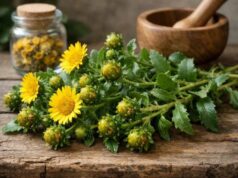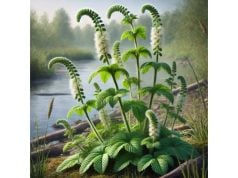
Greenthread, commonly called cota or one form of Navajo tea, is a slender Southwestern herb with thread-like leaves, yellow flowers, and a long history as a brewed household tea. Botanically, it is Thelesperma filifolium, though in everyday tradition its common names sometimes overlap with other Thelesperma species. That overlap matters, because greenthread is best understood as a traditional beverage herb first and a modern supplement second.
What makes it appealing is not a dramatic “superherb” identity, but a practical one. Greenthread has been used as a warming, mildly astringent tea for stomach upset, excess mucus, feverish feelings, mouth discomfort, and general daily drinking. It also has a place in Southwestern textile and dye traditions. The chemistry appears to center on flavonoids, tannin-like astringent compounds, and other polyphenols, but the species-specific research base remains small.
That means the smartest approach is a balanced one. Greenthread is culturally important, pleasant to drink, and pharmacologically interesting, yet it is not well studied in human trials. Its best use is as a respectful, tea-based herb with modest goals, clear limits, and attention to sourcing and safety.
Core Points
- Greenthread is a traditional caffeine-free tea herb most often used for mild digestive discomfort, throat or mucus complaints, and general everyday drinking.
- Its best-described active compounds are flavonoids and other polyphenols, while tannin-rich astringency likely helps explain some of its traditional uses.
- A practical traditional guide is about 12 dried stalks for 10 cups, or roughly 1 dried stalk per cup, boiled or steeped for about 5 minutes.
- Wild-harvested greenthread should not be collected near roadsides or mining-impacted land because contamination has been documented in related Navajo tea harvests.
- Pregnant or breastfeeding people, and anyone with strong Asteraceae allergies, should avoid medicinal use unless a clinician who understands herbs says otherwise.
Table of Contents
- What Is Greenthread
- Key Ingredients and Medicinal Properties
- Does Greenthread Help with Digestion and Colds
- How to Use Greenthread Tea
- How Much Greenthread per Day
- Safety, Interactions, and Who Should Avoid It
- What the Evidence Actually Says
What Is Greenthread
Greenthread is a North American herb in the sunflower family, Asteraceae. The species in focus here, Thelesperma filifolium, is known for its fine, thread-like leaves, yellow flower heads, and long use as a brewed tea in the Southwest. It is often called cota, Indian tea, Pueblo tea, Hopi tea, or Navajo tea, although those common names are not always botanically precise. In real-world use, several Thelesperma species have historically been gathered, brewed, and discussed together. That is one of the most important things to understand before looking at its benefits.
In other words, greenthread is both specific and broad. Specific, because Thelesperma filifolium is a real species with a distinct botanical identity. Broad, because community knowledge, regional naming, and commercial tea traditions often refer to a group of closely related greenthreads rather than a single laboratory-standardized herb. That helps explain why the cultural record is much richer than the modern clinical record.
Traditionally, the plant has been valued more as a dependable household tea than as a strong dose-driven medicine. The stems, leaves, and flowers are dried and brewed into a reddish-brown or amber drink with a mild, slightly sweet, resinous, almost pine-like flavor. It has been used for daily drinking, for mild digestive trouble, for colds and mucus, and as a simple home remedy when more formal medicines were unavailable. In some communities, it also served as a dye plant, giving warm yellow to orange-brown tones to textiles and basketry.
That tea-first identity makes greenthread different from many herbs that are now sold mainly as capsules or extracts. It is much closer in spirit to caffeinated green tea as a daily brewed beverage, except greenthread is traditionally caffeine-free and generally used in a gentler, more folk-medicinal way.
A practical botanical snapshot looks like this:
- Family: Asteraceae
- Common beverage names: cota, greenthread, Indian tea, Navajo tea, Pueblo tea, Hopi tea
- Main part used: aboveground parts, especially stems, leaves, and flowers
- Main form used: tea or decoction
- Traditional non-tea use: natural dye
This is also a herb where culture matters. Greenthread is not just a list of compounds. It is part of Southwestern and Indigenous plant knowledge, including Diné, Ndé, Pueblo, and other regional traditions. A careful article should therefore do two things at once: acknowledge the plant’s cultural role and stay honest about what modern research has and has not confirmed. That balance is especially important because online articles often flatten greenthread into either folklore or hype, when it is really something more grounded than either.
Key Ingredients and Medicinal Properties
Greenthread’s chemistry is interesting, but it is not described as thoroughly as the chemistry of globally popular herbs. That means a careful writer has to distinguish between what is known for Thelesperma filifolium itself, what is known for cota-type greenthread teas more generally, and what comes from related Thelesperma species. When that distinction is kept clear, the plant still shows a credible medicinal profile.
The best-supported chemical theme is polyphenols. Work on related Thelesperma species has identified flavonoids such as luteolin, luteolin-7-O-glucoside, and marein. Later phytochemical work in another Thelesperma tea species also identified phenylpropanoids, flavonoids, phytosterols, and other antioxidant-active molecules. That does not prove Thelesperma filifolium has an identical profile, but it strongly suggests that greenthread teas are part of a flavonoid-rich, phenolic plant tradition rather than a chemically empty folk beverage.
There is also species-specific evidence for astringency. Regional material on Thelesperma filifolium points to tannins and describes the tea as having a drying or astringent effect. That single detail is more important than it might seem. Astringency helps explain why the tea has traditionally been used for excess mucus, loose digestion, mouth discomfort, and certain “damp” symptoms in folk practice. A plant does not need to be dramatic to be useful; sometimes a drying, toning action is exactly why a tea stays in household use for generations.
From a practical standpoint, greenthread’s medicinal properties are best described as:
- Mildly astringent
- Antioxidant-rich, based on flavonoid and polyphenol chemistry
- Traditionally digestive-supportive
- Traditionally diuretic in some Southwestern herb literature
- Mildly cleansing or drying in mouth and throat use
It is also reasonable to think of greenthread as a “whole tea herb” rather than a single-compound herb. The visible tea, the aroma, the astringent feel, and the traditional uses all suggest that its effects come from a combination of tannins, flavonoids, and other small plant compounds working together. This is similar to how people experience many classic infusions: the activity is broader and gentler than a pharmaceutical extract, but still noticeable.
Nutritionally, the tea itself appears to contribute only small amounts of minerals such as potassium, calcium, and magnesium. That means greenthread is not best understood as a nutrient supplement. Its value is more functional than nutritive. You drink it for comfort, habit, and mild plant activity, not because it is a dense source of vitamins.
One useful comparison is with peppermint as a classic functional tea herb. Peppermint is defined by menthol and a cooling, aromatic effect. Greenthread seems to be defined more by flavonoids, tannins, and a drying, slightly sweet, gently resinous quality. Different chemistry, different feel, but a similar everyday-herb logic.
The main limitation is standardization. There is no widely used modern monograph that tells consumers exactly how much luteolin or total polyphenol their greenthread tea contains. That is why medicinal properties should be described with humility. Greenthread is clearly more than a pleasant drink, but it is not yet a fully mapped clinical phytomedicine.
Does Greenthread Help with Digestion and Colds
This is where traditional use is strongest and modern proof is weakest. Greenthread has a long record of use for stomachache, digestive discomfort, feverish feelings, mouth pain, worms, kidney complaints, and symptoms linked to excess mucus. But most of that knowledge comes from ethnobotanical and historical records, not large clinical trials. So the fairest answer is yes, it may help in modest ways, especially as a tea for everyday self-care, but the evidence remains mostly traditional rather than clinical.
Digestive use is probably the most believable modern fit. Greenthread tea has been described for stomachaches and other digestive ailments in both official regional sources and herbal safety summaries. That makes sense because mildly bitter, mildly astringent, polyphenol-rich teas often work best for the exact kinds of symptoms people describe vaguely: heaviness after meals, unsettled stomach, minor cramping, or that “off” feeling that is uncomfortable but not dangerous. It is the kind of herb people reach for before the problem becomes medical, not after.
Colds and mucus are the other classic use. The astringent action described for Thelesperma filifolium helps explain why the tea has traditionally been used to reduce mucus secretions. This is not the same as saying greenthread treats viral infections. Astringent plants may make the mouth, throat, or upper-airway secretions feel less excessive without acting like antiviral drugs. That is a very different claim, and it is the more honest one.
Other traditional benefits appear repeatedly in regional accounts:
- Mild relief of stomachache
- Support during colds with excess mucus
- Temporary easing of mouth or tooth discomfort
- Fever support in folk practice
- Mild urinary or diuretic use
- Gentle daily drinking when a caffeine-free tea is wanted
What should a modern reader realistically expect? Usually something subtle. A cup or two may feel settling, drying, and lightly warming. The best outcome is often not “symptom gone,” but “I feel more comfortable.” That is a very normal level of benefit for a traditional beverage herb. It may also be why greenthread remained popular: it is pleasant enough to drink and useful enough to remember.
One helpful contrast is with chamomile as a more globally studied soothing tea. Chamomile has a broader clinical footprint for digestion and calm. Greenthread has a deeper Southwestern cultural footprint but a thinner clinical one. That does not make it ineffective. It just means the confidence level should be different.
Where caution is needed is in repeating the boldest historical claims too literally. References to gonorrhea, parasites, kidney problems, and “blood purification” belong to the historical record, but they should not be translated into modern treatment advice. At most, they tell us the herb was respected and used broadly. They do not prove it is an evidence-based treatment for those conditions today.
A fair summary is this: greenthread is most plausible as a gentle digestive and upper-respiratory comfort tea, not as a stand-alone therapy for serious illness. That may sound modest, but for a traditional daily herb, modest and reliable is often the real point.
How to Use Greenthread Tea
Greenthread is primarily a tea herb. That is the form that best matches both its cultural history and its current practical value. While some herbs now live mostly as capsules, tinctures, or standardized extracts, greenthread still makes the most sense as a brewed plant. The stems, leaves, and flowers are the important parts, and traditional accounts describe steeping or lightly boiling nearly the whole aboveground plant.
The simplest use is as a daily beverage. Dried greenthread can be brewed on its own, served hot or cold, and sweetened lightly if desired. Its flavor is usually described as mild, slightly sweet, and gently piney or resinous. Some people enjoy it plain, while others combine it with a small amount of honey or lemon. It can also be used as a caffeine-free alternative to commercial tea, which is one reason it held value in households where imported tea or coffee was not always available.
A second use is as a short-term comfort tea. That is when greenthread is most likely to be taken for stomach upset, feelings of excess mucus, mouth discomfort, or general under-the-weather fatigue. In this context, the tea is not trying to be a strong drug. It is trying to be warm, drying, and useful.
Traditional and practical ways to use it include:
- A hot daily infusion as a household tea
- A slightly stronger tea during digestive upset
- A cooled tea as a simple mouth rinse
- A decoction used externally for minor skin irritation in traditional practice
- A plant source for yellow to orange-brown dye
Preparation can be done two main ways. An infusion means pouring hot water over the dried plant and steeping it covered. A light decoction means simmering or boiling it briefly. Herbal safety summaries specifically describe boiling the plant in water for about five minutes. That is a good reminder that greenthread has often been treated more like a rustic tea herb than a delicate flower infusion.
A practical use routine looks like this:
- Start with a small amount of dried herb.
- Steep or simmer for about five minutes.
- Taste before making it stronger.
- Drink it plain the first few times so you can learn its character.
- Use short term for a specific purpose or casually as a mild daily beverage.
This is also a herb where form matters less than source. Because many people wild-harvest greenthread, where it grows can matter as much as how it is brewed. A beautiful roadside stand is not automatically a good tea source. For a plant used as a simple infusion, clean sourcing is part of preparation.
People who enjoy tea rituals may find greenthread fits naturally beside other gentle brews such as Greek mountain tea for daily herbal sipping. The difference is cultural and sensory: greenthread belongs to the Southwestern desert and plains landscape, and it tastes like it.
The main mistake to avoid is treating greenthread like a concentrated modern extract. It is not an herb that needs escalating doses, stacking, or aggressive protocols to be meaningful. It works best when its form stays simple and its purpose stays modest. That is not a weakness. It is part of the herb’s design.
How Much Greenthread per Day
There is no clinically established daily dose for greenthread. That is the first point to make clearly. No modern monograph sets a standard adult oral dose, and available herbal safety summaries explicitly note that there are no known clinical trials to confirm effectiveness. So dosage has to be approached as traditional preparation guidance, not as a pharmaceutical-style recommendation.
The most concrete guide in the available literature comes from traditional tea making rather than laboratory dosing. In one museum-based regional guide, a Zuni tradition bearer describes a bundle of about 12 stalks making roughly 10 cups of tea. That is not a universal rule, but it is a valuable real-world reference because it comes from actual use rather than guesswork. It suggests a mild tea, not an intensely concentrated decoction.
A practical home range based on the available record looks like this:
- Mild daily tea: about 1 dried stalk per cup
- Traditional bundle guide: about 12 dried stalks for 10 cups
- Brewing time: about 5 minutes when simmered or boiled
- Frequency: 1 to 3 cups in a day for short-term use is more sensible than all-day repeated brewing
This should be read as a conservative tea range, not a medical prescription. Greenthread is not an herb where more is clearly better. In fact, making it extremely strong could work against the plant’s traditional logic. Its astringency and drying character are part of what make it useful, but they could also make a very concentrated brew less pleasant on the stomach or mouth.
A good way to dose greenthread is to think in terms of strength, timing, and purpose:
- For casual drinking, brew it light and enjoy the flavor
- For stomach upset, use a somewhat fuller cup and sip slowly
- For throat or mouth use, let the tea cool slightly and use part of it as a rinse
- For repeated use, keep the tea moderate rather than intense
Because the chemistry is not standardized, “one spoonful” is less dependable than plant-based measures such as stalks, visible herb volume, and taste response. If the tea tastes harshly drying or unpleasantly bitter, that is a sign to back down rather than press forward.
Another point worth making is duration. Greenthread makes more sense as a short-term or lifestyle tea than as a long-term, high-volume medicinal regimen. A few days to a couple of weeks of use for a defined reason is easier to justify than months of heavy use, especially when formal safety and clinical dosing data are limited.
If you want a rule of thumb, use this one: brew it gently, keep the first trials small, and let the tea’s taste guide you. That approach fits both the cultural record and the weak state of modern dosing research. Overcomplicating greenthread is usually less helpful than respecting it as a modest, traditional infusion.
Safety, Interactions, and Who Should Avoid It
Greenthread appears relatively gentle when used as a moderate tea, but “gentle” is not the same as “fully studied.” The safety record is shaped by three realities: the lack of formal clinical trials, the use of overlapping common names across more than one Thelesperma species, and the fact that wild-harvested tea herbs can reflect the quality of the land they came from.
The clearest practical safety issue is sourcing. A study on Navajo tea made from Thelesperma megapotamicum found metal and metalloid contamination concerns in plants gathered from mining-impacted regions and from areas near high traffic. In that research, cadmium exceeded World Health Organization raw medicinal plant guideline levels in some samples, and plants collected from higher-traffic areas contained significantly more contamination. Even though that paper is on a related Thelesperma tea species rather than only T. filifolium, it offers one of the most important real-world lessons for greenthread use: do not assume a wild medicinal plant is clean simply because it is wild.
The next major caution is incomplete life-stage safety data. Herbal safety sources state that safety during pregnancy and lactation has not been established. That alone is a good reason to avoid medicinal use in pregnancy or breastfeeding, even if small culinary or occasional social tea use has historical precedent in some communities.
Potential problems or cautions include:
- Overharvesting or misidentification when gathering wild plants
- Contamination from roadsides, dust, mining areas, or disturbed soil
- Possible irritation or intolerance if the tea is brewed very strong
- Allergy risk in people sensitive to Asteraceae-family plants
- Unclear effects in pregnancy, breastfeeding, and medically complex patients
Interactions are not well studied. There are no good modern clinical interaction maps for greenthread. That means caution is more sensible than certainty. If a tea is traditionally used as a diuretic or for kidney-related complaints, it is prudent for people taking diuretics, managing kidney disease, or being monitored for fluid balance to avoid self-prescribing it in strong daily amounts. That is not because a dangerous interaction is proven. It is because the evidence is too thin to act casually.
Who should avoid greenthread medicinally unless a clinician approves it?
- Pregnant or breastfeeding people
- People with strong ragweed or Asteraceae allergies
- People wild-harvesting from uncertain land
- People with significant kidney disease or on fluid-balance medicines
- Anyone using it instead of proper care for infection, persistent fever, or urinary symptoms
There is also a cultural safety point that often gets missed. Because greenthread is part of living Indigenous and regional traditions, sourcing should be respectful and sustainable. Taking whole plants from limited stands, harvesting from polluted ground, or treating the herb like a novelty product strips away the very context that preserved it.
The best safety message is simple: a moderate, cleanly sourced tea is one thing; careless wild harvesting and assumption-driven medicinal use are another. With greenthread, good judgment begins before the kettle is even on.
What the Evidence Actually Says
The evidence on greenthread is best described as tradition-rich, chemistry-light, and clinically thin. That is not a criticism of the plant. It is simply the current research reality. If someone asks whether greenthread is a respected traditional herb, the answer is clearly yes. If they ask whether it has promising polyphenol and flavonoid chemistry, the answer is also yes. If they ask whether it has been tested in robust human trials for digestion, colds, kidney complaints, or mouth pain, the answer is no, not in any meaningful modern way.
That uneven evidence base matters because niche herbs are easy to misread. One mistake is dismissing them because they do not have large trials. The other is overpromoting them because they have a beautiful history. Greenthread deserves neither extreme. It deserves a fair, well-bounded interpretation.
What the current evidence supports reasonably well:
- Thelesperma filifolium has a clear traditional identity as a brewed tea herb in New Mexico and the Southwest
- Greenthread or cota-type teas have been used for digestive discomfort, mucus-heavy colds, feverish states, and mouth discomfort
- Thelesperma species contain flavonoids and other polyphenols that can plausibly support antioxidant and mild medicinal activity
- Related greenthread teas can reflect environmental contamination, which makes sourcing a real safety issue
What the evidence does not currently support with confidence:
- Clinically proven treatment of infection
- Proven treatment of kidney disease
- Reliable drug-like effects on worms, sexually transmitted infections, or serious fever
- Standardized dosing across products and species
- Well-defined interaction data
One of the most useful insights here is that greenthread is probably strongest as a “small-help” herb. It is the kind of tea that may make a mild problem feel easier to live with, or a daily routine feel more grounded. That kind of value is easy to overlook in modern herbal marketing, which often rewards big claims. But many traditional herbs earned their place precisely because they were modest, repeatable, and available.
In terms of evidence quality, greenthread does not compete with better-studied beverage herbs such as green tea and other globally researched infusions. Where it stands out is in cultural continuity, regional identity, and a believable fit between traditional use and the chemistry that has been described in related Thelesperma work.
So the clearest final judgment is this: greenthread is worth respect, cautious use, and further research. It is not a miracle plant, but it is not empty folklore either. It sits in that middle ground where many honest herbs live—promising, practical, culturally rooted, and still waiting for modern science to catch up to the depth of its traditional story.
References
- Nature Trail Audio Stop 14 2026 (Official Site)
- A PLACE AT MOTHER Earth’s Table edible Wild plants of the Rio Grande Region 2009 (Museum Guide)
- Cota Current page (Herbal Safety Summary)
- Occurrence and Risk of Metal(loid)s in Thelesperma megapotamicum Tea Plant 2019 (Safety Study)
- Flavonoids of Thelesperma megapotanicum 1982 (Phytochemistry)
Disclaimer
This article is for educational purposes only and is not medical advice. Greenthread is a traditional herbal tea, not a proven treatment for infection, kidney disease, parasites, sexually transmitted infections, or any other serious medical condition. Because modern clinical research is limited and wild-harvested plants may be contaminated, medicinal use should be cautious and purpose-specific. Speak with a qualified healthcare professional before using greenthread if you are pregnant, breastfeeding, have kidney problems, take prescription medicines, or plan to use the herb regularly for symptoms that are persistent, worsening, or unexplained.
Please share this article on Facebook, X, or any platform where thoughtful herbal education is welcome.