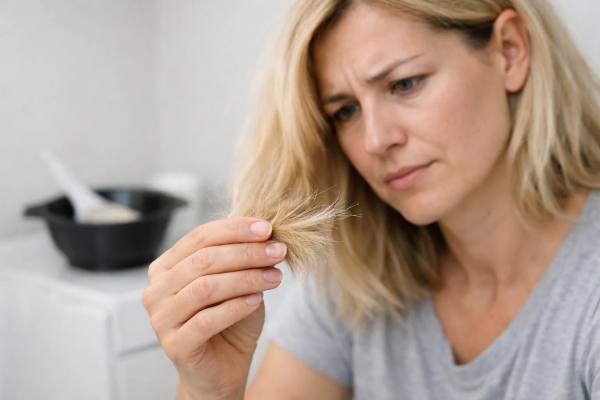
Bleach can create striking color changes, but it does so by pushing hair through one of the harshest cosmetic processes available. To lift pigment, bleach opens the cuticle, uses an alkaline environment to swell the fiber, and relies on oxidation to break down melanin. That same process can weaken proteins, strip protective lipids, raise porosity, and leave the shaft rougher, drier, and easier to snap.
That is why bleach damage rarely shows up as just one problem. It may look like frizz, feel like stiffness, behave like tangling, and sound like “my hair is shedding,” when much of the loss is actually breakage. The good news is that damaged hair can often be made more manageable, stronger-feeling, and less fragile with the right routine. The harder truth is that not all damage is reversible. Once parts of the cuticle are lost, recovery is often about reducing further harm, improving flexibility, and trimming what cannot be saved.
The most useful approach is practical rather than dramatic: learn the warning signs early, stop the habits that keep the damage going, and build a routine that supports the hair fiber you still have.
Quick Overview
- Bleach damage often shows up as dryness, roughness, tangling, dullness, and breakage before it shows up as obvious hair loss.
- A good recovery plan can improve softness, strength, and manageability, but it cannot fully restore severely overprocessed hair to virgin condition.
- Ongoing bleaching, high heat, and rough wet handling can undo progress faster than most repair products can help.
- Bond-supporting products, conditioning layers, and strategic trims can reduce breakage and make damaged hair easier to live with.
- Pause further bleaching for at least several weeks, and do not re-lighten until wet hair no longer feels gummy, overly stretchy, or fragile.
Table of Contents
- What bleach changes inside hair
- Signs bleach damage is getting worse
- The first recovery steps
- A repair routine that helps
- What to avoid while recovering
- When to get professional help
What bleach changes inside hair
To understand bleach damage, it helps to think of hair as a layered fiber rather than a simple strand. The outer cuticle acts like overlapping scales that protect the inner cortex. The cortex provides much of the hair’s strength, elasticity, and body. During bleaching, alkaline ingredients help swell the hair shaft so oxidizing agents can enter and break down pigment. That lift is the point of bleaching, but it comes with structural tradeoffs.
As the process repeats, the cuticle becomes rougher and more porous. Protective surface lipids are reduced, friction goes up, and the hair loses some of its ability to hold moisture in a balanced way. The result is a paradox many people recognize immediately: hair that feels dry but also takes on water too fast, then becomes weak and vulnerable while wet. That is why heavily bleached hair can feel crisp when dry and strangely stretchy in the shower.
Protein damage matters too. Bleaching can disrupt disulfide bonds and other structural interactions within keratin, which lowers tensile strength. In plain language, the fiber can no longer tolerate daily stress as well as it used to. Combing, towel friction, heat styling, ponytails, and even sleeping can create breakage that healthier hair would have handled without complaint.
Damage also tends to be uneven. Mid-lengths and ends are older fibers that have already accumulated weathering from washing, brushing, UV exposure, and heat. If bleach is layered repeatedly over previously lightened sections, those weaker areas pay the highest price. That is why the ends often start to look translucent, frayed, or thinner long before the roots do.
The most important practical point is this: bleached hair is often not “dead” in a dramatic sense, but it is mechanically compromised. A good routine can improve how it behaves by reducing friction, increasing flexibility, smoothing the surface, and reinforcing weak areas. What it cannot do is fully rebuild a severely eroded cuticle or make overprocessed lengths biologically new again. That distinction helps people spend more wisely and panic less.
This is also where the language of repair can get confusing. Some products truly improve the feel and performance of damaged hair, while others mostly coat the surface. Both can still be useful. In fact, surface protection is often exactly what damaged hair needs. A broader look at bond repair for damaged hair helps explain why the best routines usually combine internal support claims with very practical surface conditioning.
Signs bleach damage is getting worse
Bleach damage rarely arrives all at once. More often, it appears as a sequence of warnings that people mistake for “just dryness” until the hair becomes difficult to manage. One of the earliest signs is texture change. Hair feels rougher, catches on itself more easily, and no longer moves with the same smoothness. Brushing takes longer. Ends knot together. Shine drops off even right after styling.
The next sign is porosity behaving badly. Damaged hair may soak up water quickly, dry strangely fast in some areas and very slowly in others, or refuse to hold toner and color evenly. It can also become frizzier because a lifted, uneven cuticle does not reflect light or retain surface smoothness as well. Many people describe this as hair that suddenly looks dull, swollen, or “blown open.”
Breakage is the most important sign to catch early. You may see short snapped pieces on clothing, the sink, your desk, or your pillow. The broken strands are often shorter than your full hair length and may have tapered or frayed ends rather than the tiny white bulb seen with true shed hairs. If you are trying to sort that out, the distinction between breakage and hair loss becomes essential, because bleach usually causes shaft fracture far more often than root-level shedding.
Wet behavior is another clue. Healthy hair stretches a little and springs back. Overprocessed hair often becomes gummy, mushy, or overly elastic when soaked. If a wet strand stretches too far, feels weak, and snaps with almost no force, the internal structure has likely been compromised. That is a strong warning against further bleaching.
Common signs that damage is progressing include:
- hair that feels straw-like or rough even after conditioning
- tangles forming quickly at the nape and ends
- ends looking thin, split, or see-through
- dull color that fades or tones unevenly
- snap-off during detangling or blow-drying
- a gummy, overly stretchy feel when wet
There can also be scalp clues. Stinging during processing, lingering tenderness, flaking, redness, or small sores suggest the issue is not limited to the shaft. That moves the problem from cosmetic damage into possible scalp injury.
A useful reality check is this: if your styling routine has become gentler but your hair is still breaking more each week, the damage is not stable. It is progressing. That is the point to stop troubleshooting around the edges and shift into recovery mode. The earlier you respond, the more usable length you usually preserve.
The first recovery steps
The first step after obvious bleach damage is not buying five repair products. It is stopping the cycle that caused the damage. That usually means pausing further bleach, high-lift color, harsh toning, and unnecessary heat while you reassess what the hair can still tolerate. If the hair feels gummy when wet, snaps easily, or looks dramatically thinner from mid-length to ends, adding more chemical stress is usually the fastest route to a haircut you did not plan on.
Next, reduce mechanical stress. Hair is most fragile when wet, and bleached hair is especially vulnerable. Use a wide-tooth comb or flexible detangling brush, start at the ends, and work upward in sections. Do not scrub aggressively with a towel. Press water out gently and use a soft towel or cotton T-shirt instead of rough rubbing. Even small changes here can reduce daily breakage more than a new mask can.
Then stabilize the scalp and the shaft separately. If you had burning, persistent redness, blistering, or unusual tenderness during or after the bleach session, you may be dealing with more than cosmetic damage. A true chemical injury needs more caution than a dry hair routine can provide. That is where chemical burn warning signs are more relevant than another bond treatment. Hair fiber damage and scalp injury can occur together, but they are not the same problem.
Once the immediate damage phase has passed, simplify the routine:
- Use a gentle shampoo rather than a strong clarifier.
- Follow with a rich rinse-out conditioner every wash.
- Add one targeted treatment category at a time, such as a bond-supporting treatment or protein-containing mask.
- Finish with a leave-in that reduces friction and improves slip.
- Reassess after two to three washes instead of changing products daily.
A trim is often part of the real recovery plan, even if it is not the most exciting advice. Severely split, frayed, or thinned ends keep catching, tangling, and splitting upward. Removing the worst area can make the remaining hair far more manageable and help treatments seem more effective because they are not fighting irreparable ends.
This is also the moment to reset expectations. The short-term goal is not “undo all bleach damage.” It is to restore enough softness, lubrication, and strength that the hair stops worsening under normal handling. Once breakage slows and the fiber behaves more predictably, you can think about longer-term maintenance. In the early phase, restraint is a treatment. Damaged hair improves fastest when it is no longer being asked to survive the same insults that injured it in the first place.
A repair routine that helps
A useful bleach-recovery routine usually does four jobs at once: clean without stripping, add internal and surface support, reduce friction, and protect the hair from the next round of damage. The exact products vary, but the logic stays the same.
Start with cleansing. A gentle shampoo is usually better than a squeaky-clean one, especially if the hair feels rough or tangles when wet. Overwashing with aggressive cleansers can worsen dryness and friction. Many people do well washing less often for a while, as long as scalp comfort remains good. The goal is a clean scalp and manageable lengths, not that stripped feeling some people mistake for freshness.
Conditioning is the anchor. A rinse-out conditioner helps flatten rougher cuticle edges, improve slip, and make the hair easier to detangle. For hair that has been heavily bleached, a leave-in product can matter almost as much as the wash-out conditioner because it keeps lubricating the fiber through brushing, drying, and daily movement. This is one reason protective silicones in hair care deserve more credit than they often get. On damaged hair, surface smoothing is not cosmetic fluff. It is mechanical protection.
Targeted treatments fit into three broad categories:
- bond-supporting products that aim to reinforce weakened structural interactions
- protein or amino-acid-based treatments that can improve feel and strength for some users
- moisture-focused masks and humectant-rich formulas that improve flexibility and softness
The trick is balance. Hair that is both overprocessed and repeatedly treated can become stiff if the routine leans too hard into protein-heavy products without enough conditioning slip. On the other hand, hair that gets only rich masks may feel softer for a day but still break because it lacks structural support. Many people do best alternating treatment types instead of layering every category in one wash.
A practical weekly pattern might look like this:
- one to two gentle wash days
- conditioner every wash
- one targeted treatment in place of regular conditioner once weekly
- leave-in after every wash
- heat protectant whenever heat is used
Recovery also benefits from lower-friction habits. Silk or satin sleep surfaces, loose nighttime protection, and less aggressive brushing help preserve progress. The best routine is not the most complicated one. It is the one that makes the fiber easier to handle week after week.
There is one hard limit worth remembering: products can improve performance, but they cannot permanently replace lost cuticle layers. A good routine gives damaged hair a better chance to survive normal life with less snapping. That is a real win, even if it is not the same thing as full reversal.
What to avoid while recovering
Most bleach recovery stalls for one reason: the person adds helpful products but does not remove the habits that keep injuring the fiber. The first thing to avoid is repeat bleaching before the hair has stabilized. If hair still feels weak when wet, catches easily, or shows active breakage, another lift session is usually a bad gamble. The hair may survive cosmetically in the salon chair and then start snapping over the next week.
High heat is the second major obstacle. Damaged hair already has reduced tolerance for stress, so hot tools can push a compromised shaft past its limit. That does not mean you must avoid all heat forever, but it does mean using less of it, using it less often, and never skipping a protectant. For many people, reviewing air-drying versus blow-drying damage changes the way they use dryers, because the issue is not simply heat versus no heat. It is temperature, distance, technique, and how fragile the hair is to begin with.
A few other common mistakes are worth calling out:
- rough towel drying
- detangling from the roots downward
- tight ponytails on weak mid-lengths
- frequent clarifying shampoos
- layering multiple acidic or highly fragranced treatments at once
- chasing instant softness with heavy oils while skipping real conditioning support
DIY fixes can also backfire. Vinegar rinses, baking soda, repeated protein cocktails, and social-media “rescue hacks” often sound decisive but can make damaged hair more unpredictable. A pH-shifting rinse may temporarily change the feel of the cuticle, but it will not rebuild severely overprocessed fibers. Likewise, using very frequent protein treatments because the hair feels weak can leave it stiff, rough, or harder to detangle if the rest of the routine is not balanced.
Another major mistake is treating all breakage as if it were dryness. Dryness matters, but bleach damage is also a structural problem. Hair can feel soft from oils and still snap because the underlying fiber is too compromised. That is why the best routines combine lubrication, conditioning, and bond or strength support instead of relying on shine alone.
Finally, avoid the trap of perfection. Damaged hair often improves in stages, not in a straight line. One good wash does not mean it is ready for another bleaching session. One bad wash does not mean nothing is working. The more useful question is whether the overall trend is better: fewer snapped hairs, less tangling, more predictable texture, and ends that look less ragged over time.
Recovery usually fails from impatience more than from a lack of products. Avoiding the next insult is often more powerful than adding the next treatment.
When to get professional help
Some bleach damage is manageable at home. Some is not. The line between the two becomes clearer when you stop asking “does it feel dry?” and start asking “is the fiber or scalp functioning normally?” If the answer is no, professional input can prevent a cosmetic problem from becoming a medical or major length-loss problem.
Scalp symptoms are the clearest reason to seek help. Persistent burning, marked redness, swelling, blistering, crusting, or pain after bleaching is not just routine sensitivity. That pattern can suggest irritation, a chemical burn, or an inflammatory reaction that deserves proper evaluation. Scalp discomfort that lasts beyond the immediate wash day should not be brushed off.
Hair behavior can also signal that at-home recovery is no longer enough. Get help if:
- breakage is so severe that whole sections look thinned out within days
- hair feels gummy and stretches excessively every time it gets wet
- ends are snapping off faster than trimming can control
- the scalp is visible because of shaft breakage, not just styling separation
- the hair and scalp were both exposed to overlapping chemical services
A stylist with strong corrective experience may be the right first stop when the main issue is uneven lightening, weakened lengths, or the need for a strategic cut and lower-risk color plan. A dermatologist is the better fit when the scalp is inflamed, there is true shedding from the root, or you are unsure whether you are dealing with breakage alone. Readers who are seeing both fragility and unexpected shedding often need a dermatologist’s threshold for hair concerns, because not every post-bleach complaint is purely cosmetic.
Professional help is also valuable when you want to bleach again eventually. A good colorist can map which areas are safe to lighten, which need to be left alone, and whether a lower-volume, partial, or slower lightening plan is wiser. That planning matters because many serious bleach problems happen when already-lightened hair is processed again as if it were untouched.
The deeper truth is that recovery is partly about accepting a new strategy. Some hair can return to a manageable, healthy-looking state with careful treatment and trims. Some needs a significant cut and a reset. That is not failure. It is often the quickest path back to hair that looks good, feels better, and stops breaking every time you touch it. The best professional guidance does not promise miracles. It helps you protect what is still salvageable and make smarter choices from that point forward.
References
- Mechanisms of impairment in hair and scalp induced by hair dyeing and perming and potential interventions 2023 (Review)
- On Hair Care Physicochemistry: From Structure and Degradation to Novel Biobased Conditioning Agents 2023 (Review)
- Effects of excessive bleaching on hair: comparative analysis of external morphology and internal microstructure 2024 (Study)
- Improving the Mechanical Properties of Damaged Hair Using Low-Molecular Weight Hyaluronate 2022 (Study)
- Hair Cosmetics: An Overview 2015 (Review)
Disclaimer
This article is for educational purposes only and does not diagnose or treat scalp disease, chemical burns, or hair loss disorders. Bleach damage can overlap with scalp irritation, allergic reactions, and true hair shedding, and those problems may need a professional evaluation rather than a home repair routine. Seek prompt medical care if bleaching is followed by significant pain, blistering, scalp swelling, widespread shedding, or signs of infection.
If this article was useful, please share it on Facebook, X, or another platform you use so others can find it too.