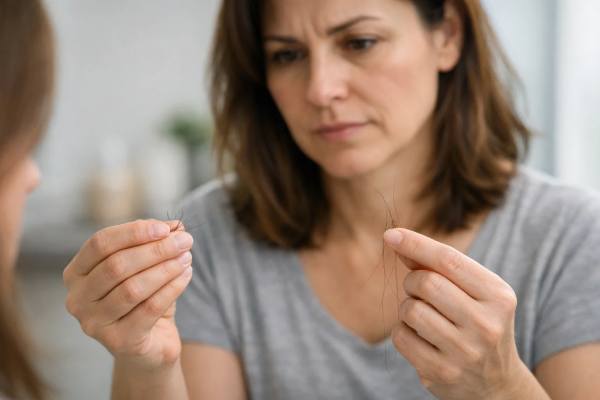
When more hair shows up on your brush, pillowcase, or shower floor, the first question is often the hardest one: is your hair breaking, or are you actually losing it from the scalp? The distinction matters because the causes, timeline, and best next steps can be very different. Breakage usually points to damage along the hair shaft from heat, friction, chemicals, or weak fiber structure. Hair loss usually points deeper, involving the follicle, the growth cycle, hormones, inflammation, stress, nutrition, or medical conditions.
The tricky part is that both problems can make hair look thinner, rougher, and harder to style. They can also happen at the same time. Someone may have shedding from stress and breakage from bleach. Another person may think they have breakage when the real issue is early pattern thinning. Learning the visual clues can help you respond faster, protect what you have, and know when home care is enough and when a medical workup makes more sense.
Key Insights
- Breakage usually leaves short, uneven, frayed strands, while true hair loss often leaves full-length hairs with a bulb at the root.
- Hair breakage is more often linked to heat, chemical processing, friction, and weak shaft structure than to the follicle itself.
- Hair loss is more likely when you notice increased shedding from the root, widening parts, patchy bare areas, or a drop in overall density.
- Sudden patchy loss, scalp pain, redness, scaling, or shiny scar-like skin deserves prompt medical evaluation.
- A simple first check is to compare the hairs you are finding: snapped pieces suggest breakage, while full strands with root bulbs suggest shedding.
Table of Contents
- What Breakage and Hair Loss Actually Mean
- Visible Clues That Point to Breakage
- Signs That Suggest True Hair Loss
- Why Hair Breaks in the First Place
- Common Causes of Shedding and Thinning
- What to Do Next and When to Get Help
What Breakage and Hair Loss Actually Mean
Hair breakage and hair loss can look similar in the mirror, but they are not the same process. Breakage means the hair fiber snaps somewhere along its length after it has already emerged from the scalp. The follicle may still be healthy and growing, but the strand cannot stay intact long enough to keep its length. That is why breakage often shows up as rough ends, flyaways, a halo of short pieces, or hair that seems stuck at the same length for months.
Hair loss, by contrast, involves hairs leaving the scalp from the root or follicles producing progressively thinner hair over time. Sometimes this looks like active shedding. Sometimes it looks like slow thinning, a wider part, more visible scalp, temple recession, or patchy areas where density drops. In many cases, the strand itself is not damaged at all. The issue is the follicle, the growth cycle, or the scalp environment.
A useful way to think about it is this:
- Breakage is a fiber problem.
- Hair loss is a follicle problem.
- Thinning can be caused by either one, or by both together.
That overlap is what confuses many people. Repeated bleaching can cause obvious breakage, but it can also irritate the scalp enough to complicate things. A stressful illness can trigger shedding, and the shorter regrowing hairs may be mistaken for breakage. Tight styling can cause mid-shaft breakage in one area and traction-related follicle damage in another.
Texture also changes how the problem appears. Straight hair may show breakage as split ends and a wispy perimeter. Wavy, curly, and coily hair may show it as loss of definition, frizz, tangling, and snap points at bends in the strand. Hair loss, on the other hand, is often easier to notice in the scalp pattern: a broader part, reduced ponytail thickness, more scalp under bright light, or distinct bare patches.
The key point is that length problems and density problems are not always the same thing. Hair that feels thin may be breaking off. Hair that feels unchanged in texture may still be shedding more than usual. The goal is not to guess based on one sign, but to look at the whole pattern: the strands you find, the scalp you see, and the timeline of what changed.
Visible Clues That Point to Breakage
Breakage usually leaves a visual trail. The strongest clue is inconsistency. The strands you collect are not all the same length. Some are only a few inches long. Others are mid-length pieces. Many look blunt, frayed, feathered, or split at the ends. When breakage is the main issue, the hair often feels weaker before it looks thinner. It may snag on itself, tangle more easily, lose shine, or feel rough even after conditioning.
A close look often shows several classic patterns:
- Short hairs sticking out through the top layer
- A frizzy halo around the crown or ends
- Split, forked, or white-tipped ends
- Shorter pieces concentrated where you use elastics, clips, or heat tools
- A thinner-looking perimeter while the scalp itself still seems normally covered
Location matters. Breakage often clusters in high-stress zones. The front pieces may snap from frequent styling. The crown may show damage from repeated blow-drying or flat ironing. The nape can break from friction against collars, scarves, and rough fabrics. Hair near ponytail anchors may shorten first because that section gets stretched and rubbed day after day. Many people also notice more breakage on the side they sleep on.
Another clue is stalled length. If your roots keep growing but the overall length never seems to increase, the hair may be growing and breaking at roughly the same rate. This is common after bleach, relaxers, repeated high heat, rough detangling, or chronic dryness. It is also common in hair with structural fragility, where the strand is naturally more vulnerable.
You can also inspect the actual hairs you are finding. Broken hairs usually do not have the small club-shaped bulb seen at the root of a shed telogen hair. Instead, both ends may look snapped, tapered, or frayed. You may find more short bits on your shirt, sink, desk, or bathroom counter than full-length strands in the shower.
Breakage also tends to change the feel of the hair before it changes the scalp view. The scalp may still look evenly covered, but the mid-lengths and ends appear thin and see-through. If that sounds familiar, it is worth reviewing common signs of split ends, because they often travel with breakage and signal that the fiber is under ongoing stress.
The more uneven the strand lengths, the more likely breakage is part of the story. True hair loss can create short regrowth, but regrowth usually appears in a pattern that makes sense for recovery. Breakage looks more chaotic. It creates a scatter of weak, incomplete lengths rather than a clean wave of new hairs coming in from the scalp.
Signs That Suggest True Hair Loss
True hair loss is more likely when the problem starts at the scalp rather than along the strand. The most common clue is increased shedding of full-length hairs. These often have a tiny bulb at one end, which means the hair came out from the follicle rather than snapping in the middle. You may see more long hairs in the shower drain, on your brush, or on your clothing. A temporary shedding episode can still feel dramatic, even when the follicles are capable of regrowth.
The pattern of change is often more revealing than the number of hairs. Hair loss becomes more likely when you notice:
- A wider part than usual
- More visible scalp at the crown or temples
- A ponytail that feels smaller from root to ends, not just thinner at the bottom
- Patchy bare areas with relatively normal-looking skin
- Hair that is coming in finer over time, making density slowly fade
Patchy loss points to a different set of causes than diffuse thinning. Smooth round or oval patches can suggest alopecia areata. Recession at the temples or gradual thinning over the crown can fit pattern hair loss. Broad shedding across the whole scalp, especially a few months after illness, surgery, childbirth, major stress, or crash dieting, often fits telogen effluvium. In that situation, the hair cycle shifts and more hairs enter the resting phase, so shedding rises weeks to months after the trigger rather than immediately.
Hair loss also becomes more concerning when scalp symptoms join the picture. Pain, itching, burning, tenderness, marked redness, thick scaling, pustules, or shiny areas with less visible follicle openings may point to inflammation or scarring disorders. Those are not typical signs of simple cosmetic breakage. They suggest the follicle and scalp need direct medical assessment.
Another subtle sign is miniaturization. In pattern hair loss, follicles gradually produce thinner, shorter hairs over time. That can create a mix of thicker and finer strands in the same area, especially near the hairline or part. People often describe this as “my hair is still there, but it is not the same hair.” The issue is not a snapped shaft. It is a changed growth pattern.
If the shedding seems out of proportion, remember the timeline. Temporary shedding often lags behind the trigger. A fever in January may show up as shedding in March. That delay makes the connection easy to miss unless you know the hair growth cycle. Looking backward two to four months can be more useful than focusing only on what changed this week.
Hair loss is more likely when density drops from the scalp outward. Breakage is more likely when coverage seems decent but the lengths look ragged, weak, or uneven.
Why Hair Breaks in the First Place
Hair breaks when the shaft loses enough strength, flexibility, or surface protection that everyday handling becomes too much for it. Most breakage is cumulative. It is rarely caused by one brush stroke or one wash. More often, it develops after repeated stress that weakens the cuticle, exposes the inner cortex, and creates weak points where the strand starts to fray or snap.
Heat is a major cause. Blow-dryers, flat irons, curling wands, and hot brushes pull moisture out of the fiber and can change its internal structure when used too often or at high temperatures. Chemical processing is another common trigger. Bleach, highlights, perms, relaxers, straighteners, and frequent coloring can all weaken bonds inside the strand and roughen the cuticle. Once that protective outer layer is chipped away, friction does more damage.
Mechanical stress matters just as much. Hair can break from:
- Aggressive towel rubbing
- Rough detangling, especially when hair is swollen and wet
- Repeated backcombing
- Tight elastics placed in the same spot
- Extensions, heavy braids, or styles that keep pulling
- Sleep friction against rough cotton surfaces
- Habitual twisting, picking, or brushing
Moisture balance also plays a role. Very dry hair tends to be brittle and rigid, so it snaps more easily. But hair that is repeatedly soaked, manipulated, and left swollen for long periods can also weaken over time. This is one reason some people notice damage with daily overwetting, harsh cleansing, or long stretches in wet buns.
Texture and structure influence risk. Curly and coily strands bend more along the shaft, which creates natural stress points. Fine hair has less bulk to absorb damage. Gray hair may feel coarser but can still be fragile. Hair with prior chemical processing often breaks where new growth meets older treated hair because the shaft is not equally strong from root to tip.
The practical lesson is that breakage usually improves when you reduce repeated insult, not when you chase one miracle product. A useful routine often includes gentler cleansing, slip during detangling, fewer high-heat passes, less tension, and targeted protection before styling. If heat is part of your routine, understanding how heat protectant sprays work can help reduce damage, though they do not make extreme heat harmless.
Breakage is often the visible result of a stressed fiber, not a scalp disease. That makes it more responsive to habit changes than many forms of true hair loss. But it also means results are gradual. Once the shaft is split or cracked, that strand cannot biologically heal. The goal is to prevent further snapping, smooth what can be smoothed, and protect healthier new growth as it comes in.
Common Causes of Shedding and Thinning
Hair loss has a wider medical range than breakage because the follicle responds to hormones, inflammation, immune signals, medications, nutrition, and shifts in the hair cycle. The most common cause of sudden diffuse shedding is telogen effluvium. This happens when a larger-than-normal number of hairs move into the resting phase and shed later. Common triggers include high fever, major illness, surgery, childbirth, significant emotional stress, rapid weight loss, low protein intake, iron deficiency, thyroid problems, and certain medications.
Pattern hair loss is different. It tends to be gradual, not abrupt. In men it often affects the temples and crown. In women it more often shows as a wider part, reduced density over the top of the scalp, or a see-through ponytail with the frontal hairline partly preserved. The hairs become finer over time because the follicles miniaturize. People may not notice heavy shedding at all. They simply see less volume each year.
Patchy hair loss raises other possibilities. Alopecia areata can cause smooth bald patches that appear quickly. Traction alopecia may affect the hairline in people who wear tight styles often. Some inflammatory or scarring alopecias can cause patchy thinning with pain, redness, scaling, or tenderness and may permanently reduce regrowth if treatment is delayed.
Medications deserve special attention because the timing can be misleading. Hair may start shedding weeks to months after beginning, stopping, or changing a drug. Hormonal shifts matter too, especially postpartum, during perimenopause, or after stopping estrogen-containing birth control.
When trying to sort the causes, it helps to think in buckets:
- Cycle disruption: stress, illness, surgery, postpartum changes, crash dieting
- Hormonal influence: pattern hair loss, androgen excess, thyroid changes
- Nutritional issues: low iron, low protein, broader deficiency states
- Immune and inflammatory causes: alopecia areata, scalp inflammatory disorders
- Medication-related triggers: certain blood pressure drugs, retinoids, anticoagulants, and others
One important reality is that shedding does not always mean permanent loss. Many telogen effluvium episodes settle once the trigger is corrected, though visible recovery takes time because hair grows slowly. Pattern hair loss and scarring conditions follow a different path and usually need earlier, more targeted treatment.
This is why the timeline matters so much. Breakage often follows repeated external damage right away. Shedding often follows an internal trigger after a delay. Thinning that slowly expands over years is a different pattern again. Matching the speed, location, and type of change gives you a much better chance of identifying the real cause instead of treating every problem like damage.
What to Do Next and When to Get Help
If you are not sure whether you are dealing with breakage, hair loss, or both, start with a short, structured check rather than changing ten products at once. Two weeks of careful observation can reveal a lot.
First, examine the hairs you are finding. Are they mostly short snapped pieces, or full-length strands with a bulb at one end? Second, look at where the change is happening. Are your ends thinning while scalp coverage seems stable, or is density dropping near the part, crown, or hairline? Third, think back two to four months. Illness, surgery, childbirth, medication changes, strict dieting, and major stress often fit delayed shedding better than breakage.
Then simplify your routine for six to eight weeks:
- Reduce hot-tool use and lower the temperature when you do use heat.
- Avoid tight styles, especially if the hairline feels sore.
- Detangle with more slip and less force.
- Pause overlapping bleach or harsh chemical services.
- Trim visibly split ends so damage does not keep traveling upward.
- Protect hair overnight with low-friction habits, such as the methods often used in protective sleep hairstyles.
During this period, pay attention to scalp symptoms. That is where the decision about medical care often becomes clearer. Make an appointment sooner rather than later if you notice any of the following:
- Sudden patchy hair loss
- A widening part or fast drop in density
- Shedding that lasts beyond several months
- Redness, thick scale, pustules, burning, or scalp pain
- Recession or thinning tied to tight hairstyles
- Broken hairs plus severe itching or signs of inflammation
- Loss of eyebrows, eyelashes, or body hair
- Fatigue, weight change, menstrual changes, or other symptoms that suggest a broader medical issue
A dermatologist may use the history, scalp exam, trichoscopy, and sometimes lab work or biopsy to sort out the cause. That level of precision matters because the treatments are not interchangeable. Bonding treatments and trims can help damaged lengths, but they will not stop autoimmune patch loss. A hair growth medication may help a follicle problem, but it will not reverse repeated snapping from a flat iron set too high.
The most reassuring truth is that many people can identify the direction of the problem with a few concrete clues. Uneven, frayed, short pieces point toward breakage. Full-length shed hairs, scalp-driven thinning, patch formation, or delayed shedding after a trigger point toward true hair loss. Once you know which process is leading, your next step becomes much more logical, and usually much more effective.
References
- Approach to the patient with hair loss 2023 (Review)
- Hair Shaft Disorders in Children – An Update 2023 (Review)
- Androgenetic alopecia: An update 2023 (Review)
- A Three-Step Diagnostic Algorithm for Alopecia: Pattern Analysis in Trichoscopy 2025 (Review)
- Telogen Effluvium 2025 (Review)
Disclaimer
This article is for educational purposes only and does not replace medical advice, diagnosis, or treatment. Hair breakage and hair loss can overlap, and some causes of thinning involve hormonal, autoimmune, inflammatory, nutritional, or scarring conditions that require professional evaluation. Seek care from a qualified clinician or dermatologist if you have sudden shedding, patchy loss, scalp pain, redness, heavy scaling, or progressive thinning.
If this article helped you, please share it on Facebook, X, or your preferred platform so others can find it too.