Hair fibers are one of the fastest ways to make thinning hair look fuller without changing your haircut, starting a medication, or committing to a wig or topper. They work by clinging to existing strands and softening the contrast between hair and scalp, which is why they can make a widening part, sparse crown, or diffuse thinning look less noticeable in minutes. For many people, that visual change matters. A better-looking part line can make styling easier, improve confidence, and buy time while medical treatment, regrowth, or a new routine takes effect.
The key is using them with realistic expectations. Hair fibers are camouflage, not treatment. They do not regrow hair, and they cannot create convincing density on a smooth, bare scalp. But when they are matched well, layered lightly, and placed where your natural hair still gives them something to hold onto, they can look remarkably believable. The most natural results come from restraint, careful placement, and understanding where fibers shine and where another option will serve you better.
Essential Insights
- Hair fibers can make mild to moderate thinning look fuller right away when enough existing hair is present for the fibers to cling to.
- The most natural result comes from matching the root color, applying in thin layers, and focusing on the part line and crown rather than packing the scalp densely.
- Hair fibers do not treat hair loss and usually look unconvincing on shiny, completely bare areas.
- Apply them only to fully dry, styled hair, then lock them in with a light mist of setting spray from a distance.
Table of Contents
- What Hair Fibers Can and Cannot Do
- How Hair Fibers Create Natural Coverage
- How to Apply Hair Fibers Step by Step
- Mistakes That Make Fibers Look Obvious
- Hair Fibers Versus Other Cover Up Options
- Safety Scalp Care and When to Seek Help
What Hair Fibers Can and Cannot Do
Hair fibers are tiny cosmetic particles, often made from keratin-like or plant-derived materials, that are designed to sit on and around existing hair so the hair mass looks thicker. Their real value is visual. They reduce scalp show-through, darken a sparse area, and make nearby strands appear denser. In practical terms, that means they are most useful when you still have hair in the area but not quite enough coverage.
They tend to work best for:
- A widening part
- Mild to moderate crown thinning
- Diffuse thinning through the top of the scalp
- Areas where miniaturized hairs are still present
- Touch-ups between washes, styling sessions, or color appointments
They are less successful for:
- Completely bald, smooth patches
- Shiny scalp with no stubble or short hairs
- Large frontal gaps with no surrounding density
- Wet, oily, or product-heavy hair
- Severe shedding days when the base keeps changing
This distinction matters. The best candidates are not people with the most dramatic hair loss. They are people with enough hair left to create believable shadow. Hair fibers do not build volume the way mousse does, and they do not fix the cause of thinning. They simply make the hair you still have look more substantial.
That is why they are often most satisfying early in the hair-loss journey. Someone with diffuse top thinning may feel that their hair looks “almost normal” again after a careful application. Someone with advanced loss may instead notice that the fibers make the scalp look dusty, flat, or artificially dark. Knowing that limit saves frustration.
They can also be a useful bridge. Many people use fibers while waiting for medical treatments to help, while deciding whether they want a topper, or while learning more about the cause of their thinning. If your pattern sounds familiar, a guide to female pattern thinning can help you judge whether camouflage alone is enough or whether treatment should be part of the plan.
The most important mindset is this: fibers are for optical improvement, not transformation. You are not trying to recreate teenage density. You are trying to soften contrast so the eye sees hair first and scalp second. That smaller goal is exactly what makes hair fibers so effective when they are used well.
How Hair Fibers Create Natural Coverage
Hair fibers look natural when they mimic shadow, not when they create a solid block of color. That is the secret behind a believable result. Most formulas are lightly charged so they cling to existing strands through electrostatic attraction. Once attached, they sit along the hair shaft and around nearby hairs, which makes each cluster look thicker and makes the scalp beneath look less exposed.
This is why fibers usually flatter the crown and part line more than the bare front edge. In those zones, even thin hairs give the fibers something to grip, and the scalp is partly hidden already. The fibers deepen that partial coverage. At the front hairline, however, the eye is very sensitive to hard edges. Too much product there can look like paint rather than hair.
A natural effect depends on three forms of matching:
- Color match: Match your roots, not your ends. If your lengths are lighter from sun, bleach, or highlights, choosing the lighter shade often makes the scalp area look gray or dusty.
- Density match: The sparse area should still look like hair, not a filled-in marker line. A little visible scalp can be more believable than total opacity.
- Texture match: Fine, airy hair usually needs a softer application. Coarse or curly hair can often tolerate slightly more product.
The illusion also changes with lighting. Bathroom lighting may make the result look perfect, while daylight from above exposes a heavy application. That is why a good test is to step near a window after you finish. If the coverage still looks soft and dimensional, you are in the right range.
Another point many people miss is that fibers are not the same as a scalp spray or pigmented powder. Fibers are strongest when they have hair to cling to. Sprays and powders are stronger when you need to tint visible scalp itself. If the issue is true hair breakage rather than follicle thinning, coverage may also behave differently, because short snapped strands create an uneven surface. In that situation, it helps to understand the difference between shedding and hair breakage versus hair loss before deciding what kind of camouflage will look best.
The most believable applications usually follow this rule: let your real hair do as much of the work as possible, and let the fibers finish the picture. They are not meant to replace your strands. They are meant to exaggerate the density that is still there. Once you understand that, it becomes much easier to place them where they help and avoid the spots where they will always look forced.
How to Apply Hair Fibers Step by Step
Applying hair fibers naturally is less about the product itself and more about sequence. The order matters because fibers behave very differently on clean, dry, styled hair than they do on damp hair or over creams and oils.
A reliable method looks like this:
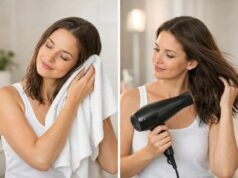
- Start with a dry scalp and dry hair.
Any dampness encourages clumping and weakens adhesion. If you use a leave-in or scalp treatment, let it dry fully before you begin. - Style your hair first.
Create your part, add lift at the roots if needed, and place your hair where you want it to stay. Fibers should be one of the last steps, not the first. - Section the area mentally.
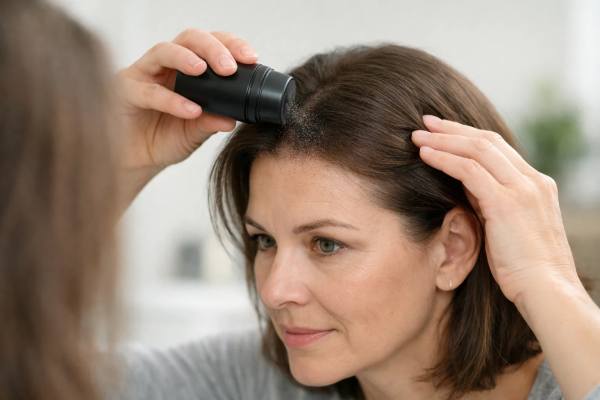
Do not shake product everywhere. Decide whether you are correcting a part line, crown, temple, or diffuse top area. - Apply lightly from above.
Sprinkle or pump small amounts directly over the sparse zone. Build slowly. It is much easier to add than to remove. - Use your fingertips sparingly.
A gentle pat can settle fibers. Rubbing smears them and exposes the scalp again. - Refine the edges.
If the part looks too wide, add a little more beside the line, not directly into it. If the front looks too dark, soften it by brushing a few strands forward. - Set the result.
Use a light mist of hairspray or a dedicated setting spray from about 8 to 12 inches away. Too-close spraying can blow the fibers into patches. - Check in natural light.
Tilt your head, look from both sides, and make sure the scalp does not look flat or inked in.
A few extra details make a big difference. If you use topical hair-loss medication, apply that first and wait until the scalp is fully dry. If your roots get oily quickly, hair fibers may slide or separate by afternoon, so keeping a wash routine that matches your scalp can improve wear time; this is where a guide to wash frequency by scalp type can help.
For the most natural finish, focus on the “zones of distraction”:
- The top of a widened part
- The center of the crown
- The see-through spots visible under overhead light
Use less at the very front than you think you need. The human eye reads perimeter mistakes instantly. A soft, slightly imperfect hairline almost always looks better than a sharp, heavily filled one.
Once you get the hang of it, the full routine can take only a few minutes. The best applications are usually the ones that look boring up close: no harsh line, no obvious powdery buildup, just less scalp showing through.
Mistakes That Make Fibers Look Obvious
When people say hair fibers looked fake on them, the problem is usually not that fibers never work. It is that one or two common mistakes made the result too dense, too dark, or too flat. Natural-looking coverage is subtle. Obvious coverage is usually overcorrection.
The biggest mistakes are these:
- Choosing the wrong shade.
A shade that matches highlighted lengths instead of natural roots often looks ashy. A shade that is too dark creates a helmet effect. - Applying to damp hair.
Dampness turns fine particles into clumps. The result can look dirty rather than dense. - Using too much at the hairline.
The frontal edge should be airy. Packing fibers right up to the perimeter creates a blunt border that does not resemble real follicle spacing. - Layering over creams, waxes, or heavy oils.
Fibers need a relatively dry surface. Greasy styling products can make them grab unevenly and transfer more easily. - Trying to cover bare scalp completely.
If there is no hair to anchor the product, the area often ends up looking painted. That is a sign to switch tactics, not add more. - Ignoring the cause of thinning.
If you keep hiding a thinning edge while continuing the hairstyle or habit that is stressing it, the problem can progress. If tension is part of the story, these hairline protection steps matter more than better camouflage.
A good self-check is to look at your scalp from three angles: straight on, above, and in side light. Heavy applications often pass the mirror test from one angle and fail from another. Photos can also reveal whether the covered area looks naturally dimensional or uniformly dark.
Another frequent issue is expecting one product to solve every zone. Fibers are often strongest at the crown and weakest on the fully exposed front. Some people get a better result by using fibers through the top and leaving the first few millimeters of the hairline softer and less filled. Others combine a small amount of powder at the perimeter with fibers behind it. The point is not perfection with one product. The point is a believable overall picture.
Also remember that your hair changes day to day. Humidity, oil, static, and shedding can all affect how fibers behave. A method that looks flawless on wash day may need a lighter hand on day three. Once you stop chasing the exact same result every time and start adjusting for the condition of your scalp and hair, the finish looks much more natural.
Hair Fibers Versus Other Cover Up Options
Hair fibers are popular because they are quick, low-commitment, and easy to wash out. But they are only one camouflage tool. Choosing the right one depends on how much hair you still have, where the thinning sits, and how much effort you want to put into your daily routine.
Here is the practical comparison:
- Hair fibers
Best for mild to moderate thinning with existing hair present. Excellent for part lines, crown show-through, and diffuse top thinning. Less effective on smooth bald spots. - Root sprays and pigmented powders
Better for tinting visible scalp, softening contrast at the front, or covering gray roots at the same time. They can work where fibers have less to grip. - Toppers and wigs
Better for advanced thinning, large areas of loss, or people who want dependable all-day coverage without daily camouflage tricks. A guide to wigs and toppers can help if you are reaching the point where fibers no longer give enough coverage. - Scalp micropigmentation
Better for people who want a longer-lasting optical effect, especially with short hairstyles or a clearly visible scalp. It adds the look of density, not real texture. - Medical treatment
Best when you want to address progression, not just appearance. Camouflage and treatment often work well together rather than competing.
Hair fibers fit best when your goal is “look better today.” They are especially appealing if your thinning is not severe enough to justify a topper but obvious enough to bother you in bright light or photos. They are also easy to adjust. You can use more on high-visibility days and skip them at home.
Their weakness is consistency. Because they wash out and depend on your existing strands, the result is never completely independent of your real hair. Wind, rubbing, sweat, heavy product use, and changing density all affect performance. Toppers and more structured prosthetic options ask more of you up front, but they can be more reliable for extensive loss.
So the real question is not which option is “best.” It is which option matches your stage of thinning and your tolerance for daily effort. If you still have enough hair for fibers to blend into, they often provide the most natural low-commitment improvement. If you spend every morning trying to force them to hide areas with almost no anchor hair, you have probably outgrown them and deserve a tool that asks less of you.
Safety Scalp Care and When to Seek Help
Hair fibers are cosmetic products, so they are generally lower risk than drug treatments, but “cosmetic” does not mean risk-free. The main issues are irritation, buildup, poor scalp hygiene, and using camouflage to postpone needed medical evaluation.
Most people tolerate fibers well, especially when they are used on healthy skin and washed out regularly. Problems are more likely when:
- The scalp is already inflamed, sore, or broken
- You have active dermatitis, psoriasis, folliculitis, or infection
- You are sensitive to dyes, fragrance, or preservatives
- You pile fibers over oily residues and rarely cleanse the scalp
- You share applicators or use old, contaminated tools
A few practical safety rules help:
- Do not apply fibers to open skin, scabs, pustules, or oozing areas.
- Stop using them if you notice itching, burning, stinging, rash, or unusual flaking.
- Wash them out gently rather than scratching them off.
- Clean brushes, nozzles, and applicators regularly.
- Treat hair fibers as camouflage, not permission to ignore ongoing thinning.
This last point is important. Fibers can make a problem look smaller than it is, which can delay diagnosis. Sudden shedding, patchy loss, loss of eyebrows or lashes, scalp pain, scaling, or visible redness deserve attention even if coverage hides them for now. If you are unsure what deserves a workup, these signs for seeing a dermatologist for hair loss are a good starting point.
You should get medical help sooner if:
- Hair is coming out rapidly over days to weeks
- The scalp burns, hurts, or feels tender
- You see round bald patches
- You notice crusting, pus, or marked scaling
- Hair loss is affecting brows, lashes, or body hair
- Thinning began after a major illness, medication change, or hormonal shift
Used wisely, hair fibers can be part of a healthy plan. They can help you feel more like yourself while you investigate the cause, start treatment, or decide whether you want another camouflage option. The safest approach is simple: protect the scalp, keep expectations realistic, and let the product improve your appearance without becoming a substitute for real diagnosis or care.
References
- Considerations and recommendations on camouflage in alopecia in Black women 2023 (Review)
- All that a Dermatotrichologist needs to know about Hair Camouflage: A Comprehensive Review 2022 (Review)
- Patient Satisfaction and Adverse Effects Following the use of Topical Hair Fiber Fillers 2022 (Clinical Study)
- Female-pattern hair loss: therapeutic update 2023 (Review)
- Review of hair prosthetic options for patients with alopecia 2024 (Review)
Disclaimer
This article is for educational purposes only and is not a diagnosis or personal medical advice. Hair fibers can improve the look of thinning hair, but they do not treat the cause of hair loss. If you have sudden shedding, patchy bald spots, scalp pain, redness, scaling, or signs of infection, seek evaluation from a dermatologist or other qualified clinician.
If this article helped you, please share it on Facebook, X, or your preferred platform so someone else dealing with thinning hair can find it too.