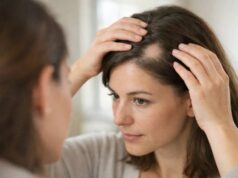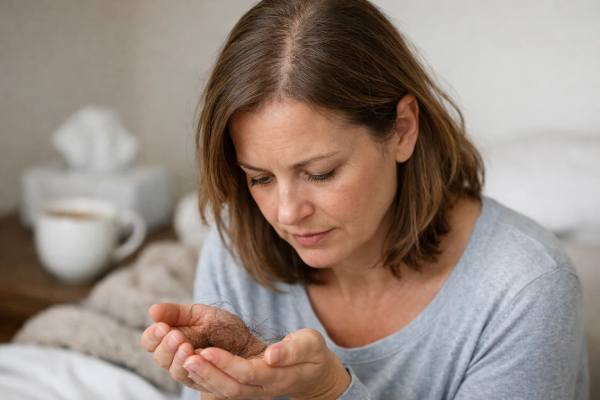
Seeing extra hair on your pillow, in the shower, or tangled in your brush a few weeks after a bad flu or high fever can feel deeply unsettling. It also feels illogical. You are finally recovering, yet your hair seems to be getting worse. In many cases, that delayed shedding pattern points to post-viral telogen effluvium, a temporary shift in the hair cycle that often happens after a major physical stressor such as fever, infection, poor appetite, or rapid weight loss during illness.
The good news is that this kind of shedding is usually reversible, and it does not mean your follicles have died or scarred over. The more useful question is not simply “Why is this happening?” but “Does this timeline fit normal post-illness shedding, and what can I do that actually helps?” Understanding the typical delay, the expected recovery pattern, and the signs that suggest another diagnosis can prevent panic, stop unhelpful supplement stacking, and help you decide when reassurance is enough and when a medical workup is worth it.
Key Insights
- Hair shedding after a high fever or flu usually begins weeks after the illness, not during the illness itself.
- Most post-viral shedding is temporary and improves once the hair cycle resets.
- Some viral illnesses, especially COVID-19, may trigger an earlier and more abrupt shed than classic telogen effluvium.
- Patchy bald spots, scalp inflammation, or shedding that continues past six months deserve medical evaluation.
- The most useful approach is to support recovery, avoid new stressors, and check for nutrient or thyroid issues only when the history suggests a reason.
Table of Contents
- Why Illness Can Trigger Shedding
- The Post-Viral Shedding Timeline
- How Regrowth Usually Unfolds
- What Actually Helps Recovery
- Signs It May Be Something Else
- When Testing and Treatment Matter
Why Illness Can Trigger Shedding
Hair does not grow in one continuous, uniform way. Each follicle cycles through phases of growth, transition, rest, and eventual release. Under ordinary circumstances, most scalp hairs are actively growing, while a smaller share are resting. After a major physical stressor, that balance can shift. A high fever, a true influenza infection, pneumonia, COVID-19, or another systemic illness can push more follicles than usual out of the growth phase and into the resting phase. Several weeks later, those hairs shed.
That process is called telogen effluvium. It is one of the most common reasons for sudden, diffuse shedding after illness. “Diffuse” matters here: the hair loss is spread across the scalp rather than appearing as one sharply defined bald patch. The follicles are still present. They have simply changed timing. If you want a deeper primer on the hair growth cycle, that foundation makes the delayed nature of post-fever shedding much easier to understand.
Fever itself is only part of the story. The body-wide inflammatory response of infection can be a trigger, but so can what often comes with being sick: eating less, sleeping poorly, losing weight quickly, dehydration, stopping or starting medications, or simply being under intense physical stress. A difficult illness can stack several triggers on top of each other. That is why someone may notice a heavier shed even after a “simple” virus if they also had a week of barely eating, lost several pounds, or took new medications during recovery.
Another reason this type of shedding feels alarming is that the scalp often looks normal. There may be no redness, no rash, no scarring, and no pain. You may just notice that your ponytail feels thinner, your part looks a little wider, or the drain catches more hair than usual. Hair washing does not cause this kind of loss. Shampooing simply loosens hairs that were already scheduled to come out. The same is true for brushing.
This is also why post-viral shedding can be emotionally confusing. The illness is over, but the hair change arrives later, making it feel unrelated or mysterious. In reality, the delay is one of the strongest clues that the shed is reactive rather than permanent. When the trigger is clear and the pattern is classic, the main issue is usually timing and patience rather than damage.
The Post-Viral Shedding Timeline
The most useful thing to know about post-fever hair shedding is that it is usually delayed. In classic acute telogen effluvium, the increased fall often begins about 6 to 12 weeks after the triggering event. For many people, that works out to roughly two or three months after the fever, flu, or other infection. This delay is so typical that it often becomes the key diagnostic clue.
A simple way to picture the timeline is this:
- You get sick.
- The illness disrupts the follicle cycle.
- The hairs quietly move into a resting phase.
- Weeks later, those resting hairs are released.
That lag is why people often say, “I was sick in January, but the shedding started in March.” The timing fits.
Not every viral shed follows the classic schedule exactly. Some post-viral cases, especially those linked to COVID-19, seem to start earlier and can feel more abrupt. Instead of beginning at the two- to three-month mark, the shed may show up closer to one to two months after infection. That does not automatically mean the process is more dangerous. It simply suggests that post-viral shedding is not always perfectly uniform.
Once shedding starts, it can be dramatic. You may notice hair all over your hands when conditioning, a heavier hair ball after washing, or more strands on clothing and bedding. The amount often looks far more frightening than the actual thinning at first, especially if your hair is long. Long hairs create visual drama. A hundred long strands in the shower can look like a crisis even when the scalp change is still mild.
The active shedding phase usually lasts for weeks, not days. Many people see the worst of it over one to three months. In a straightforward acute case, the overall episode generally settles within six months from onset. That does not mean your hair looks fully restored by then. It means the excessive shedding phase should be tapering rather than worsening.
One common source of panic is the idea that the shed should stop as suddenly as it started. It usually does not. Recovery is often gradual. One week you lose a lot. The next week it seems only slightly better. Then you have a bad wash day, followed by a calmer one. A bumpy improvement pattern is still improvement.
It also helps to separate “shedding” from “balding.” Reactive shedding means hairs are cycling out. It is different from a condition in which follicles are progressively miniaturizing over time. If that distinction still feels blurry, this guide on hair shedding versus hair loss can help clarify what you are seeing. In classic post-fever shedding, timing matters as much as appearance.
How Regrowth Usually Unfolds
Regrowth after post-viral shedding rarely announces itself in a dramatic way. The first sign is often not new hair at all. It is less hair falling out. That matters because people frequently expect to see a quick return of fullness and assume recovery is not happening when the mirror still looks the same. In reality, the sequence is usually: shedding slows first, visible density improves later.
When new growth becomes noticeable, it often shows up as short, upright hairs along the hairline, temples, or part. These are the “baby hairs” many people spot under bright bathroom light. They can look fluffy, uneven, or even frizzy at first. That is normal. Fresh regrowth is short, light, and harder to control than mature strands. It takes time for those new hairs to lengthen enough to blend into the rest of the hairstyle.
The next stage is subtle thickening. Your scalp may look less exposed under overhead light. Your part may seem narrower. The shower shed may no longer feel shocking. But visual density often lags behind biological recovery because hair length returns slowly. If you lost a significant amount of long hair, you do not replace that visual mass overnight.
That delay is especially noticeable in people with longer hair, curly hair, or naturally fine strands. With long hair, the shed looks dramatic and the fullness takes longer to rebuild. With curls, shrinkage can hide regrowth early on. With fine hair, even a temporary reduction in density can feel more obvious at the crown and temples.
Another important point: a post-viral shed can uncover an older issue that had been easy to ignore before. Someone with mild inherited pattern thinning may feel that the fever “caused” all of the problem, when in fact the illness triggered a shed that made a preexisting tendency easier to see. This is one reason some people do not bounce back exactly as expected. The telogen effluvium improves, but a background condition remains.
A more realistic recovery script looks like this:
- Shedding starts several weeks after illness.
- Shedding peaks and then slowly eases.
- Short regrowing hairs appear.
- Density improves gradually.
- Full visual recovery takes longer than the shedding phase.
This is why it helps to judge progress by trends rather than single days. One wash day is noisy data. Four to six weeks of overall change is more useful. If the shed is clearly less intense, your scalp symptoms are absent, and regrowth is visible, you are usually moving in the right direction even if your hair still feels thinner than usual.
Patience is not a glamorous treatment, but in true post-viral shedding it is often the most biologically accurate one. The follicles generally need time to re-enter a more normal rhythm, and your hair needs time to regain length as well as number.
What Actually Helps Recovery
When shedding feels relentless, it is tempting to try everything at once: expensive serums, giant supplement stacks, scalp gadgets, hair-growth gummies, oils, and a complete product overhaul. Most of that noise adds cost and stress without changing the core biology. What helps most is usually much simpler.
Helpful moves
The first step is to remove ongoing stressors where possible. If the trigger was a high fever or flu, you cannot undo it, but you can avoid layering on new hits such as crash dieting, very low protein intake, harsh bleaching, tight styles, or excessive heat. Hair recovery goes better when the body is adequately fed and no longer in a “catch up” state.
Nutrition matters most when there has been poor intake during illness or a preexisting deficiency. Focus on steady meals, enough protein, and correction of proven deficiencies rather than taking a dozen supplements “just in case.” Low iron stores, low protein intake, thyroid problems, and major calorie restriction can prolong the picture or make recovery less impressive. If iron status is a concern, especially after heavy periods, vegetarian or vegan eating, or prior low labs, a focused review of ferritin and hair growth levels can help frame the discussion you have with a clinician.
Gentle scalp and hair care also helps. Wash your scalp as needed for comfort and oil control. Do not avoid shampoo out of fear that washing is “causing” the loss. Use a mild cleanser, condition well, detangle gently, and minimize mechanical stress. Keep ponytails loose. Save aggressive coloring, extensions, and repeated hot-tool styling for later.
Sleep and stress management deserve more credit than they usually get. They do not erase a post-viral shed, but they reduce one more layer of physiological burden. A body recovering from infection, poor sleep, and emotional stress all at once has more to stabilize.
What usually does not help
- Cutting the hair does not stop shedding at the follicle level.
- Oiling the scalp does not reverse telogen effluvium.
- Mega-dosing biotin or random vitamins rarely helps unless there is a real deficiency.
- Constantly counting shed hairs can worsen distress without improving outcomes.
Topical minoxidil is a more nuanced case. It is not required for most classic post-fever shedding, but some dermatologists may consider it off-label when shedding is prolonged, distress is high, or there is likely overlap with pattern thinning. It is best viewed as a selective supportive option, not a universal fix. The foundation is still trigger control, nutritional recovery, scalp gentleness, and time.
Signs It May Be Something Else
The reason timeline matters so much is that not all hair loss after an illness is simple post-viral shedding. Sometimes the illness is a trigger layered on top of another condition. Sometimes the timing only partly fits. And sometimes what looks like “shedding” is actually a different problem entirely.
One of the clearest red flags is patchiness. Telogen effluvium is usually diffuse. If you have one or more sharply defined bald spots, especially smooth round patches, that pattern points away from classic post-fever shedding and more toward conditions such as alopecia areata. That needs a different conversation and often a different treatment plan.
Scalp inflammation is another clue. Redness, thick scale, pustules, significant burning, or focal pain are not typical features of straightforward reactive shedding. A tender scalp alone can happen, but visible inflammatory change raises the possibility of seborrheic dermatitis, psoriasis, folliculitis, contact dermatitis, or a more serious inflammatory alopecia.
Pattern matters too. If the main change is a widening center part, more scalp show at the crown, or gradual thinning at the temples, an inherited pattern component may be present. In that case, the fever may have triggered a temporary shed that made a longer-term tendency easier to notice. The post-viral piece may improve while the background pattern does not disappear on its own.
Pay attention to hair quality as well as quantity. If you are seeing lots of short broken pieces, frayed ends, or snapped strands rather than full-length hairs with a club-shaped bulb, breakage may be a large part of the problem. That points more toward cosmetic damage, heat, tension, or chemical processing than a pure shedding disorder.
Other clues that deserve medical attention include:
- Shedding that continues beyond six months
- Recurrent waves of shedding without a clear trigger
- Loss of eyebrow, eyelash, or body hair
- Fatigue, cold intolerance, menstrual changes, major weight change, or other systemic symptoms
- Hair loss that begins immediately after a medication change
- Significant thinning in a child, teenager, or postpartum patient with added symptoms
In short, the “looks the same all over and started weeks after the fever” story is reassuring. The more your story drifts away from that pattern, the more useful a professional exam becomes. Post-viral shedding is common, but it should not be used as a catch-all label for every sudden hair problem.
When Testing and Treatment Matter
Not every person who sheds after a bad flu needs a long lab panel, prescription treatment, or scalp biopsy. In fact, one of the more helpful clinical insights is that testing should be guided by the story, not done in a reflexive shotgun fashion. A very classic case, with a clear high-fever trigger, diffuse shedding beginning two to three months later, and early signs of improvement, may need little more than confirmation and follow-up.
A clinician usually starts with the basics:
- When was the illness?
- How high was the fever, and how sick were you?
- When did the shedding begin?
- Was there weight loss, poor intake, surgery, hospitalization, or a medication change?
- Are there scalp symptoms, patchy areas, or signs of pattern thinning?
- Is there a history of thyroid disease, iron deficiency, heavy periods, or prior hair issues?
That history is often more valuable than a very broad test panel. If the picture is not fully classic, or if shedding is severe, prolonged, or recurrent, targeted labs may be reasonable. Common examples include a complete blood count, ferritin or iron studies, and thyroid testing. Vitamin B12, vitamin D, zinc, or other labs may make sense when diet, symptoms, or medical history point in that direction, but they are not equally useful for everyone.
A dermatologist may also use trichoscopy, a magnified scalp exam, to look for signs that favor telogen effluvium versus alopecia areata, pattern hair loss, or inflammatory disease. A biopsy is usually reserved for unclear cases, suspected scarring conditions, or situations in which the diagnosis is being reconsidered.
Treatment decisions depend on what the exam shows. If it is a straightforward post-viral shed, the plan may be reassurance, recovery support, and watchful follow-up. If there is overlap with pattern thinning, inflammation, or an untreated deficiency, the treatment becomes more specific. That is why getting the label right matters so much.
You should move medical evaluation up the list if the shedding is extreme, the scalp looks inflamed, you see patches, or the process is still going strong after six months. This guide on when to see a dermatologist for hair loss can help you judge urgency more clearly.
The key takeaway is practical: post-fever shedding is often self-limited, but persistent or atypical cases deserve a closer look. The goal is not to overmedicalize every shed. It is to avoid missing the cases that need more than patience.
References
- Telogen Effluvium: A Review of the Literature 2020 (Review). ([PMC][1])
- “Shedding” low yield testing for telogen effluvium: A cross-sectional study of 16,381 laboratory results from newly diagnosed patients 2023. ([PubMed][2])
- Global epidemiology of telogen effluvium after the COVID-19 pandemic: A systematic review and modeling study 2024 (Systematic Review). ([PMC][3])
- The Difference Between SARS-CoV-2 Associated Telogen Effluvium and Telogen Effluvium Due to Other Causes 2024. ([PMC][4])
- Use of 5% Topical Minoxidil Application for Telogen Effluvium: An Open‐Label Single‐Arm Clinical Trial 2025 (Clinical Trial). ([PMC][5])
Disclaimer
This article is for educational purposes only and is not a diagnosis or a substitute for medical care. Hair shedding after fever or flu is often temporary, but patchy loss, scalp inflammation, severe ongoing shedding, or symptoms such as fatigue, weight change, or menstrual changes should be assessed by a qualified clinician or dermatologist. Do not start or stop prescription treatments, iron, or other supplements based only on online information.
If this article helped, consider sharing it on Facebook, X, or another platform you use so someone else dealing with post-fever shedding can recognize the pattern sooner.