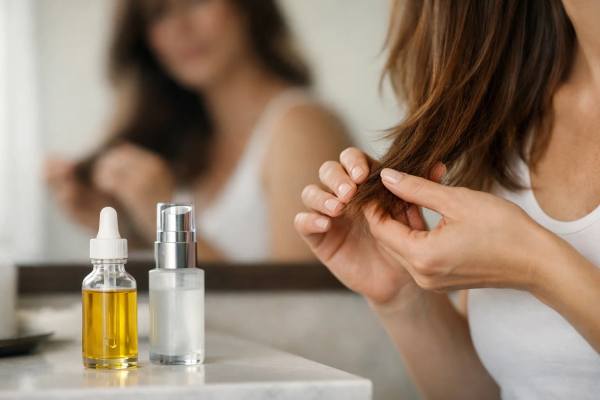
Hair oil and hair serum are often treated like substitutes, yet they solve different problems on the hair fiber. One is usually chosen for softness, reduced dryness, and pre-wash protection. The other is usually chosen for frizz control, shine, slip, and a smoother finish in humid air or after styling. That overlap is why many routines become heavier than they need to be. A rich oil can flatten fine hair within minutes, while a glossy serum may make damaged ends look better without doing much for deeper dryness. The real difference is not just texture. It is how each product interacts with the hair shaft, scalp, and styling routine. Some oils can reduce protein loss and help limit swelling during washing. Most serums work more like a surface film, improving feel and appearance while lowering friction. Once you match the product to your hair type, porosity, and wash habits, the choice becomes much simpler. In many cases, the best answer is not oil or serum, but knowing when each one belongs in the routine.
Quick Overview
- Hair oil is usually better for dryness, rough ends, and pre-wash protection, especially on coarse, curly, or high-porosity hair.
- Hair serum is usually better for frizz control, shine, humidity resistance, and a smoother finish during styling.
- Too much of either can cause limp roots, buildup, dullness, or scalp irritation if it spreads onto the scalp.
- Start with a very small amount: a few drops of oil on lengths before washing, or one pump of serum on mid-lengths and ends after washing.
- Heavy scalp oiling is not ideal for every scalp and can worsen some flaky or itchy conditions.
Table of Contents
- What hair oil and serum actually do
- The real formula differences
- Which hair types benefit most
- How to use hair oil well
- How to use hair serum well
- Can you use both together
What hair oil and serum actually do
The easiest way to separate hair oil from hair serum is to think about purpose before shine. Both can make hair look glossier, but they are usually built for different jobs. Hair oil is most often used to soften dry hair, reduce roughness, improve flexibility, and add lubrication before or after washing. Depending on the oil, it may partly penetrate the hair shaft or sit more on the surface. Hair serum, by contrast, is usually designed to create a smoother outer film that improves slip, controls flyaways, reduces static, and makes the surface look more polished.
That difference matters because hair is a fiber, not living tissue once it leaves the scalp. You are not “feeding” the visible strand in the way marketing language sometimes suggests. You are managing friction, swelling, water loss, surface roughness, and breakage risk. Oils tend to help with lubrication and, in some cases, wash-related stress. Serums tend to help with alignment of the cuticle surface so the hair reflects light better and tangles less. When someone says a serum “fixed” their hair, what they usually mean is that it improved feel and appearance right away. When someone says an oil “helped” their hair, they often mean the hair felt less brittle and held up better between washes.
This is also why neither product is universally better. If your main complaint is puffy ends, weather frizz, or a dull finish after blow-drying, serum is often the more direct match. If your main complaint is chronic dryness, roughness, or crunchy ends from repeated washing, coloring, or heat, oil often makes more sense. Some people need one and not the other. Others do best with oil before washing and serum after washing.
It also helps to remember that “hair oil” and “hair serum” are broad labels, not tightly regulated scientific categories. A lightweight serum may contain oils. An oil may contain silicones or esters. A leave-in marketed as a serum may behave more like a finishing gloss than a treatment. This is why reading the ingredient list and the brand’s directions is often more useful than judging the name alone.
For the scalp, the distinction is even more important. Many hair oils are really meant for the hair lengths, not routine scalp coating. And most serums are meant for the hair shaft, not the scalp, unless they are specifically formulated as scalp serums. If your roots get oily fast or your scalp runs sensitive, it helps to think of both products as fiber care first, with scalp use reserved for formulas clearly made for scalp skin.
The real formula differences
Formula is where the difference becomes practical. A classic hair oil is built around lipids such as coconut oil, mineral oil, argan oil, sunflower oil, olive oil, or lighter esters that mimic an oily feel. Some oils are better at coating the outside of the strand. Some are better at moving into the fiber to a limited degree. Coconut oil is the best-known example in this conversation because it has been studied for reducing protein loss in hair more effectively than some other oils. That does not mean every oil behaves the same way, or that more is always better. It means that oil choice affects performance.
Hair serums usually rely on a different architecture. Many use silicones, silicone alternatives, conditioning polymers, emollient esters, and glossing agents. The goal is usually to spread a very thin, even film over the hair shaft. That film lowers friction, reduces snagging, tames static, and helps the cuticle lie flatter. A good serum often feels light in the hands, spreads quickly, and gives immediate cosmetic payoff. It may also make detangling easier and reduce the rough, swollen feel that hair gets in humidity.
This is where confusion around “natural” and “synthetic” often gets in the way. Some people avoid serum because it sounds artificial. Others avoid oil because it sounds heavy. In reality, both categories can be useful or irritating depending on the formula, the amount, and the hair type. Silicones, for example, are often criticized online, yet they can be very effective surface protectants for dry, frizz-prone hair. If you want a more detailed look at that topic, this guide to how silicones protect the hair surface helps separate marketing myths from everyday performance.
The feel on the hair also tells you a lot about the formula. Oils usually feel richer, slower to absorb, and easier to over-apply. Serums usually feel silkier and more controlled in small doses, but they can leave hair limp or coated if layered too heavily. Oils often pair well with wash-day repair or very dry ends. Serums often pair well with styling, humidity control, and finishing. That is why the same person may love oil on a weekend wash day and serum on a workday blowout.
One more detail matters: not every glossy product marketed as a serum offers true heat protection. Some do, but many are simply smoothing products. If the label does not clearly claim heat protection, do not assume it can replace a dedicated heat protectant. The finish may look sleek while the strand still faces avoidable thermal stress.
Which hair types benefit most
Hair type is where the oil-versus-serum decision usually becomes obvious. Fine, straight, or low-density hair often does better with serum because it needs surface smoothing without too much weight. A few drops of oil can be enough to make the ends look better, but the margin for overuse is small. Serum is often easier to dose on this hair type, especially when the goal is shine, flyaway control, or a neater blow-dry.
Medium to thick hair can go either way, depending on damage level and climate. If the hair is fairly healthy but frizzes in humidity, serum may be the better first choice. If it is color-treated, porous, rough, or repeatedly heat-styled, oil often becomes more helpful, especially as a pre-wash step or as a tiny finishing step on dry ends. Curly, coily, and highly textured hair often benefits from oil more often than fine straight hair does, but even here the answer is not automatic. Some textured hair loves oils on the lengths and hates silicones. Other textured hair becomes softer and easier to detangle with a light serum layered over a leave-in.
Porosity matters too. High-porosity hair usually loses smoothness fast and takes on water quickly, so it often responds well to richer emollients and strategic sealing. Low-porosity hair often dislikes heavy layers and may look greasy before it looks nourished. If you are not sure which camp you are in, a guide to low and high porosity care can make product choice far less frustrating.
Scalp behavior should also shape the decision. If your roots get oily within a day or two, you may want to keep oils away from the scalp and reserve them for the lower half of the hair. If you deal with dandruff, seborrheic dermatitis, or scalp breakouts, routine scalp oiling may not help and can sometimes make the situation feel worse. In that case, a serum for the lengths may give you the cosmetic improvement you want without leaving residue near the roots.
A simple way to decide is to match the product to the problem:
- Choose oil first when the main issue is dryness, brittleness, rough ends, or wash-related swelling.
- Choose serum first when the main issue is frizz, static, tangling, lack of shine, or humidity.
- Choose both carefully when the hair is dry and frizzy, especially if it is long, colored, or frequently heat styled.
- Choose neither at the scalp unless the formula is clearly intended for scalp skin and your scalp tolerates it well.
The right pick is often less about trends and more about where your hair sits on the spectrum from fine and easily weighed down to coarse and chronically under-lubricated.
How to use hair oil well
Hair oil works best when it is used with a clear reason rather than as a default finishing step every day. The most useful roles are usually pre-wash protection, softening of dry ends, and reducing roughness on hair that swells and tangles easily. For many people, the most successful method is not saturating the scalp or coating the entire head. It is applying a small amount to the mid-lengths and ends before washing, leaving it on for a short period, and then shampooing as usual.
A practical starting point is this:
- Begin with dry or slightly damp hair.
- Place a few drops of oil in your palms.
- Apply from the ears downward, concentrating on the driest sections.
- Leave it on for about 30 minutes before washing.
- Adjust amount upward only if your hair still feels rough after a few tries.
That approach tends to work better than guessing with a large amount. Fine hair may need only two or three drops. Thick or very curly hair may need more, but even then, it helps to build slowly. Too much oil can attract lint, make shampooing harder, and leave the hair flat by the next day.
Scalp oiling deserves a more careful discussion. Some people enjoy it, but it is not automatically beneficial for everyone. If your scalp is oily, flaky, acne-prone, or easily irritated, frequent oiling may leave it feeling heavier rather than healthier. A focused look at scalp oiling benefits and risks can help you decide whether it fits your scalp rather than your social feed. In many cases, the hair shaft benefits from oil more reliably than the scalp does.
Oil can also be used as a finishing product, but the amount needs to be even smaller. Think of one drop warmed through the palms and touched only to the last few inches of dry hair. That is often enough to take the edge off rough, overprocessed ends. More than that can separate the strands and make the hair look piecey rather than glossy.
A few common mistakes make hair oil underperform:
- Applying it too close to the roots.
- Using it every day when a once- or twice-weekly pre-wash step would be enough.
- Expecting it to replace trimming of split ends.
- Using it on already coated hair, where it sits on residue instead of the strand itself.
Used well, oil can make hair feel calmer, less brittle, and easier to manage. Used carelessly, it often creates the false impression that oils “do not work,” when the real issue was dose, placement, or hair type mismatch.
How to use hair serum well
Hair serum shines when the goal is control and finish. It is usually the better option for flyaways, friction, puffiness, and that rough surface feeling that shows up after towel-drying or blow-drying. The best place to start is on freshly washed, towel-blotted hair, because the serum can spread more evenly before the hair sets into its dried shape.
A simple method works for most people:
- Dispense a very small amount, often one pump or less for fine to medium hair.
- Rub it between your palms.
- Apply to mid-lengths and ends first.
- Comb through with fingers or a wide-tooth comb.
- Add more only if the hair still looks unruly after drying.
That small-amount rule matters. Serum is easier to overuse than many people expect, especially on fine hair. Too much can leave the surface glassy in the wrong way: slippery, flat, and slightly coated instead of soft and controlled. The best result usually comes from an amount that is almost disappointingly small at first.
Serum is also a strong choice for humid climates, polished styles, and frequent styling brushes because it reduces surface friction and keeps the cuticle looking more aligned. On longer hair, it can prevent the day-two “triangle effect,” where the ends swell outward while the roots sit flat. It is also useful for protecting the look of the hair between trims by making older ends catch less on one another.
One caution is worth repeating: serum and heat protectant are not always the same thing. Some formulas are made to do both, but many are simply smoothing products. If you use hot tools often, check the label rather than assuming shine equals protection. When your routine includes blow-drying or straightening, it helps to understand what a true heat protectant does so you do not rely on the wrong product.
Serum can also be used on dry hair, but the amount should be even smaller than on damp hair. One partial pump or a drop spread over the palms is often enough to calm flyaways or add a little light reflection before you leave the house. Applied too late and too heavily, it can make the surface look slick while the interior still feels dry.
Serum usually makes the most sense when your hair is not crying out for deep softness, but it does need a more controlled surface. For many people, that makes it the more versatile daily product, while oil becomes the targeted support product used less often and with more intention.
Can you use both together
Yes, you can use both together, and for some hair types that is the most effective approach. The trick is to separate timing, amount, and placement so the products do not compete. In most routines, oil works best before washing or as a tiny end treatment, while serum works best after washing for smoothing and finish. That order makes sense because oil helps with softness and wash-related stress, while serum helps manage the hair you are about to wear.
A balanced routine might look like this:
- Use oil on the lengths 30 to 60 minutes before wash day.
- Shampoo and condition normally.
- Apply serum to damp mid-lengths and ends before air-drying or blow-drying.
- Add a final micro-amount only to dry ends if the hair still feels rough.
This combination is especially useful for long, color-treated, curly, bleached, or high-porosity hair that feels dry inside but still frizzes on the surface. It is usually less helpful for fine hair unless the oil step is very light and occasional. If your roots get greasy quickly while your ends stay dry, you may also need a routine built around root restraint and end support. In that case, a guide to balancing oily roots and dry ends can be more useful than buying stronger products.
The main reason this pairing fails is buildup. Hair can only hold so much residue before it loses bounce and starts looking dull, even when it feels coated. Signs include flat roots, sticky ends, reduced volume, and a sense that products sit on the hair instead of improving it. If that starts happening, reduce amount first, then reduce frequency, and consider a more thorough cleansing schedule. This overview of how to fix product buildup can help when the hair feels heavy no matter what you apply.
A few final decision rules keep things simple:
- Use oil only if the hair is dry but not especially frizzy.
- Use serum only if the hair is mostly healthy but needs polish and humidity control.
- Use both if the hair is dry, porous, and surface-frizzy.
- Use less of each than you think you need.
- Keep both away from the scalp unless the product is specifically made for scalp use.
The best routine is rarely the most complicated one. It is the one that gives your hair softness, control, and shine without trading those gains for residue, flatness, or irritation.
References
- Effect of mineral oil, sunflower oil, and coconut oil on prevention of hair damage 2003 (Controlled Study)
- Hair Cosmetics: An Overview 2015 (Review)
- Shampoos and Conditioners: What a Dermatologist Should Know? 2015 (Review)
- Hair Shaft Damage from Heat and Drying Time of Hair Dryer 2011 (Study)
Disclaimer
This article is for educational purposes only and is not a substitute for medical advice, diagnosis, or treatment. Hair oils and hair serums can improve comfort, appearance, and manageability, but they do not treat every cause of hair breakage, shedding, scalp itch, or hair loss. If you have sudden shedding, patchy hair loss, scalp pain, burning, persistent flaking, or a reaction after using a hair product, seek advice from a qualified clinician or dermatologist.
Share this article on Facebook, X, or your preferred platform if it helped you decide whether your hair needs the softness of an oil, the control of a serum, or a careful mix of both.