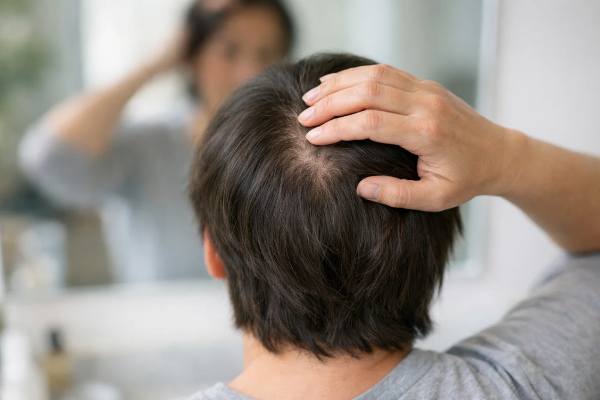
Crown thinning is one of the most common and most emotionally loaded forms of hair loss because it often shows up in photos, under bright overhead light, or when the hair is wet long before it feels dramatic in the mirror. The crown, also called the vertex, is a high-yield spot for diagnosis: in men, it often reveals early pattern hair loss; in women, it can show widening through the central scalp; and in some inflammatory conditions, it is the first place where permanent loss begins.
The good news is that crown thinning is not a single diagnosis. It is a pattern, and patterns can be interpreted. That matters because the best treatment depends less on the location alone and more on the cause underneath it. Some cases respond well to minoxidil and prescription therapy. Others improve only after a trigger, such as illness, low iron, hormonal change, or scalp inflammation, is identified. The earlier the pattern is recognized, the better the chance of slowing progression and preserving density.
Quick Overview
- Crown thinning is often treatable, especially when it is caught before the scalp becomes visibly sparse.
- The most common cause is pattern hair loss, but shedding, inflammation, and scarring conditions can also start at the crown.
- Early treatment usually preserves more hair than late treatment aimed at regrowth alone.
- Burning, pain, pustules, heavy scale, or shiny scalp skin are warning signs that need prompt medical evaluation.
- Take clear photos of the dry crown in the same lighting every 8 to 12 weeks to judge progress more accurately.
Table of Contents
- What crown thinning usually means
- The main causes at the crown
- How to tell what pattern you have
- Best first-line treatments that work
- Procedures and add-ons worth considering
- When to test, treat, and escalate
What crown thinning usually means
The crown is not just another patch of scalp. It is a region where underlying hair-loss patterns often become visible earlier than people expect. In men, the crown and temples are classically vulnerable to androgenetic alopecia, the medical term for pattern hair loss driven by genetic sensitivity to dihydrotestosterone. In women, crown thinning often appears as reduced density across the central scalp or widening through the part and upper scalp rather than a sharply defined bald spot. In both groups, the crown can look normal in dim light and noticeably thinner in bathroom lighting, flash photography, or after a shower.
One reason crown thinning causes so much anxiety is that it is easy to misread. A normal hair whorl can make the center of the crown look more open. Fine hair, bleached hair, darker scalp contrast, and flat styling can exaggerate visibility. On the other hand, true thinning usually becomes easier to spot over time, not harder. The ponytail may feel smaller, the crown may separate more easily when the hair is clean, and the scalp may show through from several angles rather than only at one swirl point.
Crown thinning is also a pattern with practical value. It points clinicians toward a focused set of causes and can shape treatment choices. Pattern hair loss often responds better when therapy starts early, before many follicles have miniaturized for years. Some medications also tend to perform better at the crown than at the frontal hairline, which is why people are sometimes surprised that the “top back” improves before the front does.
That said, crown thinning does not automatically equal hereditary baldness. Sudden increased visibility at the crown after illness, rapid weight loss, severe stress, medication changes, or postpartum recovery may reflect shedding rather than miniaturization. Patchy loss, scalp symptoms, or a shiny scar-like look can point in an entirely different direction. The real question is not only where the hair is thinner, but how the change started, how fast it moved, and what else is happening on the scalp. When those details are combined, the crown often becomes one of the most informative places to read the story of the hair.
The main causes at the crown
The most common cause of crown thinning is androgenetic alopecia. In men, it often shows up as a gradually enlarging thin spot at the vertex, sometimes with temple recession and sometimes before the front changes much at all. In women, the pattern is usually more diffuse through the central and crown scalp, with the frontal hairline often relatively preserved. The key feature is progression over months to years rather than an abrupt shedding event.
The second major category is telogen effluvium, a shedding disorder. This can make the crown look suddenly sparse because the top of the scalp catches light so easily. Telogen effluvium often follows a trigger such as fever, surgery, childbirth, crash dieting, low iron, thyroid disturbance, severe emotional stress, or a medication change. Unlike classic pattern hair loss, it tends to feel abrupt. People often notice extra strands in the shower, on the brush, and on clothing before they notice an obvious shape change.
Alopecia areata can also affect the crown, but it usually produces smoother, more localized patches or a rapidly changing area rather than a slow, diffuse spread. In some cases, though, the pattern is less tidy and can mimic diffuse thinning. Scalp examination becomes important here because the treatment path is different.
Inflammatory and scarring conditions deserve special attention because the crown is a common starting point for some of them. One of the most important examples is central centrifugal cicatricial alopecia, which often begins near the crown and can slowly expand outward. This matters because scarring alopecia can lead to permanent follicle loss if treatment is delayed. Readers who want a closer look at the early signs of central centrifugal cicatricial alopecia should pay special attention to tenderness, burning, scale, or a gradually smooth, shiny look in the center of the scalp.
Other contributors can magnify crown visibility even when they are not the main cause. Seborrheic dermatitis, psoriasis, contact dermatitis from hair products, and chronic scratching can worsen the appearance of thinning by increasing inflammation and making the scalp more noticeable. Hair shaft damage can do it too. If the hair on top breaks more than the hair on the sides, the crown may look thinner even when the follicles are still present. In real life, mixed cases are common: a person may have baseline pattern hair loss, then a stressful illness or nutritional problem adds a wave of shedding on top of it. That is why the best diagnosis usually comes from pattern plus timing plus scalp clues, not from one detail in isolation.
How to tell what pattern you have
The easiest mistake is to treat every visible crown as true hair loss and every sudden shed as temporary. Both assumptions can be wrong. What helps most is learning the difference between thinning, shedding, breakage, and inflammation.
Pattern hair loss usually announces itself slowly. The crown looks broader over time, the scalp shows through more easily, and the hair strands in that area often look finer and less uniform than those at the sides or back. The shower drain may not be dramatically fuller. Instead, the change is in density and caliber. Many people say, “My hair is still there, but it is weaker and I can see more scalp.”
Shedding disorders feel different. Hair comes out in noticeable numbers, often across the whole scalp, and the crown simply makes the loss easier to see. The clue is volume leaving the head rather than one area shrinking first. A positive hair-pull test, in which several hairs release easily, supports shedding more than miniaturization. If you are trying to sort this out at home, these shedding-versus-thinning clues can help you frame what you are seeing before an appointment.
Breakage is another common imitator. When the problem is shaft damage, the crown may look frayed or fuzzy rather than sparse at the roots. You may see many short, snapped hairs of different lengths, especially if heat styling, bleaching, tight brushing, or rough detangling has been part of the routine. With true thinning, the hair is reduced from the scalp upward, not merely broken midway down the strand.
Scalp symptoms are where the pattern becomes more urgent. These features should change the level of concern:
- Burning, pain, or tenderness.
- Persistent itch that is new or worsening.
- Thick scale, crusting, or pustules.
- Smooth shiny skin where follicles seem to disappear.
- Rapid spread over weeks rather than months.
- Distinct patches, eyebrow loss, or body-hair changes.
These clues raise suspicion for inflammatory, autoimmune, infectious, or scarring causes. They do not prove one diagnosis, but they argue against a casual wait-and-see approach.
A practical home assessment can still be helpful. Take dry-hair photos from above every 8 to 12 weeks in the same room and lighting. Part the hair in the same way each time. Notice whether the scalp is visible only at the whorl, along a widening zone, or in a patch with altered skin texture. That pattern often reveals more than memory does. Hair loss is slow enough that people either panic too early or normalize it too long. Standardized photos create a more honest record.
Best first-line treatments that work
When crown thinning is caused by pattern hair loss, first-line treatment usually means some form of minoxidil, often combined with a prescription option when appropriate. This is where it helps to think in terms of preservation first and regrowth second. The earlier treatment begins, the more existing follicles there are to rescue.
Topical minoxidil remains the foundational option for many adults. It can lengthen the growth phase, improve hair caliber, and increase visible density over time. The crown is one of the areas that often responds best, which is encouraging for people whose main complaint is a widening spot at the vertex. For a closer look at how minoxidil works, it helps to know that success is usually measured over months, not weeks. Mild increased shedding early in treatment can happen and does not automatically mean failure.
For men with androgenetic alopecia, oral finasteride is a major evidence-based option. Its role is different from minoxidil. Instead of mainly stimulating follicles, it reduces conversion of testosterone to dihydrotestosterone, the androgen most implicated in follicle miniaturization. In practice, many men get the best stability from combining finasteride with minoxidil rather than choosing one alone. Dutasteride is another 5-alpha-reductase inhibitor used in some settings, though it is often treated as a more aggressive or off-label step depending on region and clinician preference.
For women, topical minoxidil is also a mainstay. Depending on age, hormonal background, blood pressure, and pregnancy plans, some clinicians also use low-dose oral minoxidil or antiandrogen therapy such as spironolactone. This is not a self-prescribe category. Women of childbearing potential need careful counseling, and antiandrogen use has clear pregnancy-related limits.
Good first-line treatment also includes expectations. Most therapies need at least 3 to 6 months before early change is visible and closer to 6 to 12 months for a fair assessment. Stopping effective treatment often means losing the gains because pattern hair loss is chronic. That is frustrating, but it is also why consistency matters more than chasing every new serum.
A simple, evidence-minded approach often looks like this:
- Confirm that the pattern is likely non-scarring.
- Start one core treatment you can realistically continue.
- Add a prescription option when the diagnosis and risk profile support it.
- Track progress with standardized photos, not daily mirror checks.
- Reassess after several months, not several days.
The best treatment is not always the strongest treatment on paper. It is the one that matches the diagnosis, the sex-specific safety profile, the stage of loss, and the likelihood that the person will actually stay with it.
Procedures and add-ons worth considering
When medications alone are not enough, or when a person wants to build a broader plan, procedural and device-based options can add meaningful improvement. The important word is add. Most of these approaches work best as adjuncts, not as replacements for proven core treatment in classic pattern hair loss.
Platelet-rich plasma is one of the most discussed options. It uses the patient’s own processed blood components and is injected into thinning areas of the scalp. The appeal is easy to understand: it is office-based, non-surgical, and backed by a growing body of research showing improvements in hair density and thickness in many patients with androgenetic alopecia. The downside is variability. Protocols differ by clinic, the degree of benefit is not identical from person to person, and maintenance is usually needed. People deciding between office options and medication often find value in comparing PRP with minoxidil and finasteride before spending heavily.
Low-level laser therapy is another option with a real, if more modest, evidence base. It is best viewed as a supportive tool. It may help improve density and fullness in some men and women with pattern hair loss, especially when paired with minoxidil or other standard treatment. It is attractive for patients who want a non-drug option, but the response is usually gradual and depends on adherence.
Microneedling has also moved into the crown-thinning conversation. In clinical settings, it is often used to enhance response to topical therapy rather than as a stand-alone miracle. The details matter: needle depth, device quality, treatment intervals, and scalp selection all affect both efficacy and risk. Home devices are not equivalent to professionally guided treatment and can irritate the scalp when overused.
Hair transplantation becomes a stronger option when crown loss is stable enough to plan around and donor density is good. The crown is a technically demanding area because its hairs spiral and radiate in a whorl pattern. A natural result depends on honoring that direction, not merely filling empty space. Even then, transplantation is usually best after the active pattern has been medically stabilized. Otherwise, the native hair around the grafts may continue to miniaturize and expose the work.
Cosmetic camouflage deserves more respect than it usually gets. Hair fibers, strategic cuts, tinted powders, and smarter blow-drying can reduce distress quickly while medical treatment catches up. That is not vanity. It is practical symptom control during a slow biologic process.
When to test, treat, and escalate
Not every case of crown thinning needs a long laboratory panel, and not every case should be treated blindly with over-the-counter products. The middle ground is targeted evaluation. If the pattern is classic, gradual, and strongly suggestive of androgenetic alopecia, treatment may begin with a focused plan and close follow-up. If the history is abrupt, the shedding is heavy, or other symptoms are present, the workup deserves to broaden.
Testing becomes more valuable when crown thinning is paired with one or more of the following:
- Sudden onset over 2 to 3 months.
- Heavy daily shedding rather than slow miniaturization.
- Fatigue, menstrual changes, weight change, or signs of thyroid disease.
- Restrictive dieting, low protein intake, recent illness, or bariatric surgery.
- Scalp pain, burning, crusting, or pustules.
- Patchy loss, eyebrow changes, or other autoimmune clues.
In those situations, clinicians may investigate ferritin, thyroid function, vitamin status, androgen-related clues, or other triggers based on the history. A focused review of hair-loss blood tests such as ferritin and thyroid labs can help patients understand why testing is sometimes useful and sometimes excessive.
Escalation matters even more than testing when the scalp looks inflamed or scar-like. Loss of follicular openings, a shiny surface, tenderness, and persistent symptoms raise concern for scarring alopecia. These cases should move quickly because delayed treatment can mean permanent loss of follicles that medications cannot later revive.
A dermatologist may also use trichoscopy, standardized photography, a hair-pull exam, or sometimes scalp biopsy when the diagnosis is uncertain. A biopsy sounds intimidating, but in selected cases it can distinguish scarring from non-scarring causes and save months of ineffective treatment.
One of the most practical decisions is when not to wait. If the crown has been steadily worsening for 6 months, if a treatment has clearly failed after a fair trial, or if the scalp is symptomatic, that is usually the point to move beyond self-management. The threshold should be even lower when there is rapid change, because early intervention protects more hair than late correction. For a fuller checklist of warning signs and appointment timing, readers can review when to see a dermatologist.
Crown thinning often feels like a cosmetic problem, but the best outcomes come from treating it as a medical pattern with cosmetic consequences. Once the cause is identified, the path usually becomes much clearer.
References
- Male and female pattern hair loss 2025
- Treatment of Androgenetic Alopecia: Current Guidance and Unmet Needs 2023
- Female-pattern hair loss: therapeutic update 2023
- Physical Treatments and Therapies for Androgenetic Alopecia 2024
- Platelet-Rich Plasma Effectiveness in Treating Androgenetic Alopecia: A Comprehensive Evaluation 2025
Disclaimer
This article is for educational purposes only and is not a substitute for medical diagnosis or treatment. Crown thinning can result from hereditary hair loss, temporary shedding, inflammatory scalp disease, medication effects, hormonal shifts, nutritional problems, or scarring alopecia. Because some causes can lead to permanent loss if treatment is delayed, new, fast, painful, or symptomatic crown thinning should be evaluated by a qualified clinician.
If you found this article useful, please share it on Facebook, X, or another platform you use so others can recognize crown thinning early and choose treatment more confidently.