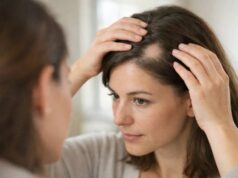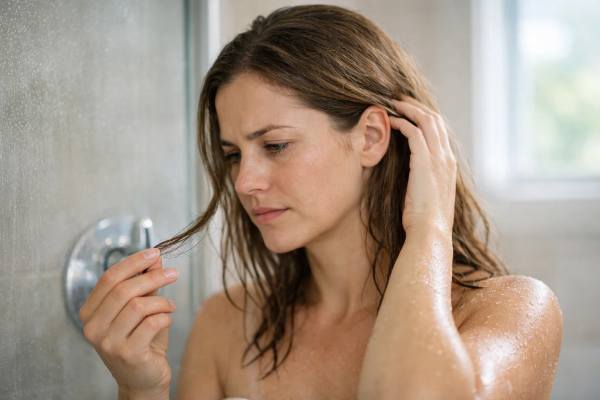
Hard water gets blamed for many bad hair days, and sometimes for hair loss itself. The truth is more specific and more useful. Hard water is water with higher levels of dissolved minerals, mainly calcium and magnesium. Those minerals can change how shampoo lathers, leave residue on the hair shaft, and make hair feel dull, stiff, rough, or harder to detangle. Over time, that can increase breakage and make thinning seem worse than it is.
That distinction matters. True hair loss begins at the follicle. Hard-water problems usually show up first in the fiber you can see and touch. The hair may snap more easily, lose softness, flatten at the roots, or turn frizzy and tangled at the ends. The scalp can also feel filmy, itchy, or harder to cleanse fully. Once you know what mineral buildup looks like, you can choose better solutions, from chelating cleansers to water treatment, and avoid mistaking shaft damage for a medical shedding disorder. For many people, the biggest win is not one miracle product. It is learning whether the shower itself is part of the problem.
Essential Insights
- Hard water most often causes buildup, roughness, and breakage-like damage rather than proven follicle-level hair loss.
- Mineral deposits can make hair feel coated, reduce shine, worsen tangles, and leave curls less defined even when the routine has not changed.
- Sudden shedding from the root, a widening part, or patchy loss usually points beyond hard water and deserves a broader evaluation.
- A chelating or clarifying wash every 1 to 4 weeks can help when buildup is recurring, especially if followed by a conditioner with good slip.
- The best test is a consistent 4- to 6-week trial: reduce mineral exposure, reset buildup, and compare your hair’s feel, breakage, and manageability.
Table of Contents
- Why hard water changes hair behavior
- Mineral buildup signs on hair and scalp
- Can hard water really cause hair loss
- How to tell if hard water is the culprit
- Solutions that actually help
- When to look beyond your shower
Why hard water changes hair behavior
Hard water is usually defined by a higher concentration of calcium and magnesium. In plumbing, those minerals leave scale on faucets, kettles, and shower doors. On hair, the effect is subtler but still noticeable. The mineral load does not sit on the follicle in the same way it forms crust on metal, but repeated washing can leave deposits and residue on the cuticle, the hair’s outer protective layer.
That outer layer matters more than many people realize. Healthy cuticles help hair feel smooth, reflect light, and resist excessive friction. When hair is repeatedly exposed to harsh conditions, whether from bleach, heat, friction, or environmental stress, the outer barrier becomes less even. Hard water can add another challenge by making cleansing less efficient and increasing the chance that hair feels coated even after it is washed. Shampoo may lather poorly, conditioner may not spread as evenly, and the hair can start to feel both dry and heavy at the same time.
This is one reason hard-water hair is so confusing. People often describe it with contradictions:
- Dry, yet hard to moisturize
- Flat at the roots, yet frizzy through the lengths
- Dull, yet somehow coated
- Tangled after washing, not before
- Stiff when air-dried, puffy when brushed
That pattern makes sense if you think of minerals and residue interfering with the hair surface. The issue is often less about “the hair cannot get moisture” and more about “the surface no longer behaves predictably.” Hair may become less flexible, less glossy, and more prone to friction where strands rub together. Friction matters because it increases snagging, and snagging increases breakage.
The effect is rarely uniform from root to tip. Newer growth near the scalp may feel relatively normal, while the mid-lengths and ends become rougher and more vulnerable. That is especially common in long hair, color-treated hair, and textured hair, where older sections have already seen more weathering. In those cases, mineral exposure may amplify an existing vulnerability rather than create a brand-new problem.
Hard water can also distort how you read your hair type. Buildup may make strands behave less absorbently or less evenly, which is one reason some people misread their needs around moisture and product weight. If your routine suddenly feels wrong, it can help to revisit how hair porosity affects product performance, because mineral deposits can make the surface behave differently than the underlying hair would on its own.
The big takeaway is simple: hard water mainly changes hair behavior at the shaft level. It alters feel, manageability, and breakage risk long before it proves anything about true scalp-level hair loss.
Mineral buildup signs on hair and scalp
Mineral buildup rarely announces itself with one dramatic symptom. More often, it shows up as a cluster of small frustrations that keep repeating no matter how carefully you wash or style.
The classic signs on hair include:
- Dullness that does not improve with conditioner
- A stiff, rough, or “squeaky” feel after rinsing
- Less slip during detangling
- More knots at the nape and ends
- Hair that looks heavy but still feels dry
- Curls or waves that lose definition faster
- Increased frizz, especially in humid weather
- Color-treated hair that looks faded or brassy sooner
- Greater breakage during brushing, washing, or styling
One of the most telling clues is a shift in how hair behaves after wash day. Instead of feeling fresh and soft, the hair may feel worse after cleansing. That often happens because minerals and soap residues interfere with rinsing, leaving a film behind. Some people notice their hair becomes harder to comb while wet, which is a high-risk moment for snapping and split ends.
Scalp signs are less specific, but they can still matter. The scalp may feel filmy, tight, or itchy after washing. Some people describe a “not truly clean” feeling at the roots, while others notice more flakes. The important nuance is that flakes do not automatically mean hard water. Dry scalp, dandruff, seborrheic dermatitis, contact irritation, and product residue can look similar at first. If the scalp is flaking, greasy, or inflamed, it helps to compare those patterns with the differences between dandruff and dry scalp rather than assuming minerals are the only cause.
Household clues often strengthen the case. If you see white scale on shower doors, crust on faucets, mineral rings in kettles, or soap that never lathers well, your hair may be dealing with the same water chemistry. Hard water often leaves its fingerprints all over the home before it shows up in the mirror.
The pattern also varies by hair type:
- Fine hair may feel limp, coated, and quick to flatten.
- Curly or coily hair may lose spring and become harder to clump cleanly.
- Bleached hair may feel even rougher and more fragile.
- Long hair often shows the problem most at the ends.
What mineral buildup does not usually do is create a sudden widened part, sharply patchy bald spots, or hair falling out from the root in large numbers. Those signs point elsewhere. Buildup is usually about texture, friction, manageability, and visible wear.
A helpful mental shortcut is this: if the complaint sounds like “my hair feels wrong,” hard water belongs on the list. If the complaint sounds like “my scalp is shedding hair from the root,” hard water may be only a side issue or not the issue at all.
Can hard water really cause hair loss
This is the question most readers actually mean when they search the topic, and it deserves a careful answer. The strongest case against hard water is not proven follicle damage. It is mineral buildup, roughness, and breakage that can look like hair loss from a distance.
That difference matters because breakage and shedding are not the same event. With breakage, the hair snaps somewhere along the shaft. You may see shorter broken pieces on clothing, around the sink, or near the crown and hairline. The ends look frayed, density seems worse, and the ponytail can feel thinner. But the follicle is still there. With true shedding, a full hair releases from the root, often with a small bulb at one end.
Hard water fits more convincingly into the breakage story than the shedding story. A mineral-coated, rougher hair shaft has more friction. More friction means more snagging when you wash, towel dry, brush, blow-dry, or wear the hair up. If the hair is already processed, sun-exposed, or heat-styled, hard water can act like a multiplier. It may not be the first injury, but it can make the existing one more obvious.
The research is more limited than many articles suggest. Small studies have found mineral pickup on hair and have linked hard water to worse feel or greater breakage risk under some conditions. At the same time, the direct evidence that hard water alone causes true follicular hair loss is weak. That is why confident claims that “hard water causes hair loss” are too broad. A more accurate statement is that hard water can make hair look thinner by increasing breakage, roughness, and visible scalp contrast.
That visible contrast is a big reason people panic. Dry, coated hair often clumps in a way that exposes more scalp under bright light. Curls lose definition. Fine hair separates into thinner sections. Roots sit flatter. All of that can imitate thinning even before actual breakage becomes severe.
The most practical question is not whether hard water is innocent or guilty in every case. It is whether it is the main driver of what you are seeing. A useful clue is where the “loss” shows up:
- Ends snapping or halo frizz suggest shaft damage.
- Hairline snap-off after styling suggests fragility and friction.
- More short broken hairs after detangling suggests breakage.
- A wider part or more hair with bulbs suggests true shedding or miniaturization.
This is why handling matters so much. If hard water has already made hair less forgiving, aggressive brushing and rough wet detangling can finish the job. Gentle technique becomes part of treatment, not an afterthought. When snagging is a daily issue, improving how you detangle wet versus dry hair can reduce the breakage that makes hard-water damage look more dramatic than it started.
Hard water can be a real problem. It just is not the same diagnosis as medical hair loss.
How to tell if hard water is the culprit
Hard water is easiest to identify when the timing and the pattern line up. If your hair changed noticeably after moving homes, switching from city to well water, renovating plumbing, or traveling for long stretches, the shower deserves suspicion. The same is true if your skin feels drier, soap lathers poorly, and scale suddenly appears on bathroom fixtures.
A few clues make hard water more likely:
- Your hair felt better in another location with a different water supply.
- The problem began without a major change in hormones, health, or medication.
- The hair feels coated and rough more than it sheds from the root.
- Clarifying temporarily helps, but the problem returns quickly.
- The household shows visible mineral scale.
A few clues make it less likely to be the whole explanation:
- Hair is falling from the root in large numbers.
- The part is widening month by month.
- You have patchy loss, eyebrow thinning, or scalp pain.
- A recent illness, childbirth, restrictive diet, or medication change lines up better with the timing.
- The scalp is persistently inflamed, greasy, or thickly flaky.
The best home test is not a sink experiment with a strand of hair. It is a controlled trial. For 4 to 6 weeks, change only the variables that target mineral exposure. Use a chelating or clarifying wash on schedule, follow with a good conditioner, reduce rough brushing, and limit extra damage from high heat. If possible, wash in a different water source for part of that period or install a treatment device intended to address hardness. Then compare your hair’s slip, shine, tangling, and breakage. Hard-water problems often respond quickly in feel, even if damaged ends take longer to look better.
Wash frequency matters here too. If buildup is part of the issue, waiting too long between washes may make the hair feel worse, not better. Yet over-cleansing with harsh surfactants can dry the shaft further. The answer is not “wash more” or “wash less” in the abstract. It is matching your cleansing rhythm to your scalp and residue load. A guide to how often to wash based on scalp type can help you run that experiment more intelligently.
You can also test the water itself through local utility reports, home test strips, or lab kits if you are on private well water. That is useful when you are deciding whether to invest in a more permanent solution.
The biggest diagnostic mistake is blaming hard water for every hair problem at once. Many people have more than one issue: mineral buildup plus bleach damage, hard water plus seborrheic dermatitis, or hard water plus true androgen-related thinning. The goal is not to force one answer. It is to identify how much of the problem improves when the mineral piece is managed well.
Solutions that actually help
The best hard-water routine does two jobs: it removes mineral residue without over-stripping the hair, and it protects the shaft so new buildup causes less friction the next time you wash.
Start with cleansing strategy. For most people, the most useful reset is a chelating or clarifying shampoo used regularly but not mindlessly. Chelating formulas are designed to bind mineral residues more effectively than a standard moisturizing shampoo. A reasonable schedule is every 1 to 4 weeks, depending on how hard your water is, how often you wash, whether you swim, and how much styling product you use. Very severe buildup may need a weekly reset for a short period, while lightly affected hair may need it only once or twice a month. If you need a framework, this guide to when and how often to clarify is a helpful starting point.
After clarifying, conditioning matters even more. Use a conditioner with strong slip and let it sit for several minutes instead of rinsing it off instantly. Hair that has been roughened by minerals benefits from reduced friction. Leave-in conditioner or a light serum on the mid-lengths and ends can help keep strands from catching on each other between wash days.
A strong hard-water plan often includes:
- A chelating or clarifying shampoo on a set schedule
- A regular gentle shampoo for other wash days
- A conditioner with enough slip for your strand size
- A leave-in or serum on the lengths and ends
- Lower-friction detangling and less aggressive towel drying
- Consistent heat protection when styling
Water treatment is the other half of the equation. A true softening system addresses the water supply itself, while other devices may reduce scale formation or improve other water characteristics. The important point is that not every filter is designed to treat hardness, so buying the first shower attachment you see is not the same as solving a calcium and magnesium problem. In homes with severe hardness, a certified water softener or conditioner may be the most effective long-term option, though cost, maintenance, and local restrictions can matter.
What about home remedies? Acidic rinses may temporarily improve feel for some people, but they do not replace a real chelating cleanse when buildup is heavy. Bond-building and repair products can also help if the hair is already damaged, but they work best after residue is controlled. Otherwise, they are trying to smooth over a surface that keeps getting recoated. When roughness persists even after you remove minerals, targeted repair for damaged hair can become the next step.
The best sign that your plan is working is not instant shine. It is less tangling, easier detangling, fewer snapped hairs, cleaner-feeling roots, and hair that responds to conditioner again.
When to look beyond your shower
Hard water is a real source of hair frustration, but it is also a convenient scapegoat. If the pattern points to a scalp or systemic issue, focusing only on water quality can delay the right diagnosis.
Look beyond hard water when you notice:
- Sudden shedding from the root, especially 2 to 3 months after illness, surgery, stress, or rapid weight loss
- A widening part or more scalp at the crown
- Patchy bald spots
- Eyebrow or eyelash thinning
- Scalp pain, burning, pustules, or thick scale
- Major hormonal clues such as irregular periods, new facial hair, or menopausal change
- No improvement after a careful 4- to 6-week hard-water trial
These patterns suggest conditions such as telogen effluvium, androgenetic thinning, alopecia areata, scalp inflammation, or traction-related loss. Hard water may still be making the hair feel worse, but it is not likely to be the primary cause of the lost density.
The scalp deserves special attention. Mineral buildup can make the scalp feel uncomfortable, but persistent itch, heavy flaking, or tenderness often means something more than water chemistry. Seborrheic dermatitis, psoriasis, eczema, and contact irritation can all damage comfort and worsen hair quality. If your scalp symptoms are taking center stage, it is worth reading about itchy scalp causes and when to worry rather than assuming the shower is the only problem.
Another clue is the location of the damage. Hard-water breakage tends to show up where hair is older or more manipulated: the ends, the nape, the crown surface, and around the face. True pattern hair loss tends to reshape the density map of the scalp itself. The ponytail shrinks. The central part widens. The temples or crown thin in a persistent pattern. Those changes are less about hair feel and more about follicle output.
There is also a psychological trap here. When a problem has an obvious household culprit, it feels easier to blame than hormones, genetics, or inflammation. That is understandable. But hair does not care which explanation feels simpler. It responds to the real one.
A balanced rule works well: if changing the water or cleansing strategy clearly improves softness, tangling, and breakage, keep treating hard water as part of the equation. If hair density still seems to be falling, move upstream and assess the scalp and the body, not just the shower head.
Hard water can absolutely make hair look and act worse. It just should not stop you from recognizing true hair loss when it is happening.
References
- WaterSense Guide to Selecting Water Treatment Systems 2025 (Official Guidance)
- Scanning Electron Microscopes/Silicon Drift Detector-Energy Dispersive Spectroscopy: An Analytical Tool to Identify Waterborne Microminerals Pickup in Human Scalp Hair Cuticle due to Water Quality 2018 (Original Study)
- On Hair Care Physicochemistry: From Structure and Degradation to Novel Biobased Conditioning Agents 2023 (Review)
- The exposome impact on hair health: etiology, pathogenesis and clinical features ‒ Part I 2025 (Review)
- To Evaluate and Compare Changes in Baseline Strength of Hairs after Treating them with Deionized Water and Hard Water and its Role in Hair Breakage 2018 (Original Study)
Disclaimer
This article is for educational purposes only and is not a substitute for medical advice, diagnosis, or treatment. Hard water can contribute to mineral buildup, roughness, and breakage, but persistent shedding, patchy loss, scalp inflammation, or progressive thinning may reflect a medical or dermatologic condition that needs professional evaluation. Seek care promptly if hair loss is sudden, painful, scarring, or associated with other symptoms such as fatigue, menstrual changes, or significant scalp redness.
If this article clarified the difference between buildup and true hair loss, please share it on Facebook, X, or another platform your audience uses most.