Heat protectant spray is one of the few styling products that can make a visible difference before damage becomes obvious. Used well, it helps reduce roughness, frizz, breakage, color dulling, and that dry, brittle feel that builds up after repeated blow-drying or flat ironing. Used poorly, it can create false confidence: the hair still feels coated, but the protection is uneven, the temperature is too high, or the same sections are being overheated again and again.
What makes this topic confusing is that heat protectants do not “block” heat in the absolute sense. They work by creating a thin conditioning film, improving slip, slowing moisture loss, and helping the hair shaft tolerate styling stress more gracefully. That is useful, but it is not magic. The best results come from combining the right formula with the right tool setting and the right amount of product.
If you understand those three pieces, you can choose smarter labels, apply less guesswork, and style with far less cumulative damage over time.
Essential Insights
- Heat protectant spray can reduce cuticle roughness, frizz, and breakage, but it does not make very high heat harmless.
- The most useful formulas usually rely on silicones, conditioning polymers, and slip-enhancing ingredients rather than oils alone.
- Even coverage matters more than a heavy coating, because missed sections still take the full force of the tool.
- A protectant should be paired with lower tool settings on damaged, bleached, fine, or high-porosity hair.
- Start with a light, even mist on mids and ends, then add only enough product for full coverage without damp patches or tacky buildup.
Table of Contents
- What Heat Protectant Spray Actually Does
- How Heat Damages the Hair Shaft
- Best Ingredients and What They Do
- How Much to Use and How to Apply It
- Mistakes That Make Protection Fall Short
- Choosing the Right Formula for Your Hair
What Heat Protectant Spray Actually Does
A heat protectant spray does not create an invisible shield that lets you style without consequences. What it does, when formulated well, is lower the mechanical and thermal stress the hair fiber experiences during styling. That difference matters because most daily heat damage is cumulative. It comes from repeated exposure, repeated combing, repeated friction, and repeated water loss rather than from one dramatic event alone.
The hair shaft is made of an outer cuticle and a deeper cortex. A protectant spray works mostly at the surface first. It coats the cuticle with conditioning agents that improve smoothness, reduce friction between strands, and help the tool move more evenly across the hair. That matters because rougher contact and snagging increase localized damage, especially at the same bent or weak spots.
A good spray can help in four main ways:
- It forms a thin film that reduces direct surface stress.
- It improves slip, so brushing and tool movement cause less tugging.
- It slows excessive moisture loss during styling.
- It helps the hair look smoother and shinier after heat, which reduces the need for extra passes.
This is why a protectant often makes hair feel better even when it cannot fully stop internal heat damage. Better glide and lower friction alone can reduce breakage. Some polymer-based pretreatments have also been shown to reduce heat-related keratin damage and combing breakage after flat ironing, which supports the basic logic behind these formulas.
Still, limits matter. A spray cannot fully compensate for a flat iron that is too hot, a blow-dryer held too close, or six slow passes over the same section. In real life, the product is one part of the system, not the whole system. That is especially important if your hair is already bleached, chemically straightened, fragile, or prone to snapping. In those cases, heat damage stacks on top of existing weakness, and even a good spray can only reduce, not erase, the risk. If repeated styling has already left the fiber rough and weakened, a guide to bond repair for damaged hair can help explain why protection and repair are not the same thing.
The most useful way to think about heat protectant spray is this: it is damage control, not damage immunity. That may sound less glamorous than product marketing, but it is more helpful. The best outcome is not just glossy hair on the day of styling. It is fewer split ends, less roughness, and more resilient texture after weeks and months of regular heat use.
How Heat Damages the Hair Shaft
Hair does not have living repair cells along the visible shaft. Once the cuticle is chipped, cracked, or lifted, the fiber cannot truly heal itself. That is why heat damage deserves respect even when it starts subtly. The early signs are not always dramatic. More often, the hair slowly loses gloss, softness, elasticity, and shape retention before obvious breakage appears.
Thermal damage affects both surface structure and internal moisture balance. At the cuticle level, repeated heat can lift or split the overlapping scales that normally protect the cortex. Once that surface becomes rougher, strands catch on one another more easily, reflect light less evenly, and feel drier. Inside the fiber, excessive heat can disturb protein structure and reduce the hair’s ability to manage moisture well. Over time, that combination raises brittleness and snapping risk.
Different tools stress the hair differently. Blow-dryers create moving hot air and can still damage the cuticle, especially when used at high temperature very close to the shaft. Flat irons and curling tools create more concentrated contact heat, which is why they are more likely to produce localized overheating. Many flat irons operate above 200°C, which is far beyond what compromised hair tolerates well.
A few practical patterns matter:
- Wet or damp hair is more vulnerable to rough handling.
- Chemically treated hair reaches the damage threshold faster.
- Fine hair usually needs less heat than coarse hair.
- Repeated passes often matter more than one controlled pass.
- Ends and older lengths are more fragile than hair near the scalp.
This is also why some kinds of heat damage have characteristic appearances. One example is the bubble-like structural change that can happen when hair is heated too intensely while moisture conditions are unfavorable. If you want a closer explanation of that pattern, heat-related bubble hair damage is a useful reference point.
Heat interacts with grooming habits too. Tension from a round brush, rough towel drying, and aggressive detangling can magnify the damage created by the hot tool itself. A dryer used carefully at a distance with continuous motion is very different from pressing concentrated heat into one section while pulling hard at the same time.
Interestingly, one hair-dryer study found that blow-drying with continuous motion at a moderate distance caused less damage than prolonged natural drying under certain conditions, likely because the hair did not stay swollen with water for as long. That does not mean hot drying is automatically better. It means technique matters. Heat is not just about temperature on the dial. It is about distance, contact time, repetition, and the starting condition of the hair.
Once you understand damage this way, heat protectant spray makes more sense. It is trying to reduce friction, smooth the cuticle, and limit some of the downstream effects of thermal stress. But if the styling setup is too aggressive, no mist can fully rescue the fiber.
Best Ingredients and What They Do
When you read a heat protectant label, the most useful question is not whether it says “protects up to 450°F.” Many products make similar temperature claims. The more informative question is which ingredient families are doing the work and whether they fit your hair type.
The most consistently useful group is silicones. These ingredients form lightweight films that reduce friction, smooth the surface, improve slip, and help the hair feel less dry after styling. Common examples include dimethicone, amodimethicone, dimethiconol, phenyl trimethicone, and cyclopentasiloxane. Some are heavier, some lighter, and some are used mainly as carriers that help spread the film more evenly. Silicones are often criticized online, but in heat styling they are among the most rational ingredients because they improve manageability and reduce direct surface stress.
The second important group is conditioning polymers. These include ingredients such as polyquaterniums, acrylate copolymers, and related film-formers. Certain polymer pretreatments have shown protective effects against hot-tool damage and combing breakage. In practical terms, they help keep the protective layer more uniform and can improve the way the hair tolerates repeated styling.
Other useful support ingredients include:
- Hydrolyzed proteins and amino acids, which can improve feel and support weakened hair, though they are not stand-alone heat shields.
- Panthenol and humectants, which can support softness and flexibility in the right formula.
- Light oils and esters, which can improve glide and reduce roughness, especially in richer formulas.
- Cationic conditioning agents, which are attracted to damaged areas and can improve smoothness where the fiber is most compromised.
What matters is the whole formula, not a single trendy ingredient. For example, argan oil alone is not the same as a well-built heat protectant system. Oils can help with slip and softness, but they usually do not replace the combined film-forming and conditioning action of silicones and specialized polymers in a dedicated protectant. That is one reason simple oiling before flat ironing often disappoints.
A few label-reading clues help:
- If the first useful actives are mostly lightweight silicones and conditioning agents, the product is likely focused on slip and thermal styling.
- If the formula is mostly botanical extracts with little film-forming support, expect lighter cosmetic benefits and weaker protection.
- If your hair is very damaged, ingredients that also support softness and flexibility may matter as much as the heat claim itself.
Ingredient balance also changes the feel. Some sprays are very light and suit fine hair. Others behave more like serum-in-a-mist formulas and suit dense, coarse, or frizz-prone hair. If your hair already struggles with chronic dryness, a broader moisture routine for dry and frizzy hair often matters alongside thermal protection, because no spray can fully compensate for an underconditioned fiber.
The best ingredient list, then, is not the longest one. It is the one that combines proven film-formers with the right weight and finish for how your hair behaves in real life.
How Much to Use and How to Apply It
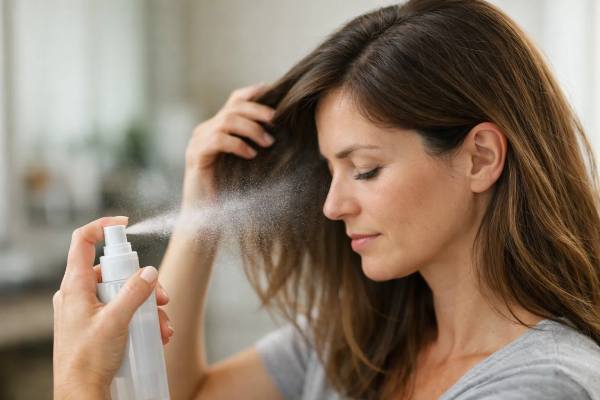
Most people either underapply heat protectant spray or use so much that the hair feels coated, damp, or sticky. The goal is not saturation. It is even coverage. You want a light, continuous film over the sections that will be exposed to heat, especially the mids and ends, which are older and more fragile than the hair close to the scalp.
Because spray nozzles vary a lot, there is no perfect universal number of sprays. A fine aerosol mist delivers differently from a pump spray, and a concentrated cream spray behaves differently from a watery detangler. That said, a practical starting point works better than guesswork.
A useful starting guide is:
- Short or fine hair: about 4 to 6 light sprays total
- Medium length hair: about 6 to 10 light sprays total
- Long, dense, or coarse hair: about 10 to 15 light sprays total, applied in sections
These are not strict doses. Think of them as a coverage check. After applying, the hair should feel lightly conditioned and slightly smoother, not soaked. If you see wet patches, hear sizzling on contact with a hot tool, or notice tacky buildup, you likely used too much or did not let the product distribute and dry properly.
Application order matters too.
- Detangle gently first.
- Section the hair so the product lands evenly.
- Spray from several inches away rather than pressing the nozzle against one spot.
- Focus on mids and ends, then use whatever remains on your hands or brush for the outer surface.
- Comb or brush through once to distribute.
- Let the product settle before high heat, especially with flat irons.
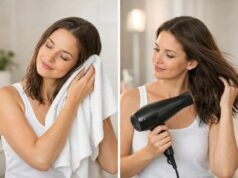
For blow-drying, most sprays work best on damp, towel-blotted hair rather than dripping-wet hair. For flat irons or curling tools, the hair should usually be fully dry before the plates or barrel touch it unless the tool is specifically designed for damp styling. Using an iron on damp hair is a common route to more damage, not faster styling.
Technique matters as much as quantity. Keep the dryer moving and avoid concentrating heat at the same distance for too long. If you are deciding between air-drying and blow-drying routines, the trade-offs in air-drying compared with blow-drying damage are worth understanding, because “less heat” is not always the whole story.
The best test is the result after styling. Hair that feels smooth, flexible, and light usually got enough product. Hair that feels unprotected, rough, or tangly may not have gotten enough. Hair that feels coated, limp, or greasy may have gotten too much. Good heat protection is usually subtle. It should improve the behavior of the hair without making the product itself the main event.
Mistakes That Make Protection Fall Short
A heat protectant can be well formulated and still disappoint if the styling routine around it is too harsh. Most failures come from application gaps, unrealistic heat settings, or habits that create more stress than the product can offset.
The first common mistake is using the protectant as permission to turn the tool all the way up. Many people see “up to 450°F” and assume that is the best or safest setting. It is not. Those claims are usually marketing shorthand, not a promise that your hair can tolerate repeated styling at the highest temperature without damage. Fine, bleached, highlighted, high-porosity, or already weakened hair usually needs lower heat, not just more spray.
The second mistake is missing sections. A few sprays over the top layer can make the hair smell nice and feel slightly smoother, but it does not help the inner layers that still take the full heat load. This is especially common in thick hair. Sectioning takes longer, but uneven coverage is one reason people say a protectant “did nothing.”
The third mistake is using multiple hot passes. Even a decent protectant loses the argument when the same section is ironed again and again because the tool is too cool for the hair type, the section is too wide, or the hair was not dried and tensioned properly first. In other words, both too much heat and too many passes can cause problems.
Other easy-to-miss issues include:
- Applying a spray too close to the hair so one area gets soaked
- Flat ironing before the product has distributed evenly
- Layering several heavy stylers until the hair feels coated
- Using a protectant but skipping regular trims on already frayed ends
- Assuming oils alone can replace a true heat protectant system
- Styling damaged hair daily without adjusting temperature downward
Another source of confusion is when the problem is not true heat damage at all. Dryness, roughness, and snapped strands may reflect both thermal stress and mechanical breakage from brushing, bleaching, friction, or poor detangling habits. If you are trying to sort out whether your issue is damage along the shaft rather than shedding from the root, hair breakage compared with hair loss can help clarify what you are seeing.
The final mistake is expecting a protectant to repair old damage. It can improve feel and reduce future wear, but it does not rebuild an intact cuticle overnight. That is why a product can work exactly as intended and still not make severely overprocessed ends look healthy.
A strong routine is built on moderation: enough product for coverage, low enough heat for the fiber, and few enough passes that the hair is not repeatedly challenged. When those basics are in place, the protectant has a fair chance to do its job.
Choosing the Right Formula for Your Hair
Not every heat protectant spray should feel the same. A formula that works beautifully on coarse, dry, color-treated hair may flatten fine hair within minutes. A mist that feels weightless on straight hair may be far too light for dense curls that need more lubrication and humidity control. The best choice is the one that gives enough protection without creating new styling problems.
For fine or low-density hair, look for lightweight sprays with thinner textures, lighter silicones, and minimal residue. You want slip and smoothness without collapse. Heavy oil-rich formulas can make fine hair look separated and greasy, which often leads people to use more heat later to “fix” the shape.
For medium to thick straight or wavy hair, a classic spray or spray-serum hybrid often works best. These formulas usually balance film-formers, silicones, and conditioning agents well enough to support both blow-drying and occasional ironing.
For coarse, curly, coily, bleached, or high-porosity hair, richer leave-ins, cream sprays, or layered protectants may perform better than ultra-light mists. These hair types often benefit from extra lubricity and conditioning because the fiber already loses moisture more easily and may have more surface irregularity. The formula should still spread evenly, but it does not need to feel as invisible.
A few selection rules help:
- Choose lighter formulas for volume and bounce.
- Choose richer formulas for frizz control and repeated blowouts.
- If you heat-style only on dry second-day hair, consider whether the product is intended for dry use as well as damp use.
- If your scalp is easily irritated, keep the product focused on lengths rather than spraying heavily at the roots.
It also helps to be realistic about what the formula can and cannot do. A spray can reduce thermal stress, but it will not protect hair from every other source of weathering. Sun, chlorine, rough towel drying, frequent bleaching, and heavy mechanical tension all add to the same wear pattern. If your lengths already feel chronically dry after summer or pool exposure, broader protection habits such as UV protection for the hair fiber matter too.
One final point is worth keeping in mind: the best heat protectant is often the one you will actually use correctly every time. A technically excellent product that feels sticky, smells overpowering, or leaves residue may sit on the shelf. A lighter product that you apply consistently and pair with smart heat settings may protect your hair better in practice.
The right formula should make styling easier, not more complicated. If your hair is smoother with fewer passes, feels less brittle after repeated wash days, and keeps more of its softness between trims, the product is doing what it is supposed to do.
References
- With or without Silicones? A Comprehensive Review of Their Role in Hair Care 2025 (Review)
- On Hair Care Physicochemistry: From Structure and Degradation to Novel Biobased Conditioning Agents 2023 (Review)
- Hair Cosmetics for the Hair Loss Patient 2021 (Review)
- Hair Shaft Damage from Heat and Drying Time of Hair Dryer 2011
- The effect of various cosmetic pretreatments on protecting hair from thermal damage by hot flat ironing 2011
Disclaimer
This article is for educational purposes only and is not a substitute for personal medical or professional hair care advice. Heat damage, breakage, scalp irritation, and sudden changes in hair texture can have more than one cause, including chemical processing, grooming habits, and underlying hair or scalp conditions. If your hair is snapping easily, your scalp is irritated, or you have sudden thinning or patchy loss, seek evaluation from a qualified dermatologist or other licensed clinician.
If this article helped you, please share it on Facebook, X, or another platform your readers and clients use most.