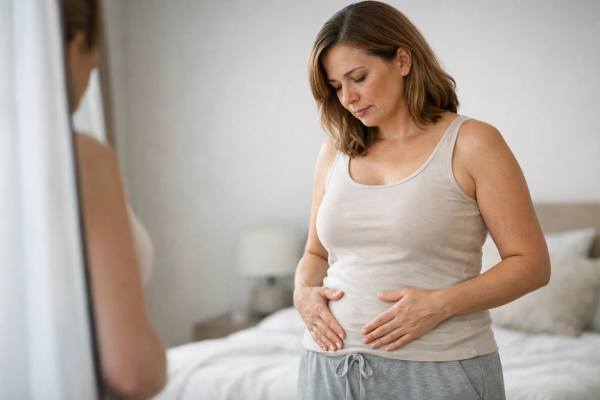
People often use the phrase “hormone belly” to describe a stubborn midsection that feels puffier, softer, larger, or suddenly unfamiliar. Sometimes the change is real fat gain. Sometimes it is bloating that rises and falls over the course of a day. Sometimes it is fluid retention, constipation, posture, or a mix of several things at once. That is part of what makes the term so frustrating: it sounds specific, but it is not a medical diagnosis.
Hormones do influence where fat is stored, how hungry you feel, how sensitive your body is to insulin, and how likely you are to retain fluid or feel bloated. But not every change around the waist is caused by a hormone disorder, and not every hormone-related change looks the same. The useful question is not whether a “hormone belly” is real in a social-media sense. It is whether the change reflects bloating, weight gain, a true endocrine issue, or a pattern that needs medical attention.
Quick Summary
- Midsection changes can come from bloating, fat gain, fluid retention, constipation, or a combination rather than one single hormone problem.
- Hormones can shift appetite, insulin sensitivity, and fat distribution, especially during menopause, with insulin resistance, or in conditions such as PCOS.
- A waistline that changes within hours is more likely to reflect bloating or fluid than body fat.
- Rapid abdominal swelling, severe pain, vomiting, blood in the stool, or unexplained weight loss should not be dismissed as “just hormones.”
- Track morning and evening waist changes, bowel habits, cycle patterns, and symptoms for two to four weeks before assuming the cause.
Table of Contents
- What Hormone Belly Usually Means
- Bloating vs True Weight Gain
- Hormones That Shift Fat
- Everyday Triggers That Mimic It
- What to Track and Test
- What Actually Helps
What Hormone Belly Usually Means
“Hormone belly” is not a formal medical term. In everyday use, it usually means one of three things: visible abdominal bloating, true fat gain around the waist, or a body-composition shift that makes the midsection look different even when body weight has not changed dramatically. Many people assume these are the same. They are not.
Bloating is often a feeling first. The abdomen may feel tight, pressurized, stretched, or full. Some people also develop visible distension, meaning the abdomen actually measures larger or looks more swollen, especially by evening. Fat gain is different. It tends to develop gradually over weeks to months and is usually less variable from morning to night. Body-composition change sits somewhere in between. A person may lose muscle, gain visceral fat, and notice a thicker waist even if the scale has not moved much.
Hormones matter because they influence all three pathways. They affect appetite, blood-sugar handling, fluid balance, digestive motility, and fat distribution. Estrogen shifts can change where fat is stored. Insulin resistance can promote central fat accumulation. Thyroid disease can slow gut movement and contribute to constipation or fluid retention. Stress hormones can affect sleep, cravings, activity levels, and meal timing in ways that indirectly change the midsection. But hormone involvement does not mean a serious endocrine disorder is always present.
That distinction matters because the internet often treats any lower-abdominal or waistline change as proof of “hormonal imbalance.” In real life, a big dinner, constipation, a menstrual cycle phase, a sedentary week, poor sleep, or more ultra-processed food can produce symptoms that feel very hormonal without revealing a new diagnosis. On the other hand, some true endocrine conditions do show up first as a changing waistline, especially when other clues travel with it.
A more useful framework is to ask four practical questions:
- Did the change happen within hours, days, or months?
- Does it fluctuate between morning and evening?
- Does it feel tight and pressurized, or more like tissue gain?
- Are there other symptoms such as irregular periods, hot flashes, constipation, acne, facial hair growth, fatigue, or rising blood sugar?
These questions do not replace testing, but they move the conversation forward. The goal is to stop treating “hormone belly” as one mysterious thing and instead separate sensation, appearance, and physiology. Once you do that, the next steps become much clearer. A belly that feels swollen after meals is a different problem from a waist that has expanded slowly over six months. Both can involve hormones, but they do not point to the same fix.
Bloating vs True Weight Gain
The fastest way to make sense of a changing midsection is to tell apart bloating and true weight gain. They can overlap, but they behave differently. Bloating tends to be more dynamic. Weight gain is more persistent.
Bloating often builds through the day. Clothes may fit in the morning and dig in by late afternoon. The abdomen may look rounded after meals, feel firm or pressured, and improve overnight. Some people describe it as “looking several months pregnant by evening.” Gas, constipation, delayed gut transit, food intolerance, pelvic-floor dysfunction, and functional gut disorders can all contribute. Visible distension may happen with or without a large amount of actual gas. Sometimes the issue is more about how the abdominal wall and diaphragm respond than about trapped air alone.
True fat gain is different. It does not appear after lunch and disappear by breakfast. It tends to show up as a steadier change in waist circumference, how clothes fit, and how tissue feels when you press on it. Central fat can be subcutaneous, meaning just under the skin, or visceral, meaning deeper around the organs. Visceral fat is the metabolically riskier kind, but you cannot diagnose it by appearance alone. A protruding abdomen can reflect bloating, weak abdominal support, posture, or subcutaneous fat and still not say much about visceral fat without broader context.
Fluid retention can blur the picture. Some people hold more fluid before a period, during hormonal medication changes, or after a high-salt, low-sleep, high-stress stretch. That can make the abdomen, hands, or face look puffier without representing true fat gain. Constipation can do the same. So can slowed digestion from inactivity or low fiber intake.
A few home clues are often useful:
- If your abdomen changes noticeably within the same day, bloating is more likely than fat gain.
- If the scale rises and falls quickly with abdominal tightness, fluid or digestive factors are more likely.
- If waist size has increased over months and stays increased even first thing in the morning, fat gain is more likely.
- If bowel habits, meal size, or specific foods reliably trigger swelling, the gut deserves attention.
One common mistake is assuming that any roundness in the lower abdomen must be fat. Another is assuming that any discomfort must be “just bloating.” Real weight gain can happen at the same time as chronic bloating, especially during life stages marked by sleep disruption, less movement, and changing insulin sensitivity. That is why midsection changes often feel so hard to decode.
In practice, the most useful first step is not to force yourself into one category too early. It is to observe pattern and timing. A waistline that changes by bedtime tells a different story from one that has been drifting upward for a year. The body usually gives clues if you watch long enough and in a structured way.
Hormones That Shift Fat
Some hormones truly do change where fat is stored and how easily the waistline grows. But their effects are not equal, and they are not all equally common. When people say “hormone belly,” the most relevant hormone patterns usually involve estrogen shifts, insulin resistance, and, less often, thyroid or cortisol disorders.
Menopause is one of the clearest examples. As estrogen declines, body composition often shifts toward more central fat storage even if total body weight does not rise dramatically at first. Aging and lower activity levels add to the effect, but menopause changes fat distribution in a way many women notice around the waist. This is one reason midlife body changes can feel sudden even when the process has been building quietly for several years.
Insulin resistance is another major driver. When the body becomes less responsive to insulin, it tends to handle glucose and energy storage less efficiently. Appetite can change, cravings may increase, and abdominal fat accumulation becomes more likely. In reproductive-age women, insulin resistance often overlaps with PCOS. That does not mean every person with a changing waist has PCOS, but it does explain why acne, cycle changes, scalp hair thinning, or facial hair growth should not be ignored. For a closer look at that overlap, it helps to understand how PCOS and insulin resistance are connected.
Thyroid disease can contribute too, though it is often oversold online. Hypothyroidism can cause some weight gain, usually modest, and may worsen constipation, slowed digestion, and fluid retention. That can make the abdomen feel heavier or more swollen. But classic large central fat gain is not usually caused by thyroid disease alone. If the midsection is changing and fatigue, cold intolerance, dry skin, and constipation are also showing up, thyroid testing becomes more relevant.
Cortisol is the hormone people invoke most often, but it needs nuance. Chronic stress can influence abdominal fat indirectly by worsening sleep, increasing snacking, changing activity patterns, and nudging the body toward insulin resistance. True endocrine cortisol excess, such as Cushing syndrome, is much rarer. It usually comes with more than a thicker waist. Purple stretch marks, easy bruising, muscle weakness, facial rounding, new high blood pressure, and rising blood sugar make that possibility more important.
In men, low testosterone can promote more central fat storage over time, though it is usually one piece of a larger picture that includes reduced muscle mass, lower energy, and metabolic changes. In women, androgen excess can contribute to a more central fat pattern, particularly when paired with insulin resistance.
The main point is this: hormones can shift midsection shape, but the body rarely changes in silence. When abdominal change comes with broader patterns, the hormonal explanation becomes more believable. When it appears alone and fluctuates quickly, bloating or lifestyle factors are often playing a larger role.
Everyday Triggers That Mimic It
Many midsection changes blamed on hormones are at least partly driven by ordinary habits, digestive patterns, or life changes that do not amount to a new endocrine diagnosis. That does not make the symptoms less real. It just changes what is most likely to help.
Meal composition is a common culprit. Large meals, fast eating, carbonated drinks, sugar alcohols, and highly processed foods can all increase bloating. Some people also react to poorly absorbed carbohydrates that ferment in the gut and pull water into the intestines. Others simply notice that days with less routine, more restaurant meals, or more snacking lead to a tighter abdomen by evening.
Constipation is another huge and underestimated factor. A person can feel bloated, heavy, and visibly distended even when weight has not truly changed. Slower bowel transit can be influenced by dehydration, low activity, low fiber, stress, thyroid disease, or abrupt changes in diet. This is one reason a “hormone belly” sometimes improves when bowel habits improve.
Sleep and stress deserve a place here too. Poor sleep can increase appetite, reduce impulse control around food, lower energy for physical activity, and alter glucose regulation. Stress can make people eat later, move less, crave more calorie-dense foods, and hold more muscle tension in the abdomen. These are not imaginary pathways. They are real physiology, but they are not the same as a rare endocrine disorder. Midlife changes in blood-sugar handling can intensify this cycle, especially if you are already seeing signs of midlife insulin resistance.
Muscle loss and posture matter more than many people realize. Less muscle mass means a lower resting energy expenditure over time, and a weaker trunk can make the abdomen project more even at the same body weight. That is one reason “my belly suddenly sticks out” can happen during sedentary periods, after injury, during menopause, or after major schedule disruption without any single hormone test coming back dramatic.
Medication changes also deserve attention. Hormonal contraception, menopausal hormone therapy adjustments, steroids, some antidepressants, constipation-causing medications, and drugs that shift appetite can all affect the midsection directly or indirectly. Alcohol can do the same by worsening sleep, lowering food restraint, and adding energy without much satiety.
A simple way to think about it is this: hormones often create the background, while everyday patterns decide how loud the effect becomes. Someone in midlife may be more vulnerable to central fat gain, but late eating, lower movement, less protein, poor sleep, and constipation often turn vulnerability into something visible. That is why the best evaluation of “hormone belly” looks at hormones and habits together rather than pretending they live in separate worlds.
What to Track and Test
Before ordering broad hormone panels or buying at-home tests, it helps to track the pattern of change. A simple two- to four-week record is often more informative than a single anxious memory of “I feel bloated all the time.” What matters is consistency.
Useful things to track include:
- morning and evening waist measurement at the same spot
- whether the abdomen feels soft, tight, or painful
- bowel habits and whether you feel fully emptied
- foods or meal sizes that seem to trigger swelling
- menstrual cycle timing, if relevant
- sleep duration and stress level
- body weight one to three times per week, not multiple times a day
- associated symptoms such as fatigue, cycle changes, hot flashes, acne, facial hair growth, or cold intolerance
This kind of record helps separate true day-to-day distension from slower fat gain. It also makes doctor visits far more productive.
Testing should be targeted, not scattershot. If the main picture is gradual waist gain with fatigue, blood-sugar concerns, or a strong family history of diabetes, metabolic testing may be more useful than a large hormone panel. If periods are irregular, acne or facial hair has increased, or fertility is a concern, androgen and ovulatory issues become more relevant. If constipation, cold intolerance, and dry skin are prominent, thyroid testing makes more sense. If you end up needing thyroid labs, it is worth knowing how to prepare for thyroid testing properly so the results are easier to interpret.
Typical first-line evaluation may include some combination of:
- waist circumference and blood pressure
- fasting glucose or A1C
- lipid panel
- TSH, sometimes with free T4
- pregnancy testing when relevant
- selective reproductive hormone testing if cycles or androgen symptoms suggest it
- cortisol testing only when there are strong clues, not because belly fat alone exists
Red flags should push the evaluation beyond a “hormone belly” conversation. Seek medical attention sooner if abdominal swelling is progressive and persistent, if there is severe pain, vomiting, blood in the stool, black stools, unexplained weight loss, marked shortness of breath, fever, or a firm new mass. Postmenopausal bleeding, rapid-onset facial hair growth, or easy bruising with muscle weakness also deserve real evaluation.
The key is not to test everything. It is to test the right things based on pattern. A structured history often answers half the question before any blood draw happens. And when symptoms are clearly escalating, targeted medical assessment is far more useful than cycling through trendy hormone explanations online.
What Actually Helps
What helps a changing midsection depends on whether the main problem is bloating, fat gain, or both. That sounds obvious, but it is the point most people miss. The plan that helps bloating is not always the same plan that helps central adiposity.
If bloating is the dominant issue, focus first on digestion, meal pattern, and bowel regularity. Eating more slowly, reducing large evening meals, limiting carbonated drinks, checking sugar alcohol intake, and walking after meals can help. Constipation deserves direct attention with hydration, activity, and a sensible fiber strategy. For some people, fiber helps quickly. For others, especially if added too aggressively, it can worsen symptoms before it improves them. A practical overview of how to increase fiber without making digestion harder can be useful when bloating and blood-sugar concerns overlap.
If true fat gain is the main issue, the most effective approach is rarely a hormone detox. It is a combination of steady nutrition, resistance training, enough protein, better sleep, and improved metabolic health. Resistance training helps preserve or rebuild muscle, which matters because muscle loss is one reason the waistline can change with age. Walking still matters, but it is not a substitute for strength work if body composition is the goal. Aiming for at least two to three strength sessions per week is more realistic and effective than trying to “spot reduce” belly fat with ab exercises.
Food quality matters, but perfection is not required. Midsection fat is more likely to improve with consistent calorie awareness, better satiety, and blood-sugar steadiness than with restrictive cleanses. Protein distribution through the day, fewer liquid calories, more minimally processed foods, and enough sleep to support appetite control often work better than short-term elimination plans.
When a real endocrine condition is present, treating it matters. That may mean thyroid medication, management of insulin resistance, targeted PCOS care, menopause-focused symptom management, or, rarely, workup for cortisol excess. But even then, hormone treatment usually works best when paired with the same boring basics people hope to skip: sleep, movement, strength training, and a repeatable eating pattern.
The midsection usually changes for reasons that are understandable, even when they are frustrating. The trick is to stop treating every abdominal change as mysterious. If the problem is bloating, reduce the triggers and improve transit. If it is fat gain, address muscle, appetite, and metabolic health. If the pattern is unusual or worsening, get a proper evaluation. That is how “hormone belly” stops being a vague label and becomes a solvable problem.
References
- European Consensus on Functional Bloating and Abdominal Distension—An ESNM/UEG Recommendations for Clinical Management 2025 (Guideline)
- A Practical Approach to the Diagnosis and Treatment of Abdominal Bloating and Distension 2022 (Review)
- Weight Gain in Midlife Women 2024 (Review)
- Endocrine Changes in Obesity 2022 (Review)
- Abdominal Obesity in Women with Polycystic Ovary Syndrome and Its Relationship with Diet, Physical Activity and Insulin Resistance: A Pilot Study 2023 (Study)
Disclaimer
This article is for educational purposes only and is not a substitute for personal medical advice, diagnosis, or treatment. A changing midsection can reflect bloating, constipation, fluid retention, fat gain, medication effects, pregnancy, gastrointestinal disease, or endocrine conditions such as menopause-related metabolic shifts, thyroid disease, insulin resistance, or, more rarely, cortisol excess. Because the causes are different, the right evaluation and treatment depend on your symptoms, medical history, medications, and exam findings. Seek prompt medical care for severe abdominal pain, vomiting, blood in the stool, unexplained weight loss, progressive swelling, shortness of breath, or other red-flag symptoms.
If this article helped, please share it on Facebook, X, or another platform you use so more people can find clear, practical information about midsection changes and hormone-related health.