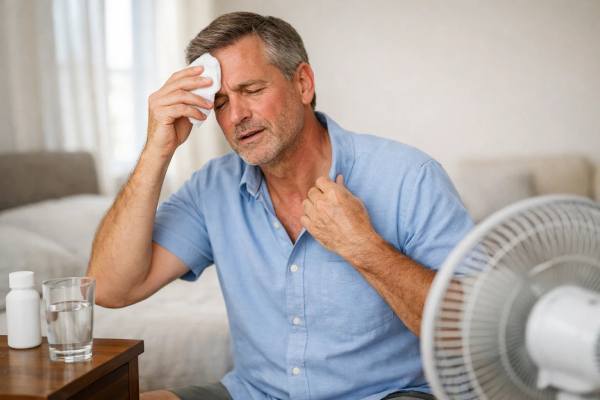
Hot flashes are usually discussed in the context of menopause, which is one reason men are often surprised, and sometimes worried, when they start happening to them. A sudden wave of heat, flushing, sweating, and then chills can feel strange enough on its own. When it starts disrupting sleep, work, or confidence, it often raises a bigger question: is this low testosterone, something more serious, or just stress? The answer depends on the pattern. In men, hot flashes are most strongly linked to a sharp drop in sex hormones, especially with androgen deprivation therapy for prostate cancer or with significant hypogonadism. But testosterone is not the only possible explanation. Night sweats, thyroid disease, infections, medication effects, alcohol, anxiety, and other medical conditions can all blur the picture. This article explains what hot flashes in men actually mean, how testosterone and estradiol fit into the story, what else can cause them, and what practical next steps are worth taking.
Top Highlights
- Hot flashes in men are real and are most strongly linked to marked sex hormone withdrawal, especially androgen deprivation therapy and significant hypogonadism.
- Low testosterone can play a role, but not every man with low testosterone gets hot flashes and not every hot flash means testosterone is low.
- Drenching night sweats, weight loss, fever, or rapidly worsening symptoms deserve broader evaluation because the cause may not be hormonal.
- Treatment works best when it targets the cause, not just the sweating itself.
- The most useful first step is to review medications and cancer therapies, then consider targeted testing rather than ordering random hormone labs.
Table of Contents
- What Hot Flashes in Men Feel Like
- Testosterone Links and Why They Matter
- Other Causes Besides Low Testosterone
- How Evaluation and Testing Work
- What Can Help Right Now
- When to Get Checked Sooner
What Hot Flashes in Men Feel Like
A hot flash is more than simply “feeling warm.” It is usually a brief vasomotor event: a sudden sensation of heat spreading through the face, neck, chest, or whole body, often followed by flushing, sweating, a pounding heartbeat, and then a chill as the episode passes. Some men describe it as an internal heat surge. Others notice damp clothes, facial redness, or repeated awakenings at night. The episode itself may last only a few minutes, but the after-effect can linger, especially if it happens during sleep.
That distinction matters because men also experience night sweats, and the two are not always the same thing. Night sweats can be part of hot flashes, but they can also happen with infections, fever, alcohol, certain medications, reflux, anxiety, sleep apnea, obesity, and other medical problems. A true hot flash tends to have a sudden “wave” pattern. Night sweating from another cause may feel more like generalized overheating, damp sheets, or repeated sweating without that classic rising-and-falling flush.
Severity varies a lot. For some men, hot flashes are occasional and mildly annoying. For others, they are frequent enough to interrupt meetings, disturb sleep, and worsen fatigue, irritability, or embarrassment. A few practical details help separate a likely hot flash pattern from general overheating:
- episodes come on suddenly rather than gradually
- they often involve the face, neck, chest, or upper body
- sweating is common, but chills afterward are also common
- they may cluster during the night or after triggers such as stress, alcohol, or warm rooms
- they may appear alongside other hormone-related symptoms such as low libido or fatigue
One reason this symptom gets overlooked is that men are less likely to be asked about it. Many only mention it after months of poor sleep or after they realize it is happening repeatedly, not randomly. That delay can matter, because in men hot flashes are often a clue to a specific physiological shift rather than a vague wellness complaint.
They are also more common in certain medical settings. Men on androgen deprivation therapy for prostate cancer often know the symptom well. Men with significant hypogonadism, especially after pituitary disease, testicular failure, or abrupt hormonal change, may also develop them. But if the pattern is drenching, associated with fever, or clearly not linked to a flushing wave, the broader category of night sweats causes becomes more relevant than testosterone alone.
The most useful first step is simply to describe the episodes accurately. A doctor can do much more with “I get a sudden flush with sweating and chills three times a night” than with “I feel hot sometimes.” In hormone care, the pattern often matters as much as the lab.
Testosterone Links and Why They Matter
The strongest hormone link between hot flashes in men and endocrine disease is a significant drop in sex steroids. Testosterone is usually the first hormone people think about, and for good reason. Men with marked hypogonadism can develop vasomotor symptoms, especially when testosterone levels fall abruptly or remain very low. This is particularly common in men receiving androgen deprivation therapy for prostate cancer, where hot flashes are one of the best-known treatment effects and often one of the most bothersome.
Still, the connection is more nuanced than “low testosterone equals hot flashes.” Many men with mildly low testosterone never experience them. Others have low libido, fewer morning erections, lower energy, or reduced physical drive without any flushing at all. Hot flashes become more likely when hormone withdrawal is stronger, faster, or more sustained. That is why they are most common in settings such as:
- androgen deprivation therapy for prostate cancer
- orchiectomy or profound testicular failure
- pituitary or hypothalamic disorders causing hypogonadism
- abrupt interruption of sex hormone support in susceptible men
There is also an important twist: testosterone may not be the only hormone driving the symptom. In men, some testosterone is converted to estradiol through aromatization, and evidence suggests estradiol withdrawal plays a major role in vasomotor symptoms. In practical terms, that means a fall in male sex hormones can disturb thermoregulation through more than one pathway. Testosterone matters, but its downstream estrogen effect may also help explain why some men flush and others do not.
This helps explain a common source of confusion. A man may hear that his testosterone is “borderline low” and assume it must explain his hot flashes. Sometimes that is true. Sometimes it is not. Hot flashes are more convincing as a low-testosterone symptom when they appear alongside a broader pattern of hypogonadism, such as low libido, erectile changes, fewer morning erections, reduced testicular volume, infertility, low bone density, fatigue, or loss of lean mass. If that wider pattern is present, a deeper look at testosterone levels and testing becomes especially useful.
Another point worth saying clearly: hot flashes in men are not a reliable marker of “normal aging.” Testosterone levels do decline gradually with age in some men, but the body usually adapts slowly. Sudden or pronounced vasomotor symptoms are more suggestive of a sharper hormonal disruption than of ordinary aging alone.
This is also why the timeline matters. Hot flashes that begin after a new cancer treatment, after pituitary surgery, or during medication-induced testosterone suppression fit a much clearer hormonal pattern than hot flashes that drift in slowly without any other symptoms. The more abrupt the drop in sex hormone support, the more plausible the hot flash explanation becomes.
So yes, testosterone links matter. But hot flashes in men are best understood as a sign of significant sex hormone disruption, not as a simple label for every man who feels overheated.
Other Causes Besides Low Testosterone
Low testosterone is important, but it is not the only explanation for hot flashes or night sweats in men. In fact, one of the most useful clinical questions is whether the symptom really behaves like a hormone-related hot flash or whether it fits a broader medical differential. That matters because some non-testosterone causes are common, and a few are important not to miss.
Thyroid excess is one example. Men with hyperthyroidism may feel intensely heat intolerant, sweaty, shaky, anxious, and unable to tolerate warm rooms. That can look like “hot flashes,” but the physiology is different. Instead of brief vasomotor waves, the overheating may feel more persistent and may come with tremor, palpitations, weight loss, or diarrhea. If that overlap sounds familiar, thyroid-related anxiety and overheating are worth considering before assuming the problem is testosterone.
Other non-testosterone causes include:
- alcohol, especially evening use that disrupts thermoregulation and sleep
- medication effects, including some antidepressants, opioids, hormone therapies, and withdrawal states
- anxiety or panic episodes that produce flushing, palpitations, and sweating
- obesity and sleep apnea, both of which can worsen nighttime overheating and sweating
- reflux or autonomic arousal during sleep
- infections, inflammatory illness, or fever-producing conditions
- malignancy, especially when sweating is drenching and paired with weight loss or persistent systemic symptoms
These alternatives matter because hot flashes in men are not always isolated endocrine events. A man who wakes sweaty after spicy food, alcohol, poor sleep, and snoring may be having a different problem than a man on androgen deprivation therapy who flushes six times a day. The first case may need sleep, alcohol, or reflux evaluation. The second fits a classic sex hormone-withdrawal pattern.
There is also a middle ground. Mood disorders, chronic stress, and sleep disruption can amplify vasomotor symptoms even when they are not the primary cause. Once sleep becomes poor, the nervous system tends to become more reactive, and sweating episodes can feel more intense or more frequent. That feedback loop can make the symptom feel “hormonal” even when the root cause is mixed.
This is why clinicians often widen the lens early instead of asking only about testosterone. Fever, weight loss, cough, diarrhea, medication changes, alcohol intake, cancer treatment, snoring, and panic symptoms all help sort the pattern. Persistent night sweating without the classic flush-wave pattern is often more about general medical differential diagnosis than about hypogonadism.
The most useful takeaway is that hot flashes in men deserve context. Testosterone is central in some cases, but a smart workup also asks what else could produce heat episodes, sweating, or nighttime arousal. In endocrine medicine, the right answer often comes from recognizing which symptom cluster the sweating belongs to, not from chasing one hormone in isolation.
How Evaluation and Testing Work
A good evaluation for hot flashes in men starts with history before labs. That is especially important because the same symptom can point to androgen deprivation, severe hypogonadism, thyroid disease, medication effects, or a non-endocrine cause. The first useful questions are often the simplest: When did the flushing start? Is it sudden or gradual? Is it daytime, nighttime, or both? Are there chills, fever, weight loss, or drenching sweats? Is there prostate cancer treatment, opioid use, steroid use, alcohol overuse, or a recent medication change?
If low testosterone is genuinely on the list, testing should usually be done properly rather than casually. That means morning testing, ideally while medically stable, with attention to symptoms and medication context. In men with suspected hypogonadism, the initial lab is usually a morning total testosterone. If it is low or borderline and the symptoms fit, it is often repeated before concluding that true testosterone deficiency is present. This is not just technical fussiness. Testosterone varies, and one low reading does not always equal a diagnosis.
From there, the evaluation often branches based on what the first result shows. Depending on the case, clinicians may add:
- LH and FSH to help distinguish primary from secondary hypogonadism
- prolactin if pituitary disease is possible
- TSH and sometimes free T4 if thyroid symptoms are present
- complete blood count or inflammatory workup if fever, weight loss, or drenching sweats are part of the story
- glucose testing if hypoglycemia or dysglycemia is suspected
- imaging later, if pituitary or structural disease becomes likely
This is one place where the broader picture of male hormone imbalance patterns can help. Hot flashes by themselves are not enough to diagnose hypogonadism. They become more informative when they appear with low libido, erectile changes, infertility, reduced muscle strength, anemia, low bone density, or testicular or pituitary clues.
Men on androgen deprivation therapy are a special group. In them, the cause is often obvious, and the more relevant question becomes severity, duration, and management rather than diagnosis. Hot flashes in that setting commonly track with suppression and later recovery of testosterone levels, which is one reason symptom timing can be almost as informative as the lab.
Testing is also shaped by what the symptom is not. A random testosterone drawn late in the day is often less useful than people expect. A random cortisol is usually not the right starting point. Broad “male hormone panels” may find noise without clarifying the diagnosis.
The most practical rule is this: test to answer a question. If the question is “Could this be hypogonadism?” then use a hypogonadism workup. If the question is “Could this be infection, thyroid disease, or cancer therapy?” the lab plan should match that instead. The best hot-flash workup is usually narrower, not bigger.
What Can Help Right Now
Relief depends on the cause, but a few immediate strategies help many men while the workup is unfolding. The first is practical heat control. Cool sleeping conditions, moisture-wicking sleepwear, layered clothing, portable fans, and keeping cold water nearby are simple measures, but they can meaningfully reduce the disruption of repeated episodes. Some men also notice consistent triggers, including alcohol, spicy meals, emotional stress, warm bedrooms, or heavy evening blankets. Tracking those patterns can make the symptom more manageable even before treatment is finalized.
The next step is to treat the driver when the driver is known. If hot flashes are linked to significant hypogonadism and the patient is an appropriate candidate, testosterone replacement may improve symptoms over time. That decision is not made from one symptom alone. It depends on consistent symptoms, repeated low testosterone levels, fertility goals, prostate and hematocrit considerations, sleep apnea risk, and the rest of the endocrine picture. If the discussion is heading that way, a closer look at testosterone replacement therapy is essential because the treatment can help the right patient but is not a casual fix.
If the cause is androgen deprivation therapy for prostate cancer, the treatment strategy is different. In that setting, testosterone replacement is usually not the answer, and symptom relief is often handled with supportive measures or non-testosterone medications chosen with the oncology team. Evidence supports several options for bothersome vasomotor symptoms in men on ADT, including gabapentin, oxybutynin, certain antidepressants, and in some settings hormonal approaches such as transdermal estrogen, though side effects and suitability vary. This is one reason ADT-associated hot flashes are best managed as part of cancer care rather than as a generic men’s health complaint.
Men whose sweating is driven by another cause need cause-specific treatment instead. Hyperthyroidism, infection, reflux, alcohol excess, anxiety, and sleep apnea are not helped by chasing testosterone. In some cases, improving sleep quality and evening habits can reduce the frequency or severity of episodes even when hormones are only part of the story.
A few practical measures often help regardless of cause:
- keep the bedroom cool and use lighter bedding
- limit alcohol near bedtime
- avoid heavy late meals if episodes cluster at night
- note whether stress, caffeine, or spicy food worsen symptoms
- discuss medication changes rather than stopping them abruptly on your own
The most important principle is that symptom control and cause control are not the same thing. Cooling the room may help tonight. Treating the underlying disorder is what changes the long-term pattern. The best results usually come when both are addressed together rather than when one is ignored.
When to Get Checked Sooner
Many hot flashes in men are benign or at least manageable, but some patterns deserve faster medical attention. The biggest reason to move sooner is when the symptom does not look like a simple vasomotor issue anymore. Drenching night sweats, unexplained weight loss, persistent fever, enlarged lymph nodes, chronic cough, severe fatigue, or a general sense of systemic illness should widen the differential well beyond testosterone. Those features can point toward infection, inflammatory disease, malignancy, or other medical problems that need evaluation sooner rather than later.
Hot flashes also deserve more prompt assessment when they appear with strong hypogonadal symptoms. These include marked loss of libido, fewer spontaneous or morning erections, infertility, shrinking testicular volume, anemia, low bone density, or a history that suggests pituitary or testicular failure. Men recovering from pituitary surgery, cranial radiation, chemotherapy, orchiectomy, or major hormone manipulation should not ignore new flushing symptoms just because they seem strange or embarrassing.
Another reason to seek care sooner is treatment context. Men on androgen deprivation therapy often expect some hot flashes, but episodes that become severe enough to impair sleep, adherence, mood, or daily functioning are worth bringing up early. There are management options, and suffering through them in silence is not a sign of toughness. It is usually just missed care.
A few patterns should move the issue up the list:
- hot flashes plus chest pain, fainting, or severe palpitations
- night sweats with fever or unintentional weight loss
- sudden onset after a new medication or cancer therapy
- hot flashes with headaches, vision changes, or symptoms suggesting pituitary disease
- repeated sleep disruption that is beginning to affect daytime safety or function
Men sometimes delay evaluation because they assume this symptom is too trivial or too unusual to mention. In endocrine medicine, unusual is often exactly why it should be mentioned. A clear description of timing, associated symptoms, medication use, cancer treatment history, and sleep disruption helps a clinician decide whether the issue is likely hormonal, systemic, or mixed.
If the symptoms are recurrent, persistent, or accompanied by abnormal labs, this is often the point where specialist evaluation becomes useful. Endocrinology is especially helpful when testosterone results are confusing, pituitary disease is possible, or the symptom pattern does not fit a straightforward explanation.
The most reassuring truth is that hot flashes in men are often explainable once the pattern is understood. The most important caution is that not every hot spell is a hormone problem, and not every hormone problem should wait. The right response is not alarm, but timely evaluation when the picture grows bigger than the flush itself.
References
- Society for Endocrinology guidelines for testosterone replacement therapy in male hypogonadism 2022 (Guideline) ([PubMed][1])
- The British Society for Sexual Medicine Guidelines on Male Adult Testosterone Deficiency, with Statements for Practice 2023 (Guideline) ([WJMH][2])
- Persistent Night Sweats: Diagnostic Evaluation 2020 (Review) ([PubMed][3])
- Bothersome Hot Flashes Following Neoadjuvant Androgen Deprivation Therapy and Stereotactic Body Radiotherapy for Localized Prostate Cancer 2024 ([PMC][4])
- A Review of Hot Flash Management in Patients With Prostate Cancer 2025 (Review) ([PubMed][5])
Disclaimer
This article is for educational purposes only and does not replace medical advice, diagnosis, or treatment. Hot flashes in men can come from low sex hormones, cancer therapy, thyroid disease, medications, infections, or other medical conditions, so persistent or severe symptoms should be evaluated in clinical context. Seek prompt care for drenching sweats, fever, weight loss, chest pain, fainting, severe palpitations, or flushing that begins alongside major hormone or cancer treatment changes.
If this article helped you, please share it on Facebook, X, or another platform you use so more people can find clear, evidence-based guidance on hot flashes in men.