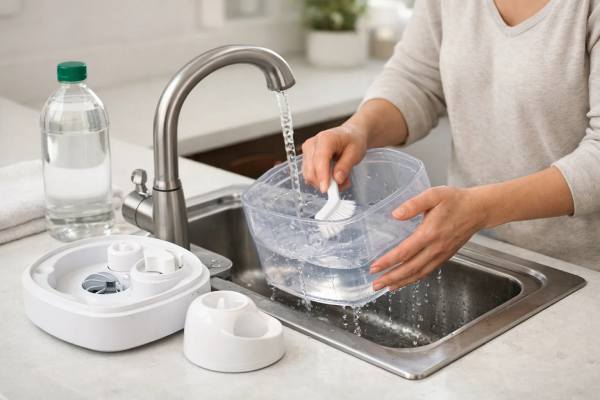
A humidifier can make indoor air feel gentler on your nose, throat, and skin—especially during dry seasons when heating pulls moisture from the air. Used well, it can reduce nighttime dryness, ease congestion discomfort, and make sleep feel more restorative. Used carelessly, it can do the opposite: stagnant water, mineral scale, and hidden biofilm can turn a helpful appliance into a source of irritating particles and unpleasant odors. Cleaning is not just about appearance—it is about preventing microbial growth, limiting “white dust,” and keeping humidity in a range that supports comfort without encouraging mold. This guide walks you through a simple daily routine, a thorough weekly clean, and safe disinfection steps when problems show up—plus type-specific tips for ultrasonic, evaporative, warm mist, and whole-house units.
Quick Overview
- Consistent cleaning reduces mineral buildup, musty smells, and the risk of blowing contaminated mist into the room.
- Daily emptying and air-drying are often more effective than occasional “big cleans” alone.
- Never mix cleaning agents, and avoid adding unapproved chemicals to the water tank.
- A weekly descale removes the film that traps bacteria and makes odors return quickly.
- Keep indoor humidity generally around 30%–50% to prevent condensation and mold while still improving comfort.
Table of Contents
- Why humidifiers get dirty fast
- The 5-minute daily cleaning routine
- Weekly deep clean and descaling
- Disinfecting without harsh fumes
- Cleaning steps by humidifier type
- Removing mold and stubborn odors
- Storage and prevention for the season
Why humidifiers get dirty fast
Humidifiers are small water systems that run warm, wet, and quiet—exactly the conditions that let buildup happen quickly. The “dirty” part is not always obvious. Even if the tank looks clear, a thin layer of film can cling to plastic seams, float valves, and the base where water sits. This film (often called biofilm) behaves like a protective blanket for microbes: it helps bacteria and mold stick to surfaces and makes them harder to rinse away with a quick swish of water.
Minerals are the other half of the problem. If you fill a humidifier with regular tap water, dissolved minerals can form scale on the tank walls and internal parts. In some humidifier designs—especially ultrasonic and certain cool-mist styles—those minerals can become airborne and settle as “white dust” on furniture. Scale also creates a rough surface where biofilm grabs more easily, so mineral buildup and microbial growth often reinforce each other.
Smells are a useful early warning. A humidifier that develops a sour, musty, or “pond-like” odor is usually telling you that water sat too long, the base stayed damp, or deposits are feeding growth. Odors can also come from a wick or filter that is overdue for replacement, or from a mist nozzle that traps residue. Because the mist is dispersed into breathing space, the quality of the tank water matters more than it would for a sink or shower you do not aerosolize.
Humidity level matters too. If you run a humidifier hard enough to create window condensation, you are creating a favorable environment for mold on walls, frames, and soft furnishings—especially in bedrooms where doors stay closed overnight. Most homes do best when indoor relative humidity stays roughly in the 30%–50% range, adjusted for the season and local climate.
The good news is that you do not need complicated tools. A consistent routine—emptying, drying, and descaling on schedule—prevents most problems before they start and keeps the unit working efficiently.
The 5-minute daily cleaning routine
Daily care is the fastest way to prevent mold, bacteria, and smells—because it removes the one thing microbes need most: standing water. Think of this as “resetting” the humidifier each day so yesterday’s water does not become tomorrow’s problem.
Before you start
- Unplug the unit before handling the base or any electrical section.
- Wash your hands, especially if someone in the home is sick.
- Keep a dedicated small brush (or a soft bottle brush) for humidifier cleaning so you are not borrowing a dish brush that carries food residue.
The daily steps
- Empty the tank completely. Do not “top off.” Topping off dilutes old water but does not remove the film on surfaces, and it lets microorganisms persist.
- Rinse with clean water. Swirl, pour out, and repeat once. The goal is to flush loose debris before it dries into scale.
- Wipe the base dry. Many problems start in the base reservoir, not the tank. Use a clean cloth or paper towel to dry any pooled water you can reach.
- Let parts air-dry. Leave the tank cap off and set the tank upside down on a drying rack or towel for airflow. If you must refill immediately, at least wipe the interior surfaces you can reach and dry the base.
- Refill with the best water you can. Distilled or demineralized water reduces scale and “white dust.” If that is not feasible, consider boiled-and-cooled water when appropriate for your situation, and clean more frequently when using mineral-heavy tap water.
Two quick checks that prevent bigger messes
- Check room humidity: If windows look wet or there is dampness on walls, lower output or run the unit less. Condensation is a sign you are pushing past the home’s ability to absorb moisture.
- Check the fill cap and gasket: A slimy feel, a sour smell, or visible residue around the cap threads is a signal that you need the weekly deep clean sooner.
This routine sounds small, but it changes everything. Daily emptying and drying interrupt the growth cycle so buildup does not get the chance to mature into stubborn film, scale, and odor that require aggressive scrubbing later.
Weekly deep clean and descaling
A weekly deep clean targets the “invisible layer” that daily rinsing misses: mineral scale and the sticky film that clings to seams, corners, and valves. If your water is hard, if you run the humidifier every night, or if anyone in the home has asthma or significant allergies, weekly cleaning is a smart baseline.
Step 1: Disassemble and inspect
- Unplug the unit and separate the tank, cap, base reservoir, and mist nozzle components you can safely remove.
- Look for cloudy film, crusty white deposits, or discoloration around crevices.
- If the unit has a removable filter or wick, take it out and follow the manufacturer’s instructions. Many wicks are designed to be replaced, not scrubbed.
Step 2: Descale with a mild acid
For many home units, a simple descaling soak works well:
- Fill the tank with a 50/50 mix of white vinegar and water (or use a citric-acid solution if you prefer a low-odor option).
- Let it soak for 15–30 minutes. If scale is heavy, a longer soak may be needed, but do not let solutions sit so long that rubber seals degrade.
- For the base, pour enough solution to cover scaled areas while keeping electrical components dry. Tilt or rotate the base if needed so the solution contacts the mineral ring.
Step 3: Scrub gently, then rinse repeatedly
- Use a soft brush to scrub the tank walls, cap threads, corners, and any valve or float area.
- Avoid abrasive pads that can scratch plastic. Scratches create more surface area for film to cling to later.
- Rinse thoroughly with clean water multiple times until the vinegar odor is faint.
Step 4: Dry completely
Drying is not optional. A humidifier that looks “clean” but stays damp is more likely to smell the next day.
- Wipe reachable surfaces, then air-dry with the cap off.
- Allow the base to air-dry fully before reassembling.
When weekly cleaning is not enough
If you see recurring slime, black spotting, or odors that return within 24–48 hours, it usually means biofilm has become established in a hard-to-reach area or in a part that needs replacing (like a wick, cartridge, or gasket). That is when safe disinfection—done correctly—becomes the next step.
Disinfecting without harsh fumes
Disinfection is not required every time you clean, but it is useful when you are trying to “reset” a unit that has developed odor, visible film, or questionable water hygiene. It is also a good idea after the humidifier has been stored with moisture inside, after a long period of heavy use, or when someone in the home has had a respiratory infection and you want to reduce the chance of reinhaling contaminated mist.
Important safety rules first
- Never mix cleaning agents. Do not combine bleach with vinegar, acids, or ammonia.
- Ventilate the area. Open a window or run an exhaust fan while disinfecting.
- Protect skin and eyes. Gloves are helpful, and splashes happen easily when rinsing tanks.
Option A: Hydrogen peroxide (often lower odor)
Many humidifiers tolerate 3% hydrogen peroxide for disinfecting water-contact surfaces.
- After descaling and rinsing, add enough peroxide to coat surfaces (or dilute per product guidance).
- Let it sit for 10 minutes (or as your manual recommends).
- Rinse thoroughly several times and allow to air-dry.
Hydrogen peroxide is often easier on the nose than bleach, but it still needs thorough rinsing to avoid dispersing residual chemical into the air.
Option B: Diluted bleach (effective, but requires care)
When bleach is appropriate for your model:
- Prepare a properly diluted solution and add it to the tank and any water-contact areas that can be safely filled.
- Ensure all interior surfaces are wet for at least 1 minute.
- Rinse repeatedly until there is no bleach smell, then air-dry fully.
How to know you rinsed enough
A practical rule: if you can still smell the disinfectant strongly when you put your nose near the tank opening, keep rinsing. After rinsing, let the unit air-dry; odors often fade further as residual moisture evaporates.
What not to do
- Do not disinfect and immediately run the humidifier unless you are confident it is thoroughly rinsed.
- Do not add “disinfectant drops” or household chemicals to the tank unless the product is specifically designed for humidifier use and your manual approves it. Some additives have been linked to serious respiratory harm when aerosolized.
Done correctly, disinfection is a periodic tool—not a daily habit. The daily routine and weekly descaling do most of the work; disinfection is for course correction when the unit has drifted into the danger zone.
Cleaning steps by humidifier type
Humidifiers share the same basic risks—standing water, scale, film—but the “problem zones” differ by design. Cleaning gets easier when you know where your model hides buildup.
Ultrasonic and impeller cool-mist units
These are common in bedrooms because they are quiet, but they can be more sensitive to mineral buildup.
- Focus area: the base reservoir and the ultrasonic transducer plate (or impeller chamber).
- Cleaning tip: after descaling, use a soft brush or cotton swab to clean edges and corners near the transducer without scratching it.
- Water choice matters: using low-mineral water reduces both scale and airborne dust.
- Extra caution: do not let liquid enter vents, fans, or electronic seams in the base.
Evaporative wick humidifiers
These units use a fan to blow air through a moist wick or filter, which often traps minerals rather than releasing them as dust.
- Focus area: the wick and the water tray where residue accumulates.
- Wick reality: many wicks are designed to be replaced on schedule. If a wick smells musty, feels slimy, looks stiff, or is discolored, replacement is often more effective than scrubbing.
- Fan and housing: keep air intake grilles free of dust so airflow stays steady and the unit does not run “wet,” which can increase odor.
Warm mist and steam vaporizers
Warm mist units boil water or heat it strongly, which can reduce some microbial concerns, but scale can build rapidly.
- Focus area: heating element surfaces and mineral rings.
- Cleaning tip: descaling becomes especially important; scale reduces efficiency and can cause overheating or poor output.
- Safety note: keep warm mist units out of reach of children due to burn risk from hot water and steam.
Whole-house and furnace-mounted humidifiers
These units connect to plumbing and HVAC, so maintenance is less about daily emptying and more about scheduled part replacement.
- Focus area: the evaporator pad (often called a water panel), drain line, and any distribution tray.
- Routine: replace the pad at least seasonally (and more often in hard-water homes), flush the drain line, and inspect for slime where water trickles.
- Professional help: if you see persistent mold, leaks, or mineral blockage, a technician can clean safely without damaging HVAC components.
The most effective cleaning plan matches the design. Once you identify your model’s “hot spots,” you can prevent odors and buildup with less effort and fewer harsh interventions.
Removing mold and stubborn odors
A humidifier that smells “funky” is not just unpleasant—it is often a sign of film, trapped moisture, or a part that has reached the end of its useful life. The goal is to remove what is feeding the smell and make sure it does not come right back.
First, identify the odor pattern
- Musty or basement-like: often mold or mildew growth, or a wick that stayed damp too long.
- Sour or fermented: stagnant water and bacterial biofilm in the tank or base.
- “Fishy” or chemical-like: mineral-heavy water reacting with residues, or a cleaning agent that was not rinsed thoroughly.
- Odor only when running: residue in the mist outlet, internal channels, or a cartridge that is overdue.
Odor reset plan
- Replace the water and do the daily routine immediately. Many odors start with old water.
- Deep clean and descale. Mineral film often “holds” odor even after rinsing.
- Disinfect if the smell persists. Use a safe method your model tolerates, then rinse and air-dry fully.
- Replace consumable parts. If your humidifier has a wick, filter, demineralization cartridge, or aroma pad, replace it rather than trying to rescue it with chemicals.
- Clean the surroundings. If the humidifier sits near a damp window, a dusty shelf, or a wall with condensation, the room environment may be contributing to the smell.
What to do if you see visible mold
Visible mold inside a humidifier is a sign to stop and clean before using it again. Small spots that wipe away on removable plastic may be recoverable with thorough cleaning and disinfection, followed by complete drying. If mold appears inside inaccessible channels, in foam or fabric parts, or returns quickly after cleaning, replacement is often the safer choice—especially in a nursery or in a home with asthma.
Why odors come back fast
When a smell returns within a day or two, it usually means one of these is still true:
- A hidden surface is still coated with film (cap threads and base corners are common).
- The unit is not fully drying between uses.
- Room humidity is high enough to keep the appliance and nearby surfaces damp.
- A filter or wick is saturated with deposits and microbes.
Treat stubborn odor as a maintenance signal. Once you address film, parts, and drying, most humidifiers stop smelling “off” without needing constant disinfectants.
Storage and prevention for the season
Seasonal storage is where many humidifiers quietly fail. A unit put away with moisture trapped inside can grow film and odor while it sits, so it comes out “dirty” before the season even starts. A short shutdown routine prevents that—and makes winter setup much easier.
End-of-season shutdown checklist
- Deep clean and descale. Do not store mineral residue; it hardens and becomes harder to remove later.
- Disinfect if needed. If there were odors, visible film, or heavy use during illness season, disinfect once, rinse thoroughly, and dry.
- Air-dry completely for 24 hours. Leave the tank cap off and allow airflow through the base area as much as your model allows.
- Store in a breathable way. Avoid sealing a damp unit in an airtight bag. If you store in the original box, confirm everything is fully dry first.
A realistic prevention schedule
If you want a plan that is easy to follow, use a simple cadence:
- Every use: empty, rinse, wipe the base, and air-dry when possible.
- Weekly: descale and scrub corners, cap threads, and water-contact surfaces.
- Monthly (or as needed): disinfect if odors, slime, or questionable hygiene appear; replace wicks or cartridges on the schedule your model requires.
Humidity control prevents more than appliance problems
A clean humidifier still needs correct settings. If you are humidifying to the point of condensation on windows or damp patches on walls, mold risk rises in the room itself. A small hygrometer can help you keep humidity in a safer comfort zone. If your home is very tight or your bedroom door stays closed, you may need a lower output setting than you expect.
When to replace instead of clean
Replace the humidifier (or key parts) if:
- Plastic is cracked, warped, or leaking.
- Odors persist despite deep cleaning, disinfection, and full drying.
- There is visible mold in areas you cannot access.
- The unit no longer produces steady mist or makes unusual noises after descaling.
Finally, be cautious with additives. If a product is not designed to be aerosolized by a humidifier, it does not belong in the tank. When in doubt, keep water simple, keep the appliance dry between runs, and rely on routine cleaning rather than chemical shortcuts.
References
- Use and Care of Home Humidifiers | US EPA 2025 (Guidance)
- Preventing Waterborne Germs at Home | Drinking Water | CDC 2024 (Guidance)
- Cleaning and Disinfecting with Bleach | Water, Sanitation, and Environmentally Related Hygiene (WASH) | CDC 2024 (Guidance)
- Indoor air humidity revisited: Impact on acute symptoms, work productivity, and risk of influenza and COVID-19 infection – PubMed 2024 (Review)
- Exposures to humidifier disinfectant and various health conditions in Korean based on personal exposure assessment data of claimants for compensation – PubMed 2023 (Observational Study)
Disclaimer
This article provides general educational information and is not a substitute for personal medical advice, diagnosis, or treatment. Humidifiers can improve comfort in dry environments, but improper use or poor cleaning can contribute to respiratory irritation or indoor mold problems. Always follow your device’s manual, use only approved cleaning methods and additives, and keep humidity at a level that avoids condensation. If you have asthma, chronic lung disease, immune suppression, or concerns about symptoms that worsen with humidifier use, seek individualized guidance from a qualified clinician.
If you found this guide useful, please share it on Facebook, X (formerly Twitter), or any platform you prefer.