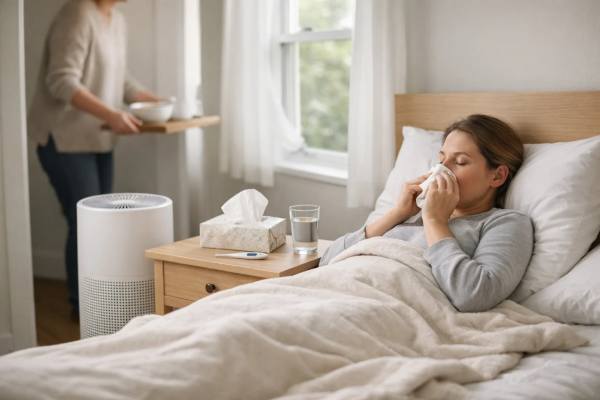
When one person gets sick at home, the hardest part is often not the symptoms—it is the logistics. A well-planned setup can reduce household spread while still keeping the sick person comfortable and supported. The most effective approach is layered: you limit shared air, reduce close contact, and simplify routines so good habits are easy to follow at 2 a.m. Small choices matter, like where the sick person rests, how air moves through the room, and how meals and medications are delivered without turning caregiving into repeated exposure. This guide focuses on practical steps that work in real homes, from apartment bedrooms to multi-story houses. You will learn how to create a “sick zone,” improve airflow without making anyone freeze, and handle food, dishes, laundry, and bathroom use in a way that protects the rest of the household.
Core Points for Household Containment
- Separating shared air and reducing close contact lowers the odds that others get sick from the same infection.
- A simple sick-room routine reduces caregiver exposure and prevents “contagion creep” through the home.
- People are often most contagious early, so strong precautions in the first 2–3 days pay off.
- Avoid harsh cleaning chemicals in enclosed spaces, and never mix disinfectants.
- Use a written plan for airflow, meals, and supplies so you are not improvising while tired.
Table of Contents
- Start with the right priorities
- Set up a sick-room zone
- Use airflow and filtration smartly
- Shared-space hygiene that works
- Meals and hydration with minimal contact
- When isolation can end safely
Start with the right priorities
If you only remember one principle, make it this: most household spread happens through what you share—especially air and time in close proximity. Surfaces matter, but they are rarely the main driver when people are breathing in the same rooms for hours. That is why a strong plan starts with a few high-impact moves rather than trying to disinfect the entire home.
Think in layers, from most protective to least:
- Distance and time: Keep the sick person in one room as much as possible. Short interactions are safer than long ones, even if you are careful.
- Cleaner air: Improve ventilation and filtration so shared air has fewer infectious particles.
- Barrier habits: Use a well-fitting mask when you must be in the same space, especially during close caregiving tasks.
- Hand and surface basics: Wash hands after caregiving, after handling tissues, and before preparing food. Clean high-touch points that multiple people use.
A practical way to reduce decision fatigue is to designate two roles:
- Primary caregiver: one person handles most close-contact tasks, which reduces the number of people exposed.
- Support person: restocks supplies, runs laundry, and handles meals with minimal room entry.
Also decide what “good enough” looks like in your home. Perfection is not realistic, but consistency is. A small set of rules that everyone can follow beats a long list that collapses after a day.
Finally, be honest about your household’s risk profile. If anyone is older, pregnant, immunocompromised, or has chronic lung disease, you should treat the situation more seriously. In higher-risk homes, consider stronger measures earlier—like stricter masking indoors, more aggressive airflow improvements, and sleeping in separate rooms even before symptoms develop in others.
The goal is not to isolate the sick person emotionally; it is to control exposure. A calm, structured plan protects everyone while still providing care that feels humane and steady.
Set up a sick-room zone
Your bedroom setup should make two things easy: keeping the sick person comfortable and keeping everyone else out. A good sick-room “zone” is not about sealing a room like a laboratory—it is about reducing traffic and preventing the sick person’s items from migrating through the house.
Choose the right room
Pick a room with:
- A door that closes fully
- A window (even a small one helps)
- Space for a small “handoff” area near the door
- The shortest path to a bathroom, if possible
If the sick person must share a bedroom (common in small homes), create a “sleep boundary” with distance, head-to-toe positioning, and a room air cleaner if available. If a high-risk person lives in the home, prioritize separating them from the sick person first.
Build a simple handoff station
Right outside (or just inside) the door, place:
- Tissues, a lined trash bag, and a second bag for “wet” items (used compresses, etc.)
- Hand sanitizer and a small bottle of soap if there is no nearby sink
- A tray or basket for food, meds, and supplies
- A notebook or phone note for dose times and symptoms
This station prevents repeated wandering and reduces the “doorway conversation” habit that turns into prolonged close contact.
Stock the room so the door stays closed
Keep essentials in the room:
- Water bottle plus an easy-refill pitcher
- Thermometer and basic medications (stored safely away from children)
- A few masks for the sick person (useful when someone must enter)
- Extra pillowcases and a light blanket (sweat happens)
- A dedicated cup and utensils if possible
Bathroom plan, even if it is shared
If there is a separate bathroom, reserve it for the sick person. If you must share:
- Schedule use so others are not brushing teeth right after the sick person coughs in the space
- Run the exhaust fan during and after use, if available
- Encourage closing the toilet lid before flushing
- Keep a disinfecting routine for the most-handled items (faucet handles, toilet handle, doorknob)
The room setup succeeds when it reduces “just one more trip” moments. Once supplies, comfort, and communication are contained to a single space, you have already cut a large portion of household spread risk.
Use airflow and filtration smartly
Airflow is where many home isolation plans quietly fail. People focus on wiping counters while the sick person’s air drifts into hallways and shared rooms for hours. You do not need fancy equipment, but you do need a strategy.
Best-case goal: keep sick-room air from spreading
If the sick person has a separate bedroom, aim for a simple rule: air should move into the sick room and then leave the home, not the other way around. You can approximate this by:
- Keeping the sick-room door closed
- Cracking a window in the sick room (even a little)
- Using a fan near the window to push air outward (if safe and practical)
This creates a gentle “pull” that reduces the chance that the sick-room air leaks into the rest of the home. If it is very cold outside, do this intermittently—several short ventilation cycles can still help.
Use filtration to clean the air you cannot replace
If you have a portable HEPA air cleaner, place it in the sick room and run it continuously on a tolerable setting. If you only have one air cleaner and no separate room is possible, put it where people spend time together, positioned so it draws air from the shared space without blowing directly from the sick person toward others.
If your home has central HVAC:
- Use a high-quality pleated filter your system can handle
- Run the fan more continuously during the illness period if that is an option
- Keep supply and return vents unblocked
Avoid airflow mistakes that backfire
- Do not aim a strong fan from the sick person directly toward the door or hallway. That can push respiratory particles into shared space.
- Do not rely on scented sprays, essential oils, or “air sanitizers” to solve an airflow problem. Cleaner air comes from ventilation and filtration, not fragrance.
- Do not increase humidity excessively. A comfortable mid-range humidity can help mucous membranes feel less dry, but too much humidity can encourage mold and create condensation that adds new problems.
Make it workable, not punishing
A strategy that makes the household miserable will not last. If cold air is an issue, ventilate in short bursts, close the door promptly, and use layered bedding instead of overheating the whole room. If noise is the barrier, run the air cleaner higher during the day and lower at night, and prioritize ventilation during caregiving tasks when the door opens.
Air interventions feel invisible, but they are often the difference between “everyone got it” and “it stopped with one person.”
Shared-space hygiene that works
Good hygiene in a household isolation setup is less about bleaching everything and more about targeting the moments and places where germs actually travel: hands, high-touch surfaces, and shared items that go from the sick room to the rest of the home.
House rules that reduce spread without drama
- One caregiver at a time: Fewer people entering the room means fewer exposures.
- Mask for close care: If you must be within arm’s length for more than a moment—helping with a shower, checking breathing, changing bedding—a well-fitting mask adds protection.
- Handwashing triggers: Wash hands after room entry, after handling tissues, and before food preparation. If soap and water are not available immediately, use sanitizer and wash when you can.
High-touch surfaces to clean regularly
Focus on what multiple people touch:
- Doorknobs, light switches, and faucet handles
- Remote controls and game controllers
- Refrigerator handle, microwave buttons, kettle handle
- Shared bathroom surfaces (especially if the bathroom is shared)
Cleaning with household detergent removes grime and reduces germs. Disinfecting can be reserved for situations where someone is actively sick and shared high-touch items cannot be avoided. Follow product directions and keep ventilation in mind—strong fumes in a closed bathroom are an avoidable hazard.
Laundry and bedding without creating a germ cloud
- Use a dedicated hamper or bag for the sick person’s laundry.
- Avoid shaking sheets or clothing; shaking can send particles into the air.
- Wash with regular detergent and dry thoroughly.
- If you share a washer, you do not need to run an empty “sterilizing” cycle after every load, but wiping touch points (like washer knobs) is reasonable.
Trash and tissues
Line a trash bin in the sick room and empty it regularly using tied bags. If the sick person is coughing heavily, tissues and disposable wipes add up quickly; a steady emptying routine reduces overflow and accidental contact.
Shared bathroom tactics that matter
If bathroom sharing is unavoidable, timing and airflow help:
- Run the exhaust fan during and after use when possible
- Keep a hand towel for the sick person only, or use paper towels
- Clean the faucet handle and toilet flush area more often than the mirror or floor
Hygiene works best when it is narrow, repeatable, and tied to real household habits. The goal is not to sanitize your life; it is to prevent the same hands and objects from carrying illness into every room.
Meals and hydration with minimal contact
Food and drink are where households accidentally break their own isolation plan. People linger at the doorway, offer tastes, share utensils, or carry used dishes through the kitchen without thinking. A simple meal system keeps the sick person nourished while limiting repeated exposure.
Set up a “no lingering” meal handoff
Use the handoff station at the door:
- Leave the tray, knock, and step back
- Keep conversations short and farther away when possible
- Ask yes-or-no questions that do not require long discussion (“Need more water?” “Any nausea?”)
If the sick person needs more monitoring, do a planned check-in time instead of frequent small visits.
Choose foods that support recovery and reduce mess
Illness-friendly meals are easy to eat, easy to digest, and easy to clean up:
- Broths, soups, oatmeal, yogurt, bananas, rice, toast
- Protein options that are simple (eggs, soft beans, shredded chicken)
- Salty fluids when appetite is low (broth, oral rehydration drinks)
- Small, frequent portions instead of large plates
A practical rule is to prioritize fluids first, then calories. Dehydration makes fatigue, headache, and dizziness worse, and it can increase risk for complications in both children and older adults.
Handling dishes safely without turning the kitchen into a quarantine zone
- Ideally, the sick person uses a dedicated cup and utensils.
- If that is not possible, standard dishwashing with detergent is effective.
- Avoid rinsing dishes in a way that splashes contaminated water onto counters. If needed, let dishes soak briefly, then wash.
- Clean the sink handle and counter area after dish handling if multiple people use the space.
Water strategy that reduces trips
Keep a large water bottle and refill pitcher in the sick room. Add simple options like:
- Warm tea with honey (for adults and older children)
- Ice chips or popsicles for sore throat comfort
- Oral rehydration solutions when vomiting or diarrhea is present
If the caregiver is also working or caring for children
Batch tasks:
- Prepare meals and supplies for the next 6–8 hours at once
- Combine check-ins with delivery
- Keep a written list of what was offered and what was consumed
Meals are also emotional support. A predictable system—quiet delivery, minimal fuss, and good hydration—keeps the sick person cared for without turning every snack into a household exposure event.
When isolation can end safely
Families often ask for a single number of days, but contagiousness is not perfectly predictable. It depends on the virus, the person’s immune response, and how severe symptoms are. Still, you can make decisions that are both practical and protective by using symptoms and timing together.
A sensible “step-down” approach
In many respiratory infections, the period of highest contagiousness is early—often around symptom onset and the first few days. That is why strict measures up front matter. After that, you can often transition from “strict separation” to “reduced precautions” when both of these are true:
- Symptoms are improving overall for at least a full day
- Fever has been gone for at least 24 hours without fever-reducing medication
When returning to shared spaces, add a buffer period where you keep extra precautions:
- Better ventilation and filtration
- Avoiding crowded indoor gatherings at home
- Masking during close contact when feasible
- Sleeping separately if cough is still frequent
This step-down plan protects others while acknowledging that households cannot stay in full lockdown indefinitely.
Situations where you should extend precautions
Consider maintaining stricter separation longer if:
- The sick person has a heavy, frequent cough that sprays secretions
- There are vulnerable household members (older adults, immunocompromised people, infants)
- The sick person cannot reliably cover coughs or wash hands (common with toddlers)
- Symptoms worsen again after initial improvement
A relapse in fever or a sudden worsening of symptoms is a reason to step back into stricter measures and consider medical advice, especially if shortness of breath, chest pain, or dehydration is present.
When to seek medical care promptly
Household containment is not a substitute for clinical evaluation. Seek urgent care immediately for severe breathing trouble, bluish lips, confusion, inability to stay awake, signs of dehydration (very little urine, extreme dry mouth), severe chest pain, or a seizure. For infants—especially under 3 months—fever should be treated as urgent. For high-risk adults, early antiviral treatment may be an option for certain infections, and it works best when started promptly.
Reset the home after the illness phase
Once the sick person is improving and back to normal activities, do a practical reset:
- Wash bedding and towels
- Clean high-touch surfaces that were used heavily
- Air out the sick room and replace any air-cleaner filters on schedule
The best outcome is not “nobody ever shares a germ.” It is preventing a single illness from cascading into a week-long chain through the household—while still providing care that is organized, kind, and safe.
References
- Preventing Spread of Respiratory Viruses When You’re Sick | Respiratory Illnesses | CDC 2025 (Guidance). ([CDC][1])
- Taking Steps for Cleaner Air for Respiratory Virus Prevention | Respiratory Illnesses | CDC 2025 (Guidance). ([CDC][2])
- When and How to Clean and Disinfect Your Home | Water, Sanitation, and Environmentally Related Hygiene (WASH) | CDC 2025 (Guidance). ([CDC][3])
- Guide to Air Cleaners in the Home | US EPA 2025 (Guidance). ([US EPA][4])
- Non-pharmaceutical interventions to reduce influenza transmission in households: a systematic review and meta-analysis – PMC 2025 (Systematic Review and Meta-analysis). ([PMC][5])
Disclaimer
This article is for general educational purposes and does not replace individualized medical advice, diagnosis, or treatment. Respiratory illnesses can range from mild to serious, and the safest home plan depends on age, pregnancy status, immune function, chronic medical conditions, and symptom severity. Follow medication labels, avoid mixing cleaning chemicals, and seek urgent medical care for severe or rapidly worsening symptoms, breathing difficulty, dehydration, confusion, or fever in young infants. If you are unsure whether it is safe to care for someone at home, contact a qualified clinician for guidance.
If this article helped you protect your household, please share it on Facebook, X (formerly Twitter), or any platform you prefer.