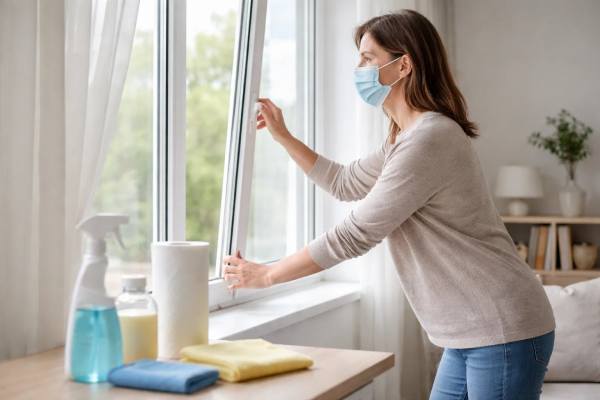
A cold can move through a household quickly because home life is built on shared air, shared touchpoints, and close routines—meals, bathrooms, bedtime help, and cramped spaces on busy days. The good news is that you can lower the odds of a “one cold becomes five” week without turning your home into a sterile zone. The most effective approach uses layers that reinforce each other: masking during close contact, smarter ventilation so fewer germs linger in the air, and targeted cleaning that focuses on hands and high-touch surfaces rather than endless disinfecting. This article gives you a practical home plan that works in apartments, family houses, and shared living spaces. You will learn how to set simple mask rules people will actually follow, improve airflow without freezing the room, and clean in ways that reduce spread while protecting skin and lungs from harsh chemicals.
Essential Insights
- Layering masks, cleaner air, and targeted cleaning reduces household spread more reliably than any single tactic.
- Short, predictable routines (morning and evening) prevent “prevention fatigue” when everyone is tired.
- Overusing strong disinfectants in small spaces can irritate airways and trigger symptoms in sensitive people.
- The first 2–3 days of symptoms are often the most important window for stricter precautions at home.
- A simple “close contact = mask” rule is easier to follow than trying to remember dozens of exceptions.
Table of Contents
- How colds spread at home
- Mask rules that actually get followed
- Ventilation that reduces shared air
- Air cleaners and HVAC filters
- Cleaning targets that matter most
- Bathroom, laundry, and meal routines
- When to relax precautions safely
How colds spread at home
Colds are caused by several viruses (often rhinoviruses), and they spread through a few predictable routes. Understanding those routes helps you choose the right defenses instead of doing everything at once.
1) Shared air during close time indoors
When someone with a cold talks, coughs, sneezes, or even breathes, they release respiratory particles. In a home, those particles matter most when people spend time in the same room—watching TV, eating, helping a child with bedtime, or sharing a car ride. The longer the shared time and the smaller the room, the higher the opportunity for exposure. That is why “cleaner air” steps and masks are so powerful: they address the route that happens quietly, even when nobody touches anything.
2) Hands carrying germs to eyes and nose
Colds spread when viruses land on hands and then reach the face. This can happen after wiping a nose, handling used tissues, touching a doorknob, or sharing a phone. Many people touch their face without noticing, which is why handwashing and “don’t share personal items” rules can outperform complicated surface cleaning plans.
3) High-touch surfaces as a relay point
Surfaces are not always the main driver, but they become important when multiple people touch the same items repeatedly: remote controls, faucet handles, refrigerator handles, light switches, and shared toys. Targeted cleaning reduces the “relay effect,” especially in households with children.
Timing matters as much as tactics
Household prevention works best when you start early. Many people are most contagious around the start of symptoms, and habits set in the first day tend to carry through the week. If you wait until everyone is coughing, prevention becomes much harder.
A useful mental model is a three-part goal: reduce shared air, reduce shared hands, and reduce shared items. If your plan achieves those reliably, you will usually see fewer secondary cases—or milder, later-onset illness in others.
Mask rules that actually get followed
Masks help most in the exact moments households find hardest to avoid: close care, shared meals, and small rooms. The key is to choose simple rules that match real life rather than an ideal schedule.
A workable home mask plan
Use a “close contact = mask” rule for the first few days of illness:
- Wear a mask when you are within arm’s length of the sick person for more than a brief moment (helping with meds, taking a temperature, comforting a child, changing bedding).
- Wear a mask in shared spaces when the home cannot separate rooms well (small apartments, shared bedrooms).
- Prioritize masks when ventilation is limited (closed windows, cold weather, crowded rooms).
Who should mask: the sick person, the caregiver, or both?
If you can only choose one, it often helps when the sick person masks during interactions outside their main room, because it reduces the amount of virus released into shared air. In many households, the most realistic strategy is:
- Sick person masks for trips to the kitchen or bathroom and during short conversations.
- Others mask during close care, especially when the sick person is coughing frequently.
Choosing a mask that fits your household
Fit and comfort matter because a great mask in a drawer does nothing. Consider:
- A well-fitting disposable mask for short tasks.
- A higher-filtration option for longer close contact, especially if someone in the home is higher risk.
- Child-sized masks only when the child can wear them safely and consistently (and never for very young children who cannot manage them).
Make masks frictionless
Place a small basket near the sick room and another near the kitchen entrance with masks, tissues, and hand sanitizer. Most compliance problems are not philosophical—they are logistical. If the mask is two rooms away, people skip it.
Common mask mistakes at home
- Wearing a mask under the nose or constantly adjusting it (more face-touching).
- Reusing visibly soiled or damp masks.
- Treating masks as a substitute for cleaner air. Masks and ventilation work best together.
A practical benchmark: if the household can follow the mask plan during the highest-contact moments (caregiving, shared bathroom traffic, bedtime routines), it usually reduces spread more than trying to mask “all day” and burning out by day two.
Ventilation that reduces shared air
Ventilation is the quiet workhorse of cold prevention. It lowers the concentration of respiratory particles in the air so fewer viruses are available to inhale. You do not need perfect airflow engineering—just a consistent, low-effort approach.
Start with the simplest win: fresh air cycles
If outdoor air quality is acceptable and it is safe to do so, use short ventilation cycles:
- Open windows for 5–15 minutes a few times per day, especially after high-contact moments (meal time, caregiving, group TV time).
- Create cross-ventilation by opening windows on opposite sides of the home when possible.
Even brief cycles can noticeably reduce stuffiness and help “reset” the air.
Use exhaust fans like mini-ventilation engines
Bathrooms and kitchens often have exhaust fans that remove indoor air. Use them strategically:
- Run the bathroom fan during and after showers and toilet use, especially if a sick person shares the bathroom.
- Run the kitchen exhaust while cooking and during meal prep when multiple people gather.
Keep air moving the right way
Fans can help, but direction matters.
- Avoid aiming a fan from a sick person directly toward other people or toward a hallway. That can push particles into shared spaces.
- If you are using a window fan, aim it to push air out of the sick person’s room when feasible, with the door mostly closed. This encourages air to leave the room instead of drifting out into the home.
Cold weather and comfort: make ventilation sustainable
Ventilation fails when it makes people miserable. If it is very cold:
- Use shorter, more frequent ventilation bursts instead of leaving windows open.
- Ventilate most aggressively during times you would be moving anyway (after bathroom use, while boiling water for tea, before bedtime).
- Dress for comfort and use layered bedding rather than overheating the whole room.
Humidity matters, but avoid extremes
Very dry air can make noses and throats feel worse, while overly humid air can encourage mold and condensation. Many homes do well in a moderate range (often around 30%–50%), adjusted for season and local climate. If windows are wet with condensation, that is a sign to back off humidification and improve ventilation.
Ventilation is not an all-or-nothing project. A few repeatable actions—fresh air cycles, exhaust fans, and smart fan placement—often cut household spread more than people expect.
Air cleaners and HVAC filters
When you cannot open windows—because of weather, outdoor pollution, noise, or safety—filtration becomes the next best tool. Air cleaners and HVAC filters reduce airborne particles, which can help lower exposure in shared rooms.
Portable air cleaners: how to use them well
If you have a portable air cleaner (often labeled HEPA), place it where it can do the most work:
- Best placement is usually in the room where people spend the most time together (living room) or in the sick person’s room if you are trying to keep their air from spreading.
- Run it continuously on a tolerable setting. Higher fan speeds usually clean more air but can be noisy, so many households run it higher during the day and lower at night.
- Keep the intake and outflow unobstructed. Do not tuck it behind a chair or under a shelf.
Sizing matters more than brand
An air cleaner is only as effective as the amount of air it can move and clean. If the unit is too small for the room, it will not keep up. A practical approach is to match the unit to the room size and prioritize the rooms where people gather most.
Avoid ozone-producing devices
Some products marketed as “ionizers” or “ozone generators” can irritate lungs. For cold prevention, focus on straightforward particle filtration rather than devices that intentionally create ozone.
HVAC filters: a whole-home helper
If your home has central heating or cooling, the system can support cleaner air when:
- The filter fits properly and is changed on schedule.
- The system fan runs often enough to pull air through the filter.
- You use the highest-efficiency filter your system can handle without restricting airflow too much.
Even without a high-end filter, regular maintenance matters. A clogged filter can reduce airflow and may worsen comfort, which leads people to close vents or stop using the system—reducing the air-cleaning benefit.
A simple “air strategy” for households
If you want one plan that works in most homes:
- Ventilate with outdoor air when you can.
- Add a portable air cleaner in the most-used shared room.
- Use your HVAC system reliably with a clean filter if available.
- Combine air cleaning with short mask use during close contact.
Filtration is especially valuable when a sick person cannot stay isolated (young children, shared bedrooms, caregiving needs). It makes the air layer stronger, which reduces how much you have to rely on perfect behavior from everyone.
Cleaning targets that matter most
Cleaning is most effective when it is targeted. A cold-prevention plan does not require disinfecting every surface; it requires reducing the number of germs that reach hands and faces.
The highest-impact habit: hand hygiene with triggers
Instead of saying “wash your hands more,” attach handwashing to specific moments:
- After blowing a nose, coughing into hands, or handling tissues
- After caring for the sick person (meds, temperature checks, bedding)
- After using the bathroom
- Before preparing food and before eating
Aim for at least 20 seconds with soap and water when possible. When you cannot get to a sink immediately, a hand sanitizer with at least 60% alcohol is a practical bridge until you can wash properly.
High-touch surfaces worth your time
Choose a small list you can clean once or twice per day during the illness period:
- Doorknobs and cabinet pulls
- Light switches
- Faucet handles
- Refrigerator handle and microwave buttons
- Remote controls, game controllers, and shared phones or tablets
If children are in the home, add the items they touch repeatedly: toy bins, tablet cases, and favorite comfort objects that travel room to room.
Clean first, disinfect second (when needed)
Many products work best when surfaces are not greasy or dusty. In most homes, routine cleaning with soap or detergent is enough for many surfaces. Disinfection is more relevant when:
- Someone is actively sick and multiple people must use the same bathroom
- A household member is higher risk
- A surface is frequently touched and difficult to avoid (shared remote, shared kitchen counter zone)
Chemical safety matters in respiratory illness season
Strong fumes can irritate an already inflamed airway. Protect lungs while protecting the household:
- Ventilate while cleaning, especially in bathrooms.
- Never mix cleaning products.
- Follow label directions, including how long a disinfectant should stay wet to work.
- Consider gloves to prevent skin irritation if you are cleaning more frequently than usual.
Tissues, cough etiquette, and “where the germs go”
Place tissues and a lined trash bin in the rooms where the sick person spends time. Encourage coughing or sneezing into a tissue or elbow rather than hands, then immediate disposal and hand hygiene. This simple containment step reduces the amount of virus that ends up on shared surfaces.
If you keep cleaning narrow, repeatable, and tied to real household touchpoints, you get the benefits without exhausting everyone.
Bathroom, laundry, and meal routines
Households often lose control of spread through everyday logistics—bathroom lines, shared towels, dishes, and laundry baskets. A few focused routines reduce exposure without adding much work.
Bathroom routines that reduce spread
If possible, assign the sick person a dedicated bathroom. If you must share:
- Run the exhaust fan during and after use when available.
- Encourage closing the toilet lid before flushing to reduce spray.
- Use separate towels or switch to disposable paper towels for hand drying during the illness period.
- Clean the highest-touch points daily: faucet handle, toilet handle, doorknob, and light switch.
A simple scheduling trick helps: if the sick person uses the bathroom, wait a little before others crowd in, and ventilate the space.
Laundry: avoid the “shake and spread” mistake
Bedding and clothing can carry secretions. The key is handling, not fear:
- Use a dedicated hamper or bag for the sick person’s laundry.
- Do not shake sheets or clothes; shaking can send particles into the air.
- Wash with regular detergent and dry thoroughly.
- Wash hands after handling laundry, even if you wore gloves.
If the sick person sweats at night, changing pillowcases more often than the entire bed can be an efficient compromise.
Dishes and meals: prevent accidental sharing
Colds spread easily when households share cups, utensils, and snack bowls. Set clear rules:
- The sick person uses a dedicated cup and utensils if possible.
- No sharing drinks, straws, lip balm, vapes, or toothbrush storage cups.
- For shared meals, avoid family-style serving where multiple hands touch the same utensils.
Dishwashing with detergent is effective. The main risk is not the plate—it is touching your face after handling it. Wash hands after loading the dishwasher or washing up.
Food delivery that limits close contact
If one person is clearly sick, create a simple handoff spot near their room:
- Place meals and fluids on a tray, knock, and step back.
- Keep check-ins short and purposeful.
- Batch tasks (fluids, tissues, meds) to reduce repeated room entry.
These routines protect the household while still supporting the sick person’s recovery. Comfort and containment can coexist when the systems are simple enough to run on tired brains.
When to relax precautions safely
A cold-prevention plan needs an off-ramp. If you try to maintain strict rules indefinitely, people stop following them. The safest approach is to tighten precautions early and then step down as symptoms improve.
A practical step-down framework
Consider two phases:
Phase 1: Higher-precaution window (often first 2–3 days of symptoms)
- Use masks for close contact.
- Prioritize ventilation and air cleaning.
- Limit shared-room time and avoid crowded family gatherings in one room.
- Clean high-touch surfaces daily and reinforce hand hygiene triggers.
Phase 2: Reduced-precaution window (when symptoms are clearly improving)
When the sick person is improving and fever has been gone for at least 24 hours without fever-reducing medicine (if fever occurred), many households can relax gradually:
- Keep ventilation habits (they help with comfort too).
- Reduce masking except during close care or if coughing is still frequent.
- Continue basic hand hygiene and avoid sharing drinks until symptoms are minimal.
Situations where you should keep precautions longer
Extend the higher-precaution approach if:
- The sick person has intense, frequent coughing or heavy nasal discharge.
- The household includes higher-risk members (older adults, immunocompromised people, pregnant people, infants).
- Multiple household members develop symptoms at staggered times, creating a longer overall exposure period.
- Symptoms worsen after initial improvement.
When to consider medical advice
Most colds resolve with home care, but seek prompt guidance if there is:
- Shortness of breath, chest pain, or worsening wheeze
- Signs of dehydration (very little urine, dizziness, extreme dry mouth)
- Confusion, unusual sleepiness, or inability to keep fluids down
- High fever that persists, or a fever that returns after improving
- Concerning symptoms in infants and very young children
A home reset after the peak
Once the household is past the worst days:
- Wash commonly used bedding and towels.
- Clean the high-touch surfaces you focused on during the illness.
- Air out the main rooms and replace air-cleaner filters on schedule.
The goal is not to eliminate all risk. It is to shorten the chain of transmission so one cold does not become a household-wide outbreak.
References
- Preventing Spread of Respiratory Viruses When You’re Sick | Respiratory Illnesses | CDC 2025 (Guidance)
- Taking Steps for Cleaner Air for Respiratory Virus Prevention | Respiratory Illnesses | CDC 2025 (Guidance)
- Hygiene and Respiratory Viruses Prevention | Respiratory Illnesses | CDC 2025 (Guidance)
- Guide to Air Cleaners in the Home | US EPA 2025 (Guidance)
- Physical interventions to interrupt or reduce the spread of respiratory viruses – PubMed 2023 (Systematic Review)
Disclaimer
This article is for general educational purposes and does not replace individualized medical advice, diagnosis, or treatment. Respiratory symptoms can have many causes, and what is safest at home depends on age, pregnancy status, immune function, chronic medical conditions, and symptom severity. Follow product labels for medications and cleaning agents, avoid mixing household chemicals, and use extra caution when infants, older adults, or immunocompromised people are in the home. Seek urgent medical care for severe or rapidly worsening symptoms, breathing difficulty, chest pain, confusion, signs of dehydration, or concerning symptoms in young children.
If you found this guide helpful, please share it on Facebook, X (formerly Twitter), or any platform you prefer.