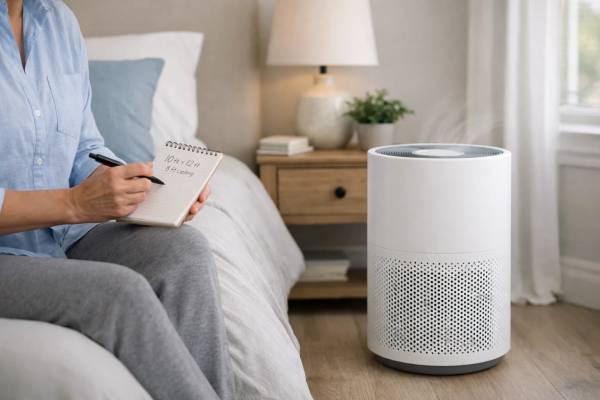
Air purifiers are often marketed as simple fixes, but virus-focused sizing is more technical than picking a popular model. The goal is not “fresh-smelling air”—it is enough clean air per hour to meaningfully lower the concentration of airborne particles that carry respiratory viruses. That is where CADR (Clean Air Delivery Rate) becomes useful: it lets you translate a room’s size and how you use it into a realistic airflow target. Done well, CADR-based sizing helps you avoid the two most common outcomes: a purifier that is too small to matter, or one so loud that nobody runs it at the needed speed. This guide walks you through the math, then shows how to adjust for real-life factors like doors opening, crib placement, classroom occupancy, and quiet nighttime operation. You will finish with a clear way to choose a CADR for bedrooms, nurseries, and classrooms—and a checklist to avoid misleading specs and unsafe “ozone” devices.
Quick Overview
- Correct CADR sizing can meaningfully reduce airborne particle buildup in shared rooms during respiratory virus season.
- A higher CADR run at a lower speed often performs better in real life than a small unit run inconsistently.
- “Room size” claims on boxes may assume lower air-cleaning intensity than you want for virus reduction.
- Avoid air-cleaning devices that intentionally generate ozone or irritant byproducts.
- Use the formula
CADR = room volume × target air changes ÷ 60to pick a practical minimum, then add a comfort margin.
Table of Contents
- What CADR tells you about viruses
- Choose a target clean-air rate
- Do the CADR math step by step
- Make the math real-world-proof
- Bedroom and nursery sizing playbook
- Classroom and daycare sizing strategy
- Common mistakes and safety checks
What CADR tells you about viruses
CADR is the single most useful number on an air purifier box—when you know what it represents. Clean Air Delivery Rate is a measure of how much filtered air a device delivers, usually reported in cubic feet per minute (cfm). You can think of it as the purifier’s “clean-air flow,” not simply how strong the fan feels.
A helpful mental model is:
- Airflow moves air through the device.
- Filtration efficiency removes particles from that air.
- CADR combines the two into one practical rate: how much particle-cleaned air you actually get.
For respiratory viruses, the main concern is aerosol particles that can stay suspended and accumulate in indoor air, especially in smaller rooms or crowded spaces. CADR ratings are often listed for three particle categories (commonly described as smoke, dust, and pollen). For virus-focused sizing, the “smoke” value is frequently treated as the most relevant proxy because it represents smaller particles. Even so, CADR is not a virus-specific number; it is a particle-removal performance metric that you translate into a room-cleaning rate.
Two key clarifications prevent costly mistakes:
- CADR is usually measured at the highest fan speed. If you plan to run the purifier on a quieter middle setting at night (common in bedrooms and nurseries), your effective CADR will likely be lower than the headline number.
- CADR describes cleaning power inside one room, not an entire home or school wing. Air cleaners are best understood as “room tools.” If you place one unit in a hallway and expect it to protect multiple bedrooms behind closed doors, the math will not support the hope.
Finally, CADR does not replace ventilation. Ventilation brings in outdoor air and removes indoor air; filtration cleans indoor air. A well-sized purifier is most effective when it is part of a layered approach that also considers room use, occupancy, and airflow patterns.
The promise of CADR is simple: it lets you stop guessing and start sizing based on how much clean air a room needs per hour. That is where the next steps—target rates and math—come in.
Choose a target clean-air rate
Sizing starts with a decision: How much clean air per hour do you want in this space? That decision is usually expressed as air changes per hour (ACH), meaning how many times the room’s air is effectively cleaned or replaced in an hour. With a purifier, the term is often used as equivalent ACH (sometimes called “clean air changes”), because the device is cleaning recirculated air rather than replacing it with outdoor air.
A practical way to choose a target is to match it to three factors:
- How many people share the space (and for how long)
- How likely it is that someone may be contagious (childcare rooms and classrooms face this more often)
- How much outside ventilation you already have (open windows, mechanical ventilation, exhaust fans)
Here are commonly used, workable targets for virus-conscious sizing in real homes and schools:
- Bedrooms (adult or teen): aim for 4–6 equivalent ACH during illness or high-risk periods, especially overnight when doors are closed and hours accumulate. Lower can still help, but this range tends to be noticeable without becoming impractical.
- Nurseries: aim for 5–6 equivalent ACH, but treat noise and airflow comfort as part of sizing. Many families prefer a larger unit that can run quietly at a lower speed while still meeting the target.
- Classrooms and daycare rooms: aim for 5–8 equivalent ACH from filtration plus whatever ventilation already provides, because occupancy is high and exposure time is long. In practice, this often means multiple purifiers distributed around the room rather than one powerful unit in a corner.
If those numbers feel abstract, translate them into a simple idea: higher ACH means faster dilution of airborne particles. If someone coughs or talks continuously in a room, a higher cleaning rate limits how high the background concentration can rise.
A few sensible modifiers help you pick the right end of the range:
- Choose the higher end if the room is small, crowded, poorly ventilated, or used by people at higher health risk.
- Choose the lower end if the room is large, well ventilated, and lightly occupied—especially if the purifier is one layer among several.
One more reality check: if the purifier is so loud that it is used only occasionally, your true ACH over a full day may be close to zero. Targets only work when they are sustainable. That is why the next step is not just math—it is math with a plan for how you will actually run the device.
Do the CADR math step by step
Once you choose a target ACH, the CADR calculation is straightforward. You only need room dimensions and a ceiling height estimate.
Step 1: Measure room volume
Use feet for CADR in cfm:
Room volume (ft³) = length (ft) × width (ft) × ceiling height (ft)
If you are working in meters:
Room volume (m³) = length (m) × width (m) × ceiling height (m)
Step 2: Convert your target to a CADR requirement
For CADR in cfm:
Required CADR (cfm) = Room volume (ft³) × Target ACH ÷ 60
For devices rated in cubic meters per hour:
Required CADR (m³/h) = Room volume (m³) × Target ACH
And if you need to convert between rating systems:
1 cfm ≈ 1.7 m³/h
Step 3: Do a quick example (bedroom)
A typical bedroom: 12 ft × 12 ft × 8 ft
- Volume =
12 × 12 × 8 = 1,152 ft³
If you want 5 ACH:
- Required CADR =
1,152 × 5 ÷ 60 = 96 cfm
That number often surprises people because it seems “small.” The catch is that many units only deliver their full CADR on high speed. If the bedroom is used for sleep, you may run the unit at a quieter setting that delivers less than the label CADR. That is why many people add a margin.
Step 4: Example (nursery)
Nursery: 10 ft × 12 ft × 8 ft
- Volume =
10 × 12 × 8 = 960 ft³
Target 6 ACH:
- Required CADR =
960 × 6 ÷ 60 = 96 cfm
The nursery and bedroom examples land near the same minimum CADR—but nursery comfort often demands a bigger device run quietly.
Step 5: Example (classroom)
Classroom: 30 ft × 25 ft × 9 ft
- Volume =
30 × 25 × 9 = 6,750 ft³
Target 6 ACH from air cleaning:
- Required CADR =
6,750 × 6 ÷ 60 = 675 cfm
That is rarely a single quiet unit. In practice, you might use two to four devices whose combined CADR meets the target, distributed to improve mixing and reduce “dead zones.”
The math gives you a clean starting point: a minimum CADR to meet your target under ideal conditions. The next section shows how to adjust for the conditions you actually live and work in.
Make the math real-world-proof
The CADR formula assumes something that rarely happens in real rooms: perfect mixing and continuous operation at the rated speed. To size responsibly, add practical adjustments that reflect how spaces behave.
1) Add a “quiet-speed” margin
Most people do not run purifiers on the loudest setting all day. If you plan to run the device on medium or low, you should assume your effective CADR will drop. A simple way to protect performance is to:
- Calculate your minimum CADR using the formula.
- Choose a unit (or combination of units) with a higher rated CADR so you can meet the target at a quieter speed.
A common real-life approach is to size so that your target is achievable at medium speed, not only at maximum.
2) Account for doors, hallways, and “leaky rooms”
If the bedroom door is frequently opened, or if the purifier is meant to support an adjacent hallway, the effective room volume becomes larger and airflow patterns change. Instead of doing complex modeling, use a conservative rule:
- If the door is open much of the time, size as though you are cleaning a larger zone, or plan on a second unit in the adjacent space.
3) Use more than one unit in big or long rooms
One large purifier in a corner can leave areas of slower circulation. Two moderate units often outperform one giant unit because they:
- Reduce stagnant pockets
- Allow quieter operation by splitting the workload
- Provide redundancy if one unit is turned down or turned off
This matters most in classrooms, open-plan rooms, and daycare spaces where the “far end” of the room may not see much cleaned air from a single device.
4) Placement can help or hurt your effective CADR
Good placement is less about interior design and more about airflow:
- Keep the purifier’s intake and exhaust clear of furniture.
- Avoid placing it where the cleaned-air stream blows directly from one person’s breathing zone toward others.
- In shared rooms, place units where they support overall mixing, not just one corner.
5) Treat “room size” claims as marketing, not math
Many boxes list a recommended room area. That number may be based on a lower cleaning intensity than you want for viruses, may assume an 8-foot ceiling, and may reflect maximum-speed operation. Use CADR and your own target ACH as the truth test.
The real-world goal is not perfection. It is reliability: a setup that achieves meaningful cleaning most hours of the day without becoming so loud, drafty, or inconvenient that it gets abandoned.
Bedroom and nursery sizing playbook
Bedrooms and nurseries share one defining feature: long, uninterrupted time indoors—often with the door closed. That makes them ideal candidates for CADR-based sizing, but it also introduces constraints like noise sensitivity and comfort.
Bedroom sizing: aim for steady overnight cleaning
A bedroom plan works best when it is consistent:
- Pick a target in the 4–6 equivalent ACH range during illness, post-exposure periods, or high-transmission seasons.
- Size the purifier so it can meet that target without running at its loudest setting all night.
If you calculated that your room needs 100 cfm for the target, consider choosing a device rated higher so the device can deliver near that level at a quieter speed. This is often the difference between a purifier that runs every night and one that gets switched off after an hour.
Nursery sizing: prioritize quiet performance and safe placement
Nurseries add safety considerations that matter as much as CADR:
- Choose a target around 5–6 equivalent ACH when you are trying to reduce airborne risk, but size with a comfort margin so the unit can run quietly.
- Keep cords secured and out of reach, and avoid placement where the airflow creates a noticeable draft on the crib.
A practical nursery approach is to select a unit with a higher rated CADR than the minimum, then run it on a stable mid setting overnight. This avoids the “too loud on high, too weak on low” trap.
Where to place the purifier in a sleeping space
Think “clear airflow” and “no direct blast”:
- Place it a few feet from walls and curtains if possible.
- Avoid aiming exhaust directly at the sleeper’s face.
- If the room is very small, prioritize keeping the intake unobstructed and the exhaust pointed into open space.
When one unit is not enough
If a bedroom connects to a nursery, or if you are trying to protect a caregiver sleeping in the same room as a sick child, you may do better with:
- One unit near the caregiver’s side of the room and another closer to the source area, sized so the combined CADR meets your target.
Filter care as part of sizing
Even the best CADR math fails if filters are clogged. Build a simple habit:
- Check prefilters regularly (they load quickly in dusty homes).
- Replace filters on schedule—or sooner if airflow drops noticeably or the unit runs harder to achieve the same effect.
A bedroom or nursery purifier earns its place when it can run quietly, continuously, and predictably. If you size for comfort as well as CADR, you are far more likely to get the real-world cleaning rate you intended.
Classroom and daycare sizing strategy
Classrooms, daycare rooms, and shared learning spaces are the hardest environments to size for viruses because they combine three challenges: high occupancy, long exposure time, and variable ventilation. The good news is that CADR math scales well—if you treat it as a system design problem rather than a single purchase.
Start with the room’s baseline needs
Measure the room volume and choose a target equivalent ACH from filtration, often 5–8 depending on crowding and existing ventilation. Then calculate total required CADR.
If the result is 600–900 cfm or higher, that is your signal that a one-unit approach may be unrealistic due to noise and placement limits.
Use multiple units to reach the total CADR
For many classrooms, the best solution is two to four purifiers whose CADRs add up to your target. Benefits include:
- Lower noise by distributing airflow across devices
- Better room coverage and fewer stagnant corners
- Easier troubleshooting if one unit fails or is turned down
A simple approach is to place units on opposite sides of the room, keeping intakes unobstructed and away from curtains, bookcases, or piles of backpacks.
Plan for “real classroom behavior”
CADR plans fail when they assume perfect behavior. Build in resilience:
- Expect doors to open frequently. Consider that your effective “zone” may leak into hallways.
- Expect someone to turn down a loud unit. Size so the system still performs at moderate speeds.
- Expect furniture to shift. Choose placements that remain clear even as the room layout changes.
Noise is not a minor detail
If students and teachers find the sound distracting, devices will not run as intended. The most sustainable approach is often:
- Higher total CADR spread across more units, run at moderate speeds.
This can be more effective than one powerful unit that only runs intermittently.
Maintenance responsibilities must be assigned
In schools and childcare, the “filter schedule” is not automatic. Clarify:
- Who checks prefilters
- Who orders replacements
- How often filters are replaced
- Where replacement filters are stored
Without a plan, performance slowly degrades and nobody notices until a device is visibly dirty or noisy.
In shared spaces, CADR sizing is about consistency over time. A system that quietly delivers enough clean air during every class period will do more than a bigger system that is often switched off.
Common mistakes and safety checks
Sizing for viruses has a few predictable traps. Avoiding them protects both performance and health.
Mistake 1: Trusting “covers up to” claims without checking CADR
A stated room size can hide assumptions about ceiling height, fan speed, and low cleaning intensity. Always anchor your decision on CADR and your target ACH. If a box does not clearly provide CADR, treat that as a red flag for performance transparency.
Mistake 2: Buying too small because the minimum math looked low
The formula often produces a modest minimum CADR for bedrooms. The mistake is forgetting that you will likely run the device below max speed. If you want meaningful cleaning overnight, size so your target is achievable at a quieter setting.
Mistake 3: Using the wrong CADR value
If multiple CADR values are listed, choose the one that best represents smaller particles for your purpose. If only one CADR is advertised, confirm it is a real CADR rating and not an invented “airflow” number.
Mistake 4: Poor placement that blocks airflow
A purifier shoved behind a chair is like a heater covered by a blanket—it cannot do its job. Ensure:
- Intake and exhaust are clear
- The unit is not pressed into a corner with restricted flow
- The device is stable and unlikely to be tipped over (especially around toddlers)
Mistake 5: Choosing devices that generate irritants
Avoid air cleaners marketed as “ozone,” “ion,” or “activated oxygen” solutions for virus control. In occupied rooms—especially nurseries and classrooms—prioritize filtration-based devices that do not intentionally generate lung irritants.
Mistake 6: Ignoring filter loading and replacement costs
CADR is not a one-time purchase; it is an ongoing performance promise. Before you buy, check:
- How often filters need replacement in typical use
- Whether filters are widely available
- Whether the purifier has a washable prefilter to reduce load on the main filter
A quick pre-purchase checklist
- CADR is clearly stated, ideally with multiple particle categories.
- The unit can meet your target at a speed you will actually use.
- Noise and airflow direction suit the room’s purpose (sleep, learning, caregiving).
- Filter replacements are affordable and easy to obtain.
- The device does not intentionally generate ozone or similar byproducts.
When you combine solid CADR math with these safety checks, you end up with something rare in indoor air decisions: a plan that is both technically sound and livable.
References
- Guide to Air Cleaners in the Home | US EPA 2025 (Guidance)
- Taking Steps for Cleaner Air for Respiratory Virus Prevention | Respiratory Illnesses | CDC 2025 (Guidance)
- Efficacy of Portable Air Cleaners and Masking for Reducing Indoor Exposure to Simulated Exhaled SARS-CoV-2 Aerosols — United States, 2021 | MMWR 2021 (Experimental Study)
- Portable air cleaners and residential exposure to SARS‐CoV‐2 aerosols: A real‐world study – PMC 2022 (Real-World Study)
- Effectiveness of filtering or decontaminating air to reduce or prevent respiratory infections: A systematic review – PubMed 2023 (Systematic Review)
Disclaimer
This article is for general educational purposes and does not replace professional medical, engineering, or indoor air quality advice for your specific setting. Air purifier effectiveness depends on room layout, ventilation, occupancy, device placement, and consistent operation at an appropriate speed. If you are making decisions for high-risk individuals, infants, immunocompromised people, or large shared spaces such as schools and childcare facilities, consider consulting qualified clinicians and building or ventilation professionals. Always follow manufacturer instructions, use safe electrical practices, and avoid devices that intentionally generate ozone or other respiratory irritants.
If this guide helped you make a safer plan, please share it on Facebook, X (formerly Twitter), or any platform you prefer.