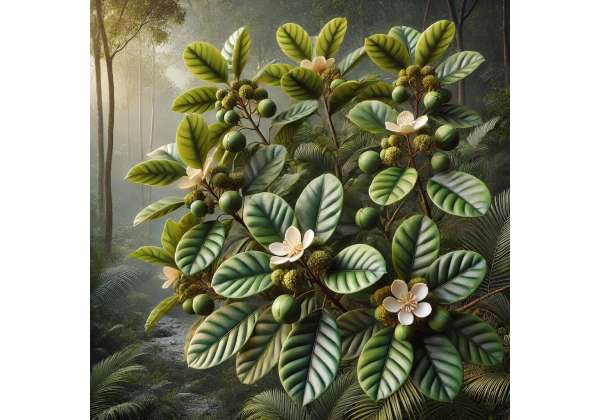
Huito, also known in different regions as jagua or genipap, is a tropical fruit tree with a long life in food, folk medicine, and natural dye traditions. The plant is best known for its unripe fruit, which yields a dark blue-black pigment used in body art, and for its ripe fruit, which is made into drinks, preserves, and regional remedies. In medicinal contexts, different parts of the plant have been used for sore throat, bruises, digestive discomfort, skin problems, and inflammatory complaints.
What makes huito especially interesting is its chemistry. The fruit is rich in iridoids such as genipin, geniposide, and related compounds, while the leaves and bark also contain flavonoids and phenolic substances. These constituents help explain why researchers keep studying huito for antioxidant, anti-inflammatory, antimicrobial, and tissue-related effects. Still, the evidence is uneven. Most of the strongest findings come from laboratory and animal work, not large human trials. The most useful way to understand huito is as a multi-use medicinal fruit with credible traditional value, promising phytochemistry, practical non-medicinal uses, and a need for cautious, realistic expectations.
Core Points
- Huito is used most often as a traditional digestive, anti-inflammatory, and topical-support plant rather than a well-standardized modern supplement.
- Its best-known compounds are iridoids such as genipin and geniposide, along with flavonoids and phenolic compounds.
- Human juice research has used 250 mL twice daily for 3 weeks, but no standardized medicinal oral dose exists.
- Avoid self-prescribing concentrated extracts during pregnancy or breastfeeding, and use extra caution if you have sensitive skin or use temporary jagua-style body dye.
Table of Contents
- What is huito?
- Key ingredients and actions
- What huito may help with
- How to use huito
- How much huito per day?
- Safety and who should avoid it
- What the evidence really says
What is huito?
Huito is the fruit of Genipa americana, a tropical tree native to Central and South America. In Brazil it is widely known as jenipapo or genipap. In parts of the western Amazon and Andean regions, the same plant is often called huito or jagua. The tree belongs to the coffee family, Rubiaceae, which is worth noting because that family includes many species with bitter, aromatic, or pigment-rich chemistry.
The plant has a dual identity. On one side, it is a food tree. The ripe fruit is aromatic, soft, and often made into juices, syrups, jams, liqueurs, and fermented beverages. On the other side, it is a traditional medicinal plant. Different communities have used the fruit, leaves, bark, and sometimes roots in household remedies for digestive complaints, sore throat, fever, bruises, skin concerns, and inflammatory discomfort. The plant is also famous for one non-medicinal use that many people know before they know its health story: the unripe fruit yields a clear juice that darkens into a blue-black stain on the skin and has long been used in body painting and temporary tattoo products.
That mix of food, medicine, and dye use is important because it changes how huito should be judged. It is not a single-purpose herb with one classic capsule dose. It is a culturally important plant with multiple preparations and very different applications depending on which part is used and how mature the fruit is.
A helpful way to think about huito is by plant part:
- Unripe fruit: richest in the chemistry behind the blue-black pigment and many of the iridoid compounds that attract research attention.
- Ripe fruit: more often consumed as food, juice, or preserves.
- Leaves and bark: more closely tied to folk medicinal preparations for inflammation, skin complaints, and other traditional uses.
This matters because many online summaries blend all these uses together as though the whole plant behaves the same way. It does not. The ripe fruit you drink, the unripe fruit used in body dye, and the leaf extract tested in a lab are not interchangeable.
Readers sometimes assume huito is mainly a cosmetic plant because of jagua body art, but that misses its broader role. It is better understood as a medicinal fruit tree whose cultural uses happen to include a remarkable natural pigment. That broader frame makes it easier to discuss both benefits and safety in a way that fits the real plant rather than a single commercial product.
Key ingredients and actions
The most important compounds in huito are its iridoids, especially genipin, geniposide, geniposidic acid, and related molecules. These compounds are central to the plant’s chemistry and help explain why huito is studied both as a medicinal plant and as a natural color source. In the unripe fruit, they are involved in the reaction that creates the distinctive blue-black pigment. In pharmacology, they are the compounds most often linked to antioxidant, anti-inflammatory, and tissue-related effects.
Genipin is the best-known of the group. It is often discussed not only for plant medicine but also for biomedical and food applications because it can cross-link proteins and other natural materials. That technical use may sound far from herbal medicine, but it tells you something important: genipin is reactive, biologically interesting, and not a trivial plant compound. That is part of why huito attracts attention far beyond folk use.
The plant does not stop at iridoids. Reviews and extract studies also describe:
- Flavonoids
- Phenolic compounds
- Phenolic acids
- Triterpenes in some extracts
- Polysaccharides in leaf material
These compounds matter because they broaden the plant’s actions. Instead of acting like a one-compound product, huito behaves more like a layered botanical. The fruit chemistry leans heavily toward iridoids. The leaves and bark add more of the flavonoid and phenolic profile often associated with antioxidant and anti-inflammatory activity.
In practical terms, the likely actions of huito are:
- Antioxidant
- Anti-inflammatory
- Mild antimicrobial in some extracts
- Topical staining and cross-linking effects from unripe fruit chemistry
- Possible antiplatelet and anticoagulant effects in certain leaf preparations
That last point is especially important for safety. Some leaf studies suggest actions on platelet behavior and inflammatory mediators. This does not mean drinking the fruit is equivalent to taking a blood-thinning drug, but it does mean concentrated preparations should not be treated casually.
Another useful detail is that huito changes with ripeness. Unripe fruit tends to be richer in certain iridoids and is the material most often used for pigment extraction. Ripe fruit is more often treated as food. This helps explain why the plant’s chemistry and its uses shift so much depending on the form.
Readers familiar with quercetin as a common flavonoid may already know that plants with mixed iridoid and flavonoid profiles often show broad preclinical activity. Huito fits that pattern. The key is not to overread it. Rich chemistry makes a plant promising, but not automatically proven in humans.
What huito may help with
The real question is not whether huito has interesting chemistry. It clearly does. The better question is where that chemistry might translate into useful, realistic outcomes. The most defensible answer is that huito may help as a traditional food-medicine plant with topical, digestive, and inflammatory relevance, but the evidence is much stronger in the lab than in the clinic.
Traditional use points to several main themes.
1. Minor inflammatory and sore-throat support
Leaf and bark remedies have long been used in household medicine for throat irritation, feverish states, bruises, and inflammatory discomfort. Modern animal and extract studies give some support to this pattern, especially around anti-inflammatory effects. Still, this is not the same as saying huito is a proven treatment for chronic inflammatory disease.
2. Digestive and food-based support
The ripe fruit has a long history as a food and beverage ingredient, and folk medicine also links it with digestive support. That makes sense in a broad way because many medicinal fruits sit in the space between nourishment and gentle therapeutic use. What it does not mean is that huito juice has established benefits for conditions such as IBS, ulcer disease, or liver disease.
3. Topical and skin-related use
In traditional practice, the plant has been used externally in various ways, and the unripe fruit is widely used as a temporary stain on the skin. Some people associate this with wound or skin care, but the stronger modern caution is that natural dye use is not automatically the same as therapeutic skin use. A plant can stain the skin effectively without being soothing for every person.
4. Antioxidant and protective potential
This is where modern research gets most excited. Fruit, leaf, bark, and peel extracts have shown antioxidant and related bioactivities in lab work. That suggests possible relevance for oxidative stress, but it does not yet prove a meaningful human health effect from casual use.
There are also more speculative areas that appear in reviews:
- Antimicrobial activity
- Antiparasitic signals
- Enzyme inhibition relevant to carbohydrate digestion
- Antiplatelet and anticoagulant activity in leaf extracts
These findings are interesting, but they remain mostly preclinical. The safest way to interpret them is as research leads, not home-treatment instructions.
For minor topical care, huito belongs in a gentler conversation with other plants used for soothing skin, not as a replacement for proper wound or rash care. And for oral use, the fruit makes more sense as a traditional food medicine than as a miracle remedy.
So yes, huito may offer real value. But that value is likely to be modest, preparation-dependent, and most meaningful in settings that respect the difference between traditional use and proven clinical effect.
How to use huito
Huito can be used in several ways, but each form belongs to a different tradition and carries different expectations. This is one of the most important points for safe use. A ripe fruit drink, an unripe fruit body dye, and a leaf extract are not simply stronger or weaker versions of the same thing. They are different preparations with different goals.
The most practical forms are these:
1. Ripe fruit as food
This is the most grounded and least risky way most people encounter huito. The ripe fruit is used in juices, preserves, syrups, fermented beverages, and desserts. When consumed this way, huito fits more comfortably into the category of medicinal food than concentrated herbal therapy. This is the form that makes the most sense for general culinary exposure.
2. Juice or pulp preparations
Some human research has used genipap juice, but that does not automatically convert juice into a standardized treatment. Juice is best thought of as a food-based preparation that may deliver iridoids and phenolic compounds, not as a precisely dosed medicine.
3. Leaf or bark preparations
These belong more clearly to folk medicinal practice. Traditional use includes decoctions, washes, and local preparations for inflammation, bruising, or throat complaints. Modern extract studies often use leaf or bark material rather than the ripe edible fruit. This is exactly why casual substitution is a bad idea. The medicinal literature on leaves and bark does not justify improvising home extracts without good guidance.
4. Unripe fruit for skin dye
This is a real and historically important use. The clear juice darkens on the skin and is used for body art and temporary tattoos. It can be culturally meaningful and visually striking, but it should not be confused with a universally gentle skin treatment. The chemistry that makes the stain durable also explains why some people react to it.
A practical use hierarchy looks like this:
- Start with food-like exposure if your interest is mainly wellness.
- Treat concentrated extracts as specialized products, not kitchen experiments.
- Keep topical dye use separate from medicinal skin use.
- Avoid assuming that traditional use makes every preparation safe for daily use.
If your main interest is digestive comfort rather than huito specifically, more familiar food-medicine options such as ginger for digestive support are easier to study, dose, and evaluate. Huito is best used when you want its specific chemistry or traditional context, not just any plant with a wellness halo.
How much huito per day?
This is where a careful article needs to be more honest than many supplement pages. There is no widely accepted standardized medicinal dose for huito. Not for the fruit, not for the leaves, and not for the bark in the way readers usually expect from modern herb guides. The plant is too diverse in form and too lightly studied in humans for that kind of certainty.
The most concrete human intake figure comes from juice research, where adults consumed 250 mL of genipap juice twice daily for 3 weeks. That study was designed to look at biomarkers of intake and metabolism, not to establish a therapeutic dose for a medical condition. It is useful because it shows a real human exposure amount, but it should not be mistaken for a recommended daily medicinal standard.
A safe way to interpret huito dosing is by category:
- Food use: ripe fruit and juice in normal culinary amounts are the most reasonable entry point.
- Traditional medicinal use: varies widely by region, plant part, and preparation, with no modern standardization.
- Extract use: should follow product labeling and, ideally, practitioner guidance.
- Topical dye use: depends on the product and should begin with a small test area rather than broad application.
A practical rule set is more helpful than a fake precise number:
- Prefer food-like forms over concentrated forms.
- Do not combine multiple huito products and assume the total is still mild.
- Do not self-escalate from juice to leaf or bark extracts just because the fruit seemed well tolerated.
- Reassess quickly if your reason for use is medical rather than culinary.
There is also an important plant-part issue. The ripe fruit, unripe fruit, leaves, and bark are not dose equivalents. A person who tolerates a glass of fruit juice may not tolerate a concentrated leaf extract or topical dye.
For readers who want a simple takeaway, it is this: huito is easier to approach as a food than as a self-dosed medicinal herb. Once you move into extracts, folk decoctions, or body-dye products, the margin for guesswork shrinks.
That is why the most responsible “dosage” advice is partly negative advice. Do not chase milligrams without standardized labeling. Do not assume ripe fruit intake predicts topical tolerance. And do not use human juice-study amounts as though they were a proven treatment dose.
Safety and who should avoid it
Huito is not one safety story. It has at least three: food safety, extract safety, and skin-use safety. The ripe fruit as food is one thing. A concentrated leaf extract is another. A jagua-style skin dye from unripe fruit is something else again. Keeping those categories separate is the best way to stay realistic.
For oral use, the biggest caution is the lack of standardized human safety data for medicinal dosing. Preclinical studies suggest that leaf extracts can have meaningful biological activity, including anti-inflammatory and antiplatelet effects, but some toxicology work also shows that higher-exposure extract models can affect tissues in ways that deserve caution. That does not mean huito is broadly unsafe. It means concentrated non-food preparations are not the same as eating the fruit.
People who should be most cautious include:
- Pregnant or breastfeeding people
- Children
- Anyone taking anticoagulants or antiplatelet drugs
- People with chronic liver or kidney disease
- Anyone with very sensitive skin or a history of contact dermatitis
- People considering repeated jagua-style skin applications
For topical use, the main concern is allergic contact dermatitis. Natural temporary tattoo products made from jagua or huito fruit extract are often marketed as gentler than black henna because they do not rely on para-phenylenediamine. Even so, natural does not mean non-allergenic. Genipin and related fruit compounds can still trigger allergic reactions in some people.
The most sensible topical precautions are simple:
- Patch test first
- Avoid broken or inflamed skin
- Do not assume repeated past use guarantees future tolerance
- Stop immediately if you notice burning, rash, blistering, or swelling
Common-sense oral precautions matter too. If you are using huito for wellness rather than as food, avoid stacking it with multiple other strong botanical products. And if you have unexplained bruising, bleeding, severe stomach symptoms, or ongoing inflammation, do not replace evaluation with more plant experiments.
People seeking broad antioxidant support may do better with more standardized options such as grape seed for polyphenol support rather than improvising with a less standardized tropical medicinal fruit. Huito is best respected as a plant with interesting benefits and real limitations, not as a universal safe natural product.
What the evidence really says
The evidence for huito is promising, but it is not deep. That is the fairest summary. The plant has a strong traditional record, interesting chemistry, and a growing body of laboratory and animal studies. What it does not have is a large, mature clinical literature showing clear therapeutic effects in humans.
The strongest evidence is in three areas.
First, phytochemistry.
There is little doubt that Genipa americana contains biologically active compounds, especially iridoids such as genipin and geniposide. Reviews consistently describe these as central to the plant’s identity. This is the most solid part of the evidence base.
Second, preclinical anti-inflammatory and antioxidant activity.
Leaf, bark, and fruit-derived preparations have shown anti-inflammatory, antioxidant, and sometimes antimicrobial or antiplatelet effects in test systems. These results are useful because they make the traditional uses more plausible. They also help identify which plant parts may deserve further study.
Third, human exposure evidence as food.
A small amount of human work has looked at juice intake and urinary metabolites after genipap consumption. That matters because it confirms that the fruit delivers measurable compounds to the body. But it still falls short of proving health outcomes such as symptom relief, prevention, or treatment.
Where the evidence weakens is just as important:
- There are very few human efficacy trials.
- Oral medicinal dosing is not standardized.
- Different plant parts are studied for different effects, which makes generalization difficult.
- Topical dye safety is not identical to food safety.
- Some popular claims, including antimicrobial and metabolic benefits, are still mostly preclinical.
That means huito should not be framed as a proven treatment for inflammation, diabetes, infection, anemia, or skin disease. It is more accurate to call it a research-supported traditional plant than a clinically established modern remedy.
A balanced conclusion looks like this:
- Huito is pharmacologically interesting.
- Its traditional uses are coherent and culturally meaningful.
- Its best-supported benefits are still mostly indirect or preclinical.
- Its safest everyday role is closer to medicinal food and careful topical use than to high-dose self-medication.
That kind of conclusion may sound modest, but it is actually useful. It lets readers appreciate the plant’s real value without confusing possibility with proof.
References
- Genipa americana L.: A Review on Traditional Uses, Phytochemistry and Biological Activities 2024 (Review)
- Biological properties of bioactive compounds from the fruit and leaves of the genipap tree (Genipa americana L.): A systematic review 2023 (Systematic Review)
- Polysaccharide-rich extract of Genipa americana leaves exerts anti-inflammatory effects modulated by platelet mediators 2024 (Preclinical Study)
- Toxicological effects of aqueous extract of Genipa americana L. leaves on adult zebrafish (Danio rerio): Chemical profile, histopathological effects and lack of genotoxicity 2023 (Toxicology Study)
- Allergic contact dermatitis caused by a new temporary blue-black tattoo dye – sensitization to genipin from jagua (Genipa americana L.) fruit extract 2017 (Case Report)
Disclaimer
This article is for educational purposes only and does not replace medical advice, diagnosis, or treatment. Huito is a traditional medicinal fruit with promising but limited human evidence, and its safety depends heavily on the form used. Speak with a qualified healthcare professional before using concentrated huito products if you are pregnant, breastfeeding, take blood-thinning medicine, have chronic illness, or plan to use jagua-style body dye on sensitive skin.
If this article helped you, please share it on Facebook, X, or another platform where thoughtful plant-based health information could help someone else.