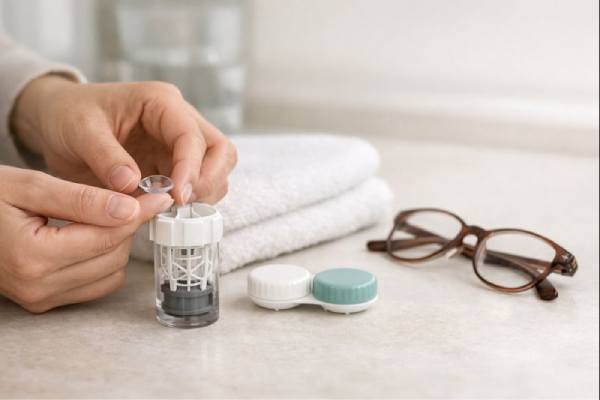
Hydrogen peroxide contact lens solution is the “deep clean” option in modern lens care: strong disinfection, excellent deposit control, and typically no preservatives left sitting on the lens. For many wearers—especially those who react to multipurpose solution ingredients—it can be a meaningful comfort upgrade. The trade-off is that peroxide systems demand a precise routine. The same chemistry that wipes out germs can sting intensely and injure the eye if it is not fully neutralized.
This guide explains what peroxide systems are doing at a molecular level, why the special case matters, and how to use them safely without guesswork. You will learn practical decision points (one-step vs two-step, which lenses they fit best), a step-by-step nightly workflow, and how to handle common problems such as burning, cloudy lenses, and missed neutralization time.
Essential Insights
- Hydrogen peroxide systems provide high-level disinfection and strong deposit control, often without preservative exposure on the lens.
- The neutralization step is non-negotiable; unneutralized peroxide can cause severe burning and corneal injury.
- Use only the provided peroxide case and replace it regularly; a flat case will not neutralize peroxide correctly.
- Soak for the full labeled time (commonly about 6 hours) before inserting lenses.
- If peroxide contacts your eye, remove lenses immediately and rinse with sterile saline or water, then seek urgent eye-care guidance if pain or vision changes persist.
Table of Contents
- Why peroxide systems feel so different
- The chemistry, neutralization, and what gets removed
- One-step vs two-step and how to choose
- A safe nightly routine, step by step
- Common mistakes and how to handle burning
- Who should consider peroxide and who should avoid it
Why peroxide systems feel so different
Hydrogen peroxide lens systems sit in a separate category from multipurpose solutions (MPS). With MPS, you typically “rub, rinse, and store” in the same liquid, and the bottle is designed to be gentle enough that a small residue on the lens is usually tolerable. Peroxide systems flip that logic: the disinfecting liquid is intentionally potent, and the routine is built around converting it into something eye-safe before the lens ever touches your eye.
Two features drive the “different feel” many people notice:
- Preservative-free experience on the eye. Most peroxide systems are designed so that, after neutralization, the remaining liquid is essentially saline-like (water plus oxygen byproducts during the reaction). For people who get chronic redness, dryness, or itching from certain preservatives or surfactants, removing that exposure can matter.
- High disinfection “headroom.” Peroxide is an oxidative disinfectant. Instead of relying mainly on preservatives that disrupt microbial cell membranes, it creates reactive oxygen species that damage proteins, lipids, and nucleic acids. That broad mechanism is one reason peroxide systems have a strong reputation for disinfection performance—when used correctly.
That “when used correctly” is the key. Peroxide is not forgiving of shortcuts:
- A flat lens case does not neutralize peroxide.
- A rushed soak time may leave active peroxide on the lens.
- Topping off old solution can dilute or destabilize the regimen.
Think of peroxide care as more like a controlled chemical process than a “rinse and go” product. The reward is a clean, comfortable lens and robust disinfection. The cost is that your routine has to be consistent, and you must respect the neutralization step every single time.
The chemistry, neutralization, and what gets removed
A peroxide system has two jobs: disinfect and finish neutral (safe). Understanding the pathway helps you avoid the most common safety errors.
What hydrogen peroxide is doing during disinfection
Hydrogen peroxide (H₂O₂) is an oxidizer. In practical terms, it damages microorganisms by attacking essential cellular components—proteins, membrane lipids, and genetic material. That broad “oxidative stress” pathway is why peroxide can be effective across a wide range of common lens contaminants.
Peroxide also helps with deposit control:
- Proteins from the tear film can cling to lenses, especially if you wear them long hours or have allergy-driven mucus and inflammatory debris.
- Lipids can create a hazy film that reduces wetting and makes lenses feel “greasy” or unstable.
- Biofilm risk can develop in lens cases when microbes adhere to surfaces and build protective layers. While no solution makes you immune to case contamination, peroxide systems paired with good case habits can reduce the microbial burden.
Still, chemistry is not magic. Mechanical cleaning matters. “Rub and rinse” steps (when the manufacturer allows them for your lens type) can physically remove debris that disinfectants cannot fully penetrate.
Neutralization: turning strong disinfectant into something eye-safe
Neutralization is the step that transforms peroxide into water and oxygen. The special case contains a catalyst—commonly a platinum disc in one-step systems—designed to drive that conversion. During the soak, you may see tiny bubbles; that is oxygen being released as peroxide breaks down.
Why the case matters: the catalyst needs the right geometry, materials, and exposure time to complete the reaction. A regular “flat” case is essentially just storage; it does not reliably neutralize peroxide. Without full neutralization, the remaining peroxide can cause immediate pain, tearing, redness, and potentially corneal surface injury.
Why “it only stung a little” is still a red flag
People sometimes assume that mild stinging means the peroxide is “almost neutralized.” Unfortunately, eyes are not pH meters. Even partially neutralized peroxide can irritate or injure tissue. The safest mindset is binary: either you completed the full labeled neutralization regimen, or you treat the lenses as unsafe to insert.
When you respect the chemical timeline, peroxide systems can be both powerful and comfortable. When you don’t, they can punish you quickly.
One-step vs two-step and how to choose
Peroxide systems usually come in two formats: one-step and two-step. The “steps” refer to when neutralization happens.
One-step systems
In a one-step system, you place lenses in the provided case and fill it with peroxide. Neutralization begins automatically because the case contains the catalyst. This is the most common format in many countries because it is simpler and reduces the chance that someone forgets to add a neutralizing tablet.
Pros
- Fewer moving parts: easier to use consistently.
- Neutralization starts immediately—no waiting to add a tablet.
- Often a good choice for people who value routine simplicity.
Cons
- You must use the correct case every time.
- If you accidentally remove lenses early, they may still carry active peroxide.
- Case wear matters: an old or damaged catalyst disc may neutralize less reliably.
Two-step systems
In a two-step system, lenses soak in peroxide first, then you add a neutralizing tablet (or a separate neutralizer) after the disinfection period. This design can be effective, but it introduces a “human factor” risk: forgetting the neutralizer.
Pros
- Some wearers like the explicit separation of disinfect and neutralize.
- Depending on the product, it may fit certain specialty lens routines.
Cons
- Higher chance of user error if the neutralizing step is missed or mistimed.
- More items to handle (tablets, timing, storage).
Choosing the right peroxide option for your lenses
Not all contact lenses and care regimens are interchangeable. Before switching, check two things:
- Lens material and modality. Soft daily-wear lenses, many reusable soft lenses, and many rigid gas permeable (RGP) and scleral lenses can be compatible—but the instructions may differ. Some specialty lenses have specific cleaning requirements (for example, extra surfactant cleaning or specific rinsing fluids).
- Your eye history. If you have had corneal infections, inflammatory events, severe dry eye, or a history of poor lens tolerance, your clinician may prefer a certain disinfection approach and case replacement schedule.
A practical decision shortcut
- If you are switching because of preservative sensitivity, peroxide is often worth trying.
- If you struggle with routine consistency, choose the simplest system you can execute correctly every day (often one-step).
- If you frequently travel, work long shifts, or nap unexpectedly, build a plan for minimum soak time so you are not tempted to shortcut neutralization.
The “best” peroxide system is the one you will use correctly—without exceptions.
A safe nightly routine, step by step
A peroxide routine should feel almost boring—because consistency is what keeps it safe. The details below are intentionally specific, but always prioritize the instructions for your exact product and lens type.
Before you start: set up for zero mistakes
- Keep peroxide away from your regular drops and saline. Many bottles have a red cap or tip to help you recognize peroxide. Do not rely on memory alone; make it visually obvious which bottle is which.
- Use the provided case only. Put any spare flat cases in a different drawer so you never grab the wrong one at night.
- Commit to the full soak time. Many systems require around 6 hours to fully neutralize. Treat that as a hard boundary, not a suggestion.
Step-by-step workflow
- Wash and dry hands thoroughly. Water exposure is a major contamination pathway. Dry with a lint-free towel.
- Remove one lens and clean it if your system allows rubbing.
- Place the lens in your palm.
- Apply a small amount of approved cleaner (or the peroxide solution if the manufacturer specifically allows a rub step for your lens type).
- Gently rub with a fingertip for the recommended time.
- Rinse appropriately.
- If your regimen includes rinsing, use the recommended fluid (often sterile saline or the specified solution).
- Avoid tap water—ever.
- Place the lens in the correct basket. Make sure it is centered and not folded or pinched.
- Fill the case to the line with peroxide. Do not underfill (poor disinfection) or overfill (leaks and messy counter contamination).
- Close the cap fully and store upright. An upright position helps ensure the catalyst is submerged and the process runs as designed.
- Leave it alone for the full neutralization period. No “quick check,” no opening to peek.
Morning insertion: keep it clean and simple
- Open the case and insert lenses as directed.
- If your lens type requires rinsing before insertion (common in many scleral routines), use sterile, preservative-free saline approved for that purpose.
- Never “top off” yesterday’s solution. Discard after each cycle.
Case hygiene that actually matters
Even with peroxide systems, the case is not immortal:
- Replace the peroxide case on the schedule recommended by your product or clinician.
- Do not transfer peroxide into another case “just for today.” That is how neutralization failures happen.
- Keep the case clean and dry between cycles when applicable to your system’s instructions.
If you follow a consistent process and respect the timer, peroxide care becomes a low-drama, high-performance routine.
Common mistakes and how to handle burning
Most peroxide injuries happen the same way: a rushed moment, a wrong case, or a “close enough” soak time. The goal is not perfection—it is designing habits that make errors unlikely.
Mistake: inserting lenses before neutralization is complete
This can happen if you:
- Soak for less than the minimum time.
- Remove lenses early because your schedule changed.
- Put lenses in the case and forget you did it, then grab them too soon.
Safer fix: keep a backup option. If you cannot meet the minimum soak time, switch to glasses for that day, or use a clinician-approved alternate regimen for emergencies. Do not improvise with partial neutralization.
Mistake: using a flat case
A flat case does not contain the catalyst needed for neutralization. People make this mistake when traveling, when the provided case breaks, or when they pour peroxide into “whatever case is clean.”
Safer fix: keep a spare manufacturer-provided peroxide case in a travel kit, stored separately from flat cases. If you lose it, do not use peroxide until you have the correct case again.
Mistake: rinsing lenses with peroxide
Some wearers mistakenly use peroxide like saline and rinse right before insertion. That is a direct hit of active peroxide on the eye.
Safer fix: label your bottles. Store peroxide and saline in different locations. If you are prone to mix-ups, choose packaging that looks and feels distinct.
Mistake: topping off or reusing solution
Reusing solution can reduce disinfection performance and increase contamination risk. Topping off also dilutes the system and can alter the intended chemistry.
Safer fix: treat solution as single-use per cycle. Fill fresh every time.
If your eye burns: what to do immediately
A peroxide exposure often feels unmistakable: sharp burning, intense tearing, redness, and light sensitivity.
- Remove the lens immediately if it is still in your eye.
- Rinse the eye with sterile saline if available. If not, flushing with clean water is better than doing nothing in an emergency, but sterile saline is preferred when possible.
- Do not reinsert the lens that caused the exposure.
- Assess symptoms over the next hour. If pain is significant, vision is blurry, light sensitivity is strong, or discomfort does not improve quickly, seek urgent eye care.
Warning signs you should not ignore
Get prompt clinical evaluation if you notice:
- Persistent pain, foreign-body sensation, or worsening redness
- Blurred vision that does not clear
- Light sensitivity that makes it hard to keep the eye open
- Discharge or increasing swelling
- A “hazy” spot on the cornea or a feeling that something is stuck
Peroxide systems are safe when used as designed. The moment you suspect a neutralization failure, treat it as an eye-safety issue—not a minor inconvenience.
Who should consider peroxide and who should avoid it
Peroxide is not automatically “better” than multipurpose solution. It is a different tool with distinct strengths. The best match depends on your eyes, your lenses, and how you live.
Good candidates for peroxide systems
You may benefit from peroxide care if you relate to any of these:
- Preservative sensitivity: chronic redness, itching, burning, or end-of-day discomfort that improves when you stop using preserved products.
- Heavy deposit formation: cloudy lenses, reduced wetting, or recurring protein film despite good hygiene.
- High-demand wearing patterns: long days, dusty environments, or frequent exposure to cosmetics or aerosols that increase lens contamination.
- History of noncompliance with rubbing: peroxide does not replace rubbing when recommended, but some wearers do better with a “structured” system that feels more intentional and harder to shortcut.
Situations that require extra planning
Peroxide care can be tricky if you:
- Need flexibility in wear time. If you often remove and reinsert lenses in short windows, a peroxide system may feel inconvenient because it needs full neutralization time.
- Travel frequently. It is still doable, but you must travel with the correct peroxide case and keep bottles clearly separated from saline and drops.
- Have reduced vision or dexterity challenges. The risk of grabbing the wrong bottle or case is higher. In these situations, packaging choices, tactile labels, and simplified routines matter.
When to avoid switching without clinician input
Seek personalized guidance if you have:
- Recent corneal infection or inflammatory events
- Significant dry eye disease requiring a tailored lens-surface strategy
- Scleral lenses, ortho-k, or specialty designs with specific cleaning and rinsing needs
- A history of allergic conjunctivitis where deposits and mucus are heavy and you may need adjunct cleaning steps
A balanced “compare and decide” checklist
Ask yourself:
- Can I reliably meet the minimum soak time every day?
- Will I keep peroxide in the correct case only, every time?
- Do I have a backup plan for nights when life gets chaotic?
- Is my discomfort more likely from preservatives or from lens fit and dryness?
If you can execute the routine consistently, peroxide systems can be an excellent long-term option. If you cannot, it is safer to choose a regimen you will follow correctly—because the safest solution is the one used as intended.
References
- Hydrogen Peroxide-Based Contact Lens Care Products: Consumer Labeling Recommendations -Premarket Notification (510(k)) Submissions 2022 (Guidance)
- Contact Lenses: Safe Use of Hydrogen Peroxide Solution | FDA 2023 (Consumer Guidance)
- Differential Antimicrobial Efficacy of Preservative-Free Contact Lens Disinfection Systems against Common Ocular Pathogens – PMC 2022 (Laboratory Study)
- Biocidal Efficacies of Contact Lens Disinfecting Solutions Against Gram-Negative Organisms Associated with Lens Case-Associated Corneal Infiltrative Events – PMC 2025 (Laboratory Study)
Disclaimer
This article is for educational purposes only and does not replace personalized advice from an eye-care professional. Contact lens care recommendations vary by lens type, eye health history, and product formulation. Always follow the instructions for your specific lenses and solution, and contact a clinician promptly if you develop eye pain, redness, light sensitivity, discharge, or changes in vision—especially after possible exposure to unneutralized hydrogen peroxide.
If you found this guide useful, consider sharing it on Facebook, X (formerly Twitter), or any platform you prefer so others can use peroxide lens systems more safely.