Hair needs water to be washed, detangled, conditioned, and styled, yet water is also part of what makes hair temporarily weaker. That contradiction sits at the center of hygral fatigue, a term used in hair science and cosmetic education to describe repeated swelling and shrinking of the hair fiber as it gets wet and then dries again. The concept is real enough to be useful, but it is often explained too dramatically online. Water itself is not the enemy, and healthy hair is meant to tolerate normal wetting. The bigger question is when repeated swelling starts to matter.
The answer usually depends on the condition of the fiber. Hair that is bleached, heat-damaged, highly porous, relaxed, or already weathered tends to take up water more easily and resist stress less effectively. In that setting, long soaking, rough detangling while wet, frequent wet styling, and repeated wash-and-dry cycles can contribute to breakage and a limp, weakened feel.
So the smartest approach is not to fear moisture. It is to understand when water exposure becomes stressful, how to reduce unnecessary swelling, and how to protect the length you already have.
Essential Insights
- Hygral fatigue refers to stress from repeated swelling and drying of the hair fiber, not a scalp disease or a type of hair loss from the root.
- Water alone is usually not enough to ruin healthy hair, but damaged and high-porosity hair is more vulnerable to swelling-related weakness and breakage.
- Hair is mechanically weaker when wet, so rough combing, tight styling, and long wet periods often matter more than washing itself.
- A practical way to lower risk is to shorten unnecessary soaking time, condition well, detangle gently, and avoid leaving fragile hair wet for long stretches.
Table of Contents
- What Hygral Fatigue Actually Means
- Why Some Hair Swells More Than Others
- How to Recognize the Signs
- Routines That Can Make It Worse
- How to Prevent Water-Related Fiber Damage
- When the Problem Is Probably Something Else
What Hygral Fatigue Actually Means
Hygral fatigue is not a medical diagnosis. It is a hair-fiber concept used to describe what can happen when the hair shaft repeatedly absorbs water, swells, and then contracts again as it dries. The idea is straightforward: hair is a protein fiber with internal structures that change when exposed to water. As water moves into the shaft, the fiber expands. As it dries, it contracts. Over time, that cycle may add wear, especially if the cuticle is already compromised.
That does not mean ordinary washing is harmful. Hair is supposed to get wet. In fact, most healthy hair handles regular washing without any dramatic consequence. The more important point is that wet hair is temporarily more vulnerable. Water disrupts hydrogen bonding inside the fiber, making the strand more flexible but also easier to stretch, snag, and stress mechanically. When people talk about “water damage,” what they often mean is not pure hydration in isolation. They mean hydration plus friction, brushing, tension, heat, chemical weathering, or prolonged swelling in already fragile hair.
This is where the term gets overused. Online, hygral fatigue is sometimes described as if any contact with water steadily ruins hair. That is too simplistic. A single wash does not create chronic fiber damage, and neither does using conditioner as directed. The risk is cumulative and context-dependent. Repeated wetting matters most when the fiber is already porous, damaged, or handled roughly during its weaker wet state.
It also helps to separate hygral fatigue from another consumer phrase: “moisture overload.” That term is often used loosely to describe hair that feels limp, mushy, overly soft, or hard to style. Sometimes that sensation reflects true water-related fiber stress. Other times it reflects product buildup, heavy conditioning, poor protein balance in a routine, or simple styling frustration. A closer look at over-conditioned hair signs and moisture overload confusion can help clear up that overlap.
The most accurate working definition is this: hygral fatigue refers to cumulative physical stress from repeated wet swelling and drying of the hair shaft, especially in hair that is already more hydrophilic and structurally vulnerable. It belongs in the conversation about hair breakage, porosity, and cosmetic damage, not in the conversation about follicles shutting down or hair permanently “stopping growth.”
That distinction matters because the fix is different. You are not treating the scalp. You are managing the fiber.
Why Some Hair Swells More Than Others
Not all hair reacts to water in the same way. The biggest reason is that not all hair has the same barrier quality. A healthy hair fiber has a cuticle surface and lipid layer that help limit friction and slow down unnecessary water movement. When that outer protection is worn away, the hair becomes more hydrophilic. In plain language, it takes on water more readily, swells more easily, and tends to feel rougher, tanglier, and less resilient.
Chemical processing is one of the clearest reasons this happens. Bleaching, repeated coloring, straightening, relaxing, and perming can disrupt the cuticle and deeper structural regions of the hair shaft. Once that damage accumulates, water can move in and out more freely. That repeated expansion is more stressful for a compromised fiber than for an intact one.
Heat damage can push hair in the same direction. Frequent hot tools, especially without adequate protection, do not just roughen the surface. They can also worsen internal fragility, making wet handling riskier. UV exposure, friction from rough fabrics, and aggressive brushing pile onto that background damage over time.
Curl pattern can influence the experience too, though not because curly hair grows differently. Curly, coily, and tightly textured fibers often have more bends, twists, and asymmetry along the shaft. Those structural features can make the fiber more prone to weathering and breakage, especially when combined with chemical services, tension, or poor detangling practices. The point is not that textured hair is inherently fragile in a pathological way. It is that the daily stress pattern can be different, and water management often matters more.
Porosity is the most useful concept here. High-porosity hair tends to absorb water quickly and lose it quickly. It may dry fast on the surface yet still behave as if it has unstable moisture balance, frayed cuticles, and poor retention of conditioning benefits. Low-porosity hair tends to resist water entry more, which can feel helpful in one context and frustrating in another. A practical guide to low- and high-porosity care helps explain why the same routine can feel protective on one head of hair and exhausting on another.
There is also a subtle but important point about damage history. Someone may think their hair suddenly became “water sensitive,” when in reality the fiber has been gradually losing its protective surface for months through bleach, heat, friction, hard brushing, or strong surfactants. Water then becomes the moment when that damage shows itself most clearly.
So when some hair seems to “hate water,” the real problem is rarely water alone. It is the condition of the barrier the water is meeting.
How to Recognize the Signs
Hygral fatigue does not usually announce itself with one dramatic symptom. It tends to show up as a pattern: hair that feels increasingly weak, overly stretchy when wet, rougher after drying, duller at the ends, and more prone to tangling or snapping during ordinary care. The change is often gradual enough that people notice the consequences before they recognize the cause.
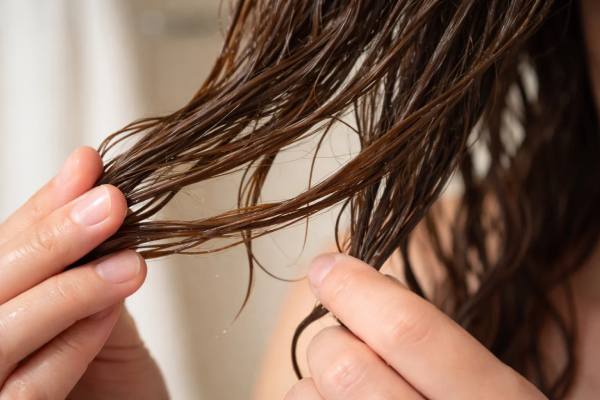
One of the classic complaints is that the hair feels soft in an unhelpful way while wet, then brittle or puffy once dry. Another is that the strands seem to stretch too much when combed wet, as though they have lost some spring and backbone. That overstretched feeling matters because the hair shaft is not meant to be pulled repeatedly at its weakest point.
Common signs can include:
- Increased tangling after washing.
- Mushy or overly elastic wet hair.
- Frizz that persists even after conditioning.
- Dullness and loss of smooth reflection.
- Split ends or mid-shaft snapping.
- Hair that seems to be “breaking off” before it can retain length.
- A limp, weakened feel after frequent wet styling or masking.
The pattern is easier to recognize if the hair has a known damage history. Someone who bleaches regularly, heat styles often, sleeps with wet hair, keeps hair in damp buns, or rewets curls every day may slowly accumulate this kind of fiber stress. But even then, it is worth being careful with labels. Not every soft or frizzy day means hygral fatigue. Product buildup, poor cleansing, heavy leave-ins, hard water effects, heat damage, and simple breakage from grooming can create very similar symptoms.
That is why the most useful question is not “Does my hair look hydrated?” It is “Does my hair feel weaker and behave worse after repeated wetting cycles?” If the answer is yes, water-related swelling may be part of the story.
It also helps to separate root-level shedding from shaft damage. Hygral fatigue affects the hair fiber, not the follicle. It does not cause classic hair loss disorders. If you are seeing short snapped pieces, thinning ends, and breakage around fragile sections, that points toward shaft damage. If you are seeing full-length hairs coming out from the root with a white bulb, that is a different process. A closer guide to breakage versus true hair loss can help distinguish those patterns.
Another clue is where the damage sits. Water-related fatigue often shows up most in the oldest or most processed areas: highlighted lengths, ends, crown sections that are heat styled daily, or curl clusters that are constantly re-wet and manipulated. The scalp itself may be completely normal.
That makes hygral fatigue less of a diagnosis and more of a recognizable damage pattern. Once you start looking for the sequence instead of one perfect symptom, it becomes easier to spot.
Routines That Can Make It Worse
The routines most likely to worsen hygral fatigue are usually the ones that keep hair wet for long periods, repeatedly re-wet it without much recovery time, or combine water exposure with friction and tension. This is why a routine can feel “moisturizing” while still being hard on the fiber.
One common culprit is prolonged soaking. Leaving the hair saturated for extended periods, whether through very long wash days, repeated rinsing, heavy water-only refreshing, or frequent soaking masks, increases the amount of time the shaft spends in its swollen state. For resilient virgin hair, this may not matter much. For high-porosity or chemically treated hair, it can add stress.
Daily rewetting can do something similar. This shows up often in curl routines where hair is misted, reactivated, or heavily refreshed every morning and then manipulated again while damp. Water itself is not automatically harmful, but frequent expansion-and-shrinkage cycles add up when the fiber is already fragile.
Sleeping with wet hair is another habit that can magnify the problem. A damp pillow creates hours of friction while the hair is in a weaker state, and sections can dry bent, tangled, or compressed. That does not guarantee damage every time, but it raises the odds, especially in long or processed hair. A practical review of why wet sleeping can increase breakage is useful if this is a regular habit.
Other routines that can increase risk include:
- Detangling aggressively when the hair is dripping wet.
- Leaving heavy masks on far longer than directed.
- Repeated wash-and-style cycles for cosmetic reasons rather than scalp need.
- Tight buns, braids, or clips placed into damp hair.
- Frequent pool or hard-water exposure without follow-up conditioning.
- Shampooing with strong cleansers and then skipping slip or conditioning support.
There is also an important air-drying nuance. Letting hair dry naturally is not automatically the gentlest option if it means the fiber stays swollen for many hours, tangles while loose, or rubs against clothing while damp. On the other hand, high heat is clearly damaging. The goal is not to choose a side blindly. It is to reduce total stress. For some people, that means blotting gently, applying conditioner or leave-in, detangling once, and finishing with controlled low heat rather than leaving fragile hair soaked all evening.
The biggest pattern to avoid is repeated wet manipulation. Wetting, scrunching, rewetting, combing, adding more product, and reworking the hair again creates more opportunity for fatigue than a simpler wash, condition, detangle, and leave-it-alone routine.
In practice, hygral fatigue is rarely caused by one dramatic mistake. It is usually the sum of small wet-state stresses repeated often enough to matter.
How to Prevent Water-Related Fiber Damage
The best prevention plan does not revolve around avoiding water. It revolves around making wetting less stressful. That means reducing unnecessary swelling, lowering friction, improving slip, and protecting already damaged areas from accumulating more wear.
Start by shortening unnecessary contact time. Wash the scalp and lengths efficiently rather than leaving hair saturated for very long periods just because more time feels more nourishing. Deep treatments can still be useful, but longer is not always better, especially if the fiber is already overworked.
Next, make conditioning do real work. A good conditioner reduces friction and helps the cuticle lie more smoothly, which matters because much of the damage blamed on “too much moisture” is actually the result of manipulating swollen hair without enough slip. This is also where leave-ins, film formers, and targeted repair products can help damaged lengths behave better between washes. If your strands are already compromised, a deeper look at bond-repair options for damaged hair can help you decide where they fit realistically.
A practical prevention routine often includes:
- Cleanse according to scalp need rather than rewashing the lengths unnecessarily.
- Condition every wash if the hair is dry, processed, or tangle-prone.
- Detangle when there is enough slip, starting at the ends.
- Blot instead of rubbing with a rough towel.
- Avoid keeping fragile hair wet for hours in buns, clips, or tight styles.
- Use moderate drying strategies instead of extreme ones.
Pre-wash oiling can help in some routines, especially with coconut oil, which has been studied for its ability to penetrate the fiber and reduce some water uptake and protein loss in lab settings. That does not mean everyone needs an oil-heavy routine, and it certainly does not mean oil repairs all damage. But for some dry, porous, or processed hair, a small amount before washing can reduce stress.
It is also worth paying attention to heat strategy. Very hot tools can permanently worsen cuticle and internal damage, while leaving fragile hair wet for too long may keep it in a swollen, more vulnerable state. That is why the gentlest approach is often somewhere in the middle: controlled drying, moderate heat if needed, and less repeated manipulation overall. An honest comparison of air-drying and blow-drying tradeoffs can help when the usual advice feels contradictory.
Finally, remember that prevention gets easier when the routine is simpler. Hair that is repeatedly soaked, reactivated, restyled, and layered with heavy products often does better when the process becomes calmer. Fewer cycles, less friction, better slip, more restraint. That is usually more protective than chasing the perfect “moisture” product.
When the Problem Is Probably Something Else
Not all fragile or frizzy hair is suffering from hygral fatigue. In fact, several other problems are more common and can look very similar at first glance. That is why it is useful to treat hygral fatigue as one possible explanation, not a catch-all label for any bad hair day.
Heavy product buildup is one common mimic. Hair coated with residue can feel limp, coated, sticky, or strangely soft while still tangling and looking dull. In that case, the issue is not repeated swelling so much as surface accumulation interfering with normal feel and movement.
Heat damage is another major look-alike. Repeated flat ironing, curling, or blow-drying at high temperatures can leave hair rough, frayed, and weak even if water exposure is not excessive. Chemical damage from bleach, relaxers, or repeated dyeing is even more important. Once the internal structure is compromised, the hair may respond badly to ordinary water simply because the real injury happened earlier.
There are also shaft disorders and scalp conditions that should not be mislabeled as moisture problems. If the hair is snapping in very specific areas, looks beaded or nodular under magnification, or shows irregular white dots and weak points, the issue may be a structural shaft problem rather than an everyday cosmetic one. If there is scalp pain, burning, itching, pustules, heavy scale, or widening thinning, that is not hygral fatigue.
The clearest signs that something else may be going on include:
- Sudden increased shedding from the root.
- Patchy bald spots.
- Scalp inflammation, pain, or persistent itching.
- Breakage that continues despite simplifying the routine.
- Damage concentrated only at highly bleached or chemically treated sections.
- No improvement after reducing wet manipulation for several weeks.
It is also possible for two things to be true at once. Someone may have porous, overprocessed hair that dislikes repeated wet styling and also have a scalp condition or underlying shedding problem. That is one reason self-diagnosis can get messy.
A helpful rule is this: if the problem mainly involves the lengths looking weak, tangled, overly stretchy, and short from breakage, hygral fatigue may be part of the picture. If the problem involves the scalp, true thinning, sudden fallout, or persistent worsening despite careful hair handling, widen the frame. A guide on when hair problems deserve a dermatologist visit can help you decide when the issue has moved beyond ordinary shaft care.
The most honest answer to the title question is yes, too much repeated water swelling can contribute to hair damage. But it usually does so in partnership with porosity, prior damage, friction, and rough wet handling. Water is part of the mechanism, not usually the whole story.
References
- On Hair Care Physicochemistry: From Structure and Degradation to Novel Biobased Conditioning Agents 2023 (Review)
- Mechanisms of impairment in hair and scalp induced by hair dyeing and perming and potential interventions 2023 (Review)
- The biomechanics of splitting hairs 2024
- Benefit of coconut-based hair oil via hair porosity quantification 2022
- Secondary ion mass spectrometric investigation of penetration of coconut and mineral oils into human hair fibers: relevance to hair damage 2001
Disclaimer
This article is for educational purposes and is not a diagnosis or a substitute for professional medical advice. Hygral fatigue refers to possible damage to the hair fiber, not a scalp disease, but breakage, shedding, scalp symptoms, and texture changes can overlap with medical hair and scalp conditions. If you have sudden shedding, patchy loss, scalp pain, persistent inflammation, or ongoing breakage that does not improve with gentler care, seek evaluation from a qualified clinician.
If this article clarified the topic for you, please share it on Facebook, X, or another platform where it may help someone care for damaged hair more realistically.