Hypertrophic subaortic stenosis is an older name for a condition now most often called obstructive hypertrophic cardiomyopathy (HCM)—a disease where the heart muscle becomes abnormally thick. That thick muscle can narrow the outflow path just below the aortic valve, making it harder for blood to leave the heart, especially during activity or dehydration. Some people feel fine for years; others notice breathlessness, chest tightness, or dizziness that seems out of proportion to effort.
The good news is that evaluation and treatment have become far more tailored. Modern imaging can show when the narrowing happens (rest, standing, or exercise), and treatment can be matched to your anatomy, symptoms, and risk profile. If you’re reading because you or a family member received this diagnosis, this guide will help you understand what it means—and what you can do next.
Table of Contents
- What it is and what makes it obstructive
- What causes it and who gets it
- Symptoms, triggers, and possible complications
- How it is diagnosed and why resting tests miss it
- Treatments that reduce obstruction and improve feeling
- Daily management, family screening, and when to seek care
What it is and what makes it obstructive
Hypertrophic subaortic stenosis describes a specific problem: the heart’s main pumping chamber (the left ventricle) has thickened muscle that creates a narrowing below the aortic valve, in the “outflow tract” where blood exits the heart. Today, clinicians usually call this obstructive hypertrophic cardiomyopathy because the obstruction is not fixed like a scarred valve—it can change from moment to moment.
Here’s the key concept: the thickened muscle makes the ventricle stiffer and smaller inside, and it can also crowd the exit pathway. During a heartbeat, blood is forced through that narrowed area. The faster the blood moves, the more it can pull nearby valve tissue toward the opening, worsening the blockage. This is why symptoms often spike with dehydration, fever, alcohol, sudden standing, or intense exercise—anything that lowers filling or raises adrenaline.
Clinicians measure obstruction using a pressure difference called a left ventricular outflow tract (LVOT) gradient, reported in mm Hg. The numbers matter because they help guide treatment, but they are only meaningful in context (rest versus activity). In general:
- A gradient of 30 mm Hg or more suggests obstructive physiology is present.
- A gradient of 50 mm Hg or more at rest or with provocation (standing, Valsalva, or exercise) is commonly used as a threshold when considering advanced therapy if symptoms persist.
Obstruction is only one part of the story. Thickened muscle also relaxes less well, so the heart may fill under higher pressure, contributing to breathlessness. Over time, the left atrium (the upper chamber) can enlarge, which increases the chance of atrial fibrillation.
Two practical takeaways help patients make sense of the diagnosis:
- Your symptoms can fluctuate even if the disease is stable, because obstruction is dynamic.
- A “normal” resting test doesn’t always mean normal function, especially if your symptoms appear mainly during activity.
Understanding the “dynamic” nature of this condition is empowering: it explains why targeted medications, hydration strategies, and activity choices can make a noticeable difference.
What causes it and who gets it
In most people, hypertrophic subaortic stenosis arises from inherited changes in genes that control how heart muscle contracts. These are often called sarcomere gene variants—changes in the proteins that generate force within heart cells. The pattern is frequently autosomal dominant, meaning a first-degree relative (parent, sibling, child) may have a meaningful chance of sharing the variant. Still, expression varies: one family member might have mild thickening and no symptoms, while another develops significant obstruction.
Not every patient has an identifiable genetic variant on testing. Reasons include limits of current testing, variants not yet recognized as disease-causing, or less common mechanisms. What matters clinically is that family risk can still exist even when genetic testing is negative, which is why clinical screening remains important.
Risk factors and “who gets it” can be grouped into three buckets:
1) Family history and early clues
- A known diagnosis of hypertrophic cardiomyopathy in close relatives
- Unexplained fainting, especially with exertion
- Sudden cardiac death in a young or middle-aged relative (a signal to take screening seriously, though it does not guarantee the same outcome)
2) Physiologic triggers that worsen obstruction
These don’t cause the disease, but they often unmask it:
- Dehydration, vomiting/diarrhea, fever, or hot weather
- Alcohol binges or missed meals (lower circulating volume)
- Stimulants (including some pre-workout products and certain decongestants)
- Medications that markedly dilate blood vessels or lower blood pressure in susceptible patients
3) Conditions that mimic it
Because treatment differs, clinicians must separate true hypertrophic subaortic stenosis from “look-alikes,” such as:
- Long-standing high blood pressure causing thickened heart muscle
- Aortic valve stenosis (a fixed narrowing at the valve itself)
- Athletic remodeling (“athlete’s heart”), particularly in endurance sports
- Infiltrative or storage disorders in select cases (more common in older adults or with suggestive systemic findings)
Age of diagnosis ranges widely. Some people are diagnosed in adolescence, others in midlife after an abnormal heart murmur or ECG, and some later when atrial fibrillation develops. Pregnancy, major illness, or a new exercise program can also bring symptoms to the surface because the heart is asked to perform under new conditions.
If you’re newly diagnosed, it can help to reframe the question from “Why did this happen now?” to “What changed in my body or routine that made the obstruction show itself?” That mindset often leads to practical, fixable insights.
Symptoms, triggers, and possible complications
Symptoms in hypertrophic subaortic stenosis usually come from a mismatch: the body asks for more blood flow (during exercise, stress, heat, or illness), but the heart can’t increase output smoothly because it fills less efficiently and may obstruct more. People often describe symptoms as variable—good days and bad days—because small physiologic shifts can change the degree of narrowing.
Common symptoms include:
- Shortness of breath with exertion, especially on stairs or inclines
- Chest discomfort (pressure, tightness, burning, or heaviness), sometimes even with normal coronary arteries
- Dizziness or near-fainting, especially after sudden standing, during exertion, or after alcohol
- Fainting (syncope), particularly concerning if it occurs during or right after exertion
- Palpitations, ranging from occasional skipped beats to sustained racing
- Reduced stamina and slower recovery after activity
Symptoms often cluster around predictable triggers. Many patients benefit from tracking three details for 2–4 weeks:
- What you were doing (walking uphill, carrying groceries, showering in hot water)
- Hydration and meals that day
- Any new medication, supplement, or illness
That simple record can reveal patterns such as “lightheaded only in heat,” or “palpitations after dehydration,” which can guide both lifestyle changes and medication choices.
Possible complications are important to understand without assuming they will happen:
Atrial fibrillation (AF)
AF can begin suddenly and may cause fatigue, breathlessness, chest tightness, or a rapid irregular pulse. In this condition, AF carries a meaningful stroke risk, so clinicians often discuss anticoagulation (blood thinners) and strategies for rhythm or rate control.
Mitral valve leakage
When obstruction pulls the mitral valve forward during contraction, the valve can leak. This can worsen congestion and shortness of breath, and it can help explain symptoms that feel disproportionate to gradient numbers.
Heart failure symptoms
Most commonly, this reflects stiffness (diastolic dysfunction) rather than weak pumping. Swelling, nighttime breathlessness, or reduced activity tolerance should prompt reassessment.
Ventricular arrhythmias and sudden cardiac death (SCD)
Risk varies widely. Modern care focuses on identifying people at higher risk using multiple markers (not a single test) and offering an implantable cardioverter-defibrillator (ICD) when benefits outweigh burdens.
Red flags that should prompt urgent evaluation include fainting, new neurologic symptoms, severe or persistent chest pain, or sustained rapid palpitations with dizziness or shortness of breath. In this condition, “waiting it out” is rarely the safer choice when symptoms are new or severe.
How it is diagnosed and why resting tests miss it
Diagnosis is not just about seeing thick muscle—it’s about proving that the thickening explains the symptoms and understanding when obstruction occurs. Because hypertrophic subaortic stenosis is dynamic, a resting exam can miss the most important part: what happens when you stand up, strain, or exercise.
A thorough evaluation often includes the following:
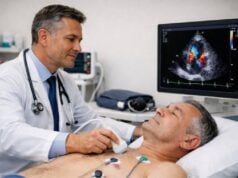
Echocardiogram (echo) with Doppler
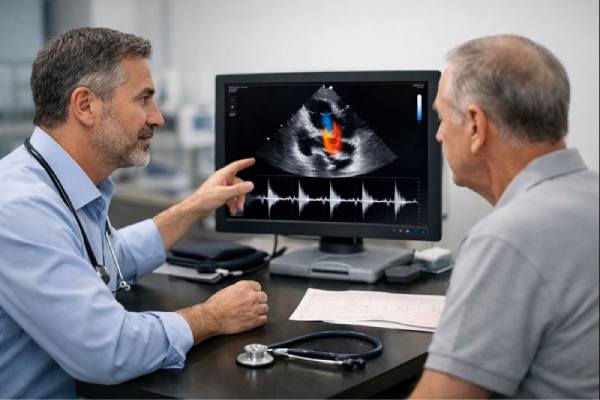
This is the core test. It measures wall thickness, heart pumping function, valve motion, and outflow gradients. A high-quality echo can also identify whether the mitral valve contributes to obstruction and whether mitral regurgitation is present.
Because obstruction can be absent at rest, clinicians often add provocation, such as:
- Valsalva maneuver (bearing down)
- Standing after lying down
- Exercise or treadmill stress echo when symptoms occur mainly with exertion
This “real-life” approach can clarify why someone with minimal resting obstruction becomes very limited during activity.
Electrocardiogram and rhythm monitoring
An ECG often shows signs of thickened muscle or strain, but it is not definitive. Rhythm monitoring (24–48 hour Holter or longer patch monitors) can detect:
- Atrial fibrillation, including silent episodes
- Non-sustained ventricular tachycardia
- Frequent premature beats that may drive symptoms
If palpitations are intermittent, longer monitoring increases the chance of catching a meaningful rhythm problem.
Cardiac MRI
MRI provides detailed anatomy and can show scar tissue patterns (often reported as late gadolinium enhancement). This can help refine risk assessment and clarify diagnosis when echo images are limited.
Exercise testing and functional assessment
Exercise testing can assess blood pressure response, reproduce symptoms, and quantify limitation. In some patients, cardiopulmonary exercise testing adds detail about oxygen uptake and whether limitations are cardiac, pulmonary, or deconditioning-related.
Genetic counseling and family evaluation
Genetic testing can be useful when it would change family screening plans. Regardless of genetic results, first-degree relatives often need periodic clinical screening because some disease-causing variants remain undetectable.
A helpful way to think about “staging” is to combine:
- Symptom burden (how much daily life is affected)
- Obstruction severity at rest and with provocation
- Rhythm history
- Structural findings (mitral valve involvement, atrial size)
- Scar burden on MRI and other risk markers
The goal is a clear, shared plan: what you can safely do, what you should avoid, and what treatment path makes the most sense for your specific physiology.
Treatments that reduce obstruction and improve feeling
Treatment aims to do three things: reduce symptoms, reduce obstruction when it is driving symptoms, and prevent major complications (especially atrial fibrillation–related stroke and life-threatening ventricular arrhythmias). Most people move through a stepwise plan, escalating only if needed.
Medication strategies
For many patients, first-line treatment focuses on slowing heart rate and reducing the force of contraction so the ventricle fills better and obstruction lessens:
- Beta blockers are often first choice. They can improve exertional symptoms by limiting heart rate spikes and reducing contractility.
- Non-dihydropyridine calcium channel blockers (such as verapamil or diltiazem) may be used when beta blockers aren’t tolerated or aren’t enough, though they require careful selection in patients prone to low blood pressure or severe obstruction.
- Disopyramide may be added in selected symptomatic patients to reduce obstruction, typically with monitoring for side effects and rhythm issues.
Good medication management is more than “pick a drug.” It involves titrating to a target heart rate and symptom response while avoiding excessive fatigue, dizziness from low blood pressure, or overly slow pulse.
Targeted therapy: cardiac myosin inhibitors
In appropriately selected patients with symptomatic obstructive disease, cardiac myosin inhibitors can reduce gradients and improve symptoms and quality of life. These medications require structured monitoring (usually periodic echocardiograms) to ensure the heart’s pumping strength remains safe. For many patients, the appeal is clear: a non-surgical option that directly addresses the mechanism of obstruction.
Procedures when symptoms persist despite optimal medication
If severe symptoms continue and significant obstruction is confirmed—especially with gradients commonly used to define severe obstruction—clinicians may recommend septal reduction therapy:
- Surgical septal myectomy: removes a targeted portion of thickened septum to widen the outflow tract. It is often preferred when anatomy is complex, when mitral valve abnormalities contribute significantly, or when other cardiac surgery is needed.
- Alcohol septal ablation: injects alcohol into a specific small artery supplying the septum to shrink that region. It can be effective in carefully selected anatomy and often appeals to patients who are not ideal surgical candidates.
Outcomes are generally best at centers with deep experience in hypertrophic cardiomyopathy, where teams routinely evaluate anatomy, select the best approach, and manage nuances in follow-up.
Preventing major complications
- ICD placement may be recommended for those with higher risk of dangerous ventricular arrhythmias, based on a combination of risk markers and shared decision-making.
- Atrial fibrillation care often includes rhythm or rate control and anticoagulation decisions that prioritize stroke prevention.
A useful expectation: effective treatment usually reduces symptom “spikes,” increases reliable stamina, and gives you a clearer sense of what is safe—rather than making you feel fragile.
Daily management, family screening, and when to seek care
Daily management is about lowering the odds that dynamic obstruction will flare. Small, consistent choices often matter more than dramatic restrictions.
Everyday habits that reduce symptom swings
- Stay consistently hydrated. Many patients notice that dizziness and breathlessness worsen when they are even mildly dehydrated. During heat, illness, or travel, plan fluids more intentionally.
- Avoid abrupt physiologic swings. Large alcohol intake, hot tubs/saunas for long periods, or intense exertion after fasting can reduce filling and provoke symptoms.
- Be cautious with stimulants and “pre-workout” products. Some contain caffeine or other compounds that raise heart rate and contractility.
- Review new prescriptions and supplements. Some blood pressure–lowering or vasodilating drugs can worsen symptoms in obstructive physiology. Do not stop medications on your own, but do ask whether a new drug could aggravate obstruction.
Exercise: helpful, with the right guardrails
Many people with this condition do well with moderate-intensity aerobic activity and sensible strength training. A practical starting point for many adults is about 150 minutes per week of moderate activity (split across the week), adjusted to symptoms and clinician guidance.
Often-smart guardrails include:
- Build gradually (avoid “weekend warrior” spikes).
- Prefer steady efforts where you can speak in short sentences.
- Avoid heavy lifting to failure and breath-holding; use lighter weights with controlled breathing.
- Stop if you develop chest pain, near-fainting, or unusual shortness of breath.
Competitive sports decisions are individualized. A thoughtful evaluation and shared decision-making approach is safer than blanket rules.
Follow-up and monitoring
Follow-up typically includes periodic echocardiograms, symptom review, and rhythm surveillance. If you have intermittent palpitations, longer monitoring can be more informative than repeated short tests. If you are on therapies that require imaging monitoring, treat those appointments as essential.
Family screening: the practical plan
First-degree relatives often need screening even if they feel well. Typical screening uses ECG and echocardiography, with frequency guided by age and family pattern:
- More often during adolescence and early adulthood (when changes can emerge)
- Less often in stable adults with repeatedly normal testing
Genetic counseling can help families interpret test results, reduce unnecessary worry, and focus attention where it belongs.
When to seek care quickly
Seek urgent evaluation for:
- Fainting or near-fainting during exertion
- New neurologic symptoms (possible stroke)
- Severe or persistent chest pain
- Sustained rapid palpitations with dizziness, breathlessness, or chest discomfort
- Worsening shortness of breath at rest, new swelling, or waking up gasping
Living well with hypertrophic subaortic stenosis is achievable. The combination that helps most people is steady hydration, thoughtful activity, careful medication selection, and a clear plan for family screening and warning signs.
References
- 2024 AHA/ACC/AMSSM/HRS/PACES/SCMR Guideline for the Management of Hypertrophic Cardiomyopathy: A Report of the American Heart Association/American College of Cardiology Joint Committee on Clinical Practice Guidelines 2024 (Guideline)
- 2023 ESC Guidelines for the management of cardiomyopathies 2023 (Guideline)
- Mavacamten in Patients With Hypertrophic Cardiomyopathy Referred for Septal Reduction: Week 56 Results From the VALOR-HCM Randomized Clinical Trial 2023 (RCT)
- Mavacamten for treatment of symptomatic obstructive hypertrophic cardiomyopathy (EXPLORER-HCM): health status analysis of a randomised, double-blind, placebo-controlled, phase 3 trial 2021 (RCT)
Disclaimer
This article is for educational purposes only and does not provide medical advice, diagnosis, or treatment. Hypertrophic subaortic stenosis (obstructive hypertrophic cardiomyopathy) varies widely in severity and risk, so evaluation and management should be individualized by a qualified clinician—often a cardiologist with experience in hypertrophic cardiomyopathy. If you have chest pain, fainting, stroke-like symptoms, severe shortness of breath, or sustained rapid palpitations, seek urgent medical care.
If you found this guide helpful, please share it on Facebook, X (formerly Twitter), or any platform you prefer, and follow us on social media. Your support helps our team keep producing clear, trustworthy health content.