Ill-scented lily, better known botanically as Veratrum viride, is one of those plants that forces a careful distinction between historical medicine and safe modern use. Native to wet meadows, streambanks, and mountain woods in North America, it has long attracted attention because its steroidal alkaloids can exert powerful effects on the heart, blood pressure, nerves, and early fetal development. In earlier eras, physicians and traditional healers used Veratrum viride for severe hypertension, pain, rheumatism, and other conditions. Today, that history is important mainly as a lesson in pharmacology and toxicity. The same compounds that once made the plant medically interesting also make it unreliable and potentially dangerous outside tightly controlled settings. Modern readers should approach it first as a poisonous plant with research value, not as a home remedy. Its real significance now lies in alkaloid chemistry, toxicology, and drug-discovery history, especially around blood-pressure effects and hedgehog-pathway research, rather than in routine herbal self-care.
Essential Insights
- Veratrum viride helped shape older blood-pressure treatment and remains important in alkaloid research.
- Certain Veratrum alkaloids helped scientists study hedgehog signaling, a pathway relevant to development and cancer biology.
- No safe self-treatment dose is established; the practical unsupervised oral dose is 0 mg/day.
- Pregnant or breastfeeding people, children, and anyone with heart rhythm or blood-pressure problems should avoid internal use completely.
- Wild foraging is risky because false hellebore can be mistaken for edible plants such as ramps.
Table of Contents
- What is ill-scented lily
- Key alkaloids and medicinal properties
- What was Veratrum viride used for
- Does ill-scented lily help today
- How is it used now
- What can it be mistaken for
- How much Veratrum viride is safe
- Safety side effects and interactions
What is ill-scented lily
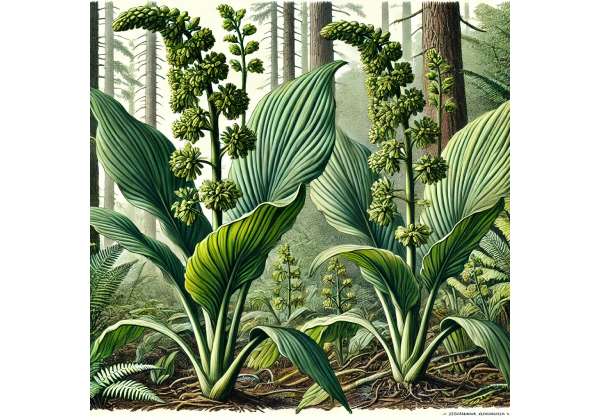
Ill-scented lily is a perennial North American plant in the genus Veratrum. Despite the common name, it is not a kitchen herb, not a safe wild green, and not a casual folk remedy. It is more widely known as green false hellebore, American false hellebore, or Indian poke. The plant grows in moist habitats, often in mountain meadows, floodplains, swamps, and stream edges, where its large pleated leaves and tall flowering stalk make it visually striking. That bold appearance is part of the problem: when young, it can resemble edible wild plants closely enough to cause dangerous foraging mistakes.
Botanically, Veratrum viride is best understood as a poisonous medicinal-history plant. Its leaves are broad and strongly veined, the stem is stout, and the flower clusters are green to yellow-green. The underground rhizome and roots are especially important because they have historically been used for extraction and are also the most toxic parts of the plant. In older texts, physicians valued the species because it could sharply reduce pulse rate and blood pressure. In modern practice, those same effects are exactly why the whole plant is considered unsafe for unsupervised use.
The plant’s reputation sits in a strange middle ground. It is too toxic to fit comfortably into modern wellness culture, yet too pharmacologically interesting to dismiss as merely an ornamental weed. It belongs to the same larger story as other once-revered but high-risk plants: their history is medically important, but their raw use is no longer a good model for safe care. That is one reason Veratrum viride now appears more often in toxicology, natural-products chemistry, and medical history than in mainstream herbal medicine books.
For readers trying to place it in practical terms, the simplest description is this: ill-scented lily is a historically medicinal, now largely obsolete toxic plant whose alkaloids helped shape older drug development and modern laboratory research. It is not a plant to experiment with at home, and it should never be treated like a general wellness herb. Understanding what it is means starting with that safety reality, then working outward into its chemistry and history.
Key alkaloids and medicinal properties
The medicinal story of Veratrum viride is really the story of its steroidal alkaloids. These compounds include protoveratrine-type alkaloids, veratramine, jervine, and related molecules that can act strongly on excitable tissues such as nerves, skeletal muscle, and heart tissue. In broad terms, they alter sodium-channel activity and trigger reflex effects that can slow the heart and reduce blood pressure. That is why older physicians found the plant pharmacologically impressive and why toxicologists still take it seriously today.
From a medicinal-properties standpoint, three themes matter most. First, some Veratrum alkaloids are strongly hypotensive, meaning they can lower blood pressure. Second, some are highly irritating and emetic, which explains why the plant was historically used to provoke vomiting and purging. Third, certain alkaloids in the wider Veratrum genus, especially cyclopamine-related compounds, have become important in developmental biology and anticancer research because they interfere with hedgehog signaling. That research value is real, but it does not turn the raw herb into a safe supplement.
Another essential point is variability. Alkaloid content changes with species, plant part, harvest conditions, and preparation. Roots and rhizomes are usually more dangerous than leaves, and the overall chemical profile is not stable enough for household dosing. This is exactly why older crude extracts caused so many problems. A plant that contains clinically active compounds can still be a poor medicine if the chemistry varies too much from batch to batch.
That distinction matters for readers who see the phrase “medicinal properties” and assume “good for regular use.” With Veratrum viride, medicinal properties mean potent physiologic activity, not safety or usefulness in self-care. In the same way that foxglove-derived heart compounds changed medicine without making the whole plant safe to self-dose, Veratrum viride matters more as a source of important alkaloids than as a modern herb to ingest.
So the key ingredients are not vitamins, gentle polyphenols, or nourishing plant compounds in the usual herbal sense. They are highly active steroidal alkaloids with a narrow margin between pharmacology and poisoning. That is why the plant deserves respect, careful language, and a safety-first interpretation. Its medicinal properties are real, but they are inseparable from serious toxic potential.
What was Veratrum viride used for
Historically, Veratrum viride was used in several very different ways, and that diversity can be misleading unless it is put in context. Indigenous and folk uses included topical applications and internal preparations for pain, rheumatism, ulcers, boils, and other difficult conditions. In older North American and nineteenth-century medical practice, the plant also gained a reputation as a strong emetic and circulatory depressant. Those terms sound old-fashioned, but they describe exactly what the plant does: it can provoke vomiting and drive the pulse and blood pressure downward.
Its most famous later use was in severe hypertension and certain obstetric emergencies, especially eclampsia and related pregnancy toxemias in the era before safer modern drugs. Mid-twentieth-century physicians explored purified or semi-purified Veratrum alkaloids because the plant could reduce blood pressure quickly. For a time, that seemed valuable. But the same preparations also caused nausea, sweating, marked hypotension, bradycardia, heart block, and general intolerance. As better therapies arrived, Veratrum viride rapidly lost its place.
That trajectory is important because it explains why the plant appears in older medical literature much more than in current clinical guidance. Its problem was not lack of effect. Its problem was too much effect, too unpredictably, with too many adverse reactions. A medicine can fail not because it is weak, but because its useful dose sits too close to its dangerous dose.
Historically, Veratrum viride was also part of an older herbal mindset in which powerful purgatives and emetics were seen as therapeutically desirable. Modern medicine does not view most of those practices favorably, and this plant is a good example of why. The dramatic physiologic responses once interpreted as cleansing or corrective are now recognized as warning signs of poisoning risk.
Readers sometimes assume that repeated historical use proves a plant is beneficial. With ill-scented lily, the better lesson is the opposite. Its history shows how many once-respected remedies were later abandoned when standards for safety, reproducibility, and patient monitoring improved. Like mandrake’s cautionary medicinal history, Veratrum viride reminds us that historical prestige is not the same thing as a sound modern recommendation.
Does ill-scented lily help today
For most modern readers, the honest answer is that the whole herb does not offer a realistic benefit profile that outweighs its risks. That does not mean the plant is scientifically unimportant. It means the useful parts of its legacy now live mostly in research, chemistry, and drug-development history rather than in direct self-treatment.
There are still three meaningful ways to talk about present-day “benefits.” The first is historical pharmacology. Veratrum viride helped researchers understand how plant alkaloids could affect blood pressure, pulse, and vascular reflexes. That knowledge mattered in the development of cardiovascular pharmacology, even though the plant itself fell out of favor.
The second is mechanistic research. Alkaloids in the wider Veratrum family helped clarify the biology of hedgehog signaling, a pathway involved in embryonic development and certain cancers. That is a major scientific contribution. Yet this is a benefit to biomedical research, not a reason to take the raw plant. A compound that is useful in the lab can be highly unsafe as a household remedy.
The third is natural-product discovery. Modern scientists still study Veratrum alkaloids because they offer structurally complex molecules that may inspire safer derivatives. This is the most constructive modern frame for the plant: not “use the herb,” but “learn from the chemistry.”
That distinction is especially important in online herbal content, where a plant’s promising compounds are often treated as proof of practical benefit. With ill-scented lily, that jump would be misleading. There is no mainstream modern role for swallowing raw root, brewing a homemade tincture, or using the plant as a daily blood-pressure herb. The evidence does not support that, and the safety margin is too narrow.
So, does it help today? Yes, but mostly indirectly. It helps science understand toxic alkaloids, developmental pathways, and the history of drug discovery. It helps clinicians remember the dangers of plant misidentification and the importance of poison-center consultation. It does not help most people as a self-prescribed herbal medicine. That is the most accurate and most useful way to answer the question.
How is it used now
Today, Veratrum viride is used far less as a therapeutic herb than as a plant of historical, toxicological, and research interest. In practical terms, modern “use” falls into four categories, and only one of them involves ordinary people.
The first is botanical identification and public-health education. Hikers, foragers, gardeners, extension agents, and poison centers need to recognize the plant because accidental ingestion still happens. That is a real modern use: learning to identify it so it is not mistaken for something edible.
The second is laboratory and analytical work. Researchers study Veratrum alkaloids to understand how they vary across species and preparations, how they act at ion channels and signaling pathways, and how they might inform future drug design. In that setting, the plant is valuable precisely because it is potent.
The third is historical or homeopathic product analysis. Modern analytical studies have shown why quality control matters with Veratrum-containing preparations. Even highly diluted products raise questions about what is actually present, how consistently it is measured, and whether consumers understand the toxicology of the source material. This is an area where modern chemistry is more important than traditional claims.
The fourth, and only truly public-facing use, is avoidance. That sounds negative, but it is practical. The best modern use of ill-scented lily for most people is to recognize it, not harvest it, not ingest it, and not improvise with old herbal formulas. This is especially true because plant alkaloid content is not visually obvious. A “small taste” is not a meaningful safety test.
For people who prefer natural medicine, that advice can feel unsatisfying. But it is the right advice. Some herbs remain relevant as teas, culinary plants, or carefully standardized supplements. Veratrum viride does not fit comfortably into any of those categories. Even compared with other caution-heavy botanicals discussed in herbal safety guides, such as lobelia safety concerns, ill-scented lily sits farther toward the “do not self-use” end of the spectrum.
In modern life, then, the plant’s role is mostly educational and scientific. It is something to understand, not something to casually use.
What can it be mistaken for
One of the most useful questions about Veratrum viride is not medicinal at all. It is practical: what can it be mistaken for? That matters because poisonings often happen in spring when inexperienced foragers see lush, folded green leaves and assume they have found an edible wild plant.
False hellebore and related Veratrum species are well known for lookalike confusion. In North America, people have mistaken them for ramps or wild leeks, wild onion, skunk cabbage, and other spring greens. The danger is highest when the plant is young, before the tall flowering stalk gives away its identity. Once cooked and chopped, the mistake can become even harder to recognize.
A few identification clues help. Edible alliums such as ramps smell distinctly of onion or garlic when crushed. Veratrum viride does not. Its leaves are strongly pleated, with parallel veins, and they wrap around a central stalk rather than emerging as simple flat allium leaves from a bulb. Habitat also offers clues: false hellebore favors very wet ground, floodplains, seeps, and marshy edges. Those clues are useful, but they are not a substitute for certainty.
This matters medically because poisoning symptoms often begin quickly, usually with severe nausea and vomiting, followed by dizziness, sweating, weakness, bradycardia, low blood pressure, and sometimes breathing changes. By the time those symptoms appear, the person is already in the territory of urgent toxic exposure, not a minor upset stomach.
The foraging lesson is simple:
- Never eat a plant you identify by leaf shape alone.
- Crush and smell suspected ramps or wild onions before collecting them.
- Avoid mixed harvests from wet, marshy sites unless identification is certain.
- If a collected plant does not smell like onion or garlic, do not eat it.
- If false hellebore is suspected, contact a poison center or emergency service promptly.
For an article like this, the lookalike problem is not a side note. It is one of the most relevant real-world uses of the information. Many readers will never seek out Veratrum viride as medicine, but some may encounter it outdoors. Knowing what it can be mistaken for may do more practical good than any discussion of its historical pharmacology.
How much Veratrum viride is safe
For modern self-care, the safest answer is straightforward: there is no established safe oral self-treatment dose of Veratrum viride. In practical terms, the unsupervised dose is 0 mg/day. That is not evasive wording. It is the most accurate dosage guidance a responsible article can give.
Older literature did use extracts, tinctures, alkaloid mixtures, and hospital regimens. But those approaches belong to a different medical era, one in which therapeutic options were narrower and adverse effects were often more tolerated than they would be today. They also depended on physician oversight, product-specific preparations, and a tolerance for nausea, bradycardia, and hypotension that would make little sense in present-day routine care. Reproducing those regimens from historical texts would be unsafe.
This is the key reason dosage advice for ill-scented lily differs so sharply from dosage advice for gentler herbs. With many botanicals, one can discuss cups of tea, milligrams of extract, timing with meals, or standardized percentages. With Veratrum viride, the variability of alkaloid content and the narrow margin between effect and poisoning make that style of guidance inappropriate.
A more useful way to frame dosage is by exposure category:
- Raw plant: avoid internal use entirely.
- Homemade tincture or decoction: not recommended.
- Commercial internal products: do not use casually, especially without medical supervision.
- Accidental exposure: any meaningful ingestion should be treated as a poison-risk event.
- Research compounds or derivatives: these belong in clinical or laboratory settings, not home experimentation.
Timing and duration are also easy to answer because they follow the same rule. There is no sensible “best time of day” for oral self-use, and there is no recommended course length for routine supplementation. If a person is looking for a natural option for blood pressure, pain, or inflammation, Veratrum viride is not the herb to start with.
In short, dosage is one area where caution should replace curiosity. The safest and most evidence-aligned dose for general readers is none.
Safety side effects and interactions
Safety is the central issue with ill-scented lily. Internal exposure can cause rapid gastrointestinal and cardiovascular symptoms, often starting with nausea, vomiting, abdominal distress, sweating, weakness, and dizziness, then progressing to bradycardia and hypotension. In plain language, the heart can slow down while blood pressure drops. Some cases also involve breathing changes, visual symptoms, tingling, chest discomfort, or altered consciousness. These are not mild “detox” reactions. They are poisoning signs.
Pregnancy deserves special emphasis. Certain Veratrum alkaloids are teratogenic, meaning they can disrupt embryonic development. That makes internal use particularly unsafe during pregnancy, and it is also one reason the plant has such an important place in developmental biology. Breastfeeding also calls for strict avoidance because later case work has shown that some Veratrum alkaloids can appear in breast milk.
Interactions are exactly what one would expect from a plant that can change pulse and blood pressure. People taking antihypertensives, heart-rate-lowering drugs, antiarrhythmics, sedatives, or other medications that affect circulation should treat the plant as incompatible with self-experimentation. The same is true for anyone with baseline bradycardia, low blood pressure, conduction abnormalities, or unstable cardiovascular disease.
Children, older adults, and people with frailty or dehydration risk are also more vulnerable. A plant that triggers vomiting and low blood pressure is especially hazardous in bodies with less physiologic reserve. That is another reason poison-center consultation matters quickly after suspected ingestion.
A useful safety summary looks like this:
- Avoid all internal self-use.
- Avoid during pregnancy and breastfeeding.
- Avoid with heart, blood-pressure, or rhythm disorders.
- Avoid with cardiovascular or sedating medications.
- Avoid foraging unless identification is absolute.
- Seek urgent help after ingestion, especially if vomiting, weakness, slow pulse, or faintness appear.
The broader lesson is worth remembering. Potent botanical effects do not guarantee practical benefit. Sometimes they only reveal how easy it is to cross from pharmacology into harm. Veratrum viride is one of the clearest examples of that rule in North American herbal history.
References
- Medicinal history of North American Veratrum 2014 (Review). ([PMC][1])
- Veratrum parviflorum Poisoning: Identification of Steroidal Alkaloids in Patient Blood and Breast Milk 2022 (Poisoning study). ([PMC][2])
- Determination of Veratrum alkaloid contents in three Veratrum species by HPLC-MS/MS 2024 (Analytical study). ([PubMed][3])
- Phytochemical Analysis of Veratrum Alkaloids in Medicinal Veratrum Globules Using High‐Performance Liquid Chromatography Coupled With Tandem Mass Spectrometry 2026 (Analytical safety study). ([PMC][4])
- The teratogenic Veratrum alkaloid cyclopamine inhibits sonic hedgehog signal transduction 1998 (Seminal mechanistic study). ([PubMed][5])
Disclaimer
This article is for educational purposes only and is not a recommendation to use Veratrum viride as a home remedy. Ill-scented lily is a toxic plant with a history of serious poisoning, and its historical medical use does not make it safe by modern standards. Anyone who is pregnant, breastfeeding, has heart or blood-pressure conditions, takes prescription medication, or suspects accidental ingestion should seek professional medical or poison-center guidance rather than self-treating.
If you found this article helpful, please share it on Facebook, X, or another platform you prefer.