An intrathoracic aortic aneurysm is a slow, often silent widening of the body’s main artery inside the chest. An aneurysm (a weakened bulge in a vessel wall) can stay stable for years, or it can enlarge until the risk of tearing or rupture becomes urgent. Because many people feel nothing at first, these aneurysms are frequently discovered on a scan done for another reason—until a warning sign appears, such as new chest or back pain, a hoarse voice, or shortness of breath.
The most important goals are simple: find it, measure it accurately, reduce the forces that make it grow, and intervene at the right time—before an emergency. This article explains what it is, why it happens, who is at higher risk, what symptoms matter, how doctors confirm it, and what treatment and long-term management usually look like.
Table of Contents
- What an intrathoracic aortic aneurysm means
- What causes it and how it grows
- Who is at higher risk?
- Symptoms, complications, and rupture warning signs
- How doctors diagnose and monitor it
- Treatment choices and long-term management
What an intrathoracic aortic aneurysm means
The aorta is the large artery that carries blood from the heart to the rest of the body. “Intrathoracic” means the portion inside the chest. A thoracic aortic aneurysm can involve different segments, and location matters because it changes symptoms, monitoring strategy, and the kind of repair that may be safest.
Common intrathoracic locations include:
- Aortic root (closest to the heart, where the aortic valve sits)
- Ascending aorta (rises upward from the heart)
- Aortic arch (curves and gives off branches to the head and arms)
- Descending thoracic aorta (travels down the back of the chest)
An aneurysm is typically defined as an aortic diameter that is clearly larger than expected for a person’s sex and body size, or about 1.5 times the normal size for that segment. Because “normal” varies, clinicians often interpret measurements in context rather than treating one number as universal.
Why it matters: the aortic wall is designed to handle strong pulsatile pressure. When the wall weakens and the vessel expands, stress on the wall rises further—like stretching an old elastic band. The main dangers are:
- Dissection: a tear in the inner layer creates a false channel for blood
- Rupture: the wall breaks completely, causing life-threatening bleeding
- Branch-vessel problems: blood flow to the brain, spinal cord, kidneys, or legs can be affected, especially with dissection
Most aneurysms are found before an emergency. That creates an opportunity: careful imaging, tight blood pressure control, and planned repair when the risk curve starts to climb. Planned treatment is far safer than rushed surgery after a rupture.
A practical way to think about this condition is as a long-term risk management problem:
- Confirm it is real and measure it correctly.
- Estimate growth rate and near-term risk.
- Reduce stress on the aorta (medical therapy and lifestyle).
- Repair it when size, growth, symptoms, or genetics suggest the balance has shifted.
What causes it and how it grows
An intrathoracic aortic aneurysm develops when the aortic wall loses strength and elasticity over time. The cause is not always one single factor; it is often a mix of “wall weakness” plus “wall stress.”
Two broad pathways: degeneration vs inherited weakness
Many thoracic aneurysms are related to age-associated changes in the aortic wall (sometimes called degenerative or sporadic disease). Over years, the wall’s structural proteins can fragment and smooth muscle cells can decline, making the aorta more likely to stretch.
Other aneurysms are driven by inherited or congenital conditions that weaken connective tissue or alter aortic architecture, including:
- Marfan syndrome
- Loeys–Dietz syndrome
- Vascular Ehlers–Danlos syndrome
- Bicuspid aortic valve (a common congenital valve variant linked to aortopathy)
- Familial thoracic aortic aneurysm syndromes (gene-related, sometimes without obvious physical features)
These inherited forms often enlarge earlier in life and may require repair at smaller diameters.
Wall stress: what accelerates enlargement
Even a mildly weakened aorta can remain stable if stress is low. Enlargement becomes more likely when the forces on the wall stay high, such as with:
- High blood pressure, especially if uncontrolled over years
- Smoking (promotes vascular inflammation and loss of elastic properties)
- Stimulants (including certain illicit drugs) that spike blood pressure
- Untreated sleep apnea (nighttime surges in blood pressure and sympathetic tone)
In some people, inflammation or infection of the aorta plays a role. Less common causes include:
- Large-vessel vasculitis (inflammatory artery disease)
- Prior chest radiation
- Trauma (more often linked to acute injury than classic aneurysm formation)
How fast do these aneurysms grow?
Growth is usually slow, but variable. Many ascending aneurysms enlarge on the order of fractions of a millimeter per year, while others—especially in genetic syndromes or with uncontrolled risk factors—can grow faster. Clinicians take “rapid growth” seriously because it shifts the benefit toward earlier repair. A commonly used red flag is growth on the order of about 0.5 cm in a year (or smaller but consistent growth over consecutive studies), particularly when paired with symptoms or high-risk anatomy.
Why precise measurement is harder than it sounds
Aorta size depends on:
- Where the measurement is taken (root vs ascending vs arch)
- How it is measured (inner-edge to inner-edge vs other conventions)
- Imaging technique and slice angle (a small tilt can change the number)
That is why good follow-up often emphasizes using the same imaging method and lab when possible, and comparing apples to apples over time.
Who is at higher risk?
Risk is about probability, not destiny. Many people with risk factors never develop a thoracic aneurysm, and some people develop one without obvious risks. Still, knowing the pattern helps clinicians decide who should be screened, how often imaging should repeat, and when family members should be evaluated.
Major risk factors that raise suspicion
These are commonly associated with intrathoracic aortic aneurysm:
- Older age, especially over 60
- High blood pressure, particularly if long-standing or poorly controlled
- Smoking history
- High cholesterol and vascular disease elsewhere (coronary, carotid, peripheral)
- Male sex (overall risk is higher, though women can have serious disease too)
Structural and genetic risk factors
These often matter more than age:
- Bicuspid aortic valve
- Marfan, Loeys–Dietz, or vascular Ehlers–Danlos
- First-degree relative with thoracic aneurysm or aortic dissection
- Known pathogenic gene variant linked to thoracic aortic disease
When a genetic cause is present, size alone is not the whole story. Family history of dissection at smaller diameters, certain gene findings, or distinctive aortic shape can lower the threshold for intervention.
Medical history clues that should prompt evaluation
Some events and conditions increase concern:
- Coarctation of the aorta (a congenital narrowing)
- Prior aortic valve surgery, especially with bicuspid valve disease
- Inflammatory artery disease (for example, giant cell arteritis or other vasculitides)
- Prior chest radiation
- Chronic kidney disease (linked to vascular stiffness and calcification)
What “higher risk” changes in real life
If you fall into a higher-risk group, clinicians may recommend:
- A baseline scan of the thoracic aorta (often CT or MRI)
- Earlier and more frequent follow-up imaging if the aorta is enlarged
- Family screening for first-degree relatives when disease is heritable or strongly suspected
- Stronger emphasis on blood pressure targets, smoking cessation, and avoiding high-strain activities
A practical self-check before your next visit
If you already know you have an aneurysm, it helps to bring:
- Your last two imaging reports (to compare measurements)
- A list of blood pressure readings from home (two weeks is often enough)
- Any family history of aneurysm, sudden unexplained death, or dissection
- A medication list including over-the-counter stimulants and decongestants
Those details can materially change the monitoring plan and the timing of repair.
Symptoms, complications, and rupture warning signs
Most intrathoracic aortic aneurysms cause no symptoms until they become large or complicated. That silence is why imaging follow-up is so important. When symptoms do appear, they often come from pressure on nearby structures or from a sudden change in the aortic wall (like dissection).
Possible symptoms of a growing aneurysm
Aneurysm-related symptoms can include:
- Deep chest, back, or upper abdominal pain that is persistent or new
- Shortness of breath or reduced exercise tolerance
- Hoarseness (pressure on a nerve controlling the vocal cord)
- Trouble swallowing (pressure on the esophagus)
- A cough that does not fit a typical infection pattern
- A sense of fullness or pressure behind the breastbone
Symptoms are not a reliable gauge of size. A moderately sized aneurysm can cause symptoms based on location, while a larger one may stay quiet. Any new, unexplained chest or back pain in someone known to have an aneurysm deserves urgent evaluation.
Complications clinicians watch for
The major complications are:
- Aortic dissection: can reduce blood flow to the brain, spinal cord, kidneys, intestines, or legs
- Rupture: catastrophic bleeding; survival depends on immediate emergency care
- Aortic valve problems: root/ascending aneurysms can stretch the valve ring and cause regurgitation (backflow), leading to heart failure symptoms
- Clots and emboli: less common, but disturbed flow can contribute to clot formation
Emergency warning signs: when to call for help now
Seek emergency care immediately for any of the following, especially if you have a known aneurysm:
- Sudden, severe chest pain or upper back pain (often described as tearing, ripping, or the worst-ever pain)
- Pain that migrates from chest to back or abdomen
- Fainting, sudden weakness, or collapse
- Stroke-like symptoms (face droop, trouble speaking, one-sided weakness)
- New leg pain, numbness, or cold limb (possible loss of blood flow)
- Severe shortness of breath, pink frothy sputum, or sudden inability to breathe comfortably
- Shock signs: clammy skin, confusion, very low blood pressure
Why the “wait and see” approach can be risky in emergencies
Dissection and rupture can evolve rapidly. Early treatment can prevent organ damage and improve survival, but delays are costly. If you are unsure whether symptoms are serious, it is safer to be evaluated and reassured than to “sleep it off.”
A useful rule: stable, mild discomfort that behaves like a muscle strain is one thing. Sudden, severe, unfamiliar pain—especially with faintness, neurologic changes, or shortness of breath—is another.
How doctors diagnose and monitor it
Diagnosis is about more than confirming an aneurysm exists. The goal is to define exact location, exact size, growth rate, and risk features, because those guide timing and type of repair.
The core imaging tests
Common ways to evaluate the thoracic aorta include:
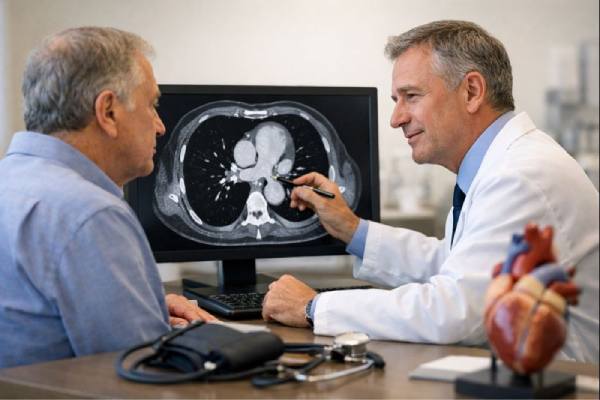
- CT angiography (CTA): fast, highly detailed, often first-line for precise sizing and surgical planning
- MRI angiography (MRA): excellent detail without ionizing radiation; useful for long-term surveillance, especially in younger patients
- Echocardiography: ultrasound of the heart; best for the aortic root and ascending aorta in many patients, and for assessing valve function
In urgent settings (suspected dissection), CTA is frequently preferred for speed and availability. MRI can be less suitable in emergencies due to time and monitoring constraints, though practices vary by center.
Why measurement technique matters
Aneurysm decisions can hinge on millimeters. Good imaging reports usually specify:
- The segment measured (root vs ascending vs arch vs descending)
- The measurement method and plane (perpendicular to flow is ideal)
- Whether the aorta is tortuous (curved), which can distort measurements
- Whether there are features such as ulcer-like projections, intramural hematoma, or penetrating atherosclerotic ulcers (which can change risk)
It is common to repeat imaging when:
- The first scan was done without an aortic protocol
- There is uncertainty about the true maximal diameter
- The reported size is near a treatment threshold
Typical surveillance intervals
Follow-up is individualized, but many clinicians use patterns like:
- Initial confirmation and a repeat study in about 6 months to establish growth rate
- If stable and small, imaging every 12–24 months
- If larger, growing, or genetically high risk, imaging every 6–12 months
- In carefully selected low-growth cases, some clinicians extend intervals further, but only when risk remains clearly low and measurement quality is strong
Consistency helps. Using the same imaging modality and the same measurement conventions reduces false alarms and missed growth.
Additional workup that may be recommended
Depending on the scenario, clinicians may also evaluate:
- Blood pressure patterns (including home readings)
- Lipids and diabetes risk
- Kidney function (important for contrast studies and medication planning)
- Genetic testing and family screening when heritable disease is suspected
- Coexisting valve disease, especially bicuspid aortic valve
A good diagnosis visit often ends with three clear takeaways: your current aortic size by segment, your likely growth risk, and a written plan for the next scan and what symptoms should override the plan.
Treatment choices and long-term management
Treatment is shaped by a simple balancing act: the risk of the aneurysm versus the risk of repair. Many intrathoracic aneurysms are managed medically for years, while others need planned intervention sooner because of size, growth, symptoms, or genetics.
Medical therapy: lowering stress on the aorta
The strongest evidence-based goal is tight blood pressure control. Lower pressure reduces the force on the aortic wall every second of the day. Common medical approaches include:
- Beta-blockers to reduce heart rate and the force of contraction (often used in heritable aortopathies)
- ACE inhibitors or ARBs for blood pressure control (often used broadly when appropriate)
- Statins when atherosclerosis or lipid risk is present
- Avoiding medications that spike blood pressure, including certain stimulants and some decongestants (ask your clinician which are safe)
Targets vary by individual, but many clinicians aim for a resting blood pressure in a controlled range that avoids frequent spikes, alongside a heart rate that is not persistently high.
Activity and lifestyle: what helps, what to avoid
A useful principle is “steady effort, low strain.” Often recommended:
- Aerobic activity at a conversational pace (walking, cycling, swimming) most days of the week, as tolerated
- Avoiding heavy lifting or breath-holding strain (Valsalva), which can cause sudden pressure surges
- Smoking cessation and avoidance of nicotine products
- Treating sleep apnea when present
- Maintaining a stable, healthy weight and reducing excess salt if blood pressure is sensitive
A practical guideline many teams use is to avoid maximal lifts or “grinding reps.” If you cannot breathe normally during the effort, it is probably too much strain.
When surgery or stent repair is considered
Intervention is typically considered when one or more of these applies:
- The aneurysm reaches a size threshold (often lower for genetic syndromes and certain anatomies)
- There is rapid growth over serial imaging
- Symptoms are plausibly related to the aneurysm
- There are high-risk features (certain gene variants, strong family history of early dissection, or complex shape)
Repair options include:
- Open surgical repair (common for root and ascending aneurysms; may include valve-sparing procedures or valve replacement if needed)
- Endovascular repair (TEVAR) for many descending thoracic aneurysms, depending on anatomy and landing zones
Open repair is more invasive but can be definitive for segments that are not suitable for stents. TEVAR can reduce recovery time but requires lifelong imaging to monitor for endoleaks (persistent blood flow outside the stent graft) and device-related issues.
Long-term follow-up after diagnosis or repair
Long-term care usually includes:
- Scheduled imaging (even after successful repair, because the remaining aorta can change)
- Ongoing blood pressure management and medication adherence
- A clear emergency plan for sudden chest/back pain
- Family screening when indicated
- Coordination before major procedures, pregnancy, or new intense exercise plans
The best outcomes tend to come from consistency: reliable measurements, steady risk-factor control, and timely repair performed electively rather than in crisis.
References
- 2022 ACC/AHA Guideline for the Diagnosis and Management of Aortic Disease: A Report of the American Heart Association/American College of Cardiology Joint Committee on Clinical Practice Guidelines 2022 (Guideline)
- 2024 ESC Guidelines for the management of peripheral arterial and aortic diseases 2024 (Guideline)
- Thoracic Aortic Aneurysm Growth Rates and Predicting Factors: A Systematic Review and Meta‐Analysis 2025 (Systematic Review)
- ACR Appropriateness Criteria® Thoracic Aortic Aneurysm or Dissection-Treatment Planning and Follow-Up: 2024 Update 2025 (Practice Guideline)
Disclaimer
This article is for general education and does not replace personalized medical advice, diagnosis, or treatment. An intrathoracic aortic aneurysm can become life-threatening if it dissects or ruptures. Seek emergency care immediately for sudden severe chest or back pain, fainting, stroke-like symptoms, new severe shortness of breath, or signs of shock. Treatment decisions—including blood pressure targets, activity limits, imaging frequency, and when to repair—depend on aneurysm location, size, growth rate, genetics, other medical conditions, and local expertise. Always follow guidance from your clinician or specialist team.
If you found this article helpful, please share it on Facebook, X (formerly Twitter), or any platform you prefer, and follow us on social media. Your support through sharing helps our team keep producing high-quality, trustworthy health content.