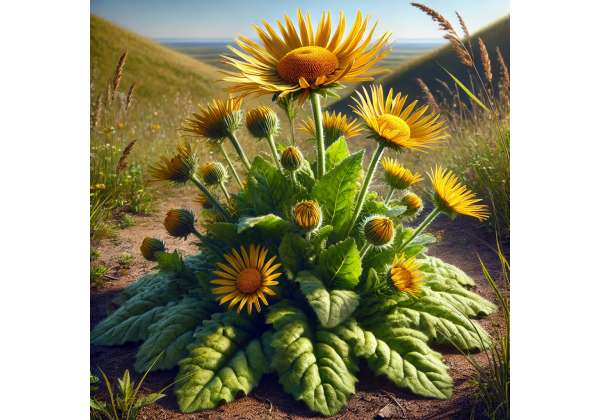
Inula, better known in Western herbal practice as elecampane, is a tall, aromatic perennial whose thick root has been used for centuries in traditional European and Asian medicine. Its reputation rests mainly on respiratory and digestive support. Herbalists have long turned to the root for deep, stubborn coughs, excess mucus, sluggish digestion, and poor appetite. What keeps the plant relevant today is that its traditional use is backed by an unusually rich chemistry. Inula root contains inulin, essential-oil constituents, and sesquiterpene lactones such as alantolactone and isoalantolactone, compounds now being studied for antimicrobial, anti-inflammatory, and broader pharmacological effects.
That said, Inula is not a modern evidence-based cure for cough, bronchitis, or gut complaints. Most current research is laboratory or preclinical, not large human trials. It is also one of those herbs that asks for respect: its active compounds may irritate sensitive skin, trigger allergy in some people, and interact poorly with self-prescribing habits. This guide covers what Inula is, what its key compounds do, how it is traditionally used, what dosage ranges are commonly cited, and where safety matters most.
Core Points
- Inula is traditionally used for productive coughs, chest congestion, and sluggish digestion.
- Its key compounds may provide antimicrobial and anti-inflammatory activity, especially in the root.
- A commonly cited traditional dose is 1.5 to 4 g dried root or 1.5 to 4 mL liquid extract three times daily.
- People with Asteraceae allergy, pregnancy, breastfeeding, or a history of contact dermatitis should avoid self-prescribing it.
Table of Contents
- What is inula?
- Key ingredients and medicinal properties
- Does inula help coughs and digestion?
- Other potential benefits and uses
- How to use inula
- How much inula per day?
- Safety, side effects, and who should avoid it
- What the evidence actually says
What is inula?
Inula usually refers to Inula helenium, the plant more widely known as elecampane. It belongs to the Asteraceae family, the same broad family that includes daisies, chrysanthemums, ragweed, and chamomile. The part used medicinally is the root and rhizome, not the bright yellow flower. When fresh, the root has a pungent, spicy, somewhat camphor-like scent. When dried, it becomes the familiar bitter, warming herb that shows up in old cough syrups, decoctions, and digestive formulas.
Historically, Inula had a larger place in traditional practice than it does today. Medieval and early modern herbal texts describe it as a warming root used for heavy phlegm, chronic cough, chest tightness, and weak digestion. It was often prepared with honey, wine, or other herbs to make it easier to take and to direct its action toward the lungs or stomach. In some folk systems, it was also used externally for skin problems or as part of warming poultices.
Its two main traditional themes are easy to remember. First, it is a respiratory root, chosen when mucus feels thick, sticky, and hard to move. Second, it is a digestive bitter, used when appetite is poor, the stomach feels cold or sluggish, or there is a sense of heaviness after meals. That combination is one reason the plant stayed popular for so long: many old herbalists believed chest congestion and weak digestion often traveled together.
Modern readers should know that Inula is not widely self-prescribed today, even though it remains respected among herbal practitioners. One reason is that better-studied herbs have taken over many of its traditional roles. Another is safety. Elecampane’s sesquiterpene lactones can trigger allergy in susceptible people, especially with topical use. So while it is a classic root, it is not a casual kitchen herb.
From a broader herbal perspective, Inula sits somewhere between a bitter digestive root and a lung-supporting expectorant. That gives it some overlap with familiar respiratory herbs such as mullein for traditional respiratory support, but its action is more warming, more bitter, and usually more rooted in the dried underground parts than in soft aerial tissues. It is best understood as a focused, older-style medicinal root with a long tradition and a smaller but still interesting modern research profile.
Key ingredients and medicinal properties
The medicinal value of Inula starts with its chemistry. The root contains a mix of polysaccharides, volatile compounds, bitter principles, and especially sesquiterpene lactones. Among the best-known are alantolactone and isoalantolactone, the two compounds most often discussed in modern research. These are not just chemical curiosities. They are the reason Inula keeps showing up in studies on inflammation, microbes, adipogenesis, and cell signaling.
The root is also a source of inulin, a fructan-type fiber that is well known in nutrition science as a prebiotic. That matters because it partly explains why Inula was once considered a digestive root as well as a respiratory herb. Still, readers should keep the distinction clear: the fact that the root contains inulin does not mean every traditional use of elecampane has been clinically proven. It simply means the plant contains one component with recognized gut-related relevance alongside many other active compounds.
Its essential oil contributes another layer. Volatile constituents help shape the root’s scent and may add antimicrobial and aromatic effects. Meanwhile, the sesquiterpene lactones appear to account for much of the plant’s sharp biological activity. These compounds have been studied for antimicrobial action against certain bacteria and fungi, anti-inflammatory activity in immune and epithelial models, and broader pharmacological effects ranging from antioxidant to antiproliferative behavior in laboratory systems.
That leads to the most practical way to think about Inula’s medicinal properties:
- Bitter and digestive-stimulating
- Expectorant and mucus-moving in traditional use
- Antimicrobial in early laboratory research
- Anti-inflammatory in preclinical models
- Potentially metabolically active through alantolactone-related pathways
The plant’s “warming” reputation in old herbal language probably reflects the combined effect of bitterness, aromatic sharpness, and expectorant action. It is not a bland demulcent. It tends to be chosen when the picture feels cold, damp, sluggish, or congested.
One helpful comparison is with green tea for antioxidant support. Both plants contain compounds that attract attention for oxidative-stress and signaling effects, but Inula is much more specialized and much less supported by large human trials. That means the medicinal properties of elecampane should be read as pharmacologically plausible and tradition-informed rather than clinically settled.
In practical terms, the chemistry supports why herbalists have historically used the root for thick chest congestion, microbial burden in the respiratory tract, and weak digestion. It also explains why safety deserves attention. A plant with active sesquiterpene lactones may offer therapeutic promise, but it may also irritate or sensitize some people. With Inula, those two facts belong together.
Does inula help coughs and digestion?
This is where Inula’s traditional identity is strongest. For coughs and digestion, the herb has a long and coherent historical use, even though modern clinical proof is still limited.
In respiratory formulas, Inula is usually described as an expectorant for thick, difficult mucus rather than as a simple soothing herb for a dry throat. Traditional practitioners often reserve it for chest congestion that feels deep, stale, or hard to clear. In that setting, the root is thought to loosen secretions and make coughs more productive. That explains why it often appeared in old cough syrups and decoctions, especially when paired with honey or other lung herbs. It belongs more to the “move and clear” category than to the “coat and soothe” category.
Laboratory work gives that tradition some support. Extracts and sesquiterpene lactones from Inula helenium have shown antimicrobial activity, including activity against staphylococcal strains in vitro. Other studies suggest anti-inflammatory effects in respiratory-related cell models, with suppression of inflammatory mediators relevant to irritated airway tissue. These findings do not prove that elecampane cures bronchitis or chronic cough in people, but they do make the old use pattern more believable.
The digestive side of Inula is easier to miss because it gets overshadowed by the lung story. Yet herbal traditions regularly describe the root as a bitter warming tonic for poor appetite, heavy digestion, and a “cold” stomach picture. That makes sense when you taste the root. Bitterness often signals digestive stimulation, and aromatic roots have long been used to wake up sluggish gastric function. Inula may not be the first herb chosen for mild indigestion today, but in classical practice it was often given when mucus, bloating, and heaviness seemed linked.
A practical way to frame its likely uses is:
- Productive cough with sticky mucus
- Chest congestion with a sense of coldness or heaviness
- Poor appetite
- Sluggish digestion after meals
- Formulas where lung and digestion support overlap
This helps explain why Inula is often compared with other classic roots and lung herbs. In cough formulas, it may share space with licorice in traditional soothing blends, but the feel is different. Licorice is softer and sweeter. Inula is more bitter, more pungent, and more directed toward clearing.
The most balanced answer, then, is yes, Inula may help with cough and digestion in the traditional sense, especially where mucus and digestive stagnation are prominent. But that answer is still based more on longstanding herbal practice and early mechanistic research than on modern randomized trials. Readers should see it as a respected traditional herb with credible biological support, not a clinically proven first-line treatment.
Other potential benefits and uses
Although cough and digestion are the classic reasons people look up Inula, they are not the whole story. Modern research on elecampane and its sesquiterpene lactones has widened interest into several other areas, though most remain firmly preclinical.
One of the most discussed is anti-inflammatory activity. Extracts and isolated compounds from Inula helenium have shown the ability to reduce inflammatory signaling in cell and tissue models. That matters because it could partly explain the plant’s older use in irritated respiratory states and some skin applications. Still, readers should separate mechanistic promise from proven treatment. A reduction in inflammatory mediators in the lab is encouraging, but it does not automatically translate into a reliable effect in people with asthma, dermatitis, or chronic inflammatory disease.
Another area is antimicrobial activity. Root extracts and isolated sesquiterpene lactones have shown activity against selected bacteria and fungi in vitro. This is one reason elecampane remained relevant in folk medicine for infected-looking coughs, stale congestion, and sometimes skin complaints. But here again, the research does not justify replacing standard antimicrobial care with the herb.
A third area is metabolic research. Alantolactone and related compounds have been studied for effects on adipogenesis and cell signaling relevant to weight and metabolic dysfunction. That is scientifically interesting, especially because it shows Inula is more than a “cough herb.” But no one should read this as evidence that elecampane is a validated fat-loss or metabolic supplement.
There is also growing interest in antioxidant and neuroactive pathways, especially through isoalantolactone. Reviews suggest this compound may have antimicrobial, anti-inflammatory, neuroprotective, and even antidepressant-like activity in experimental settings. These are exciting findings for pharmacology, but they still sit far from everyday clinical use.
Traditional external use deserves a brief mention too. Inula has been applied in some folk settings for bruises, skin irritation, and warming topical preparations. Yet this is where caution is strongest, because elecampane is also known for allergic skin reactions in susceptible people. So a traditional topical use does not equal a universally safe topical herb.
Compared with better-studied options such as boswellia for inflammation support, Inula remains a more exploratory plant. Its broader benefit profile includes:
- Anti-inflammatory potential
- Antimicrobial activity
- Metabolic signaling research
- Experimental neuroprotective interest
- Limited traditional topical use
All of these uses are real enough to take seriously, but not strong enough to support sweeping health claims. The most honest reading is that Inula’s newer research expands its importance, yet its most dependable role still lies in traditional respiratory and digestive practice rather than in modern multi-purpose supplementation.
How to use inula
The way Inula is used matters almost as much as the dose. The root is the main medicinal part, and traditional preparations usually aim to extract its bitter, aromatic, and expectorant qualities rather than to make it pleasant. That is why elecampane often appears in strong decoctions, tinctures, syrups, and compound formulas rather than in delicate herbal teas.
A decoction is one of the most classical forms. Because the root is dense and fibrous, simmering works better than a short infusion. Decoction fits both traditional respiratory and digestive use. For coughs, the liquid is often combined with honey or taken warm. For digestive use, the bitter taste itself is part of the medicine.
A liquid extract or tincture is another common form. This is practical because it concentrates the root and is easier to dose than a homemade decoction. Tinctures also show up more often in practitioner-led formulas where several lung or bitter herbs are combined. In some settings, elecampane tincture is used in smaller amounts as one ingredient rather than as a stand-alone remedy.
Syrups are especially traditional for respiratory use. Elecampane’s bitter root can be challenging to take on its own, so syrup makes it easier to use consistently while directing it toward cough and congestion. This is where it often pairs well in classic herbal style with soothing herbs such as marshmallow in old-style cough syrups, though the actions differ. Marshmallow softens and coats. Inula warms and moves.
Less common forms include powders, capsules, lozenges, and candied root. These can work, but they often flatten the plant’s character. With roots like this, the preparation changes the experience. A capsule hides the bitterness, which may reduce one of the digestive cues herbalists historically valued.
A sensible use framework looks like this:
- Choose the root or rhizome, not the flower.
- Use a decoction or tincture for traditional internal use.
- Reserve syrup mainly for cough and mucus support.
- Be cautious with topical use, especially on sensitive skin.
- Prefer short, purposeful use over indefinite daily use.
Inula is not the best beginner herb because its taste is strong and its safety profile is not as forgiving as milder roots. It makes more sense when there is a specific goal, such as a congested cough or a cold, sluggish digestive pattern, rather than vague general wellness. Used that way, it retains the character that made it valuable in older herbal traditions.
How much inula per day?
Dosage is one of the few areas where elecampane has a reasonably clear traditional range, but it is still important to understand what that range means. It reflects traditional herbal practice, not modern high-quality clinical validation.
A commonly cited range for dried root or rhizome decoction is 1.5 to 4 g three times daily. For liquid extract, a traditional range often given is 1.5 to 4 mL three times daily for a 1:1 preparation in low-strength alcohol. These figures come from herbal monograph traditions rather than from large randomized trials, so they are best treated as historical practice guidance, not as a guarantee of efficacy or universal safety.
That matters because Inula is not a gentle nutritive herb. Even traditional dosing assumes the plant is being used in a targeted way, often for short periods, and usually for a clear indication like productive cough or cold, weak digestion. More is not automatically better. In fact, with strongly active roots, pushing the dose can increase the risk of irritation without necessarily improving the result.
The form also matters:
- Decoction is the classic choice for root material
- Tincture or liquid extract offers easier measurement
- Syrup is often taken in smaller repeated amounts
- Capsules vary too much by product to copy tincture or decoction doses directly
A practical approach is to start at the lower end of the traditional range and see how the body responds. That helps identify stomach sensitivity, bitter tolerance, and any early signs of allergy or irritation. If the plant is being used in a mixed formula, the elecampane portion may be smaller than a stand-alone dose.
Timing depends on the goal. For digestion, it is often taken before meals or in small amounts shortly before eating. For respiratory support, it may be taken throughout the day in divided doses, especially when cough or mucus is active. In syrup form, some practitioners favor smaller repeated doses over one large serving.
It is helpful to compare this with other bitter roots such as gentian in traditional digestive practice. Both are often used in measured, intentional doses rather than casually. The key difference is that Inula carries a stronger respiratory identity in addition to its bitterness.
So the best dosing summary is this: elecampane does have a traditional dosage framework, but it is not a modern standardized supplement with universally interchangeable preparations. Use conservative amounts, respect the form, and treat historical ranges as guidance rather than proof.
Safety, side effects, and who should avoid it
Safety is one of the biggest reasons Inula deserves a careful, not casual, approach. The main issue is allergy, especially allergic contact dermatitis related to its sesquiterpene lactones. Elecampane belongs to the Asteraceae family, and that family already carries cross-reactivity concerns for people sensitive to ragweed, chrysanthemums, feverfew, arnica, and related plants. With elecampane, the risk is not theoretical. Published reports describe contact dermatitis from preparations containing Inula helenium extract.
This makes topical use the most obvious area for caution. A herb that has been used externally in folk practice can still be a bad idea for sensitive skin. Anyone with eczema, a history of plant allergy, nickel-related contact reactivity, or previous reactions to Asteraceae plants should treat Inula as high-risk for external use. Patch testing is not enough to make it carefree.
Oral use may also cause problems in sensitive people. Possible side effects include:
- Stomach upset
- Nausea
- Bitter intolerance
- Mouth or throat irritation with strong preparations
- Allergic reactions in susceptible individuals
Pregnancy and breastfeeding are also stop points. There is not enough high-quality modern safety evidence to support medicinal use during either period. The same cautious approach applies to young children unless guided by a qualified practitioner.
Another safety issue is that traditional use and modern approval are not the same thing. Elecampane has a long herbal history, but older official review systems have questioned its therapeutic evidence and flagged adverse-effect concerns. That does not make the herb unusable. It does mean the modern evidence base is not strong enough to justify casual self-prescribing simply because the herb is old and familiar.
Who should avoid self-prescribing Inula:
- People with Asteraceae allergy
- Anyone with a history of allergic contact dermatitis
- Pregnant people
- Breastfeeding people
- Young children
- People with very sensitive skin or chronic eczema
- Anyone who reacts strongly to bitter aromatic roots
The safest real-world mindset is that Inula is a practitioner-style herb rather than a beginner herb. If a person needs a mild everyday lung or digestive herb, there are often gentler options. Inula makes more sense when there is a clear traditional indication and a good reason to choose a stronger root with a more complex safety profile.
That balance matters. Elecampane is not “unsafe” in a simple absolute sense, but it does carry enough allergy risk that it should be respected. With this herb, the line between therapeutic activity and unwanted reactivity is part of the same chemistry.
What the evidence actually says
The modern evidence for Inula is strongest in chemistry, cell studies, and preclinical research, not in human clinical trials. That is the clearest way to understand the herb.
What is reasonably well supported:
- The root contains active sesquiterpene lactones, especially alantolactone and isoalantolactone.
- Extracts and isolated compounds show antimicrobial activity in vitro.
- Preclinical studies support anti-inflammatory effects in respiratory-related and other models.
- Traditional dosage ranges and uses are well documented in herbal literature.
What is promising but not established:
- Reliable benefit for bronchitis, productive cough, or digestive complaints in modern clinical settings
- Metabolic effects related to adipogenesis and signaling pathways
- Broader neuroprotective or mood-related benefits from isoalantolactone
- Consistent topical benefit that outweighs allergy risk
What is not justified right now:
- Treating Inula as a proven clinical therapy for respiratory infection
- Using it as a modern weight-loss or metabolic supplement
- Assuming the root is universally safe because it is traditional
- Ignoring the allergy profile
This is actually a common pattern in herbal medicine. A plant with strong traditional identity enters modern research, researchers identify interesting compounds, and laboratory findings begin to map mechanisms that seem to fit old uses. But until controlled human trials arrive, the herb remains in a middle zone: more credible than folklore, less established than evidence-based standard care.
That middle zone describes elecampane well. Its use for cough and sluggish digestion is still the most coherent and defensible part of its story. The newer benefits are intriguing, but they should be treated as research directions rather than consumer promises. If someone is choosing Inula, the most honest reason is usually not “because it is clinically proven,” but “because it is a classic traditional root with a plausible mechanistic basis and a clear herbal identity.”
So the evidence-based conclusion is measured:
- Inula is a real medicinal plant, not an empty folk remedy.
- Its strongest value remains traditional respiratory and digestive use.
- Its main research compounds are pharmacologically active and worth continued study.
- Human evidence is still too limited for broad health claims.
- Safety, especially allergy, should never be treated as an afterthought.
That makes Inula a good herb for informed readers and experienced practitioners, but a poor herb for hype-driven self-treatment. With elecampane, realism is part of good herbal judgment.
References
- From Monographs to Chromatograms: The Antimicrobial Potential of Inula helenium L. (Elecampane) Naturalised in Ireland 2022 (Open Research Article)
- Inula helenium and Grindelia squarrosa as a source of compounds with anti-inflammatory activity in human neutrophils and cultured human respiratory epithelium 2020 (Free Article)
- Isoalantolactone: a review on its pharmacological effects 2024 (Review)
- Elecampane (Inula helenium) Root Extract and Its Major Sesquiterpene Lactone, Alantolactone, Inhibit Adipogenesis of 3T3-L1 Preadipocytes 2022 (Preclinical Study)
- Contact dermatitis due to a massage liniment containing Inula helenium extract 1995 (Case Report)
Disclaimer
This article is for educational purposes only and does not replace medical advice, diagnosis, or treatment. Inula may cause allergic skin reactions and is not appropriate for everyone, especially people with Asteraceae sensitivity, pregnancy, breastfeeding, or a history of contact dermatitis. Always speak with a qualified healthcare professional before using medicinal doses of elecampane, especially if you have chronic respiratory symptoms, persistent digestive problems, or multiple health conditions.
If this article was useful, please share it on Facebook, X, or your preferred platform.