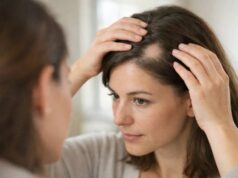
Iodine is one of those nutrients that gets pulled into hair-loss conversations with more confidence than clarity. It matters, but usually not in the simple way supplement marketing suggests. Iodine’s main job is to support thyroid hormone production, and thyroid hormones help regulate the hair cycle. That means too little iodine can contribute to hair shedding when it disrupts thyroid function. The catch is that too much iodine can do the same thing in susceptible people by pushing the thyroid in the wrong direction.
That is why iodine sits in a narrow lane: essential, but easy to misuse. Mild deficiency is still possible in some groups, especially during pregnancy, with strict vegan diets, or when iodized salt and dairy are both limited. At the same time, seaweed tablets, “thyroid support” blends, and stacked supplements can drive intake far higher than many people realize. Hair may become collateral damage when the thyroid swings into hypothyroidism, hyperthyroidism, or autoimmune irritation.
This guide explains how iodine connects to hair loss through the thyroid, what safe intake actually looks like, who is more likely to be low, why excess can be just as problematic, and how to avoid supplement mistakes that create more confusion than benefit.
Key Insights
- Iodine affects hair mostly through thyroid hormone balance, not by directly making hair grow faster or thicker.
- Both too little and too much iodine can contribute to shedding if thyroid function becomes abnormal.
- Most adults need a moderate daily amount, while pregnancy and lactation raise iodine needs enough to make intake planning more important.
- Kelp, “thyroid support,” and multiple overlapping supplements can push iodine intake too high without obvious warning.
- The safest approach is to check thyroid and deficiency clues before supplementing rather than treating hair loss with iodine on guesswork alone.
Table of Contents
- How Iodine Connects to Hair Through the Thyroid
- Deficiency vs Excess and Why Both Matter
- Safe Intake, Food Sources, and Who Runs Low
- Supplement Pitfalls That Cause Problems
- When Hair Loss Deserves Testing, Not Self-Treatment
- What Recovery Usually Looks Like
How Iodine Connects to Hair Through the Thyroid
Iodine does not sit inside the hair follicle acting like a cosmetic growth booster. Its main role is upstream. The thyroid gland uses iodine to make thyroxine and triiodothyronine, the hormones that help regulate metabolism, temperature, energy use, and many tissue-level processes, including the hair cycle. When thyroid hormone production drifts too low or too high, hair is one of the tissues that often shows the change.
That is why iodine-related hair loss is usually thyroid-related hair loss first. The follicle cares less about iodine as an isolated nutrient and more about whether thyroid signaling stays steady enough to support normal cycling. When that balance is disrupted, more hairs may leave the growth phase too early or linger in resting phases longer than they should. The result is often diffuse shedding rather than a sharply defined bald patch.
This is also why hair loss from iodine issues can be easy to overestimate or misread. Someone may assume they need more iodine because their hair is thinning, when the true problem is already hypothyroidism, hyperthyroidism, iron deficiency, stress shedding, or patterned thinning. Another person may start a supplement for “thyroid support,” then develop more shedding because the added iodine pushes a vulnerable thyroid into dysfunction. The same symptom can appear on both sides of the intake curve.
The hair pattern itself is usually nonspecific. Thyroid-linked shedding often looks like diffuse loss, reduced volume, more hair in the shower or brush, or slower regrowth after shedding. Hair may also feel drier, rougher, finer, or more brittle depending on the broader endocrine picture. Those changes do not prove iodine is the cause, but they make the thyroid worth considering.
A few practical clues make the iodine-thyroid link more plausible:
- Hair shedding travels with fatigue, cold intolerance, constipation, dry skin, or menstrual change.
- Hair loss appears alongside symptoms of thyroid overactivity, such as palpitations, tremor, heat intolerance, or unexplained weight change.
- A supplement or seaweed-heavy routine started before the shedding changed.
- The person is pregnant, postpartum, vegan, highly salt-restrictive, or otherwise at higher risk for iodine imbalance.
That is why thyroid context matters so much. The article on thyroid-related hair loss symptoms and labs is useful here because it explains the scalp signs that often travel with abnormal thyroid function, regardless of whether iodine is the original trigger.
The central point is simple: iodine matters for hair because thyroid hormones matter for hair. That makes iodine important, but not automatically helpful in supplement form. Hair loss improves when thyroid function is corrected, not when iodine is pushed blindly in one direction.
Deficiency vs Excess and Why Both Matter
One of the most important truths about iodine is that the risk curve bends both ways. Too little can cause trouble, and too much can cause trouble too. Hair loss sits in the middle as a possible downstream sign of either problem if thyroid function is pushed out of balance.
Iodine deficiency can reduce the thyroid’s ability to make enough hormone. When intake stays too low for long enough, the gland compensates by working harder, and thyroid-stimulating hormone may rise in an attempt to keep hormone production going. If the thyroid cannot keep up, hypothyroid symptoms may follow. Hair shedding, dry hair, rough texture, fatigue, constipation, dry skin, and cold intolerance can all show up in that setting. In severe deficiency, thyroid enlargement can also occur.
But excess iodine is not a harmless buffer against deficiency. In people with certain risk factors, a large iodine load can trigger thyroid dysfunction in either direction. Some develop hypothyroidism because the gland fails to adapt to the increased iodine exposure. Others develop iodine-induced hyperthyroidism, especially when there is underlying thyroid autonomy or nodular disease. Autoimmune thyroid disease can also be part of the story. Hair may then shed because the thyroid has been destabilized, not because more iodine was inherently “bad for hair.”
This is why high-dose iodine products can be so misleading. They are often marketed as metabolism or thyroid support, yet the thyroid is not a muscle that performs better the more raw material you give it. It behaves more like a precision system. Past a certain point, extra input can create noise instead of better output.
The “both directions matter” principle explains several common real-life scenarios:
- A person with low intake improves thyroid function once a real deficiency is corrected.
- A person with normal intake starts kelp or iodine drops and later develops abnormal thyroid tests.
- A person with autoimmune thyroid disease becomes more sensitive to supplement swings.
- A pregnant person assumes more iodine is always better and unknowingly overshoots with multiple products.
This does not mean iodine is dangerous. It means iodine is dose-sensitive. The body needs it every day, but within a range that supports physiology rather than overwhelming it.
Hair loss readers often benefit from seeing this as a thyroid stability issue rather than a vitamin-style “more is better” issue. The article on hair loss from nutrient overload and supplement excess fits well here because it shows how hair can worsen when a micronutrient is pushed past useful levels.
A helpful rule is that deficiency tends to be quieter and contextual, while excess often arrives through products, contrast exposure, or unusual intake patterns. Both deserve respect. The safest question is not “Should I take more iodine?” but “Is my intake appropriate for my thyroid, life stage, and current health picture?” That question is much more likely to protect the hair cycle than a reflex supplement purchase.
Safe Intake, Food Sources, and Who Runs Low
Safe iodine intake is not mysterious, but it is easy to misjudge because food labels are inconsistent and supplement marketing rarely emphasizes totals. Many adults need a moderate daily intake, not a high one. Pregnancy and lactation raise needs enough to deserve closer attention, but even then the target is still measured, not extreme.
In practice, iodine comes from a relatively small set of sources. Iodized salt is the best-known one, but it is not universal. Some people use sea salt, kosher salt, or specialty salts that are not iodized. Dairy often contributes meaningful iodine in many diets. Fish and seafood can add more. Eggs contribute some. Seaweed can contain very large amounts, but that is exactly why it is a poor casual “health food” solution for many people. Its iodine content can vary so widely that it is difficult to treat as a controlled dose.
The groups most likely to run low are not necessarily the people who think about iodine the most. They are often the people whose diet pattern quietly removes the main sources. Risk can be higher in people who:
- Avoid iodized salt and do not get much dairy or seafood.
- Follow vegan or very restrictive diets without a deliberate iodine source.
- Are pregnant or lactating and rely on a prenatal without iodine.
- Follow salt-restricted diets and assume all salt is nutritionally equivalent.
- Live on highly processed foods while rarely using iodized salt at home.
This is one reason hair loss can appear alongside broader diet shifts. A person may move to a plant-based diet, remove dairy, cut salt, and then assume the resulting shedding means they need a “hair growth” supplement. In reality, the first step may be checking whether the diet still covers the nutrients tied to thyroid function. The article on vegan diet patterns and hair loss risk is especially useful for that reason.
Pregnancy deserves special attention because iodine demands rise, and fetal development depends on adequate thyroid hormone support. Yet this is also the stage where careless supplementation can backfire if multiple products overlap. A prenatal, an extra iodine tablet, seaweed snacks, and a thyroid-support blend can create a very different total than the label on any one bottle suggests.
Food-first planning usually works well when the diet is broad enough and iodized salt is used appropriately. Supplements become more relevant when needs are higher, diet is limited, or a clinician specifically recommends them. What is not wise is assuming hair loss alone proves iodine deficiency.
A practical intake mindset looks like this:
- Know whether your household salt is iodized.
- Notice whether dairy, seafood, eggs, or other consistent sources are present.
- Check whether a prenatal or multivitamin already contains iodine.
- Avoid stacking products without adding the totals.
- Treat seaweed and kelp as high-variability sources, not routine dose tools.
Safe intake is about adequacy, not maximizing. That distinction is exactly what protects the thyroid from the kinds of swings that show up later in the shower drain or the widening part line.
Supplement Pitfalls That Cause Problems
Most iodine mistakes do not happen because someone deliberately chooses an extreme dose. They happen because iodine hides inside multiple products, or because a “natural” source sounds gentler than it really is. This is why supplement pitfalls matter so much in hair-loss conversations.
The first trap is kelp and seaweed supplements. These products are often marketed as clean, plant-based, or thyroid-friendly, yet seaweed can contain highly variable iodine amounts. One product may deliver a modest dose while another provides far more than the user expects. A person who thinks they are taking a trace mineral for hair or metabolism may actually be giving the thyroid a repeated excess load.
The second trap is stacking. A multivitamin may contain iodine. A prenatal may contain iodine. A thyroid formula may contain iodine. A “hair skin and nails” blend may include kelp or sea minerals. Add daily seaweed snacks or iodized salt, and the total can climb faster than people realize. Because each label is read in isolation, the real intake is often underestimated.
The third trap is assuming symptoms always mean deficiency. Fatigue, weight change, dry hair, and shedding can look like a call for more iodine, but they can also reflect existing hypothyroidism, autoimmune thyroid disease, postpartum shifts, or other nutrient problems. Taking iodine before clarifying the cause may complicate the picture rather than solve it.
The fourth trap is using supplement logic instead of thyroid logic. Hair marketing tends to present nutrients as if each one were a direct lever for thickness. Thyroid physiology does not work that way. More iodine does not automatically translate into better hormone balance. In certain people, it does the opposite.
Common supplement mistakes include:
- Taking kelp because it sounds gentler than potassium iodide.
- Using two or three overlapping formulas without adding the total iodine.
- Treating a prenatal as automatically complete without checking the label.
- Starting iodine drops for hair shedding without any thyroid evaluation.
- Assuming “natural thyroid support” blends are low risk because they are sold over the counter.
This is why readers worried about nutrient-based hair fixes often benefit from stepping back before buying anything. The article on red flags in hair growth supplements fits naturally here because iodine problems often arise through the same pattern: persuasive labels, incomplete totals, and a promise that sounds simpler than the biology really is.
There is also a timing trap. Some people take iodine because they recently became pregnant, switched diets, or noticed a little more shedding. Those are real moments when intake matters, but they are also moments when thyroid vulnerability and overlapping products are common. Good intentions can still create excess.
A safer supplement rule is to treat iodine like a targeted nutrient, not a casual beauty add-on. Know the dose, know the reason, know the other products you are taking, and be especially careful if you have thyroid disease, are pregnant, or are already seeing symptoms that suggest the gland is under stress.
When Hair Loss Deserves Testing, Not Self-Treatment
Hair loss deserves testing rather than self-treatment when the story is no longer just cosmetic. If shedding is persistent, density is visibly changing, or thyroid symptoms are joining the picture, it is smarter to investigate than to guess with iodine.
The reason is that iodine imbalance is difficult to diagnose from hair alone. Diffuse shedding can happen with hypothyroidism, hyperthyroidism, iron deficiency, low protein intake, postpartum change, fever-related telogen effluvium, medication effects, and patterned thinning. Even if iodine is involved, the more actionable finding is often the thyroid abnormality it helped produce.
Clues that should push testing higher on the list include:
- Hair shedding with fatigue, constipation, cold intolerance, dry skin, or menstrual changes.
- Hair loss with palpitations, heat intolerance, tremor, anxiety, or unexplained weight loss.
- Recent use of kelp, thyroid formulas, iodine drops, or multiple overlapping supplements.
- Pregnancy, postpartum change, or lactation combined with thinning.
- A vegan or highly restricted diet with no clear iodine source.
- A personal or family history of thyroid disease.
A typical medical workup may include thyroid-stimulating hormone and, depending on the context, free thyroid hormone levels and thyroid antibodies. Iodine testing is more specialized and not usually the first step for every person with shedding. That is one reason self-diagnosing iodine deficiency from hair symptoms is unreliable. Many people need a thyroid evaluation and a broader hair-loss assessment more than they need an isolated iodine test.
A wider lab picture can matter because other deficiencies or internal triggers may be doing more to the hair than iodine ever was. Iron status, complete blood count, and other basics may be relevant when shedding is diffuse. The article on blood tests often used in hair-loss evaluation helps show where thyroid testing fits in that broader framework.
It also helps to know when not to wait. Hair loss that is patchy, rapidly worsening, or accompanied by scalp inflammation is less likely to be explained by iodine alone. Likewise, thyroid symptoms that are significant deserve medical care even if the hair changes seem manageable.
A practical decision path looks like this:
- Review whether iodine exposure recently changed through diet, prenatal, kelp, or supplements.
- Notice whether thyroid-type symptoms are present.
- Stop adding extra iodine unless you were specifically told to take it.
- Arrange thyroid and hair-loss evaluation if shedding is persistent or density is dropping.
- Use the diagnosis to guide intake rather than using intake to chase the diagnosis.
Testing does not turn every hair problem into a thyroid problem. It simply prevents the common mistake of treating one plausible nutrient as the answer before the physiology has actually been checked. In a topic this dose-sensitive, that kind of restraint often protects both thyroid stability and the hair cycle.
What Recovery Usually Looks Like
When iodine-related hair loss improves, it usually improves because thyroid function improves, not because the hair follicle received a direct beauty benefit. That recovery is often gradual. The lab change tends to come first, shedding reduction next, and visible density later.
If the problem was true deficiency, recovery usually depends on correcting the deficiency safely and restoring normal thyroid signaling. If the problem was excess, recovery depends on removing the unnecessary load and allowing the thyroid to stabilize, sometimes with medical treatment if dysfunction has already developed. In both cases, hair improvement follows the biology of the hair cycle, which means it can lag behind the intervention by weeks to months.
That delay is normal. Many people feel discouraged because they stop the wrong supplement, correct the thyroid issue, and still see shedding for a while. Hair follicles need time to shift out of the disrupted cycle. Some hairs that were already pushed into resting phases will still shed before the scalp begins to look fuller again. Patience is part of treatment, not a sign that nothing is working.
Recovery also depends on whether iodine and thyroid balance were the only issue. In real life, hair loss often has overlap. A person may have mild thyroid dysfunction plus low ferritin. Another may have postpartum shedding plus a prenatal that lacked iodine. Another may have patterned hair loss that became more obvious during a thyroid swing. When those overlaps exist, fixing iodine alone may help without fully restoring the hair to its prior baseline.
A few practical points improve the odds of a smoother recovery:
- Avoid frequent dose changes unless a clinician recommends them.
- Do not jump from avoiding iodine entirely to taking large amounts.
- Recheck the supplement lineup so the original excess does not recur.
- Keep hair care gentle while active shedding is high.
- Judge progress monthly, not day to day.
This is also the stage where people are tempted to add more products. That can be a mistake. If the thyroid is stabilizing, the hair may recover on its own timetable. Adding multiple growth serums, extra nutrient stacks, and high-dose formulas at once can make it harder to tell what helped and what irritated the scalp or changed the thyroid again.
A better mindset is controlled correction rather than aggressive optimization. If the diagnosis was iodine-related, the success marker is stable thyroid function and a gradual return toward your normal hair cycle, not the highest supplement dose you can tolerate.
The overall message is reassuring but measured. Iodine-related hair shedding is often reversible when the underlying thyroid issue is identified and handled appropriately. The key is that the path back usually runs through balance. Not fear of iodine, not enthusiasm for iodine, but enough intake to support thyroid function without pushing it into another avoidable swing.
References
- Iodine – Health Professional Fact Sheet 2024
- Impact of Thyroid Dysfunction on Hair Disorders 2023 (Review)
- Risks of Iodine Excess 2024 (Review)
- Iodine Deficiency and Iodine Prophylaxis: An Overview and Update 2023 (Review)
- Impact of iodine intake on the pathogenesis of autoimmune thyroid disease in children and adults 2022 (Review)
Disclaimer
This article is for educational purposes only and is not a diagnosis or a substitute for personal medical care. Hair loss can have many causes, and iodine-related shedding usually works through thyroid dysfunction rather than through iodine alone. Seek medical care for persistent diffuse shedding, visible thinning, thyroid symptoms, pregnancy-related questions, or any plan to use iodine supplements when you have known thyroid disease or abnormal thyroid tests.
If this article helped, please share it on Facebook, X, or another platform your readers trust.