Iron is one of the nutrients hair follicles notice quickly when supply runs low. That is because growing hair is metabolically active tissue, and iron helps support oxygen delivery, cellular energy, and the rapid turnover that healthy follicles require. When iron intake or iron stores fall short, shedding can increase, regrowth can feel slower, and hair may look less full even before anemia is obvious.
That does not mean every person with hair thinning needs an iron supplement. It means iron deserves a smarter look. Food-first strategies are often the best place to start because the type of iron, the meal around it, and the body’s ability to absorb it all matter. A bowl of lentils with vitamin C-rich vegetables may do more than an iron-rich food eaten beside tea and dairy. Heme iron from seafood or meat is absorbed differently from nonheme iron in beans, greens, and fortified grains. Once you understand those patterns, iron-rich eating becomes much more practical and much less guesswork.
Quick Summary
- Iron supports hair growth best when intake, absorption, and overall nutrition all line up.
- Heme iron from meat and seafood is absorbed more efficiently than nonheme iron from plant foods.
- Vitamin C-rich foods can improve iron absorption, especially in plant-based meals.
- Iron supplements are not harmless hair boosters and should not replace proper testing when deficiency is possible.
- Build iron-focused meals by pairing an iron source with vitamin C and keeping tea, coffee, and high-calcium foods away from that meal when possible.
Table of Contents
- Why iron matters for hair
- Best food sources of dietary iron
- Pairings that improve iron absorption
- Who needs a smarter iron strategy
- When food is enough and when to test
- Practical meal ideas and common mistakes
Why iron matters for hair
Iron helps the body do something hair follicles depend on every day: move oxygen and support energy-intensive growth. Follicles are not passive structures. They cycle, divide, build keratin, and maintain a long active growth phase when conditions are favorable. When iron is low, that environment becomes less supportive. The result is often diffuse shedding rather than a sharply defined bald spot. For many people, this shows up as more hair in the shower, more strands on clothing, or a ponytail that feels smaller over time.
One reason this topic gets confusing is that iron deficiency and iron deficiency anemia are not the same thing. A person can have low iron stores before hemoglobin drops far enough to be called anemia. That matters for hair because the follicle may respond to reduced reserves earlier than the rest of the body makes the problem obvious. Ferritin, which reflects stored iron, is one of the lab markers clinicians often review when diffuse shedding is part of the picture. Readers who want the broader connection between iron deficiency, ferritin, and hair loss usually find that the conversation is less about one magic number and more about the whole clinical picture.
Iron in food also comes in two forms, and this shapes how useful a meal may be. Heme iron comes from animal foods such as meat and seafood and is absorbed more efficiently. Nonheme iron comes from plant foods and fortified products. It still counts, but its absorption is more easily affected by what else is eaten at the same time. That is why one iron-rich meal can work much better than another with a similar number on paper.
It also helps to keep expectations realistic. Eating more iron-rich foods does not make hair grow overnight. Hair responds slowly because the follicle cycle moves slowly. If low iron is part of the shedding problem, improving intake can support recovery, but visible density usually returns over months, not days. The most useful mindset is not “What food makes hair grow fast?” but “What pattern of eating gives the follicle the raw materials it has been missing?”
A final point matters just as much: iron is not a general hair vitamin for everyone. Too little can be a problem, but too much is not better. That is why food-first strategies are often a safer and more sustainable starting point than aggressive self-supplementation.
Best food sources of dietary iron
The best iron-rich foods are not all in one category, but they do not all perform the same way either. In general, heme iron sources are the most efficiently absorbed. That makes foods like oysters, beef, sardines, and other meats especially useful when iron intake needs a practical lift. Organ meats, especially liver, are very high in iron, though not everyone wants them regularly and some people need to be cautious with frequent liver intake because of vitamin A.
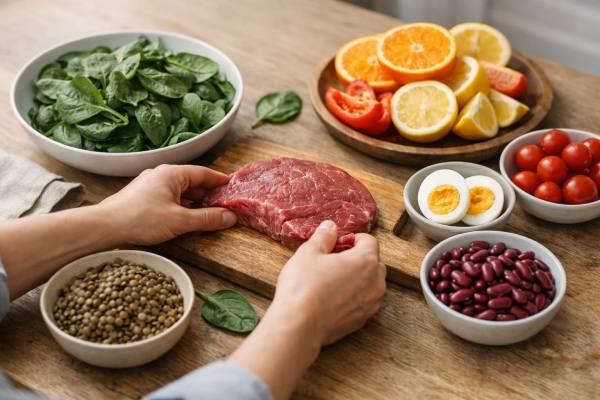
Among familiar foods, some standout sources include oysters, beef liver, lean beef, sardines, and darker poultry cuts. These foods do not just provide iron. They also come packaged with protein, which matters because hair follicles need more than one nutrient to build strong strands. That is one reason a balanced iron-focused meal tends to work better than chasing a single “superfood.”
Plant-based iron sources are still valuable, especially for people who eat little or no meat. The strongest options include lentils, white beans, tofu, chickpeas, spinach, fortified breakfast cereals, cashews, and enriched grain products. The key difference is that plant-based iron is nonheme iron, so meal composition matters more. A fortified cereal may look impressive on the label, but the real benefit depends on what it is eaten with and what may be blocking absorption at the same meal.
A practical way to think about food sources is to divide them into tiers.
Strong heme iron choices
- Oysters
- Beef liver
- Lean beef
- Sardines
- Darker cuts of poultry
Strong nonheme iron choices
- Fortified cereals
- White beans
- Lentils
- Spinach
- Tofu
- Chickpeas
- Cashews
- Enriched breads and grains
This is also where common misconceptions start. Spinach contains iron, but it is not automatically the best iron food for every person because plant compounds can reduce how much is absorbed. Fortified cereals can help, but some are high in sugar and low in protein, which makes them less satisfying as a stand-alone breakfast. Dark chocolate contains some iron too, but it is not the most efficient or practical way to rebuild intake.
For hair support, the best iron source is usually the one you will eat consistently in a meal that also supports absorption and overall nutrition. Someone who reliably eats lentils with tomatoes, peppers, and a protein source may build a better routine than someone who buys liver once, hates it, and never repeats the experiment. Someone else may do best with seafood twice a week and beans on alternate days.
Iron-rich eating works best when it is repeatable. Hair follicles do not respond to one perfect dinner. They respond to a pattern. That is why a modest but sustainable rotation of strong iron foods usually beats the search for one dramatic “best” source.
Pairings that improve iron absorption
Iron intake is only half the story. Absorption is where many hair-focused nutrition plans either become useful or quietly fail. This matters most for nonheme iron, the form found in beans, lentils, tofu, greens, nuts, and fortified grains. Nonheme iron can absolutely contribute to better iron status, but it is more influenced by the rest of the meal.
The most helpful pairing is vitamin C. Foods such as citrus, kiwi, strawberries, tomatoes, bell peppers, broccoli, and other vitamin C-rich produce can improve nonheme iron absorption when eaten in the same meal. This does not need to be complicated. Lentils with tomatoes, tofu with bell peppers, beans with salsa, or fortified cereal plus berries are all practical ways to make the meal work harder.
Animal protein can help too. Meat, poultry, and seafood not only provide heme iron, they can also enhance the absorption of nonheme iron eaten alongside them. This is one reason mixed meals often outperform plant foods eaten alone from an iron perspective. A beef and bean chili, for example, gives both heme and nonheme iron plus a structure that usually fits real life.
The flip side is just as important. Several common foods and drinks can reduce iron absorption when consumed right with an iron-focused meal. The most important are:
- Tea
- Coffee
- High-calcium dairy taken at the same meal
- Calcium supplements taken with iron
- Some high-phytate foods when the entire meal is built around them without enhancers
This does not mean you need to fear these foods. It means timing matters. Tea or coffee an hour or two away from an iron-focused meal is very different from washing down lentils with a large mug of black tea. The same goes for milk or calcium supplements.
Stomach acid also plays a role, which is why some people with chronic digestive issues or long-term acid-suppressing medication use may absorb iron less efficiently. If that history fits, the problem may be bigger than food choice alone. Readers exploring how digestion affects iron and B12 status often find that absorption issues can look like a “good diet that somehow is not working.”
A few easy meal upgrades make a real difference:
- Add a vitamin C-rich food to plant-based iron meals.
- Keep tea and coffee away from your most iron-focused meal.
- Do not take calcium supplements alongside iron-rich meals or iron tablets.
- Use mixed meals when possible instead of relying on one food alone.
- Repeat these habits consistently rather than chasing one “perfect” pairing.
For hair growth, this is where good intentions become useful biology. A bowl of chickpeas is fine. A bowl of chickpeas with tomatoes, lemon, herbs, and a meal structure that does not sabotage absorption is better.
Who needs a smarter iron strategy
Not everyone needs to think about iron in the same way. Some groups are more likely to come up short either because their needs are higher, their intake is lower, or their losses are greater. Menstruating women are one of the clearest examples. Monthly blood loss raises iron needs, which is why adult women before menopause generally need more dietary iron than adult men. Pregnancy is another major category because iron requirements rise sharply. Postpartum recovery can also be a vulnerable period, especially if blood loss was significant or diet has been inconsistent.
Teenagers, endurance athletes, frequent blood donors, and people recovering from illness or surgery also deserve more careful attention. So do people who follow restrictive eating patterns, avoid many animal foods, or rely heavily on convenience foods with low nutrient density. A plant-based diet can absolutely be iron-adequate, but it usually requires more intention because nonheme iron is less bioavailable and vegetarians generally need more iron on paper to make up for that difference. For readers navigating a more plant-forward pattern, vegan diet and hair loss can be a useful next read.
People with digestive disorders may need a smarter plan too. Celiac disease, inflammatory bowel disease, prior bariatric surgery, chronic gastritis, and some medication patterns can all make it harder to absorb iron normally. In those cases, a person may be eating respectable meals and still struggle to maintain iron stores.
Low intake is not the only issue. Under-eating overall can magnify the problem. Someone under stress, dieting aggressively, using appetite-suppressing medication, or unintentionally skipping meals may not be falling short on iron alone. They may be falling short on calories and protein too, which makes hair recovery harder. Hair follicles are practical. They do not only ask whether iron is present; they also ask whether the body is in a position to support growth at all.
A useful risk checklist includes:
- Heavy menstrual bleeding
- Pregnancy or postpartum recovery
- Vegetarian or vegan eating without careful planning
- Frequent blood donation
- Endurance training
- Low-calorie or low-protein dieting
- Digestive disorders or prior bariatric surgery
- Ongoing diffuse shedding with fatigue or restless legs
Being in one of these groups does not prove iron deficiency. It does mean that a casual, generic diet may not be enough. These are the situations where meal planning, timing, and sometimes laboratory testing become much more worthwhile. The goal is not to turn eating into a chemistry exam. It is to recognize when the body is more likely to need deliberate support.
When food is enough and when to test
Food is the right starting point for many people, but it is not always the whole answer. If hair shedding is mild, recent, and the diet has clearly been low in iron-rich foods, improving meals may be a sensible first move. But if the shedding is persistent, if fatigue or dizziness is present, if periods are heavy, or if there is a history of digestive disease or major dietary restriction, testing is often more efficient than guessing.
The lab marker most people hear about is ferritin, which reflects iron stores. Clinicians may also look at hemoglobin, a complete blood count, iron studies, and sometimes thyroid tests or other markers depending on the broader picture. That matters because hair shedding is not caused by iron alone. A person can have low ferritin, thyroid issues, low protein intake, postpartum shedding, medication-related shedding, or several overlapping triggers at once. A more targeted discussion of ferritin, thyroid, and hair-loss blood tests can help set expectations about why testing is sometimes useful and sometimes overdone.
Supplements are where caution becomes important. Iron supplements can be very effective when deficiency is present, but they are not harmless. Gastrointestinal side effects are common, especially at higher doses, and taking iron without a real need can lead to unnecessary problems. Iron can also interact with medications and can be dangerous in overdose, particularly around children. That is why self-prescribing iron “for hair growth” is not the same as eating more lentils or oysters.
There is also a practical clue in the timeline. Even when iron deficiency is confirmed and corrected, hair does not rebound immediately. Shedding may slow first, and visible fullness may take much longer to catch up. That is normal. The follicle cycle has its own pace.
Food-first strategies are often enough when:
- The diet has been clearly low in iron-rich foods
- Symptoms are mild
- There are no major risk factors for significant deficiency
- The goal is prevention or gentle support
Testing becomes more important when:
- Shedding is ongoing or significant
- Fatigue, weakness, dizziness, or shortness of breath are present
- Periods are heavy
- Pregnancy, postpartum, or blood loss are part of the story
- A restrictive diet or digestive disorder is present
- Supplements are being considered
The strongest plan is usually the one that matches the level of risk. Hair shedding is stressful enough without turning iron into a guessing game.
Practical meal ideas and common mistakes
Iron-rich eating becomes much easier when it stops sounding like a list of ingredients and starts looking like real meals. For breakfast, one practical option is iron-fortified cereal topped with berries or kiwi instead of relying on toast and coffee alone. Another is eggs plus a side of beans and salsa, though eggs are not an especially strong iron source by themselves. For readers trying to build a more complete morning routine, high-protein breakfast ideas for hair pair well with iron goals because protein and iron often need to improve together.
Lunch and dinner are where iron planning gets simpler. A lentil soup with tomatoes and lemon, a beef and bean chili, a sardine bowl with roasted peppers, tofu stir-fry with broccoli and red bell pepper, or chickpea stew with citrus-dressed greens all make sense. These meals work because they combine an iron source with ingredients that help absorption instead of competing with it.
A few common mistakes are worth avoiding.
Mistake 1: Relying on one “healthy” food
Spinach is useful, but it is not enough by itself. Hair-supportive iron intake usually comes from variety.
Mistake 2: Drinking tea or coffee with iron-focused meals
This is one of the easiest ways to reduce the benefit of an otherwise good meal.
Mistake 3: Assuming more supplement equals faster regrowth
Iron is not a cosmetic booster. High doses can cause side effects and should not be taken casually.
Mistake 4: Forgetting overall diet quality
A person can eat one iron-rich dinner and still be under-fueled the rest of the day.
Mistake 5: Expecting food to fix every kind of hair loss
Iron-rich meals help most when iron is genuinely part of the problem.
A simple day might look like this:
- Breakfast: fortified cereal with strawberries, plus a protein source.
- Lunch: lentil salad with tomatoes, parsley, and lemon.
- Snack: cashews or roasted chickpeas.
- Dinner: lean beef, tofu, or sardines with vegetables that include bell peppers or broccoli.
- Coffee or tea: away from the most iron-focused meal.
That kind of structure is not flashy, but it is effective. Hair follicles respond better to a repeatable pattern than to a burst of enthusiasm followed by inconsistency. If you suspect iron is part of your shedding story, the best meal plan is usually the one that raises intake, improves absorption, and fits your actual life well enough to last.
References
- Iron – Health Professional Fact Sheet 2025
- Iron Absorption: Factors, Limitations, and Improvement Methods – PMC 2022 (Review)
- Dietary Iron – StatPearls – NCBI Bookshelf 2024 (Clinical Review)
- Telogen Effluvium – StatPearls – NCBI Bookshelf 2024 (Clinical Review)
- Assessment of Serum Ferritin Levels in Female Patients With Telogen Effluvium – PMC 2025
Disclaimer
This article is for educational purposes only and is not a substitute for medical advice, diagnosis, or treatment. Hair shedding and slow regrowth can have many causes, including iron deficiency, thyroid disease, medication effects, low protein intake, hormonal shifts, illness, and inflammatory scalp conditions. Persistent shedding, fatigue, dizziness, heavy menstrual bleeding, pregnancy-related concerns, or suspected deficiency should be assessed by a qualified clinician before starting iron supplements.
If this article helped, please share it on Facebook, X, or another platform you use so more people can make sense of iron, absorption, and hair growth without guesswork.