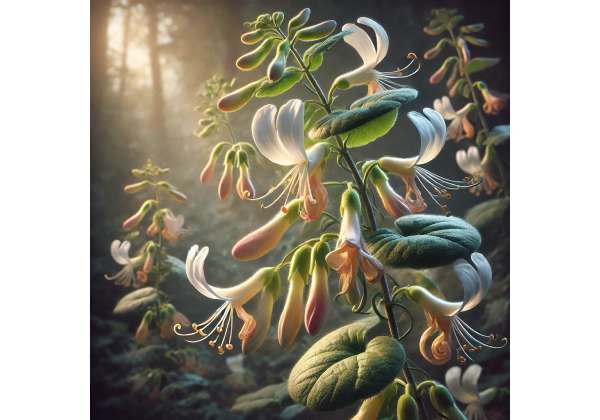
Italian woodbine, also known as Italian honeysuckle, is a fragrant climbing shrub best known for its cream-to-pink tubular flowers and sweet evening scent. Botanically, it is Lonicera caprifolium, a European species that belongs to the broader honeysuckle group. That group matters, because many medicinal claims online blur this plant with other Lonicera species, especially Japanese honeysuckle. Italian woodbine has its own traditional profile and should be treated as a distinct herb rather than a generic stand-in for all honeysuckles.
Historically, the flowers and leaves have been used in folk practice for skin irritation, mild respiratory discomfort, and soothing washes or infusions. Modern research is still limited, but direct studies on Lonicera caprifolium essential oil and flower extracts suggest antioxidant, antibacterial, wound-healing, and antinociceptive potential. The plant also contains aromatic compounds, polyphenols, and spermidine-rich floral material that help explain why it attracts interest in skin, inflammation, and healthy-aging research.
Still, this is not a clinically established medicine. Human dosing is not standardized, berry use is poorly defined, and most data come from laboratory or animal work. A careful, evidence-aware reading is the best way to approach it.
Brief Summary
- Italian woodbine shows the most credible early promise for antioxidant and topical wound-support activity.
- Its flower essential oil also appears to have antibacterial and mild pain-relief potential in preclinical research.
- A cautious traditional infusion range is about 1 to 2 g dried flowers per 250 mL water, once or twice daily.
- Pregnant or breastfeeding people, children, and anyone using concentrated essential oils internally should avoid self-prescribing it.
Table of Contents
- What is Italian woodbine?
- Key ingredients and how they work
- Does Italian woodbine help skin and wounds?
- Can it support coughs and inflammation?
- Other potential benefits and traditional uses
- How to use Italian woodbine
- How much Italian woodbine per day?
- Safety, side effects, and who should avoid it
- What the evidence actually says
What is Italian woodbine?
Italian woodbine is a deciduous twining climber native to southern and central Europe. It belongs to the Caprifoliaceae family and produces highly fragrant flowers that open in clustered whorls around the upper leaves. In gardens, it is usually grown for ornament, scent, and pollinator interest. In traditional herb use, though, the flowers and leaves have also been valued for soothing, cleansing, and mildly expectorant purposes.
One of the first things a reader should understand is that Lonicera caprifolium is not the same as every other honeysuckle sold or discussed online. Much of the modern medicinal literature on honeysuckle focuses on Lonicera japonica, a different species with a deeper role in East Asian medicine. Italian woodbine shares some aromatic and polyphenol-rich features with other honeysuckles, but it does not have the same research base, the same standardization, or the same historical medical system around it. That distinction matters because species confusion is one of the easiest ways to overstate benefits.
Traditional Western herbal descriptions of Italian woodbine usually focus on the flowers and leaves. These were described as mild expectorants, soothing preparations for irritated tissues, or topical plant materials for skin complaints. In some ethnobotanical records, the flowers are also eaten as seasonal snacks or used in simple infusions. That makes Italian woodbine more of a gentle floral herb than a heavy medicinal root or bark. It is closer in feel to fragrant flower botanicals such as elderflower in traditional floral infusions than to a strongly bitter or resinous remedy.
Its medicinal identity is also shaped by how it is used. Italian woodbine is not a classic daily tonic, and it is not well suited to concentrated, unsupervised experimentation. The flowers may be infused, extracted, or studied as essential oil. The leaves appear in some folk uses, especially as external preparations. The fruits, however, are a gray area and are better left out of medicinal self-use because most modern practical interest centers on flowers and leaves, not berries.
From a modern perspective, this plant sits in an interesting middle ground. It is too active and too fragrant to dismiss as purely ornamental, but not clinically established enough to rank beside the best-studied medicinal honeysuckles. That means the most reasonable way to think about Italian woodbine is as a promising traditional flower herb with a direct but still limited evidence base in antioxidant, antibacterial, wound-support, and aroma-related applications.
Key ingredients and how they work
The chemistry of Italian woodbine helps explain why this plant appears in discussions of skin care, mild respiratory support, wound healing, and aromatic medicine. The flowers contain volatile compounds that give them their distinctive fragrance, alongside phenolic compounds and other plant metabolites that may help support antioxidant and tissue-protective activity.
Essential-oil studies on Lonicera caprifolium flowers have identified compounds such as linalool, d-limonene, alpha-cadinol, and other terpenes and oxygenated aromatic constituents. These matter because they are the compounds most likely to drive the plant’s scent profile and some of its antimicrobial or soothing activity. In practical terms, they help make the flower oil more than just a perfume ingredient. Linalool, for example, is widely studied in aromatic plants for calming, antimicrobial, and skin-compatible properties, while limonene and related terpenes often contribute to antioxidant and surface-level cleansing effects.
At the same time, the plant is not just about fragrance. Flower extracts also contain polyphenols and hydroxycinnamic acid-related compounds. A 2023 study on honeysuckle flower extract specifically identified these constituents as part of the antioxidant and prebiotic profile of Lonicera caprifolium flower extracts in honey-based mixtures. That gives the herb a second layer of interest beyond essential oil alone. It also explains why flower infusions and extracts may behave differently from the distilled oil.
Another compound group worth noting is polyamines, especially spermidine. Research comparing spring flowers found that dried Lonicera caprifolium flowers contained notable spermidine levels. That does not suddenly turn Italian woodbine into a longevity supplement, but it does add an interesting nutritional and biochemical dimension to the flower. Spermidine is often discussed in cell renewal and healthy-aging research, so its presence helps explain why floral powders and extracts are attracting attention.
A good working summary of Italian woodbine’s key ingredients looks like this:
- Volatile terpenes such as linalool and limonene
- Sesquiterpene alcohols and related aromatic compounds
- Polyphenols
- Hydroxycinnamic-acid-related compounds
- Polyamines, especially spermidine
This combination gives the plant several plausible medicinal directions at once. The volatile oil supports aromatic, topical, and antimicrobial interest. The polyphenols support antioxidant and tissue-protective interest. The polyamine profile adds a layer of curiosity around cellular resilience and cosmetic or wellness use. That kind of mixed profile is one reason flower herbs often resist simple labels.
Compared with better-known polyphenol-rich plants such as green tea for antioxidant support, Italian woodbine is far less standardized and much less clinically developed. Still, its chemistry is interesting enough to justify serious attention, especially for topical use and floral extract research.
Does Italian woodbine help skin and wounds?
This is probably the most credible modern benefit area for Italian woodbine. Among the direct studies on Lonicera caprifolium, wound-support and skin-relevant effects are where the evidence is most specific. That does not mean the herb is proven as a clinical wound remedy, but it does mean the research is strong enough to support careful interest.
A 2024 study on Lonicera caprifolium flower essential oil found that the oil showed antioxidant activity, pain-relief effects in mice, and notably strong wound-healing potential in an excision wound model. The wound closure results were impressive enough to make the species stand out from many other ornamental flower plants that have never been tested this directly. This finding matters because it gives Italian woodbine something more solid than vague traditional claims. It suggests the flower oil may influence tissue repair, possibly through a mix of antioxidant, antimicrobial, and inflammation-modulating mechanisms.
That result also fits older folk use patterns. In Western herbal tradition, honeysuckle species were sometimes used externally as washes or soothing preparations for irritated skin and mucous tissues. Italian woodbine was not one of the most famous wound herbs, but the pattern is there: fragrant floral material, surface-level use, and a reputation for calming irritated tissues. Modern lab work makes that older pattern more believable.
The strongest possible skin-related advantages of Italian woodbine seem to be:
- Mild antioxidant support for stressed tissue
- Antibacterial action that may help reduce surface microbial load
- Wound-healing potential in experimental models
- Possible relief of minor discomfort linked to inflamed skin
Still, realism matters. A promising animal wound study is not the same as proof in people with burns, eczema, ulcers, or infected wounds. There are also important formulation issues. Essential oil is much more concentrated than a floral tea or soft infusion. Something that helps in a controlled lab preparation can irritate if used too strongly at home.
This is why topical use should stay conservative. Italian woodbine makes more sense as a carefully diluted, specialist botanical than as a plant you casually crush and apply in strong amounts. Readers looking for a simpler, more traditional skin-soothing herb are often better served by calendula for basic skin comfort and repair support. Italian woodbine is interesting because it is less common and more aromatic, not because it is automatically better.
The fairest conclusion is that Italian woodbine has real promise for skin and wound support, especially through its flower essential oil and antioxidant chemistry. But its role is still exploratory. It belongs in the category of “plausible and promising,” not “clinically proven.”
Can it support coughs and inflammation?
Traditional herbal texts often describe honeysuckle flowers and leaves as mildly expectorant, soothing to irritated mucous membranes, and helpful in cough-related discomfort. Italian woodbine inherits part of that reputation, but the modern evidence for respiratory use is thinner than the evidence for topical or wound-related use.
That said, the idea is not without logic. The plant’s essential oil contains linalool, limonene, and other aromatic compounds that are often associated with antimicrobial, antioxidant, and mild anti-inflammatory actions. These traits can support traditional uses where the goal is not to suppress a serious illness, but to make irritated tissues feel calmer and more comfortable. In older practice, honeysuckle flower preparations were sometimes used as gargles, teas, or simple herbal washes for sore or inflamed tissues of the throat and mouth.
A cautious modern interpretation would be this: Italian woodbine may offer gentle support in situations where inflammation, mild throat irritation, or catarrhal discomfort are part of the picture. It is less convincing as a primary herb for deep chest conditions or significant respiratory infection. There is a difference between a soothing floral herb and a major respiratory botanical.
This is where comparison helps. A plant such as mullein for traditional respiratory support has a much more coherent history and identity in cough and lung formulas. Italian woodbine is softer, more aromatic, and more likely to be used as a supportive floral ingredient than as the backbone of a respiratory protocol. That does not make it useless. It simply defines its proper scale.
Its inflammation-related potential is a little broader. The wound and essential-oil work suggests the plant can influence oxidative stress and tissue irritation. Polyphenol-containing flower extracts also support the idea that the plant may help modulate inflammatory tone at least in simple or surface-level settings. These properties may help explain why traditional uses extended beyond cough into irritated skin, sore tissues, and general floral infusions taken during mild seasonal illness.
The realistic outcomes here are modest:
- A lightly soothing flower infusion
- Mild support for irritated throat tissue
- Complementary use in mixed herbal formulas
- Possible help with low-grade inflammatory discomfort
The unrealistic outcomes are equally important:
- Treating bronchitis, pneumonia, or severe throat infection on its own
- Replacing medical care for fever or breathing symptoms
- Assuming every honeysuckle species has the same respiratory value
So yes, Italian woodbine may support coughs and inflammation in a small, traditional, adjunctive way. But that support is best understood as gentle and situational, not as a major therapeutic claim. It is a flower herb with respiratory tradition, not a deeply validated respiratory medicine.
Other potential benefits and traditional uses
Italian woodbine has a wider traditional and experimental profile than many readers expect. Once you look beyond its fragrance, the flower becomes interesting for antioxidant support, microbial balance, gentle digestive use, and even healthy-aging style ingredient research.
The antioxidant angle is one of the clearest. Both the 2024 essential-oil paper and the 2023 honey-based flower-extract study point to antioxidant behavior. This matters because antioxidant activity often helps explain why a plant performs well in skin, wound, and tissue-comfort applications. It does not prove dramatic anti-aging effects in humans, but it does support the idea that the flower is more than decorative.
The prebiotic angle is more niche but still notable. The 2023 study on honey, biomimetic NaDES, and Lonicera caprifolium extract found that honeysuckle flower extract behaved like a polyphenol-rich ingredient in a complex system and showed prebiotic-related potential. That is not enough to call Italian woodbine a gut-health herb in the modern supplement sense, but it opens an interesting possibility: the flower may have benefits that go beyond aroma and surface-level use.
Traditional use also includes minor digestive and mouth-throat applications. Older Western herbals describe the leaves and flowers as emollient, expectorant, and helpful in simple external or mucosal preparations. The language is old-fashioned, but the general meaning is familiar: this is a softening, fragrant, mildly active flower herb rather than an intensely bitter or stimulating one.
There is also growing interest in the nutritional side of the flower. The spermidine findings from 2023 do not justify strong wellness marketing, but they do suggest that Italian woodbine flowers have a richer nutraceutical profile than most ornamental flowers are given credit for. That makes them interesting in the same broad category as other edible or functional blossoms, although still far less mainstream.
A reasonable list of “other possible uses” would include:
- Gentle antioxidant support
- Floral extract use in wellness or cosmetic formulations
- Mild gargles or rinses for irritated tissues
- Exploratory healthy-aging or nutraceutical interest
- Traditional supportive use in simple seasonal infusions
This is also where it helps not to overreach. Italian woodbine is not a substitute for more deeply studied calming, skin, or antioxidant plants. Someone seeking a simple soothing flower herb might still do better with chamomile for gentle calming and skin comfort. Italian woodbine becomes more attractive when the reader wants a less common, fragrant, chemically interesting floral herb with direct though limited research behind it.
In other words, the plant’s secondary uses are real enough to explore, but they are still peripheral to its main evidence areas. Its best case remains a combination of topical, antioxidant, and mild traditional support rather than a broad-spectrum modern supplement identity.
How to use Italian woodbine
Italian woodbine can be used in several forms, but the form changes the experience and the risk. That matters because one of the easiest mistakes with fragrant herbs is to assume that tea, tincture, and essential oil are interchangeable. They are not.
The gentlest and most traditional format is a flower infusion. This is the most natural way to approach the plant for mild seasonal use, simple throat support, or general aromatic enjoyment. Infusion keeps the plant closer to its traditional floral-herb identity and avoids the intensity of concentrated oil.
A fluid extract or tincture is less clearly established for Italian woodbine specifically, but it can exist as a way to capture both aromatic and polyphenolic compounds. If used, it should be treated as a product-specific preparation rather than something that can be dosed like a flower tea.
The essential oil is the most pharmacologically interesting form in the modern literature, but also the one that deserves the most restraint. The positive wound-healing, antibacterial, and pain-related studies do not mean the oil should be swallowed casually or used undiluted. Essential oils are concentrated by nature, and the research that makes them look promising is also the reason to handle them carefully.
Topical use makes sense when it is:
- Well diluted
- Used on a limited area
- Patch tested first
- Not applied to badly damaged skin without guidance
In practice, the most reasonable uses are:
- A mild flower infusion for short-term traditional use.
- A diluted topical preparation when skin tolerance is good.
- A professionally formulated cosmetic or botanical product using the extract.
What should be avoided is improvised overuse. This is not a plant that becomes safer because it smells beautiful. Readers who want aromatic antimicrobial support in a more established format are often better served by tea tree for well-known topical aromatic use. Italian woodbine is more delicate as a flower, but more uncertain as a medicine.
A second practical point is plant part. Most modern work centers on the flower essential oil and flower extract, not the fruit. So it makes sense to keep self-use focused on flowers and carefully made preparations. Leaves may appear in older herbals, but the flower remains the most approachable and relevant form for contemporary readers.
The best use pattern is simple, conservative, and purpose-driven. Choose a preparation that matches the goal. Use it briefly. Watch how the body responds. And do not assume that because a study found strong effects in an extract, the household version should be pushed aggressively. With Italian woodbine, elegance and restraint are part of good practice.
How much Italian woodbine per day?
There is no clinically standardized human dose for Italian woodbine. That is the most important dosage fact, and it should come before any numbers. The current research on Lonicera caprifolium includes antioxidant assays, animal models, wound studies, and essential-oil analysis, but not strong modern human trials that define a best oral or topical therapeutic dose.
That means dosing has to be divided into two separate ideas: traditional use and research use.
For traditional use, a cautious flower infusion is the most reasonable starting point. A commonly workable range is about 1 to 2 g dried flowers per 250 mL water, once or twice daily. This is not a clinically proven dose. It is a conservative floral-herb preparation that fits the plant’s mild traditional identity better than stronger formats do.
For essential oil, the situation is different. The animal studies that looked promising used experimental doses and controlled topical or laboratory conditions. These findings are not home instructions. They do, however, tell us something important: essential oil is the concentrated end of the plant and should never be treated like flower tea.
A good practical dosing framework looks like this:
- Infusion: light, short-term, low-gram floral use.
- Topical diluted preparation: small-area use after a test patch.
- Essential oil: product-label use only, with dilution and restraint.
- Capsules or extracts: follow the manufacturer’s serving guidance and do not improvise equivalence from tea doses.
Timing depends on the goal. For a mild floral infusion, once in the morning and once later in the day is a sensible traditional pattern. For topical use, once or twice daily is enough to test tolerance. More frequent use is not automatically better, especially when fragrance compounds are involved.
Duration matters too. Italian woodbine is not best thought of as a long-term daily supplement. It makes more sense as a short-window herb used for a specific reason: a brief seasonal tea, a carefully chosen topical application, or a trial in a formulated product.
This is where comparison with measured traditional herbs can help. Just as gentian is used carefully in small, purposeful doses, Italian woodbine benefits from moderation rather than escalation. Even though gentian and honeysuckle are very different herbs, the dosing principle is similar: respect the preparation, and let the plant’s character set the pace.
So the most defensible dosage message is simple. There is no validated modern therapeutic dose, traditional infusions are best kept light, and concentrated products should be used only according to their own instructions. That is not an evasive answer. It is the evidence-aware answer.
Safety, side effects, and who should avoid it
Italian woodbine appears gentler than many medicinal herbs, but “gentler” does not mean risk-free. The strongest concern is not that the plant is highly toxic in normal traditional use. It is that the modern evidence base is too limited to justify casual overuse, especially in concentrated forms.
The first safety rule is about preparation strength. Flower infusions are one thing. Essential oils are another. A lightly brewed floral tea is generally much less intense than a distilled oil rich in linalool, limonene, and related compounds. That difference matters more than many people realize.
Possible side effects are likely to be mild but can include:
- Stomach upset
- Nausea
- Headache from strong fragrance exposure
- Skin irritation if topical products are too concentrated
- Allergic reaction in people sensitive to aromatic plants
A second practical safety issue is species confusion. If a product just says “honeysuckle,” that is not enough. Italian woodbine should not be assumed equivalent to Japanese honeysuckle or any other Lonicera species. Since those plants are sometimes used very differently in medicine and commerce, misidentification can change both expected benefits and safety.
The third issue is the fruit. Because the modern medicinal interest in Lonicera caprifolium focuses so strongly on flowers and their extracts, berry use is best avoided unless a knowledgeable source clearly supports it. This is one of those cases where less is safer.
Who should avoid self-prescribing Italian woodbine:
- Pregnant people
- Breastfeeding people
- Young children
- Anyone with a known allergy to fragrant flowering plants
- People planning to ingest essential oil
- Anyone already using several topical medicated products on the same skin area
People using prescription treatment for skin disease, chronic respiratory issues, or serious infection should also avoid replacing proper care with this herb. Italian woodbine may be supportive. It is not a stand-alone solution for severe symptoms.
A final safety point is worth emphasizing: the plant’s strongest modern benefits come from studies that show it is biologically active. That is exactly why restraint matters. A flower with measurable antibacterial, wound-support, and pain-related effects is not a decorative placebo. It is a mild but real botanical active. And real actives deserve modest doses and good judgment.
The safest approach is to use the flower gently, topically with dilution, and internally only in low traditional forms unless a qualified practitioner says otherwise.
What the evidence actually says
Italian woodbine is a good example of a plant that deserves more respect than hype. The evidence is not weak, but it is narrow. There are direct studies on Lonicera caprifolium flower essential oil and flower extracts showing antioxidant activity, antibacterial potential, antinociceptive effects, wound-healing activity, and an interesting polyphenol and spermidine profile. That is already more than can be said for many ornamental flowers.
At the same time, the evidence is still mostly preclinical. The strongest positive data come from:
- Essential-oil composition studies
- Antioxidant assays
- Animal pain and wound-healing models
- Antibacterial testing
- Extract chemistry and nutraceutical-style profiling
That means the most support currently exists for:
- Flower essential oil as a biologically active aromatic ingredient
- Topical or skin-related interest
- Antioxidant and antimicrobial potential
- Mild traditional use of flowers and leaves
What remains uncertain:
- Best oral dose in humans
- Long-term safety
- Consistent respiratory benefit
- Clinical effectiveness for skin conditions in people
- Whether every commercial extract behaves similarly
This matters because honeysuckle as a word often comes preloaded with benefits from other species. If readers carry over claims from Lonicera japonica or broad “honeysuckle extract” marketing, they can easily oversell Italian woodbine. The clean evidence-based position is narrower: Lonicera caprifolium is a promising medicinal flower, especially for antioxidant, topical, and wound-support directions, but not yet a fully established clinical herb.
A careful reader should come away with three main conclusions.
First, the plant is not just ornamental. Its flower chemistry is real, measurable, and pharmacologically relevant.
Second, its best evidence does not support broad miracle claims. It supports targeted curiosity: skin, wound support, antimicrobial action, and floral extract potential.
Third, traditional use and modern evidence point in the same direction, but only partially. That overlap gives the herb credibility. It does not remove the need for caution.
In short, Italian woodbine sits in the “promising and underdeveloped” category. It is more interesting than its garden reputation suggests, but less clinically settled than the strongest medicinal flowers. Used modestly and understood clearly, it may be genuinely useful. Oversold, it becomes just another example of how pretty plants attract bigger claims than the data can carry.
References
- Volatile oil constituents, antioxidant and antibacterial activities of Lonicera caprifolium L. in different areas of Iran 2025
- Chemical composition and biological activities of Lonicera caprifolium L. (Caprifoliaceae) essential oil 2024
- The Antioxidant and Prebiotic Activities of Mixtures Honey/Biomimetic NaDES and Polyphenols Show Differences between Honeysuckle and Raspberry Extracts 2023
- Comparison of the Polyamine Content of Five Spring Flowers with Wheat Germ as a Rich Anti-aging Polyamine Source for Preparation of Nutraceutical Products 2023
- Investigation of traditional medicinal floral knowledge of Sarban Hills, Abbottabad, KP, Pakistan 2016
Disclaimer
This article is for educational purposes only and does not replace medical advice, diagnosis, or treatment. Italian woodbine has promising preclinical findings, but it has not been established as a standard treatment for wound care, respiratory illness, or chronic skin disease. Speak with a qualified healthcare professional before using this plant medicinally, especially if you are pregnant, breastfeeding, managing a chronic condition, or considering concentrated extracts or essential oil.
If this article was useful, please share it on Facebook, X, or another platform you prefer.