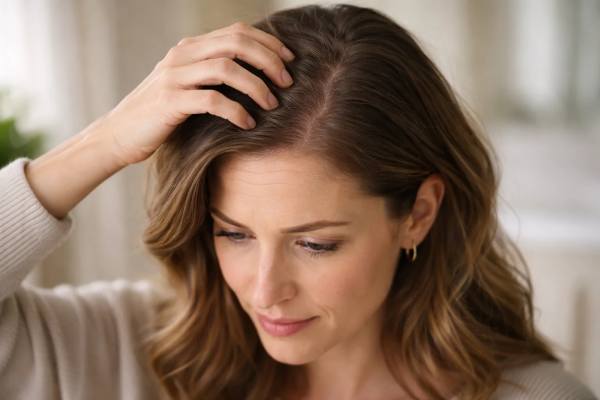
An itchy scalp can be trivial, persistent, or surprisingly disruptive. For some people it is a short-lived reaction to dry weather, skipped wash days, or a new styling product. For others, it is a clue to a scalp condition that needs targeted treatment rather than guesswork. That is why scalp itch is worth reading carefully. The same symptom can show up with dandruff, seborrheic dermatitis, psoriasis, contact allergy, fungal infection, lice, folliculitis, or a more sensitive scalp that stings and burns without obvious flakes.
The challenge is that itch often overlaps with signs people misread. Dryness can be confused with dandruff. Product buildup can look like scale. Infection may be dismissed as irritation. And scratching itself can worsen redness, flakes, and tenderness, making the original trigger harder to spot.
A clearer approach is to match the itch with the pattern around it: where it sits, what the scalp looks like, whether hair loss is present, and what has changed recently in your routine.
Quick Summary
- Most itchy scalps are caused by dandruff-related inflammation, psoriasis, product reactions, infection, or infestation rather than “sensitive skin” alone.
- The pattern matters: greasy yellow scale, thick silvery plaques, patchy hair loss, pustules, or visible nits point in different directions.
- Mild itch often improves with the right shampoo and fewer irritants, but persistent or worsening symptoms need a closer look.
- Pain, pus, patchy hair loss, swollen lymph nodes, or spreading rash are reasons to stop self-treating and seek medical care.
- A practical starting step is to review any new hair products and use a targeted wash routine for two to four weeks before judging the result.
Table of Contents
- Why scalps get itchy
- The most common causes
- Clues that point to a specific cause
- What you can try at home
- When itch signals something more serious
- How doctors diagnose and treat persistent itch
Why scalps get itchy
Scalp itch happens when the skin barrier, the local nerve endings, or the immune system becomes irritated enough to trigger the urge to scratch. That can happen for simple reasons, such as cold dry air or leftover styling residue, but it can also happen when inflammation, infection, or a scalp disorder is active. In other words, itch is not a diagnosis. It is a signal.
The scalp is uniquely easy to disturb. It has a dense network of follicles, oil glands, sweat, microbes, and sensory nerves. It also sits under hair, which changes how heat, moisture, friction, and product buildup behave. A scalp can therefore itch from excess oil just as easily as from dryness. It can itch because the skin barrier is stripped, because yeast overgrowth is contributing to seborrheic dermatitis, because plaques of psoriasis are inflamed, or because a new dye or fragrance ingredient has triggered an allergic reaction.
This is why self-diagnosis goes wrong so often. People tend to think in simple pairs:
- dry scalp or dandruff
- dirty scalp or clean scalp
- allergy or infection
Real life is messier. A person can have seborrheic dermatitis and irritation from harsh shampoo at the same time. Someone with psoriasis can scratch enough to create secondary irritation. A child with fungal infection can first be mistaken for having ordinary flakes. The symptom is the same, but the treatment path is not.
The itch cycle itself also matters. Scratching briefly relieves the sensation, but it can damage the barrier, increase redness, lift scale, and expose the skin to more irritation. That becomes a loop: itch leads to scratching, scratching worsens inflammation, and inflammation causes more itch. On the scalp, that loop is easy to miss because hair hides the skin until the problem becomes obvious.
A useful way to read scalp itch is to look for the company it keeps. Ask:
- Is there visible flaking or thick scale?
- Is the scalp oily, dry, red, or tender?
- Did the itch start after a new product, braid style, or dye?
- Are there bumps, pustules, or crusts?
- Is there patchy hair loss, broken hairs, or swollen neck nodes?
Those details move the situation from vague discomfort to a meaningful pattern.
This is also why the common “dry scalp versus dandruff” question is only a starting point. The more useful comparison is how the itch behaves alongside oil, scale, redness, and shedding. For a clearer distinction between those two look-alike problems, it helps to review dry scalp versus dandruff differences before reaching for a random treatment.
The most common causes
Most itchy scalps fall into a handful of categories. Some are common and mild. Others are common but persistent enough that the wrong treatment can drag the problem on for months.
Seborrheic dermatitis and dandruff sit at the top of the list. This often causes itching with flaking, sometimes with greasy yellowish scale and mild redness. It tends to affect oil-rich areas, so people may also notice flakes around the eyebrows, sides of the nose, beard, or behind the ears. It often waxes and wanes rather than disappearing completely.
Psoriasis is another major cause. The scale is usually thicker, drier, and more sharply defined than dandruff. The itch can range from mild to intense. Some people also have plaques on the elbows, knees, or around the hairline. Scratching can make the scalp feel raw and can briefly increase visible shedding.
Contact irritation or allergy is frequently overlooked. Hair dye, fragrance, preservatives, essential oils, dry shampoo, leave-ins, and scalp serums can all trigger itching. Sometimes the scalp is obviously red. Sometimes it simply feels tight, prickly, or sore. Allergic reactions often spread beyond the scalp to the forehead, ears, eyelids, or neck.
Fungal infection, especially tinea capitis, matters more than many adults realize. In children it is a classic cause of itchy, scaly patches with broken hairs or patchy hair loss, but adults can get it too. The scalp may show fine scale, black-dot hairs, inflamed boggy areas, or tender swollen lymph nodes.
Head lice are still common, especially in school-age children and households where close contact allows easy spread. The itch is often strongest at the nape and behind the ears. Nits attached firmly to the hair shaft can be the key clue.
Folliculitis causes itch with bumps, pustules, tenderness, or crusting. This may follow sweat, occlusive styling products, scratching, shaving, braiding, or microbial overgrowth. Some cases are superficial and short-lived; others are recurrent and need treatment.
Sensitive scalp or scalp dysesthesia is a different pattern. The scalp may itch, burn, sting, or feel sore with little visible rash. This can overlap with stress, migraines, cervical tension, barrier damage, or hair loss conditions. It is real, but it is often diagnosed only after more visible causes are excluded.
The difficult part is that these conditions can overlap. A scalp with seborrheic dermatitis can also react to fragrance. A psoriasis patient can also develop folliculitis. That is why the “one shampoo fixes all itch” idea usually fails.
When a new product seems to be involved, it is useful to think in terms of allergy versus irritation from hair products rather than assuming every reaction is the same.
Clues that point to a specific cause
The fastest way to narrow scalp itch is to stop asking only “How itchy is it?” and start asking “What does it look and feel like?” The pattern often gives better clues than the itch intensity.
Start with the scale.
- Fine, loose flakes without much redness can fit dandruff or mild dry scalp.
- Greasy yellow scale with itch and mild inflammation leans more toward seborrheic dermatitis.
- Thicker, drier, sharply outlined scale raises suspicion for psoriasis.
- Patchy scale with surrounding redness or spread to the hairline, ears, or neck makes contact dermatitis more likely.
Then look at the hair itself.
- Patchy hair loss with broken hairs suggests fungal infection more than ordinary dandruff.
- Diffuse shedding without obvious breakage can happen when inflammation is persistent, but it should make you look for a deeper scalp problem or a separate hair-loss issue.
- Hairline thinning with soreness from tight styles points away from dandruff and toward traction or mechanical irritation.
The location matters too.
- Behind the ears and at the nape: head lice often itch here.
- Along the hairline and beyond the scalp margins: psoriasis and allergic reactions commonly show themselves here.
- One localized tender area with bumps or pustules: think folliculitis or an infected inflamed patch rather than a whole-scalp condition.
Texture and sensation also help. A scalp that itches and burns after dye, bleaching, or a new active ingredient is different from a scalp that flakes steadily every winter. A scalp that feels painful to touch is different from one that simply sheds fine flakes on dark clothing. Burning, stinging, and tenderness often mean inflammation is more than superficial.
A few combinations deserve special attention:
- itch plus swollen neck nodes or tenderness: think infection
- itch plus pustules or crusting: think folliculitis or secondary infection
- itch plus thick plaques on elbows or knees: think psoriasis
- itch plus eyelid or ear rash after hair products: think allergic contact dermatitis
- itch with no visible rash but strong sensitivity: think sensitive scalp or neuropathic-type symptoms after common causes are ruled out
Children and adults are not identical here. Lice and tinea capitis are especially important in children. In adults, seborrheic dermatitis, psoriasis, folliculitis, and product reactions are often higher on the list. But adults can still develop lice or fungal infection, especially through household spread or delayed diagnosis.
If the scalp shows thick plaques, stubborn scale, or involvement beyond ordinary flaking, it is worth comparing the pattern with typical signs of scalp psoriasis rather than treating it as simple dandruff for months.
What you can try at home
Mild scalp itch often improves with a simpler routine and a more targeted wash strategy. The key is to choose a short trial that fits the most likely cause rather than rotating five products in panic.
If flakes, oiliness, and mild itch are the main issue, start with an anti-dandruff approach for two to four weeks. Wash on a consistent schedule, not only when the scalp becomes unbearable. For many people, that means two to four times weekly, though oily scalps may need more frequent washing. The shampoo has to touch the scalp, not just the hair. Let it sit for several minutes before rinsing so the active ingredient has a chance to work.
If a new product seems responsible, simplify aggressively. Stop the suspected trigger and pause extras such as scalp oils, leave-in fragrance sprays, hair perfume, dry shampoo, heavy serums, and “growth” cocktails. Product reactions often settle faster when the routine becomes boring on purpose.
A sensible home plan can look like this:
- Remove new or suspicious products.
- Choose one targeted shampoo based on the pattern.
- Wash the scalp thoroughly and regularly.
- Avoid scratching with nails or using abrasive scalp tools.
- Watch for improvement over two to four weeks.
A few practical rules matter more than most people realize:
- avoid applying thick oils to an already itchy, flaky scalp unless you know dryness is truly the driver
- do not leave irritating “tingling” products on an inflamed scalp just because they feel active
- avoid very hot water, harsh scrubbing, and frequent picking at scale
- wash brushes, combs, pillowcases, hats, and hair accessories if infestation or heavy buildup is possible
Home care should change when the clues change. For example, a child with suspected lice needs a household check and a lice-specific plan, not just a dandruff shampoo. A scalp with suspected fungal infection will not be cured with cosmetic products. A reaction to dye or fragrance will usually persist until the offending ingredient is removed.
It also helps to remember that relief and cure are not the same. Mentholated or heavily fragranced products may feel soothing for a few minutes while keeping the problem alive underneath.
If you suspect dandruff or seborrheic dermatitis but are unsure which active ingredients make sense, a guide to anti-dandruff shampoo ingredients can make the trial more deliberate and less random.
When itch signals something more serious
Most itchy scalps are not dangerous, but some deserve quicker attention because they can scar, spread, become infected, or lead to avoidable hair loss if they are treated too casually. The transition from “annoying” to “needs an exam” usually comes from the company the itch keeps.
You should worry more when itch is paired with pain, pus, bleeding from minimal touch, or patchy hair loss. Those signs suggest that inflammation is deeper than a routine flaky scalp. An itchy scalp that also has swollen lymph nodes, fever, or a boggy tender patch raises more concern for infection, especially fungal infection such as kerion or a significant bacterial folliculitis.
Red flags include:
- rapidly worsening redness or swelling
- pustules, honey-colored crusts, or oozing
- thick adherent scale with hair loss underneath
- broken hairs, black-dot patches, or patchy bald spots
- severe burning or tenderness rather than simple itch
- rash spreading to the face, eyelids, neck, or ears after product exposure
- symptoms that persist despite two to four weeks of sensible home care
- recurrent scalp itch that keeps returning after short-term improvement
Children deserve special caution because scalp ringworm can be missed as “dandruff” until hair loss appears. Adults deserve caution when the itch is paired with scalp pain, recession, eyebrow loss, or signs of scarring disease. In those situations, delay can matter.
The word “worry” does not mean assume the worst. It means do not keep guessing when the scalp is showing you that this is more than a simple dryness problem. Persistent scratching can also create secondary damage: excoriations, infection, thicker scale, and more visible shedding. Once that happens, the original cause becomes harder to read.
A few situations call for faster action:
- suspected lice in a household: act promptly to stop spread
- suspected fungal infection: get evaluated rather than masking it with steroids alone
- possible allergic reaction after dye: stop the product and seek help if swelling or facial rash develops
- itch with hair loss or pain: arrange a dermatology review sooner
When suspected fungal infection is on the table, a dedicated overview of scalp ringworm and how it is treated can help explain why shampoos alone are usually not enough.
How doctors diagnose and treat persistent itch
A good medical evaluation for scalp itch is usually simple, but it is more targeted than many people expect. The diagnosis often comes from the history and exam rather than from a long panel of tests. The most useful details are timing, triggers, the look of the scale, whether hair loss is present, and what treatments have already been tried.
A clinician will often ask:
- When did the itch start?
- Is it constant or does it flare after washing, sweating, dyeing, or styling?
- Are there flakes, bumps, pain, or burning?
- Is anyone else at home itching?
- Have you changed products, medication, or hairstyle tension?
- Is there hair shedding, patchy hair loss, or scalp tenderness?
The exam may include parting the hair in several areas, checking the hairline, looking behind the ears and on the neck, and inspecting for nits, pustules, plaques, broken hairs, or patchy scale. In some cases the next step is a specific test, not a guess:
- fungal scraping or culture if tinea capitis is suspected
- patch testing when allergic contact dermatitis seems likely
- dermoscopy or trichoscopy to distinguish scale patterns and hair changes
- bacterial culture if pustules or crusting are prominent
- biopsy in stubborn, unusual, or potentially scarring conditions
Treatment depends entirely on the cause. That sounds obvious, but it is where the biggest improvements happen. Seborrheic dermatitis is usually managed with medicated shampoos and, when needed, short courses of anti-inflammatory treatment. Psoriasis often needs anti-inflammatory scalp-specific therapy. Contact dermatitis improves by identifying and avoiding the trigger. Lice need pediculicidal treatment plus nit management and close-contact checks. Fungal infection usually requires oral antifungal therapy. Folliculitis may call for antimicrobial or anti-inflammatory treatment depending on the pattern.
When the scalp looks nearly normal but the symptoms are intense, the diagnosis may move toward sensitive scalp or scalp dysesthesia. That does not mean the symptoms are imagined. It means the underlying driver may be barrier damage, nerve sensitivity, muscle tension, or an overlapping hair-loss condition rather than obvious scale or infection.
The important thing is not to let persistent itch become background noise. An itchy scalp that lasts for weeks, keeps recurring, or begins affecting sleep, mood, or hair density deserves a more exact answer. If itch comes with shedding or scalp tenderness, the threshold for specialist care should be lower, and guidance on when to see a dermatologist for scalp and hair symptoms can help with that decision.
References
- Sensitive Scalp and Trichodynia: Epidemiology, Etiopathogenesis, Diagnosis, and Management 2023 (Review)
- A comprehensive literature review and an international expert consensus on the management of scalp seborrheic dermatitis in adults 2024 (Expert Consensus Review)
- Allergic contact dermatitis of the scalp: a review of an underdiagnosed entity 2024 (Review)
- Scalp Infection, Inflammation, and Infestation 2023 (Review)
- Tinea Capitis – StatPearls – NCBI Bookshelf 2023 (Clinical Review)
Disclaimer
This article is for educational purposes only and is not a substitute for medical advice, diagnosis, or treatment. Scalp itch can result from common conditions such as dandruff or product irritation, but it can also signal infection, inflammatory skin disease, infestation, or a condition that may affect hair growth if treatment is delayed. Seek medical care promptly for severe pain, swelling, pus, patchy hair loss, fever, facial spread after hair products, or symptoms that do not improve with sensible home care.
If this article helped, please share it on Facebook, X, or another preferred platform so more readers can recognize when an itchy scalp is simple and when it deserves closer attention.