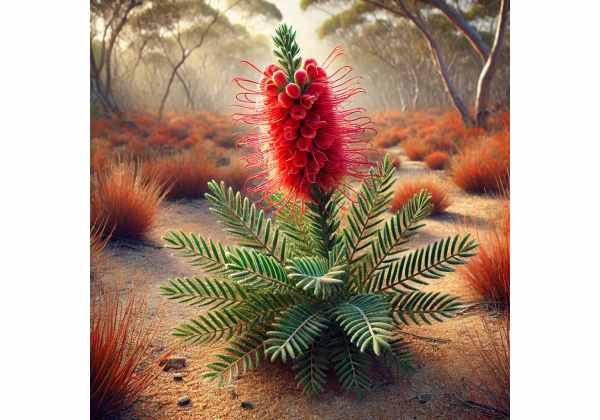
Kahili flower, better known botanically as Grevillea banksii, is a striking flowering shrub or small tree from the Proteaceae family. It is admired for its long, brush-like blooms, heavy nectar production, and strong appeal to birds and pollinators. In wellness searches, it is sometimes described as a medicinal flower, but that label needs care. The published record around Grevillea banksii is much stronger for plant chemistry and skin-safety concerns than for proven human health effects.
What makes this species interesting is its mix of bioactive compounds. Researchers have identified phenolic lipids such as alkylresorcinols, along with arbutin-related compounds and other secondary metabolites that may help explain antioxidant, antimicrobial, or anti-inflammatory activity seen in early laboratory work. At the same time, the plant is also linked to allergic contact dermatitis, and parts of the plant have been associated with cyanogenic compounds.
So the useful question is not whether kahili flower is chemically active. It is. The better question is whether it is a good self-care herb. For most readers, the honest answer is: not yet. It is better understood as a bioactive ornamental plant with research interest, limited traditional medicinal clarity, no established oral dose, and a safety profile that deserves respect.
Essential Insights
- Kahili flower contains phenolic compounds that show antioxidant potential in laboratory research.
- Some Grevillea-related compounds also show early antimicrobial and anti-inflammatory promise, but human proof is lacking.
- No evidence-based oral dose is established; for self-medication, 0 mg per day is the safest default.
- Avoid oral use during pregnancy, breastfeeding, childhood, and in anyone with plant-contact allergy or prior dermatitis.
Table of Contents
- What is kahili flower
- Key compounds and medicinal properties
- Does kahili flower have benefits
- How is kahili flower used
- How much should you use
- Side effects, interactions, and who should avoid it
- What the evidence actually says
What is kahili flower
Kahili flower is the common Hawaiian name often used for Grevillea banksii, a species native to eastern Queensland in Australia and now grown widely in warm regions for its dramatic flowers. Depending on the form, it may grow as a dense shrub or a slender small tree. The plant is easy to recognize by its divided leaves and vivid flower spikes, which range from creamy tones to bright red or crimson. Because the flowers produce abundant nectar, the plant is especially attractive to honeyeaters, butterflies, and other nectar-feeding wildlife.
From a gardening perspective, Grevillea banksii is valued for beauty, resilience, and ecological interest. From a health perspective, the picture is less straightforward. It is not a classic household herb like chamomile, mint, or ginger. Instead, it sits in a more unusual category: a plant with interesting chemistry, scattered traditional and ethnobotanical mentions, and a stronger record in phytochemical and dermatology literature than in clinical herbal medicine.
That distinction matters. Many readers assume that if a plant has vivid flowers and a long history in cultivation, it must also have a safe and established place in herbal practice. With kahili flower, that assumption can mislead. Some Grevillea species have been appreciated for nectar, and the broader family has drawn scientific interest because of unusual plant compounds. But G. banksii itself has not been developed into a standardized, evidence-backed medicinal herb.
A practical way to think about it is this:
- As a plant, it is real, useful, and biologically active.
- As a source of interesting natural compounds, it deserves research attention.
- As a self-prescribed remedy, it remains uncertain and potentially risky.
That is why serious discussion of kahili flower has to begin with identification and context. It is an ornamental species first. Any medicinal claim comes second and must be weighed against the plant’s ability to irritate skin and its lack of human dosing standards.
Readers looking for a simple verdict may find that unsatisfying, but it is the most useful starting point. Kahili flower is not a wellness fad that should be dismissed outright, nor is it a proven therapeutic herb that belongs in casual home tinctures and teas. It is a chemically interesting species whose value is currently better supported in the garden and the laboratory than in the medicine cabinet.
Key compounds and medicinal properties
The medicinal interest in kahili flower comes mainly from its secondary metabolites, which are natural compounds plants make for defense, signaling, and survival. In Grevillea banksii, the most discussed groups include alkylresorcinols and bisresorcinols, arbutin derivatives, flavonol glycosides, and cyanogenic defense compounds reported in Grevillea and the wider Proteaceae family.
Each group suggests a different kind of biological activity.
1. Alkylresorcinols and bisresorcinols
These phenolic lipids are among the most important compounds linked to Grevillea chemistry. In simple terms, they are oily phenolic molecules that can interact with cell membranes and biological signaling pathways. In laboratory settings, related compounds from Proteaceae plants have shown antimicrobial, cytotoxic, and anti-inflammatory potential. That helps explain why researchers view the genus as pharmacologically interesting.
The same class of compounds, however, also helps explain the plant’s downside. Long-chain alkylresorcinols are strongly associated with contact sensitization in Grevillea dermatitis. So one of kahili flower’s “active” features is also one of its clearest hazards.
2. Arbutin and arbutin-related derivatives
Arbutin is better known in skin-care and pigment research than in folk herbalism. It is often discussed for antioxidant activity and its effect on melanin-related pathways. Researchers have identified arbutin-type derivatives in G. banksii, which adds to the plant’s chemical interest. Still, finding an arbutin-related compound in a plant is not the same as proving a safe cosmetic or medicinal use from that plant itself.
3. Flavonol glycosides and other phenolics
These compounds may contribute to antioxidant behavior, especially in test-tube assays. Phenolics are often the reason plant extracts can neutralize free radicals or show mild antimicrobial effects in screening studies. They may also help explain why some extracts from related Proteaceae plants attract interest as functional or bioactive ingredients.
4. Cyanogenic glycosides and cyanogenic potential
This is the part that demands caution. Cyanogenic compounds can release hydrogen cyanide when plant tissues are damaged or metabolized. In the broader Grevillea and Proteaceae literature, cyanogenic defense chemistry is well documented. Historically, G. banksii has also been associated with cyanogenic glycosides in flowers, fruits, and seeds. That does not automatically mean a dangerous exposure from casual contact, but it does mean that homemade oral preparations are a poor idea.
Taken together, these compounds suggest four realistic medicinal properties in theory:
- Antioxidant potential
- Mild antimicrobial potential
- Early anti-inflammatory potential
- Strong plant-defense chemistry with clear safety implications
That last point is easy to miss. With kahili flower, the same chemistry that makes the plant interesting also makes it unsuitable for casual self-dosing. Its profile is not like a gentle culinary herb. It is much closer to a research plant whose active compounds deserve careful handling and restrained claims.
Does kahili flower have benefits
Kahili flower may have benefits, but they are best described as plausible and experimental, not established and clinical. That wording matters because a large gap separates “a plant contains active compounds” from “this plant reliably improves a human health outcome.”
The most reasonable benefits to discuss fall into three levels.
Most plausible: antioxidant activity
Because Grevillea banksii contains phenolic compounds, arbutin-related molecules, and related secondary metabolites, antioxidant activity is one of the easiest benefits to defend. In plant research, this usually means the extract can reduce oxidative reactions in a laboratory assay. That can be meaningful as a first signal. It suggests the plant is chemically active and worth further investigation.
Still, antioxidant activity in vitro does not automatically translate into better skin, less inflammation, or protection from disease in people. Many plants look impressive in antioxidant screens and then prove modest or inconsistent in the real world.
Possible but not proven: antimicrobial and anti-inflammatory effects
Compounds from Grevillea and the wider Proteaceae family have drawn attention for antibacterial and anti-inflammatory actions in early research. That is why kahili flower sometimes appears in lists of plants with medicinal promise. The phrase to focus on is “medicinal promise,” not “proven medicinal value.”
At this stage, the realistic takeaway is that kahili flower may contain compounds worth studying for infection-related or inflammation-related applications. That does not mean the raw plant should be used on wounds, brewed as a tea, or turned into a home extract. For those goals, a better-studied botanical such as Australian tea tree makes far more practical sense.
Weakest claim: direct human therapeutic benefit
This is where the evidence drops off. There are no well-established human trials showing that Grevillea banksii safely improves digestion, immunity, pain, skin disease, sleep, or any other common herbal target. There is also no accepted medicinal preparation, no agreed standardization method, and no trustworthy consumer dosing guide.
So what are the “benefits” in plain language?
- The plant has real bioactive chemistry.
- Some of its compounds have pharmacological interest.
- It may contribute useful leads for future topical or laboratory applications.
- It is not yet a dependable self-care herb.
That balanced view protects readers from two common mistakes. The first is dismissing the plant just because it is ornamental. The second is assuming that every bioactive flower should be used medicinally. Kahili flower deserves neither extreme. It has more going on than a decorative shrub, but much less practical evidence than the average reader may expect from wellness articles.
In short, kahili flower’s best-supported “benefit” today is scientific relevance. Its human health potential is still under construction, and its safety issues are already clearer than its clinical wins. That is why the most honest guidance is cautious optimism rather than enthusiastic recommendation.
How is kahili flower used
In everyday life, kahili flower is used mainly as an ornamental and ecological plant, not as a standardized medicine. That may sound disappointing in a medicinal article, but it is exactly the kind of distinction readers need.
The most common real-world uses are these:
1. Ornamental landscaping
This is the plant’s main role. It is planted for vivid blooms, bird attraction, screening, and year-round visual interest in warm climates. Gardeners prize it for resilience and nectar production more than for any internal health use.
2. Pollinator support
Kahili flower is valuable in gardens because it feeds nectar-seeking birds and insects. That is not a medicinal use in the narrow sense, but it does matter. Plants that support biodiversity can improve the quality of outdoor spaces and encourage more restorative, nature-rich environments.
3. Botanical and phytochemical research
This is where the plant becomes medically interesting. Scientists study Grevillea compounds for their structural novelty, possible antimicrobial action, pigment-related pathways, and broader natural-products potential. In other words, the plant is more promising as a source of research leads than as a home remedy.
4. Cautious ethnobotanical interest
Some Grevillea species have a history of nectar use in traditional contexts. But that broad fact should not be oversimplified into “all Grevillea flowers are good medicinal food plants.” Species matter. Plant part matters. Preparation matters. With G. banksii, the safety profile is uncertain enough that casual culinary experimentation is not wise.
For practical readers, the better question is often how not to use kahili flower. Avoid these common mistakes:
- Do not make homemade teas from flowers, leaves, or seed pods.
- Do not prepare tinctures or alcohol extracts for internal use.
- Do not rub fresh sap or crushed material onto irritated skin.
- Do not assume that nectar-rich flowers are safe to ingest in meaningful amounts.
If you grow the plant, the safest home-use approach is simple:
- Treat it as a garden specimen first.
- Wear gloves when pruning or handling broken stems.
- Wash exposed skin after contact.
- Keep children and pets from chewing plant parts.
- Avoid any internal “wellness” use unless future clinical evidence changes the picture.
That may seem conservative, but it matches the current evidence better than more adventurous herbal advice. Kahili flower is a plant to appreciate, observe, and study, not one to improvise with. Readers who want a bioactive botanical for digestion, inflammation, or skin support are better served by herbs with established human use and clearer safety boundaries.
How much should you use
There is no established medicinal dose for kahili flower. That is the most important dosing fact, and it should come before any attempt to sound practical.
When a plant lacks human clinical trials, standardized preparations, and basic safety guidance, the usual question “How much should I take?” does not have a responsible supplement-style answer. With Grevillea banksii, the safest evidence-based oral dose for unsupervised self-medication is none.
That sounds strict, but it follows from three problems:
- No validated oral preparations exist.
- No reliable human dosing studies exist.
- Safety signals already exist for irritation and potentially harmful plant chemistry.
So instead of a classic dosage chart, the best approach is an exposure-control guide.
Internal use
- Recommended self-care dose: 0 mg per day
- Best advice: avoid teas, capsules, tinctures, syrups, powders, and homemade extracts.
Topical experimentation
- Not recommended with raw plant material.
- If a commercial product ever contains Grevillea-derived ingredients, patch-test first on a 1 to 2 cm skin area and wait 24 hours before wider use.
Handling fresh plant material
- Use gloves for pruning, sap exposure, or prolonged contact.
- Wash hands, forearms, and tools promptly after use.
Duration
- Any exposure that leads to itching, burning, redness, or blistering should stop immediately.
- Repeated contact after a reaction is a bad idea because plant sensitization can worsen over time.
Some readers may feel that “0 mg per day” is not a satisfying dosage section. But honesty is more useful than false precision. Too many herbal articles invent soft ranges for plants that have never been clinically standardized. That creates the illusion of safety without the evidence to support it.
A good rule is this: when the safety literature is stronger than the therapeutic literature, the dose question flips. Instead of asking “How much should I take?” ask “How little exposure can I get away with while still using the plant responsibly?” For kahili flower, that means minimal contact, no internal self-treatment, and close attention to skin reactions.
If future research produces a purified compound, a topical formulation, or a clinically tested extract, then dosing guidance may become more specific. Right now, the disciplined answer is also the most helpful one: appreciate the plant, do not self-prescribe it, and keep exposure low.
Side effects, interactions, and who should avoid it
Safety is where kahili flower becomes most concrete. The plant’s claimed benefits are still emerging, but its risk profile is already clear enough to guide behavior.
The best-known problem is allergic contact dermatitis.
Grevillea species are well known in dermatology because they can cause itchy, inflamed rashes after contact with leaves, bark, flowers, or plant fragments. The reaction may look a lot like poison ivy or poison oak, with red, linear, blistering, or intensely itchy patches. In sensitized people, the rash can be dramatic and may spread beyond the original contact site.
This happens because some Grevillea compounds, especially long-chain alkylresorcinols, resemble the sensitizing chemistry seen in urushiol-producing plants. That is one reason Grevillea dermatitis is often described as a poison-ivy mimic. The risk is highest with pruning, sawing, trimming, or rubbing damaged plant parts on bare skin.
The second concern is ingestion risk.
Published reports associate Grevillea banksii with cyanogenic compounds in certain plant parts. Cyanogenic substances can release hydrogen cyanide under the right conditions. That does not mean a brief touch is dangerous, but it is a strong reason not to make oral preparations from flowers, fruits, seeds, or leaves.
Drug interactions
There is no strong clinical interaction database for kahili flower because it is not a well-studied medicinal product. That lack of data should not be read as reassurance. It simply means compatibility with medicines is unknown. Anyone taking prescription drugs should avoid internal experimentation rather than assume it is safe.
Who should avoid it entirely for medicinal use
- Pregnant or breastfeeding people
- Children
- Anyone with a history of plant dermatitis or very reactive skin
- Anyone previously sensitized to poison ivy, poison oak, or similar plant allergens
- People with asthma or multiple allergies who react strongly to botanical exposures
- People taking regular prescription medicines, because interaction data are missing
- Anyone tempted to use homemade oral extracts
When to seek medical care
- Widespread rash
- Facial swelling
- Blistering dermatitis
- Trouble breathing
- Eye exposure
- Suspected ingestion by a child or pet
If skin soothing is your goal, choose plants with a gentler and clearer evidence profile, such as aloe vera, rather than experimenting with raw Grevillea material.
The big picture is simple. Kahili flower is not “unsafe” in the sense that it cannot be grown or enjoyed. It is unsafe in the sense that it should not be treated casually as a medicinal herb. Most people can admire it in the garden without a problem. Trouble starts when contact is heavy, plant material is broken, or someone assumes that a bioactive plant is automatically a home remedy.
What the evidence actually says
The evidence on kahili flower is uneven, and knowing where it is strong or weak helps readers make sensible decisions.
What is well supported
- The plant is a real and recognized species with a documented phytochemical profile.
- Grevillea banksii contains distinctive compounds, including arbutin-related derivatives and resorcinol-type molecules.
- Grevillea species can cause significant allergic contact dermatitis.
- Cyanogenic defense chemistry is an important part of the wider family’s biology.
What is moderately supported
- Compounds in Grevillea and related Proteaceae plants show promising antioxidant, antimicrobial, and anti-inflammatory behavior in preclinical work.
- The plant family is chemically rich enough to justify ongoing natural-products research.
- Kahili flower may eventually prove useful as a source of isolated or formulated compounds rather than as a raw herb.
What is poorly supported or unsupported
- No good human trials show that Grevillea banksii improves a defined health condition.
- No accepted medicinal product has been standardized from the plant for general use.
- No validated oral dose exists.
- No meaningful long-term consumer safety profile exists for internal use.
That leads to an important conclusion: the current evidence supports caution more strongly than self-treatment.
Many herbal articles blur the line between “promising chemistry” and “proven effect.” Kahili flower is a good example of why that is risky. It is entirely fair to say the plant has medicinally interesting compounds. It is not fair to present it as a reliable herb for inflammation, infection, skin repair, digestion, or detox.
Compared with better-studied botanicals such as ginger, kahili flower is still at a very early stage. Ginger has human trials, recognized preparations, and practical dosage ranges. Kahili flower mostly has chemistry papers, mechanism clues, and dermatology warnings. That does not make it useless. It simply tells you where it belongs on the evidence ladder.
A balanced verdict is this:
- Kahili flower is a phytochemically interesting ornamental species.
- It may hold value for future research, especially around unique phenolic compounds.
- It is not yet a trustworthy do-it-yourself medicinal plant.
- Readers should treat safety as the main takeaway, not supplementation.
That may be less exciting than strong wellness claims, but it is more useful. The best article on kahili flower is the one that leaves readers with realistic expectations: respect the plant, stay curious about the science, and do not mistake early promise for established herbal practice.
References
- Current knowledge on chemistry of Proteaceae family, and biological activities of their bis-5-alkylresorcinol derivatives 2022 (Review). ([Springer][1])
- Diverse organ-specific localisation of a chemical defence, cyanogenic glycosides, in flowers of eleven species of Proteaceae 2023 (Open-access mechanistic study). ([PubMed][2])
- Allergic contact dermatitis from Grevillea masquerading as toxicodendron dermatitis 2022 (Case Report). ([PMC][3])
- Bisresorcinols and Arbutin Derivatives from Grevillea banksii R. Br. 2008 (Phytochemistry). ([SAGE Journals][4])
- Contact dermatitis from Grevillea ‘Robyn Gordon’ 1986 (Seminal clinical report). ([PubMed][5])
Disclaimer
This article is for educational purposes only and does not replace medical advice, diagnosis, or treatment. Grevillea banksii is not a well-established medicinal herb, and the current literature supports caution, especially around skin exposure and internal use. Do not ingest homemade preparations from this plant, and seek medical care promptly for severe rash, breathing problems, eye exposure, or suspected ingestion by a child or pet.
If this guide helped you, share it on Facebook, X, or any platform your readers use to spread accurate and safety-first herbal information.