Comprehensive
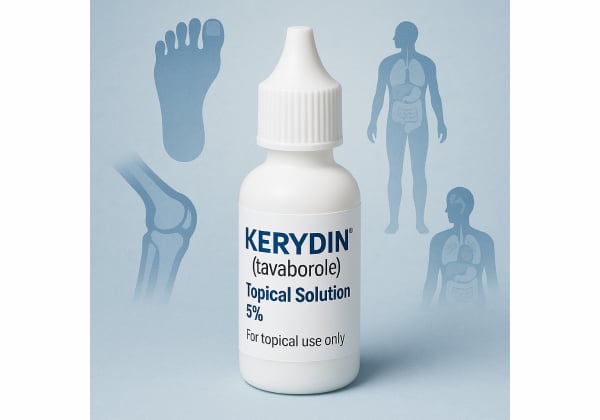
Kerydin is the brand name for tavaborole 5% topical solution, a prescription antifungal medicine used to treat mild to moderate toenail fungus (onychomycosis) caused by dermatophytes. It is a small-molecule, boron-based drug designed to penetrate hard nail plates and shut down fungal protein synthesis, helping the new nail grow in clearer over time. If you have one or a few nails with white or yellow discoloration, thickening, or crumbling—without extensive lunula (half-moon) involvement—Kerydin can be a practical, at-home option. Unlike oral therapies, it has very low systemic absorption, which reduces the risk of whole-body side effects; most reactions stay local to the treated nail and surrounding skin. That said, toenails grow slowly, and results take patience: daily applications are typically needed for 48 weeks. In this guide, you’ll learn exactly how Kerydin works, who benefits most, step-by-step application, common mistakes to avoid, how long to use it, side effects and precautions, and how it compares with other treatments so you can make an informed, confident plan with your clinician.
Fast Facts
- Once-daily 5% tavaborole can clear mild to moderate toenail fungus over 48 weeks.
- Boron-based molecule penetrates nails and blocks fungal protein synthesis.
- Local irritation is the main safety concern; avoid eyes and mouth and let nails dry.
- Typical course is one application daily to affected toenails for 48 weeks.
- Avoid if you have a known allergy to tavaborole or formula ingredients; consult during pregnancy, breastfeeding, or if you suspect a non-fungal nail disease.
Table of Contents
- What Kerydin is and how it works
- Does it work? Results you can expect
- How to apply Kerydin, step by step
- Dosage, duration, and realistic timelines
- Side effects, warnings, and who should avoid
- Drug interactions and special situations
- Evidence in context and alternatives
What Kerydin is and how it works
Kerydin (tavaborole 5% topical solution) is a prescription medicine for onychomycosis of the toenails. Onychomycosis is most often caused by dermatophyte fungi (e.g., Trichophyton rubrum and T. mentagrophytes) that invade the nail bed and plate. Kerydin’s active ingredient, tavaborole, is a boron-based antifungal that acts in a distinct way compared with older lacquers. It inhibits leucyl-tRNA synthetase in fungi, an enzyme essential for making proteins. Without protein synthesis, fungal growth slows and dies back as the nail grows out.
One reason topical therapy struggles against nail fungus is penetration: nails are dense, low-porosity structures. Tavaborole was engineered as a small molecule (~151 Da) with high nail permeability, allowing it to reach organisms living beneath and within the plate. The solution vehicle also helps wick the drug under the distal edge (the free tip), an area where fungus often colonizes. Over weeks to months, as the nail grows, the proportion of unaffected plate increases—what you see as clear nail growth from the base.
Kerydin is most suitable when:
- Disease extent is limited (e.g., ≤50–60% of the nail plate affected, minimal matrix involvement).
- Few toenails are infected (often one to three).
- You prefer to avoid systemic therapy or cannot take oral antifungals due to liver disease, medication interactions, or personal preference.
- You can commit to daily, long-term application and proper nail care.
It is less likely to succeed alone when the nail is severely thickened, the matrix (the half-moon at the base) is extensively involved, or the infection spans most nails—situations where oral therapy or combined strategies are typically better.
Mechanistically, Kerydin does not dissolve or “strip” the nail; it works biochemically. You may pair it with mechanical debridement by a clinician (or careful at-home filing) to reduce thickness and improve access, though this should be done safely to avoid injury. Because systemic absorption is minimal, Kerydin has a favorable systemic safety profile, with side effects mainly limited to local skin and nail reactions.
Does it work? Results you can expect
Clearance with any topical nail antifungal is gradual because toenails grow slowly—about 1–1.5 mm per month. In clinical studies, Kerydin once daily for 48 weeks led to higher complete cure and mycologic cure rates than vehicle (placebo solution). “Complete cure” is a stringent endpoint: 0% clinical involvement plus negative culture/microscopy. Many patients experience partial clearance (less discoloration, thinner plate, improved contour) even if they don’t meet the strict definition of “complete cure.”
What to expect over time:
- Weeks 1–8: The nail looks similar; irritation (if any) appears early and is usually mild to moderate—redness, scaling, burning, or stinging around the nail fold. Most people can continue treatment with simple adjustments (see the application section).
- Weeks 8–16: You may notice a thin band of clearer nail emerging from the base as it grows out. Discoloration at the tip persists because it’s older nail.
- Weeks 24–36: Cosmetic improvement becomes more noticeable; shoes may fit more comfortably as thickening lessens with trimming and debridement.
- Week 48 and beyond: Best outcomes are gauged. Some clinicians reassess at week 52 (four weeks after finishing) to confirm stability.
Real-world variables that influence success:
- Extent and type of fungus (dermatophyte infections respond best).
- Nail thickness and presence of onycholysis (separation from the bed).
- Consistency of daily use and letting the solution dry fully.
- Footwear habits and moisture (a dry environment helps prevent reinfection).
- Adjunctive care such as periodic professional debridement.
Even when “complete cure” isn’t achieved, clinical success—substantial reduction in diseased area—can improve comfort and appearance. If progress plateaus by about 16–24 weeks, discuss with your clinician whether to add or switch therapies (for example, combination therapy with an oral antifungal for moderate to severe disease, or rotating to another topical if tolerated poorly). For some, a maintenance approach (intermittent topical use after the main course) helps reduce relapse.
The key is aligning expectations: Kerydin works slowly but steadily when used correctly and in the right candidates. Evidence supports meaningful, measurable benefit over vehicle in mild to moderate cases, with a safety profile that suits long-term daily use.
How to apply Kerydin, step by step
Getting topical therapy right matters as much as the medicine itself. Here is a precise, practical routine that mirrors the official instructions and adds real-world tips:
- Prepare the nail (evening is best). Wash and dry feet thoroughly. If the nail is thick, gently file the surface with a clean emery board to remove loose scale (do not over-file). Trim nails straight across; avoid cutting into the corners to reduce risk of ingrown nails.
- Set up a clean surface. Place a tissue or paper towel to catch drips. Keep the bottle upright until you’re ready to apply. Do not shake; the solution is uniform.
- Apply to the entire nail. Using the dropper, place enough solution to completely cover the nail. You may need more than one drop for large or thick nails. Use the dropper tip to spread the solution to all edges.
- Wick under the distal edge. Slide the dropper tip under the free edge (the nail tip) to deliver solution beneath the plate where fungus often resides. Move side-to-side to cover the full width.
- Let it dry fully. Allow a few minutes until the nail surface is dry to the touch. Avoid socks or tight shoes until then; moisture can dilute or wick away the medicine.
- One nail at a time. Repeat for each affected toenail. Wash hands afterward with soap and water.
- Daily rhythm. Apply once daily, ideally around the same time each evening. Consistency beats occasional “extra” doses.
- Foot care habits that help:
- Rotate shoes to allow dry-out time.
- Wear moisture-wicking socks; change if damp.
- Use sandals in public showers; disinfect nail tools after each use.
- Consider a shoe sanitizer or antifungal powder if you sweat heavily.
Common pitfalls to avoid:
- Skipping days (even a few per week slows progress).
- Stopping early when the nail “looks better” (fungus may persist).
- Occluding the nail right after application with thick creams, gels, or tight socks.
- Using on fingernails without medical advice (toenails have the best evidence).
- Applying over polish or acrylics (they can block penetration).
If the skin becomes very irritated, pause for 24–48 hours, moisturize with a bland emollient around the nail fold (not immediately before dosing), then restart. If severe reactions or ingrown nails develop, contact your clinician.
Dosage, duration, and realistic timelines
Standard regimen: Apply Kerydin 5% solution once daily to each affected toenail for 48 weeks. There is no fixed “number of drops” per nail—use enough to fully cover the plate and deliver some solution under the distal edge. Let nails dry completely before socks or shoes.
Why 48 weeks? Toenails grow slowly and infected keratin must grow out and be replaced by healthy plate from the base. Dermatophyte fungi also can persist in the bed and within microchannels. Shorter courses rarely give the nail time to clear.
When you might tailor the plan:
- Mild, distal-lateral disease: Some clinicians reassess at 24–36 weeks; if clear nail growth is robust and cultures are negative, they may stop a bit earlier, though continuing to 48 weeks offers the greatest margin against relapse.
- Thicker nails or slower growers: Full 48 weeks is recommended; consider periodic debridement to speed cosmetic improvement.
- After completion: If you’re prone to recurrence (e.g., athlete’s foot, sweaty shoes), a maintenance pulse such as applying 1–3 times weekly for a few months can help (discuss with your clinician).
Missed dose: Apply as soon as you remember that same day; if it’s almost time for the next day’s dose, skip the missed one. Do not double up.
Storage and handling:
- Keep the bottle tightly closed and stored at room temperature, away from heat or open flame (the solution is flammable until dry).
- Avoid contact with eyes, mouth, or inside the nose. If accidental contact occurs, rinse with water.
When to consider alternatives or add-ons:
- No meaningful improvement by 16–24 weeks despite consistent use.
- Proximal/lunula involvement or >60–80% of the plate—often better served by oral therapy or combination (oral plus topical).
- Diabetes with neuropathy, significant peripheral vascular disease, or painful thickening—professional evaluation and possible debridement or combined regimens may be needed.
Realistic outcomes: Many users see cosmetic improvement and negative cultures by the end of the course. Complete cure is possible but not guaranteed; set expectations around visible progress and comfort, while understanding that severe or extensive disease may require other modalities.
Side effects, warnings, and who should avoid
Most common side effects occur at the application site and are usually mild to moderate:
- Redness, scaling, dermatitis around the nail folds
- Stinging or burning sensations
- Ingrown toenail or nail discomfort
- Peeling or erythema of adjacent skin
These typically appear early and improve with continued use or simple adjustments (spreading slightly less onto surrounding skin, pausing for a day, moisturizing between doses but not right before application).
Less common but important:
- Hypersensitivity reactions (rare). Stop and seek medical advice if you develop swelling, severe itching, blistering, or signs of allergy.
- Contact with eyes, mouth, or open wounds can cause irritation; rinse immediately and speak with a clinician if symptoms persist.
Warnings and precautions:
- Flammable until dry; keep away from heat, flame, or smoking during and right after application.
- For external use only; do not ingest or use inside the body.
- Do not apply to severely damaged skin or actively infected surrounding skin without medical guidance.
Who should consult before use or avoid:
- Allergy to tavaborole or any component of the solution—do not use.
- Pregnancy or breastfeeding: Systemic absorption is very low, but discuss risks and benefits with your clinician to decide if treatment can wait or proceed with monitoring.
- Children: The product is approved for toenail fungus in patients 6 years and older; younger ages require specialist guidance.
- People with uncertain diagnosis: Many nail changes mimic fungus (psoriasis, lichen planus, trauma, melanonychia). If your nail has brown/black streaks, sudden distortion, or bleeding, get evaluated before treating.
- Severe peripheral vascular disease, advanced diabetes with neuropathy, or significant nail curvature: care from a podiatrist or dermatologist is advisable, particularly to prevent complications like ingrown nails.
When to seek help promptly:
- Spreading redness, warmth, drainage, or fever (possible bacterial infection).
- Worsening pain or swelling around the nail.
- No improvement after several months of consistent, correct use.
Overall, Kerydin’s adverse effects are localized and manageable, making it a reasonable option when oral antifungals are unsuitable or undesired.
Drug interactions and special situations
Drug interactions: Because Kerydin is topical with minimal systemic absorption, traditional drug–drug interactions (like those seen with oral antifungals and the liver’s CYP enzymes) are not expected. You can generally use it alongside blood pressure medications, statins, antidepressants, and most common drugs without meaningful interaction risk. Still, share your full medication list with your clinician.
Concurrent skin products:
- You may use moisturizers on surrounding skin, but apply them after Kerydin has dried (or at another time of day) to avoid diluting the medicine.
- Avoid placing occlusive ointments or thick creams directly over the nail soon after dosing; occlusion can hinder drying and wicking under the edge.
- Nail polish, gels, or acrylics can block penetration; defer cosmetic coatings until after the treatment course if possible.
Medical conditions:
- Diabetes and vascular disease: Reduced circulation can slow nail growth and healing. Foot hygiene and proper shoe fit are critical; periodic debridement may improve outcomes. Inspect daily for skin breakdown.
- Athlete’s foot (tinea pedis): Treat concomitantly (with appropriate antifungal creams or sprays) to lower reinfection risk. Keep toes dry and change socks after exercise.
- Podiatric procedures: If you undergo nail debridement or avulsion, ask when to restart Kerydin. Typically, you resume when the area is intact and dry.
Lifestyle and environment:
- Rotate footwear and use antifungal powders if you sweat heavily.
- Choose breathable shoes; avoid prolonged dampness after swimming or showers.
- Use shower sandals in shared facilities.
Travel and storage:
- Keep the bottle upright, cap secure, and away from heat sources or flames. The solution is flammable until dry.
- Pack a small reminder (phone alarm) to maintain daily dosing across time zones; consistency is more important than exact clock time.
Because Kerydin’s interaction potential is low, the bigger challenge is adherence and technique. Nail fungus treatment is a marathon; building a routine that fits your life is the best way to convert a good medicine into a good outcome.
Evidence in context and alternatives
Where Kerydin fits: It occupies the topical therapy niche for mild to moderate toenail infections—particularly when oral antifungals are contraindicated or not desired. Pivotal clinical trials showed superiority over vehicle in complete and mycologic cure at week 52 (48 weeks of treatment plus follow-up), with a favorable safety profile dominated by local reactions.
How it compares to other options:
- Efinaconazole 10% solution: Another topical with robust evidence for mild to moderate disease. It’s applied once daily like Kerydin and is designed to penetrate the nail without debridement. Choice may come down to clinician preference, nail characteristics, and tolerability.
- Ciclopirox 8% lacquer: An older option requiring daily application and weekly removal. It can help in very superficial disease but often underperforms newer solutions for moderate involvement.
- Oral terbinafine (intermittent or continuous): The gold standard for moderate to severe dermatophyte onychomycosis. Cure rates are generally higher and faster, but systemic monitoring and interaction checks may be needed. Many clinicians combine an oral course with a topical to reduce relapse.
- Device-based options (lasers, photodynamic therapy): Evidence is mixed; costs vary and results can be inconsistent. If pursued, combine with a topical or oral antifungal and good nail care to reduce recurrence.
Selecting the right strategy:
- Few nails, distal disease, minimal thickness: Start with Kerydin and strict foot care.
- Multiple nails, matrix or proximal involvement, heavy thickening: Oral therapy or combination (oral + topical). Consider debridement.
- Recalcitrant or recurrent cases: Confirm the organism (culture or PAS stain), address tinea pedis, review footwear and moisture exposure, and consider maintenance topical therapy after a successful oral course.
When to reassess:
- No progress by 16–24 weeks despite adherence.
- New symptoms (pain, drainage) or changes that suggest non-fungal causes.
- Cosmetic goals unmet despite microbiologic cure—debridement or temporary cosmetic camouflage can help while the nail continues to grow out.
Bottom line: Kerydin is a credible, evidence-based topical for appropriately selected cases. It rewards consistency and technique, pairs well with preventive foot care, and can be combined strategically with other therapies to improve and maintain outcomes.
References
- KERYDIN (tavaborole) topical solution, 5% Prescribing Information 2018.
- Efficacy and safety of tavaborole topical solution, 5%, for the treatment of onychomycosis: Results from two randomized phase-III studies 2015 (RCT).
- Evaluation of the efficacy and safety of tavaborole topical solution, 5%, in the treatment of onychomycosis of the toenail in adults: a pooled analysis of an 8-week, post-study follow-up from two randomized phase 3 studies 2018.
- Spotlight on tavaborole for the treatment of onychomycosis 2015 (Review).
- Nail fungus: Diagnosis and treatment 2025 (Guideline overview).
Disclaimer
This information is educational and does not replace personalized medical advice, diagnosis, or treatment. Always speak with a qualified health professional about your symptoms, diagnosis, and the risks and benefits of any medication. If you experience signs of infection, severe pain, or allergic reaction, seek medical care promptly.
If you found this guide helpful, please consider sharing it on Facebook, X (formerly Twitter), or your preferred platform, and follow us on social media. Your support helps us continue creating reliable, people-first health content.