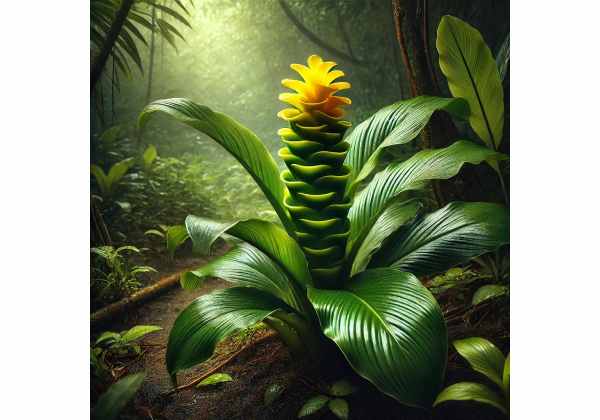
Lemon Ginger, botanically known as Monocostus uniflorus, is a small tropical plant in the spiral ginger family that draws attention for its bright yellow flowers and compact, ornamental growth. Its common name makes it sound like a familiar medicinal ginger, but that impression can be misleading. This species is not the same as culinary ginger, and it is not one of the better-documented medicinal Costaceae plants often discussed in herbal medicine. In fact, Monocostus uniflorus is best known botanically and horticulturally rather than therapeutically. The current literature supports its identity as a rare, monotypic species from Peru, but it does not yet provide strong evidence for specific, validated health benefits, standardized active compounds, or established herbal dosing.
That makes Lemon Ginger an herb best approached with restraint. It is interesting, distinctive, and worthy of botanical attention, but it is not a proven home remedy. For most readers, the most helpful approach is to understand what is known, what remains uncertain, and why caution matters more than enthusiasm.
Quick Summary
- Lemon Ginger is primarily an ornamental Costaceae plant, not a well-established medicinal herb.
- No validated species-specific health benefits have been firmly established in human studies.
- No evidence-based oral dose in mg or mL has been established for Monocostus uniflorus.
- Avoid internal use during pregnancy, while breastfeeding, in children, and in anyone using the plant as a substitute for medical care.
Table of Contents
- What is Lemon Ginger
- Key ingredients in Lemon Ginger
- What can it realistically help with
- How to use Lemon Ginger
- How much per day
- Safety and who should avoid it
- What the evidence really says
What is Lemon Ginger
Lemon Ginger, or Monocostus uniflorus, is a rhizomatous tropical herb in the Costaceae family. It is the only species in the genus Monocostus, which already makes it unusual from a botanical standpoint. Unlike many members of the broader spiral ginger group that form obvious terminal flower spikes, this species is especially notable for its solitary flowers borne from the upper leaf axils. It is native to Peru and is best described as a specialty ornamental from humid forest habitat rather than as a classic medicinal ginger.
The common name creates immediate confusion. “Lemon Ginger” sounds like a plant that should smell citrusy, work like culinary ginger, or share the familiar uses associated with ginger tea, nausea relief, and warming digestion. But Monocostus uniflorus should not be treated as a substitute for true ginger. The family relationship is different, the medicinal record is much thinner, and the plant’s main presence in the literature is botanical, phylogenetic, and horticultural.
That distinction matters because many herbal misunderstandings begin with common names. A plant with “ginger” in the name is often assumed to be digestively active, anti-nausea, or broadly medicinal. In this case, the evidence does not support such an automatic transfer of reputation. Monocostus uniflorus is better viewed as a species that sits near medicinally interesting relatives without having inherited their evidence base.
Its known profile is clearer in horticulture than in herbal medicine:
- It is a compact, tuft-forming tropical herb.
- It has spirally arranged foliage and bright yellow flowers.
- It is native to eastern or northern Peru in humid forest conditions.
- It is cultivated mainly as an ornamental plant.
This is why the plant needs a more careful introduction than many herb articles provide. The question is not whether it is a beautiful or biologically interesting species. It clearly is. The question is whether it has a well-established medicinal identity. At present, that answer is no.
In herbal terms, Lemon Ginger is much closer to a “potentially interesting but undercharacterized species” than to a standard medicinal herb. That puts it in a very different class from better-known digestive plants such as classic bitter digestive herbs or the true gingers used in traditional medicine. Readers who understand that early will make better decisions later in the article.
So what is Lemon Ginger, in practical terms? It is a rare, monotypic, ornamental Costaceae species with a distinct botanical identity, uncertain medicinal value, and no strong modern evidence base for routine self-care use. That makes it worth learning about, but not the kind of plant that should be used simply because its name sounds familiar.
Key ingredients in Lemon Ginger
This is the section where honesty matters most. For Monocostus uniflorus itself, species-specific phytochemical research is extremely limited. At present, there is no well-established list of validated active compounds for this exact species comparable to what exists for better-studied medicinal herbs. No widely cited monograph defines its key marker compounds, no standard extract has become a research norm, and no recognized pharmacopoeial profile explains its action in the way herbalists would expect for a therapeutic plant.
That does not mean the plant contains nothing biologically interesting. All plants produce secondary metabolites, and members of Costaceae are chemically active organisms. But in this specific case, there is a major difference between what is biologically likely and what is actually documented. Good herbal writing should not blur that line.
What can be said responsibly is this:
- Monocostus uniflorus is a rhizomatous member of Costaceae.
- It almost certainly contains common plant constituents such as carbohydrates, structural fibers, pigments, and low-molecular secondary metabolites.
- Published literature does not yet clearly establish a species-specific medicinal phytochemical profile.
- No validated “key ingredient” list has been accepted for clinical or traditional herbal use.
This matters because readers often assume every medicinal article should name a few impressive compounds and connect them to a list of benefits. That works only when the research actually exists. With Lemon Ginger, the more accurate conclusion is that the chemical story remains incomplete.
There is also a practical danger in filling the gap too quickly. Because the plant sits in a family that includes other ornamental and medicinal spiral gingers, it is tempting to borrow phytochemistry from better-studied relatives and present it as though it belongs to Monocostus uniflorus. That is not reliable. Family resemblance is not chemical proof, and even closely related rhizomatous plants can differ significantly in secondary metabolites.
A responsible way to think about its “key ingredients” is to divide them into three categories:
- Documented species facts
- Plausible but unverified assumptions
- Unsupported marketing claims
Only the first category is truly safe to build on. Documented facts include its taxonomic placement, rhizomatous habit, and monotypic status. Plausible but unverified assumptions include the presence of potentially useful phenolics or related plant compounds. Unsupported claims would be any confident statement that it contains specific anti-inflammatory, antidiabetic, or digestive actives without species-level evidence.
This does not make the plant uninteresting. In fact, it makes it more interesting in a scientific sense. Monocostus uniflorus is a good example of a species whose medicinal reputation has not yet caught up with the level of proof modern readers often expect. That gap is worth noticing.
For readers who want a working takeaway, it is this: there are no firmly established key medicinal ingredients for Lemon Ginger at the present time. The safest position is not to invent them. Compared with better-characterized plants such as traditional bitters with clearer phytochemical patterns, Lemon Ginger remains underdescribed as a medicinal species.
What can it realistically help with
The most realistic answer is that no clearly established therapeutic use has been validated for Monocostus uniflorus itself. That may sound disappointing, but it is actually useful. It keeps the reader from confusing an attractive tropical plant with a proven medicinal herb.
When a plant has a popular common name and belongs to a family that includes medicinal relatives, it is very easy for broad claims to appear around it. “Supports digestion,” “helps inflammation,” “used in folk medicine,” and “contains medicinal rhizomes” are the kinds of statements that often spread before species-specific evidence is available. With Lemon Ginger, those claims should be treated carefully. The present evidence does not support strong, species-specific health claims in the way it would for established herbs.
That means the most realistic “benefits” are not classic medicinal ones. They are better understood as:
- Botanical interest
- Horticultural value
- Educational value for plant enthusiasts
- Possible future research relevance
In other words, what the plant can help with right now is not necessarily human physiology. It may help someone build a shade-loving ornamental collection, study Costaceae diversity, or better understand how common names can mislead herbal consumers. Those are not the usual answers readers expect in a health article, but they are more truthful than assigning the plant benefits that have not been demonstrated.
If someone asks whether Lemon Ginger helps digestion, the honest answer is not “yes,” but “there is not enough evidence to say so.” If they ask whether it helps nausea because it has “ginger” in the name, the answer is still no—not because it has been disproven, but because the name does not count as evidence. If they ask whether it can be treated like a medicinal spiral ginger, the safest answer is again caution.
This kind of realism can be summarized in a simple framework:
- Established benefit: none clearly validated for self-care use
- Plausible but unproven benefit: unknown
- Better-established role: ornamental and botanical interest
That is why it is usually more helpful to compare Lemon Ginger with herbs that actually do have a documented role. If the reader wants a plant for mild appetite or stomach support, peppermint for digestive comfort has a much clearer tradition and use profile. If they want a rhizomatous tropical herb with a documented medicinal history, they should look elsewhere rather than forcing Monocostus uniflorus into that role.
There is, however, one quiet advantage in the current lack of evidence. It gives the plant a clean slate. Future phytochemical work may discover useful compounds or clarify traditional applications. But until that happens, the realistic benefit statement should remain narrow and careful.
So what can Lemon Ginger realistically help with today? Mostly with horticultural enjoyment, species diversity awareness, and botanical study. As a medicinal herb, it remains unproven. In some ways, that makes it a valuable teaching plant: it reminds readers that a beautiful species, a suggestive common name, and a tropical medicinal family are not the same thing as evidence-based herbal use.
How to use Lemon Ginger
The safest and most defensible way to use Lemon Ginger is as an ornamental plant rather than as a self-prescribed medicinal herb. That may seem like an unusual answer in an herb article, but it is the one most consistent with the current evidence. When a species lacks established medicinal preparation methods, the most responsible approach is to avoid turning it into a tea, tincture, or extract simply because it looks related to something useful.
At present, the most sensible uses are:
- Ornamental cultivation
- Botanical observation
- Educational garden collections
- Conservation-aware plant appreciation
In cultivation, Monocostus uniflorus appears best suited to warm, humid, lightly shaded settings with fertile, moist, well-drained soil. That makes it appealing for tropical gardens, greenhouse collections, or protected container growing. These are real uses, and for most people they are the right uses.
What should be avoided is the common herbal shortcut of copying another species’ preparation method. For example, someone may assume the rhizome can be sliced and steeped because other tropical rhizomes are used that way. Another person may assume the leaves can be crushed into poultices because the plant looks medicinal. These assumptions are understandable, but they are not well supported for this exact species.
A careful use hierarchy looks like this:
- Use it as a cultivated ornamental.
- Avoid internal self-medication.
- Avoid improvised extracts and concentrated preparations.
- Do not substitute it for better-established medicinal species.
- Treat unknown edible or medicinal status as a reason for restraint.
This is especially important with niche tropical plants, because confusion in identification can create a second layer of risk. A plant called “Lemon Ginger” may be mislabeled, swapped in trade, or confused with another Costaceae or Zingiberaceae species. Once that happens, even a carefully written article becomes less protective because the user may not have the right plant to begin with.
If someone is determined to experiment with it medicinally, the most cautious answer is still to avoid unsupervised internal use. There is no reliable preparation standard to guide the reader, no accepted dose to anchor the experiment, and no convincing benefit profile to justify the risk.
For readers who want plants with genuine home-herb practicality, it is usually better to turn to something more established such as plantain in simple household herbal use or a better-studied culinary medicinal species. Lemon Ginger is not obviously dangerous in the way some toxic plants are, but uncertainty itself is a valid reason to step back.
That leads to a useful conclusion: the best current “use” of Lemon Ginger is nonmedicinal. Grow it, study it, enjoy it, and identify it accurately. But do not assume that an ornamental tropical herb automatically belongs in the home apothecary.
How much per day
No evidence-based oral dose has been established for Monocostus uniflorus. That is the central dosage fact, and it should not be softened or hidden behind guesswork. There is no accepted monograph, no standard tea range, no validated tincture ratio, and no clinically grounded mg-per-day guidance for this exact species.
Because of that, the most responsible answer to “how much per day?” is: no routine unsupervised oral use can be recommended.
This point matters because many herbal articles fill dosage gaps with analogy. A plant that belongs to a medicinal family gets assigned a dose borrowed from a related species. That is convenient, but not careful. In the case of Lemon Ginger, the gap is too large for that shortcut to be trustworthy.
What can be said practically is this:
- No validated oral dose is established.
- No standard extract is recognized.
- No short-term human trial defines an effective amount.
- No accepted traditional dosing system is widely available for this exact species.
That leaves the reader with two realistic dosage positions.
The first is the safest position:
- Oral dose for general self-care: not established, therefore not recommended.
The second is the ornamental-use position:
- Daily use as a plant in cultivation: no medicinal dose needed.
This may feel less satisfying than a neat number, but it is more useful than inventing a range that sounds authoritative and has no real basis behind it.
If someone asks why this matters so much, the answer is straightforward. Dose is not just about effectiveness. It is about safety, repeatability, and product identity. A dose only becomes meaningful when the plant part, extraction method, concentration, and intended use are clear. None of those conditions are well established for Monocostus uniflorus as a medicinal species.
A practical decision flow would be:
- Ask whether the plant has a documented medicinal use.
- Ask whether a standard preparation exists.
- Ask whether a safe oral range has been established.
- If the answer is no at each step, do not improvise a daily dose.
That is the right answer here.
For readers who are specifically looking for a mild, evidence-aware plant they can dose before meals or use in simple preparations, Lemon Ginger is not the ideal candidate. Something like chamomile in better-understood home use is much easier to justify because the basic dose logic is already established.
So the dosage section for Lemon Ginger is intentionally brief in one sense and highly important in another. There is no proven daily amount to recommend. The safest “dose” for unsupervised internal use is none. In herbal medicine, recognizing when not to dose a plant is as important as knowing when to use one.
Safety and who should avoid it
Because Monocostus uniflorus lacks a mature medicinal evidence base, its safety profile is shaped as much by uncertainty as by known adverse effects. That is an important distinction. Some herbs are clearly safe in moderate traditional use because they have centuries of repeated practice and modern confirmation. Lemon Ginger is not in that category. Its main safety issue is not necessarily that it is known to be highly toxic. It is that it is insufficiently characterized as a medicinal plant.
That means caution should be broader, not narrower.
People who should avoid internal use include:
- Pregnant individuals
- Breastfeeding individuals
- Children and adolescents
- Anyone with significant chronic illness
- People taking multiple prescription medicines
- Anyone tempted to use it instead of standard medical care
This list is not based on dramatic case reports for the species. It is based on the basic rule that unknown or poorly studied botanicals should not be the first experiment in vulnerable populations.
Possible safety concerns include:
- Unknown gastrointestinal tolerance
- Unknown allergy or contact sensitivity
- Unknown interaction potential
- Misidentification with related tropical species
- Delay of care because of misplaced confidence in a poorly studied plant
The misidentification issue deserves more attention than it often gets. Tropical ornamentals are frequently traded under informal names, and “Lemon Ginger” is exactly the sort of common name that can drift across species. A person may think they have Monocostus uniflorus when they actually have a different spiral ginger or Costaceae plant. Once that happens, safety advice becomes even harder to apply.
Topical use also deserves caution. Readers sometimes assume that if a plant should not be taken internally, it can still be used externally without concern. That is not always true. Without clear topical tradition or modern dermatologic data, even leaf rubbing or improvised poultices should be approached carefully.
If any experimental contact occurs, patch testing on a very small intact area is wiser than broad application. Still, from a practical standpoint, there is rarely a strong reason to take that step with this species because better-established topical plants already exist.
A sensible stop-and-reassess list includes:
- Skin irritation
- Burning
- Nausea
- Mouth or throat discomfort
- Unexpected dizziness
- Any worsening of symptoms after use
For readers who simply want a safe, plant-based topical option, aloe vera in better-established topical use is much easier to justify than experimenting with Lemon Ginger.
In the end, the safety message is simple. Lemon Ginger should not be treated as harmless just because it is ornamental and tropical. Nor should it be treated as dangerous without evidence. It should be treated as insufficiently studied. In practical herbal safety, that is enough reason to avoid casual medicinal use and to keep the plant in the ornamental category unless better evidence eventually appears.
What the evidence really says
The evidence for Monocostus uniflorus is botanical, taxonomic, phylogenetic, and horticultural far more than it is medicinal. That is the most important conclusion of the whole article.
What the current literature supports reasonably well:
- The species identity is clear.
- It is the only species in the genus Monocostus.
- It belongs to the South American clade of Costaceae.
- It is native to Peru and recognized as an ornamental tropical herb.
- It is biologically interesting enough to appear in phylogenetic and genomic studies.
What the literature does not support strongly:
- Validated human health benefits
- Standardized medicinal preparations
- Defined key active compounds for clinical use
- Evidence-based dosage recommendations
- Well-mapped safety data for internal medicinal use
This makes Lemon Ginger a good example of a plant that is real, interesting, and underdocumented—but not yet a reliable medicinal herb. In many ways, that is a useful lesson. Not every member of a medicinally relevant family becomes a practical herbal remedy. Some species remain better known to taxonomists, evolutionary biologists, and plant collectors than to clinicians or herbalists.
The strongest papers involving Monocostus uniflorus place it in broader discussions of Costaceae evolution, chloroplast genomes, and generic classification. Those are valuable studies, but they are not therapeutic studies. They tell us where the plant fits, not how to dose it or what it reliably does in the body.
This is why the most responsible summary is not negative, just narrow:
- The species is botanically well enough recognized.
- Its medicinal profile remains poorly defined.
- Claims borrowed from other “gingers” or Costaceae plants should not be transferred automatically.
- The absence of clinical evidence should shape real-world decisions.
This kind of conclusion may feel restrained, but it actually gives the reader something rare and useful: a clear limit. In herbal writing, clear limits protect people better than enthusiastic uncertainty.
If future research changes the picture, the most promising areas would likely include:
- Species-specific phytochemical profiling
- Screening for antimicrobial or antioxidant activity
- Toxicology and tolerability studies
- Clarification of any traditional medicinal use in local practice
Until then, the correct evidence-based position is modest. Lemon Ginger is a distinctive ornamental Costaceae species with botanical importance and very limited medicinal validation. It is worth growing, observing, and studying. It is not yet worth presenting as a proven health herb.
References
- Monocostus uniflorus (Poepp. ex Petersen) Maas 2022
- Monocostus uniflorus (Poepp. ex Petersen) Maas 2026
- A new phylogeny-based generic classification of Costaceae (Zingiberales) 2006
- Thirteen complete chloroplast genomes of the costaceae family: insights into genome structure, selective pressure and phylogenetic relationships 2024
Disclaimer
This article is for educational purposes only and is not medical advice, diagnosis, or treatment. Monocostus uniflorus is not a well-validated medicinal herb, and no evidence-based oral dose has been established for routine self-care. Do not use it to replace medical treatment, and do not assume it has the same properties as culinary ginger or better-studied spiral gingers. Extra caution is essential during pregnancy, while breastfeeding, in children, and in anyone with chronic illness or regular medication use.
If this article was helpful, please share it on Facebook, X, or your preferred platform so more readers can find careful, evidence-aware plant information.