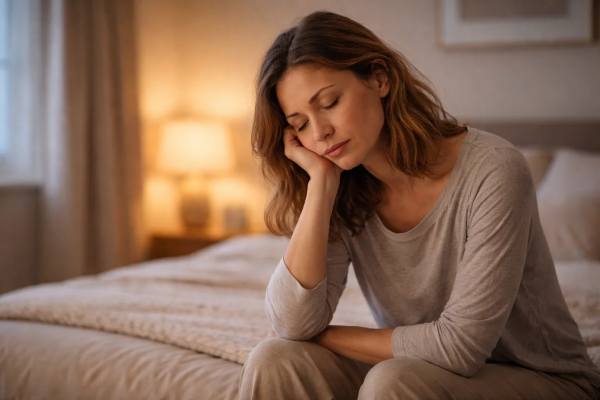
Progesterone is often described as a reproductive hormone, but its effects reach far beyond the ovaries. In the brain, progesterone and its metabolites influence signaling systems that shape how calm, steady, and sleepy you feel. When progesterone is lower than your body expects—whether due to an anovulatory cycle, a short luteal phase, postpartum shifts, or the menopause transition—many people notice changes that feel “out of proportion” to everyday stress: lighter sleep, early waking, a revved-up nervous system at night, and mood that swings faster than usual.
The tricky part is that low progesterone symptoms are real, yet not specific. The same pattern can overlap with thyroid problems, iron deficiency, sleep apnea, medication effects, and mood disorders. This article helps you spot the most telling symptom timing, understand why sleep and anxiety often travel together, and approach testing and treatment in a practical, medically grounded way.
Key Insights
- Track symptom timing across 2–3 cycles; late-luteal sleep disruption and anxiety that lift after bleeding begins can be a useful clue.
- Night sweats, early waking, and “wired but tired” evenings may reflect hormone-related changes in temperature regulation and brain calming pathways.
- Symptoms are non-specific; rule out common contributors like thyroid dysfunction, iron deficiency, sleep apnea, medication side effects, and clinical depression.
- If testing is needed, timing matters: a progesterone level is most informative about ~7 days after ovulation, not automatically on “day 21.”
Table of Contents
- Why progesterone affects sleep and calm
- Low progesterone symptoms to notice
- Sleep changes: insomnia and early waking
- Anxiety and mood shifts across the month
- Who is at risk and when it happens
- How clinicians test and rule out causes
- Treatment options and safe next steps
Why progesterone affects sleep and calm
Progesterone rises after ovulation, peaks in the mid-luteal phase, and then drops sharply just before bleeding starts. That rise-and-fall pattern matters because the brain responds to both the level and the change. Many people feel their most resilient, socially steady, and sleep-ready days in the mid-luteal window—then notice a sudden shift when progesterone falls.
Progesterone is a “night shift” hormone for the brain
A key reason progesterone is tied to sleep and anxiety is that the body converts some progesterone into neuroactive metabolites (often discussed as allopregnanolone and related compounds). These metabolites influence GABA-A receptors—one of the brain’s main braking systems. When that braking system is well supported, you may feel:
- less physical “buzz” in the evening
- fewer racing thoughts at bedtime
- more ability to fall back asleep after waking
When progesterone is low, or when it drops abruptly, some people experience the opposite: lighter sleep, more startle, and a stress response that turns on too easily at night.
Temperature regulation and night waking
Progesterone also shifts thermoregulation. In some bodies, a hormone drop can narrow the comfort zone for temperature control, so minor triggers—warm bedding, a glass of wine, a heated room—translate into sweating and waking. Even if you do not label it as “night sweats,” you might notice tossing, flipping the pillow, or waking at 3 a.m. feeling too warm.
Why symptoms vary so much
Two people can have similar lab values and very different experiences. Sensitivity is shaped by:
- how quickly hormones change (steep drops are often more noticeable)
- baseline anxiety and stress load
- sleep debt (a small shift can feel enormous when you are already depleted)
- genetics and receptor sensitivity
- coexisting issues like iron deficiency, thyroid dysfunction, or sleep apnea
This is why symptoms and timing are often more informative than a single number. The goal is not to blame every mood change on progesterone—it is to recognize when a hormone pattern may be amplifying an underlying vulnerability that is very treatable.
Low progesterone symptoms to notice
“Low progesterone” can mean different things in real life: not ovulating, ovulating but producing less progesterone than usual, having a shorter luteal phase, or experiencing a relative imbalance where estrogen effects feel stronger because progesterone support is weaker. The most useful symptom clues usually involve pattern—especially symptoms that cluster after ovulation and intensify in the days before bleeding.
Sleep-related symptoms
Common sleep complaints linked to lower progesterone states include:
- taking longer than usual to fall asleep, despite feeling tired
- waking earlier than desired (often between 2 a.m. and 5 a.m.)
- fragmented sleep with more “half-awake” time
- vivid dreams or more restless sleep
- night sweats, or waking feeling overheated without a clear reason
A frequent description is “I sleep, but it does not feel restorative.” That can happen when sleep becomes lighter and less continuous.
Anxiety and nervous-system symptoms
People often expect progesterone problems to look like “PMS.” Sometimes they do. But low progesterone can also feel more like a body-based anxiety state:
- a tight chest or fluttery stomach in the evening
- irritability that surprises you with its intensity
- difficulty tolerating noise, conflict, or multitasking
- feeling emotionally raw or unusually self-critical
- a sense of being “wired but tired” at night
Mood changes
Mood symptoms range from mild to severe and can include:
- low mood or tearfulness
- mood swings that feel rapid or disproportionate
- loss of motivation
- increased rumination and negative thinking
- reduced stress tolerance, especially in the late luteal phase
If symptoms are severe, cyclical, and disruptive—especially if they include hopelessness or thoughts of self-harm—treat that as urgent regardless of the suspected hormonal cause.
Physical signs that may travel with low progesterone
Depending on the underlying cause (anovulation, perimenopause, postpartum, thyroid issues), you might also notice:
- shorter cycles or more irregular cycles
- spotting before a period (sometimes linked with luteal phase issues)
- heavier bleeding in some anovulatory patterns
- breast tenderness or bloating
- migraines that cluster around the premenstrual window
Because these symptoms overlap with many conditions, the next step is to connect the dots with timing and context rather than relying on a symptom list alone.
Sleep changes: insomnia and early waking
Sleep problems are one of the most common reasons people start wondering about progesterone. The connection is not just “hormones affect sleep.” It is that progesterone-related shifts can change how stable your sleep is, especially in the second half of the cycle or during life stages when ovulation is inconsistent.
The three classic patterns
- Sleep-onset insomnia
You feel tired, but your brain does not downshift. You may yawn all evening, then become alert the moment you lie down. - Middle-of-the-night waking
You fall asleep, then wake and cannot return to sleep easily. Many people report a “stressy” feeling rather than a practical reason for waking. - Early waking
You wake earlier than planned and feel unable to sleep again. This can be accompanied by a sense of dread, racing thoughts, or warmth.
How to tell whether timing suggests a hormone link
A practical approach is to watch for consistency across at least 2–3 cycles:
- Do sleep problems begin after ovulation and peak 1–5 days before bleeding?
- Do they improve within 1–3 days after bleeding starts?
- Do you sleep better in the first half of the cycle?
This timing does not prove progesterone is the cause, but it is a meaningful signal—especially if the same insomnia appears during perimenopause or after stopping hormonal contraception.
Why night sweats can be “quiet”
Not everyone wakes drenched. Hormone-related thermoregulation issues can look like:
- waking to flip the pillow or throw off the blanket
- waking thirsty
- waking with a fast heart rate
- waking at the same time nightly, as if a switch flipped
If you are over 35 and notice new night waking with warmth, consider both cycle timing and broader causes like sleep apnea, alcohol timing, late exercise, or certain antidepressants.
What helps immediately while you investigate
If you are stuck awake, the goal is to protect your brain from learning “bed equals stress”:
- Keep lights low and avoid checking the time repeatedly.
- If you are awake more than ~20–30 minutes, get up briefly and do something quiet and dim until sleepy.
- Avoid alcohol as a sleep strategy; it commonly worsens second-half-of-night sleep.
- Anchor a consistent wake time for 2 weeks, even if sleep is imperfect. Stability improves sleep drive.
These steps do not replace medical care, but they reduce the spiral while you work out whether hormones are one piece of the puzzle.
Anxiety and mood shifts across the month
Low progesterone symptoms often feel psychological—yet many people describe them as primarily physical: a tense body, a startled mind, and emotions that accelerate faster than usual. That makes sense when you consider that progesterone metabolites support inhibitory signaling in the brain. When support drops, the nervous system can feel less buffered.
What “hormone-linked anxiety” often feels like
While every person is different, a common cluster includes:
- evening anxiety that is not clearly tied to a thought or event
- increased sensitivity to caffeine (or needing caffeine but feeling worse afterward)
- irritability and impatience, especially with noise and interruptions
- a sense of inner agitation paired with fatigue
- more panic-like sensations around bedtime or during night waking
If you track these symptoms, many people see a pattern: stable mood mid-cycle, then worsening in the late luteal days as progesterone declines.
PMS, PMDD, and low progesterone: how they overlap
PMS is common and can include mood symptoms. PMDD is less common but far more intense, with symptoms that significantly disrupt relationships, work, or safety. Importantly, PMDD is not simply “low progesterone.” Many experts describe it as a heightened sensitivity to normal hormone shifts. Still, cycles with low or unstable progesterone can amplify the swing.
Signs your symptoms might be in the PMDD range include:
- symptoms that reliably appear in the week before bleeding
- noticeable relief shortly after bleeding begins
- marked anger, hopelessness, or anxiety that feels unlike your baseline self
If this resonates, it is worth seeking care even if your labs are “normal.” Symptom severity and impairment guide treatment.
Depression can be cyclical, too
People sometimes dismiss serious symptoms because they are “just hormones.” That can be risky. If you have:
- persistent low mood most days
- loss of pleasure
- significant appetite or weight change
- suicidal thoughts
- inability to function at work or at home
treat this as a mental health priority first. Hormones can contribute, but you deserve support that is fast, comprehensive, and safe.
A simple tracking method that improves clarity
Try a daily 60-second log for 2–3 cycles:
- sleep quality (0–10)
- anxiety (0–10)
- mood (0–10)
- bleeding (yes or no)
- ovulation estimate (LH test, cervical mucus changes, or basal body temperature if you use it)
This creates a pattern you and a clinician can act on—without guessing.
Who is at risk and when it happens
Low progesterone symptoms are most likely when ovulation is inconsistent or when hormone shifts are steeper than your brain prefers. Understanding the “when” can immediately narrow the cause.
Anovulatory cycles and short luteal phases
If you do not ovulate, progesterone never rises in the typical mid-luteal way. That can happen with:
- polycystic ovary syndrome (PCOS)
- hypothalamic suppression from under-eating, rapid weight loss, or very high training load
- high stress and poor sleep (both can disrupt ovulation)
- thyroid dysfunction or elevated prolactin
- early perimenopause
Some people ovulate but have a shorter luteal phase (often described as under ~10 days). This can be associated with spotting before a period or cycles that feel “compressed,” though spotting also has many other causes.
Perimenopause: progesterone often changes first
In the menopause transition, ovulation becomes less predictable. Even when periods continue, progesterone peaks may be lower or more erratic. That is why sleep disruption and mood volatility can show up years before the final period—sometimes while cycles are still fairly regular.
Postpartum and after pregnancy loss
During pregnancy, progesterone levels are high, and after delivery they fall rapidly. This drop is normal, but for some people it coincides with:
- new anxiety
- insomnia that feels “biological”
- mood symptoms that intensify in the evening
If symptoms are severe or persist beyond the early postpartum weeks, seek evaluation. Postpartum mood and anxiety disorders are common and treatable, and early care matters.
After stopping hormonal contraception
When you stop combined pills, patches, or rings, your body needs time to re-establish ovulation. During that transition, cycles can be irregular and progesterone production can be inconsistent. Some people notice sleep and mood changes for a few cycles—not because something is permanently “broken,” but because the system is recalibrating.
Midlife sleep: do not assume it is only hormones
In the 40s and 50s, sleep apnea becomes more common, and stress load often peaks. Even if your symptom timing looks hormonal, it is still worth checking for:
- snoring, gasping, or unrefreshing sleep
- restless legs sensations
- new medication timing (including stimulants and some antidepressants)
- alcohol creeping earlier into the evening
A combined approach usually works best: address hormones and the sleep architecture around them.
How clinicians test and rule out causes
Testing for progesterone is not as straightforward as many people expect because progesterone changes dramatically across the cycle—and even across a single day. The best evaluation combines symptom timing, ovulation assessment, and targeted labs to exclude other common drivers of insomnia and mood symptoms.
Start with the two questions that change everything
- Are you ovulating?
Progesterone is primarily produced after ovulation. If ovulation is not happening, the “low progesterone” question becomes “why is ovulation disrupted?” - Do symptoms map to the luteal phase?
If sleep and mood issues cluster after ovulation and lift after bleeding starts, hormones may be contributing. If symptoms are constant, broaden the differential early.
Progesterone lab timing that actually makes sense
A single progesterone level is most informative about ~7 days after ovulation, when levels are expected to be near their peak. People often hear “day 21,” but that only fits a classic 28-day cycle with ovulation around day 14. If you ovulate later, a day-21 blood draw can look “low” even if you ovulated normally.
Ways clinicians estimate ovulation timing include:
- ovulation predictor kits (LH surge)
- basal body temperature shifts
- cycle tracking plus cervical mucus changes
- ultrasound monitoring in some cases
Because progesterone pulses, some clinicians repeat testing or interpret it alongside other markers rather than treating one number as definitive.
Common labs that prevent missed diagnoses
Depending on symptoms, a clinician may consider:
- thyroid testing (hypothyroidism and hyperthyroidism can mimic anxiety and insomnia)
- iron studies (low ferritin can worsen restless legs and sleep quality)
- pregnancy test when cycles are irregular
- prolactin if ovulation seems suppressed
- metabolic markers if PCOS is suspected
When to consider a sleep evaluation
A sleep study is worth discussing if you have:
- loud snoring, witnessed pauses, or waking with choking or gasping
- morning headaches, dry mouth, or persistent daytime sleepiness
- hypertension or weight changes with unrefreshing sleep
Treating sleep apnea can dramatically improve mood and anxiety—sometimes more than any hormone adjustment.
Bring data, not just distress
If possible, arrive with:
- a 2–3 cycle symptom log
- average bedtime and wake time
- a list of supplements and medications with timing
- a brief history of postpartum changes, contraceptive changes, and perimenopause symptoms
That level of clarity speeds up care and reduces trial-and-error.
Treatment options and safe next steps
If low progesterone is contributing to sleep disruption, anxiety, or mood changes, the best plan is usually layered: stabilize sleep, reduce nervous-system overload, and consider medical therapy when appropriate. Avoid self-prescribing hormones—your risk profile depends on age, pregnancy status, bleeding pattern, and personal and family history.
Foundational steps that often help within 2–3 weeks
These are low-risk and high-yield, especially if symptoms spike in the late luteal phase:
- Morning light: 10–20 minutes of outdoor light within an hour of waking.
- Caffeine boundary: keep caffeine to the morning, ideally before noon.
- Alcohol timing: if you drink, avoid using alcohol to fall asleep; it commonly worsens second-half-of-night waking.
- Temperature strategy: a cooler bedroom, breathable bedding, and a warm shower 1–2 hours before bed (followed by cooling) can reduce night waking.
- Wind-down routine: 20–30 minutes nightly of low-light, low-stimulation activity to cue the brain.
If insomnia is persistent, structured CBT-I (cognitive behavioral therapy for insomnia) can be as powerful as medication for many people because it retrains sleep drive and reduces bedtime anxiety.
Medical options clinicians may discuss
Depending on your stage of life and whether you need contraception, options can include:
- Oral micronized progesterone (often taken at bedtime due to potential drowsiness), sometimes used in perimenopause for sleep and night sweats when clinically appropriate.
- Menopausal hormone therapy for eligible individuals with significant vasomotor symptoms, typically combining estrogen with a progestogen if a uterus is present.
- Combined hormonal contraception in some perimenopausal patients who want symptom control plus pregnancy prevention.
- Targeted treatment for PMDD-range symptoms, which may include specific antidepressant strategies, sometimes used only during the luteal phase.
The “best” choice depends on whether you are ovulating, your bleeding pattern, migraine history, blood clot risk, and personal preferences.
Be cautious with over-the-counter progesterone products
Many topical “progesterone creams” are marketed for sleep and mood. Absorption and dosing can be inconsistent, and they can mask symptoms that need evaluation (like abnormal bleeding). If you suspect a hormone contribution, it is safer to bring your symptom log to a clinician and discuss regulated options.
When to seek care quickly
Seek prompt medical help if you have:
- new or heavy abnormal bleeding
- severe depression, panic, or thoughts of self-harm
- postpartum insomnia with escalating anxiety
- symptoms of mania (very little sleep with unusually high energy and risky behavior)
A hormone pattern can be part of the story, but safety comes first. With the right evaluation, most people find a plan that improves sleep and steadies mood without guessing.
References
- Efficacy of Micronized Progesterone for Sleep: A Systematic Review and Meta-analysis of Randomized Controlled Trial Data 2021 (Systematic Review and Meta-analysis)
- Oral micronized progesterone for perimenopausal night sweats and hot flushes a Phase III Canada-wide randomized placebo-controlled 4 month trial 2023 (RCT)
- The 2022 hormone therapy position statement of The North American Menopause Society 2022 (Guideline)
- European society of endocrinology clinical practice guideline for evaluation and management of menopause and the perimenopause 2025 (Guideline)
Disclaimer
This article is for educational purposes only and does not provide medical advice, diagnosis, or treatment. Sleep disruption, anxiety, and mood changes can have many causes, including conditions that require prompt care. If you are pregnant, postpartum, experiencing abnormal bleeding, or considering hormone therapy, consult a licensed clinician to review risks, benefits, and appropriate testing. If you have thoughts of self-harm, feel unsafe, or have severe or rapidly worsening symptoms, seek urgent help from local emergency services or an emergency department.
If you found this helpful, please consider sharing it on Facebook, X (formerly Twitter), or any platform you prefer.