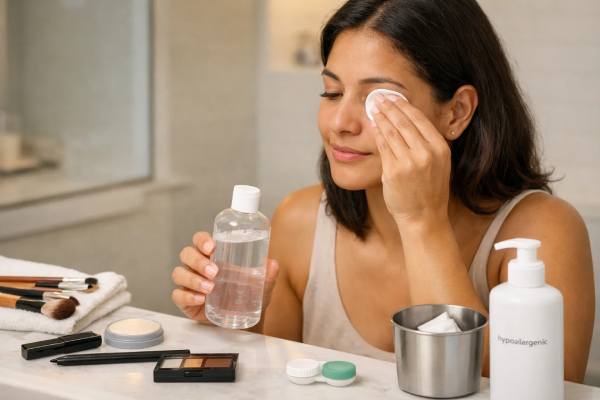
Eye makeup should enhance comfort and confidence—not leave you with burning, watering, or swollen lids by late afternoon. The challenge is that the eyelid skin is thin, the tear film is delicate, and many cosmetics are designed to stay put through heat, sweat, and long wear. That combination can turn small exposures—fragrance, preservatives, pigments, glitters, lash adhesives, even product residue in the tear line—into outsized reactions. The good news is that most makeup-related eye irritation is preventable once you understand whether you are dealing with simple irritation, an allergic response, or a lid-margin problem like blepharitis. This article breaks down the most common triggers, the ingredients and habits that quietly cause flare-ups, and the step-by-step routines that let many people wear makeup comfortably again—without playing guessing games every morning.
Quick Overview
- Many reactions improve when you stop the trigger and rebuild a minimal, fragrance-free routine for 10–14 days.
- Allergic eyelid reactions often come from products used on the hands, hair, or face—not only eye makeup.
- Waterproof and long-wear products can worsen irritation by increasing friction during removal and leaving residue near the tear film.
- Clean tools, product replacement schedules, and “no sharing” rules reduce contamination and repeat flare-ups.
- If symptoms include significant pain, light sensitivity, or contact lens intolerance, seek prompt eye-care evaluation.
Table of Contents
- Why eyelids react so easily
- Irritation vs allergy vs infection
- Common makeup triggers and ingredients
- Hygiene, tools, and product age
- Prevention routine that actually works
- What to do during a flare-up
- When to see a clinician
Why eyelids react so easily
Your eyelids are designed for movement, protection, and blinking—not for hosting long-wear pigments and adhesives. The skin on the lids is thin and absorbs substances more readily than thicker facial skin. It also sits next to the tear film, which is sensitive to oils, waxes, and residue. That is why a product that feels fine on the cheek can sting on the lid, and why a tiny amount of glitter or liner can trigger hours of watering.
The eyelid barrier is delicate
The outer layer of the eyelid has a relatively modest “brick-and-mortar” barrier compared with areas like the palms or soles. When the barrier is stressed—by harsh cleansers, scrubbing, retinoids migrating upward, or chronic dryness—more ingredients can penetrate and cause inflammation. Once inflamed, eyelid skin can enter a cycle: irritation leads to rubbing, rubbing leads to micro-injury, and micro-injury lowers the threshold for the next reaction.
The tear film can be disrupted by makeup migration
Even when you apply products carefully, tiny particles can move with blinking. Waxes and oils can mix into the tear film, destabilizing it and creating a gritty, burning sensation that looks like “allergy” but behaves like dryness. This is especially common when products are applied close to the lash roots or along the waterline, where they can interfere with the oil glands that help prevent tears from evaporating.
Friction is a hidden irritant
Waterproof mascara and long-wear liners often require more forceful removal. That extra friction can inflame lids and lashes, worsen dry eye symptoms, and create swelling that feels like an allergic reaction. In many people, the issue is less about a single ingredient and more about the daily mechanical stress of application and removal—especially when cotton pads, micellar water, and tugging repeat night after night.
“Sensitive eyes” can have multiple drivers
Makeup irritation often overlaps with conditions that already lower comfort, such as dry eye disease, blepharitis (lid-margin inflammation), meibomian gland dysfunction, rosacea, or seasonal allergies. When baseline irritation is present, the margin for error shrinks. A product that used to be tolerable can become a trigger after a stressful week, poor sleep, or a dry indoor environment.
The most helpful mindset is this: eyelid reactions are rarely random. They follow patterns tied to barrier health, tear film stability, and repeated exposures.
Irritation vs allergy vs infection
When your eyes react to makeup, the “why” matters because the solution changes. Irritation improves with gentle care and less friction. Allergy improves only when the culprit is identified and avoided. Infection needs medical attention and, sometimes, prescription treatment. Many people bounce between products because they never name which category they are in.
Irritant reactions are the most common
Irritant contact dermatitis and ocular surface irritation typically show up as burning, stinging, watering, and a “raw” feeling—often soon after application or removal. Common clues include:
- symptoms in both eyes
- worsening after waterproof products or aggressive removal
- improvement on makeup-free days
- dry, tight lid skin that flakes or feels tender
Irritation is often dose-related. The more product, the closer to the lash line, and the more rubbing involved, the more likely a flare happens.
Allergic reactions have a different personality
Allergic eyelid reactions often present with itching, swelling, redness, and sometimes scaling. They can appear hours to days after exposure, which is why the offending item is frequently missed. Clues that allergy is likely:
- intense itching as a dominant symptom
- puffy lids upon waking
- repeated flares with a pattern but no obvious “new product”
- symptoms that persist even after you stop eye makeup, because the trigger may be shampoo, nail products, fragrance, or skincare
Allergy is also notorious for “cross-exposure.” The allergen might be in eye makeup, makeup remover, face moisturizer, sunscreen, fragrance, lash glue, or even transferred from fingers after using another product.
Blepharitis can mimic allergy
Blepharitis and meibomian gland dysfunction can cause burning, gritty sensations, and red lid margins. Makeup can worsen these conditions by blocking gland openings and increasing bacterial load along the lashes. Signs include:
- crusting at the lash base
- red, thickened lid margins
- frequent styes or chalazia
- symptoms worse in the morning or late day
In these cases, the “trigger” may be makeup plus an underlying lid-margin problem that needs a consistent hygiene plan.
Infection and corneal irritation are red flags
Makeup can contribute to infection through contamination, sleeping in makeup, or micro-injuries from particles and applicators. Seek prompt evaluation if you have:
- significant pain (not just discomfort)
- light sensitivity
- blurred vision that does not clear with blinking
- thick discharge or eye stuck shut
- contact lens intolerance
If you wear contact lenses and develop pain or light sensitivity, treat it as urgent. The goal is to protect the cornea early.
If you can label your reaction type—irritant, allergic, lid-margin inflammation, or infection risk—you can stop guessing and start preventing.
Common makeup triggers and ingredients
Makeup-related eye reactions often come from a combination of product chemistry and exposure habits. People tend to blame the newest eyeshadow palette, but the culprit is just as often mascara, remover, lash glue, or “invisible” transfer from hair and hands.
Fragrance and botanical extracts
Fragrance is one of the most common reasons sensitive eyelids flare. “Unscented” does not always mean fragrance-free, and essential oils can be just as problematic. Watch for:
- fragrance, parfum, and aromatic extracts
- essential oils (such as lavender, citrus, peppermint)
- “natural” blends that smell pleasant but contain sensitizers
Because the eyelids are thin, even low-level fragrance exposure from face products can cause eyelid swelling.
Preservatives and formaldehyde-releasing agents
Preservatives prevent microbial growth, but some are frequent allergy triggers. Risk rises when products are used near the eye repeatedly. Preservatives of concern can include certain isothiazolinones and other preservative systems used across cosmetics and skincare. Lash glues may also contain ingredients that sensitize the skin over time. If you react to multiple brands, the shared preservative system is often the clue.
Pigments, metals, and shimmer particles
Some pigment systems can irritate, especially if they migrate into the tear film. Shimmer and glitter increase risk because:
- particles can shed into the eye surface
- edges can scratch or irritate the cornea
- removal often requires more rubbing
Metal contamination and exposure from tools or hands can also contribute, especially with repeated hand-to-eye contact.
Waterproof, tubing, and long-wear formulas
Waterproof mascaras and long-wear liners are common comfort offenders for two reasons:
- they can be more drying or occlusive around the lash margin
- removal often involves increased friction and repeated solvent exposure
If you notice that irritation spikes on “full glam” days, the issue may be cumulative stress: more layers, more removal force, and more residue.
Lash glue, extensions, and adhesives
Adhesives are frequent triggers because they sit near the lash line and can sensitize the skin. Warning signs include localized redness along the lash line, swelling within a day of application, and repeated flares that correlate with lash glue use. If lash extensions trigger burning or gritty sensation, consider both allergic reaction and tear film disruption from residue.
Removers and cleansing steps
Micellar waters, makeup wipes, and oil-based removers can all be helpful, but they can also cause irritation when:
- you rub instead of press-and-dissolve
- residue is left behind and migrates into the eye
- cleansing routines strip the barrier, especially with foaming cleansers
A frequent pattern is “my eyes burn at night after removal.” That points toward friction, remover residue, or barrier damage rather than a true pigment allergy.
The most useful strategy is to think in categories: irritants (friction and residue), allergens (fragrance and preservatives), and particles (glitter and fallout). Then reduce exposure systematically.
Hygiene, tools, and product age
Even a well-formulated product can become a problem if it is contaminated, expired, or applied with tools that collect bacteria and irritants. Eye makeup sits close to the tear film and lash follicles, so hygiene is not cosmetic—it is protective.
Product age matters more than most people think
Mascara and liquid eye products are exposed to air, skin oils, and repeated contact. Over time, the preservative system is challenged, and the product can change in texture and microbial risk. A practical, widely used replacement schedule is:
- mascara: about every 3 months, sooner if it smells odd, dries out, or irritates
- liquid eyeliner: about every 3–6 months depending on use and formulation
- pencil liners: longer lifespan, but only if sharpened regularly and not used on infected or irritated eyes
- cream pots: higher contamination risk because fingers and brushes repeatedly dip in
If you have had an eye infection or significant flare, discarding eye products used during that period is a reasonable safety step.
Brushes, sponges, and applicators can keep inflammation alive
Tools collect oils, skin cells, allergens, and microbes. For eye tools, frequency matters:
- wash brushes used near the eye at least weekly if you wear eye makeup regularly
- avoid using the same sponge for face and eye area during a flare-prone period
- let tools dry fully to reduce microbial growth
If a brush has a lingering smell or remains stiff with product residue, it is not clean enough for sensitive eyelids.
Sharing products is a high-risk habit
Sharing mascara, eyeliner, lash glue, or eye brushes can spread bacteria and viruses. Even if you trust the person, you cannot see what is on their lash line or whether they have early conjunctivitis. If you are prone to styes or blepharitis, sharing is especially risky.
Contact lenses add another layer of vulnerability
If you wear contact lenses and use eye makeup, small changes can make a big difference:
- insert lenses before applying makeup and remove lenses before removing makeup
- avoid applying liner on the waterline, where product can mix into the tear film and coat the lens
- be cautious with fiber mascaras and glitter shadows that can shed particles
- stop lens wear if you develop pain, light sensitivity, or discharge
A common mistake is removing makeup while lenses are still in place. That increases the chance that remover, particles, and oils will interact with the lens surface and irritate the eye.
Sleeping in makeup is not a harmless shortcut
Even one night can trigger lid-margin inflammation, styes, and significant dryness. The longer makeup sits overnight, the more it interacts with oils and debris along the lash margin. If you are flare-prone, think of removal as a non-negotiable step that protects your tear film and lid glands.
Hygiene rarely fixes a true allergy, but it dramatically reduces irritant load, microbial risk, and chronic lid-margin inflammation—three of the most common reasons makeup becomes uncomfortable.
Prevention routine that actually works
Prevention is easiest when it is structured. The goal is not to find a single “perfect” product. The goal is to reduce exposure, friction, and residue while you identify what your eyelids tolerate. For many people, a prevention routine is the difference between occasional irritation and predictable comfort.
Step 1: Reset your baseline for 10–14 days
If you flare often, the most efficient first move is a short reset:
- stop eye makeup and eye-area actives (strong acids, retinoids) temporarily
- use a gentle, fragrance-free cleanser
- keep moisturizer bland and minimal near the lid margin
- consider preservative-free lubricating drops if dryness is part of your symptoms
This calms the barrier and clarifies whether makeup is the primary trigger or whether an underlying lid-margin condition is contributing.
Step 2: Reintroduce one product at a time
When you restart, add only one new eye-area product every 3–4 days. Keep notes on:
- timing of symptoms (immediate burning vs next-day swelling)
- dominant symptom (itching suggests allergy; burning suggests irritation)
- whether the problem is localized to lid skin or feels like surface dryness
This slow approach saves money and prevents a “whole face” flare where you cannot tell what caused it.
Step 3: Apply with placement rules that protect the tear film
Small placement changes can reduce irritation:
- avoid tightlining on the waterline if you are sensitive or prone to dry eye
- keep eyeliner slightly above the lash line rather than inside it
- limit glitter and loose shimmer near the eye, especially if you wear contacts
- choose formulas that remove easily to reduce friction
If you love bold liner, consider a technique that emphasizes the lash line without filling the inner rim.
Step 4: Remove makeup with a press-and-dissolve method
A high-friction removal routine is one of the most common reasons sensitive eyes stay sensitive. A lower-irritation method:
- Saturate a soft pad with remover that you tolerate.
- Press gently against closed lids for 15–30 seconds.
- Wipe downward with minimal pressure.
- Rinse if needed, especially if you notice residue.
- Pat dry and moisturize lightly if lid skin is dry.
If your remover stings, the best remover is not “stronger.” It is one that dissolves product with less rubbing and leaves less residue.
Step 5: Choose products based on behavior, not labels
“Hypoallergenic,” “clean,” and “dermatologist tested” are not guarantees. Better criteria include:
- fragrance-free and essential oil-free
- minimal ingredient lists for the eye area
- products that remove easily without harsh scrubbing
- packaging that reduces contamination (for example, pump or tube over open pots)
If your symptoms are driven by allergy, professional patch testing can identify specific allergens so you can avoid them confidently rather than guessing.
Prevention works when it is predictable. A calm eyelid barrier, low-friction techniques, and careful reintroduction often restore comfort more reliably than constantly switching brands.
What to do during a flare-up
During a flare-up, the goal is to stop the trigger, calm inflammation, and protect the ocular surface. Many people accidentally prolong flares by switching to multiple new products at once or by scrubbing harder to “get everything off.” A calmer approach usually resolves symptoms faster.
Immediate steps for the first 48 hours
If your symptoms are mild to moderate and you do not have red-flag signs:
- stop all eye makeup and discontinue the most recent new product
- avoid rubbing, even if itching is intense
- rinse lids gently with lukewarm water if there is obvious residue
- use a cool compress for 5–10 minutes, up to a few times daily
- use preservative-free lubricating drops if the eye surface feels gritty or dry
If you suspect mascara or liner contamination, do not “try again tomorrow.” Set it aside and consider discarding it, especially if symptoms are recurring.
Rebuild with a minimal routine
For the next several days, keep the routine simple:
- gentle cleanser only, no exfoliating acids on the eye area
- a bland moisturizer applied carefully, avoiding the lash margin
- avoid new eye products until the skin and surface feel stable
If you have seasonal allergies, systemic allergy control may help overall itch, but it will not fix a true contact allergy without avoiding the culprit.
What to avoid during a flare
Avoid common missteps that intensify inflammation:
- makeup wipes that require repeated rubbing
- trying multiple new “sensitive” mascaras in the same week
- using leftover prescription drops without guidance
- applying topical steroid creams near the eyes unless directed, because the eye area is sensitive and risks increase with misuse
- wearing contact lenses if your eyes are red, painful, or light sensitive
If your flare includes significant dryness, it is often worth pausing waterproof products long-term. They can keep the cycle going by forcing friction during removal.
How to restart after symptoms settle
Once symptoms are calm for several days:
- Restart with one product you previously tolerated.
- Avoid waterline application and heavy glitter initially.
- Keep removal gentle and thorough.
- Add the next product after 3–4 days if stable.
If symptoms return quickly after one specific product, treat that as a strong signal. Do not keep “testing” it. Repeated exposure can make reactions stronger over time.
A flare-up plan is successful when it shortens the episode and leaves you with clear data about triggers, rather than a larger mystery.
When to see a clinician
Makeup irritation is common, but certain patterns deserve professional evaluation—either because the cornea may be at risk, or because repeated inflammation needs targeted treatment. Seeking help is especially important when you feel stuck in a cycle of flare-ups despite careful product changes.
Seek prompt eye-care evaluation for these symptoms
Contact an eye-care professional urgently if you have:
- moderate to severe eye pain
- light sensitivity
- reduced vision or new blur that does not clear with blinking
- significant redness in one eye
- thick discharge or eyelids crusted shut
- contact lens intolerance, especially with pain or light sensitivity
These signs raise concern for corneal involvement or infection. Eye surface problems can worsen quickly, and early treatment protects long-term comfort.
See a clinician for repeated eyelid swelling or stubborn itching
If you have recurrent eyelid swelling, scaling, and itching—especially if it persists despite stopping makeup—consider evaluation for allergic contact dermatitis. Many eyelid allergies are caused by exposures outside the eye area, including hair products, facial skincare, nail products, and fragrance. In persistent cases, patch testing can identify the specific allergens so you can avoid them precisely instead of avoiding everything.
When blepharitis or meibomian gland dysfunction may be driving the problem
If you frequently get styes or chalazia, have crusting at the lash base, or feel gritty discomfort that worsens through the day, you may need a lid-margin plan. Clinicians can assess the lid margins and oil glands and recommend a routine that may include:
- consistent lid hygiene
- warm compress strategies tailored to your symptoms
- targeted therapies when inflammation is significant
Makeup may still be possible, but it often requires technique changes—especially avoiding waterline placement and improving removal.
What to bring to your visit
To make the visit more useful:
- bring a short list of products you use on eyes, face, hair, and nails
- note the timeline: what changed 1–2 weeks before symptoms began
- take photos of swelling or redness if it fluctuates
- mention contact lens use, dry eye symptoms, and any history of eczema or allergies
A clinician can help you separate allergy from irritation, evaluate the ocular surface and lids, and recommend a plan that protects both comfort and vision.
If your eyes repeatedly react to makeup, you deserve a strategy that is clearer than trial and error. The fastest way there is to treat severe symptoms promptly and approach chronic patterns with structured reintroduction and, when needed, formal testing.
References
- Ocular adverse events associated with eye makeup: a cosmetovigilance-based cross-sectional study of prevalence and predictors among Jordanian women 2025
- What is New in Contact Allergy To Cosmetics for Physicians, Cosmetologists, and Cosmetic Users? 2025 (Review)
- Allergic contact dermatitis of the eyelids: An interdisciplinary review 2023 (Review)
- Eyelid Contact Dermatitis: 25-Year Single-Center Retrospective Study 2025
- Blepharitis Preferred Practice Pattern® 2024 (Guideline)
Disclaimer
This article is for educational purposes only and does not provide medical advice, diagnosis, or treatment. Eye irritation from makeup can range from mild irritation to allergic contact dermatitis, lid-margin inflammation, or eye-surface conditions that require medical care. Seek prompt evaluation if you develop significant pain, light sensitivity, vision changes, marked redness in one eye, thick discharge, or contact lens intolerance. For personalized recommendations—especially if symptoms are recurrent, severe, or associated with eczema or allergies—consult a qualified eye-care professional or dermatologist who can evaluate your eyes and eyelid skin and guide safe treatment.
If you found this article helpful, please consider sharing it on Facebook, X (formerly Twitter), or any platform you prefer.