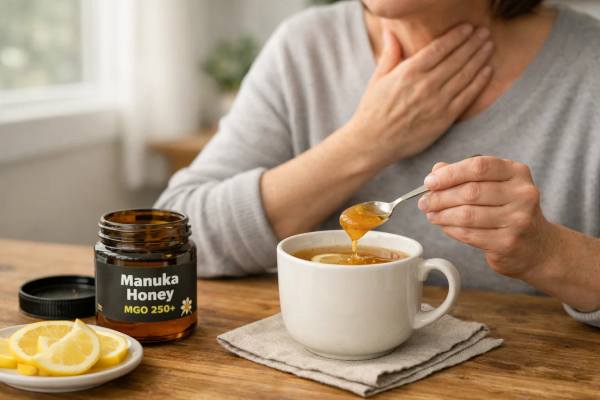
A sore throat can feel deceptively simple—until swallowing hurts, sleep breaks into fragments, and every sip stings. Honey has long been used as a soothing remedy because it coats irritated tissue, supports saliva flow, and can make coughing less harsh. Manuka honey adds a modern twist: its label often highlights MGO (methylglyoxal), a compound linked to stronger antibacterial activity than many standard honeys. That does not mean Manuka honey “kills the infection” in your throat, but it can be a practical comfort tool—especially for scratchy, inflamed throats that come with viral colds. The key is using it well: choosing a legitimate product, taking it in a way that maximizes throat contact, and knowing when it is not appropriate. This guide explains what MGO really indicates, how Manuka honey may help (and where claims overshoot reality), and how to decide when to skip honey and get medical care.
Key Facts for a Sore Throat
- Honey can reduce throat irritation by coating inflamed tissue and easing cough-driven friction, even when the cause is viral.
- Manuka honey’s MGO content is linked to higher antibacterial activity in lab testing, but symptom relief often comes from the same soothing “coating” effect as other honeys.
- Avoid any honey for infants under 12 months, and use extra caution with diabetes, severe pollen or bee-related allergies, and strict low-sugar diets.
- For best throat contact, let 1 teaspoon dissolve slowly in the mouth instead of immediately stirring it into hot tea.
- Seek medical guidance quickly for breathing trouble, drooling, one-sided severe throat pain, or symptoms that worsen after 3–5 days.
Table of Contents
- What makes Manuka honey different
- What Manuka honey really does
- How to use Manuka honey
- Understanding MGO and UMF
- When to skip Manuka honey
- When a sore throat needs care
- Building a smart relief plan
What makes Manuka honey different
Manuka honey comes from nectar of the Manuka plant and is best known for a stronger “non-peroxide” antibacterial activity than many other honeys. Most honeys rely heavily on hydrogen peroxide production (formed when honey is diluted) plus acidity and high sugar concentration to inhibit microbes. Manuka honey still has those baseline features, but it is also rich in compounds that remain active even when hydrogen peroxide is less central. The star of the label is usually MGO, short for methylglyoxal.
MGO is a naturally occurring compound that develops as Manuka honey matures. It is linked to antibacterial effects in lab testing, which is why many jars emphasize a specific MGO number. Higher numbers generally suggest stronger antibacterial potency in vitro, although “stronger” does not automatically translate into better symptom relief for every throat problem.
It also helps to separate two common goals:
- Comfort: reducing scratchiness, burning, and cough-triggered soreness
- Treatment: addressing a specific cause such as strep throat, influenza, or other infections
For comfort, the thickness of honey matters as much as its unique chemistry. That viscous coating can reduce friction on irritated tissue, and the sweet taste can stimulate saliva, which naturally moistens and protects the throat.
For treatment, Manuka honey is not a substitute for medical evaluation when the cause is bacterial tonsillitis, a deep neck infection, or another condition that needs targeted care. A jar label cannot tell you whether your sore throat is viral, bacterial, reflux-related, allergy-related, or due to voice strain.
A realistic way to view Manuka honey is as a supportive tool: it can make symptoms easier to tolerate while your body heals, and it may add some antimicrobial “bonus” activity compared with standard honey. Your best results come from using it strategically and pairing it with the right basics: hydration, pain control when needed, and an eye for red flags.
What Manuka honey really does
The most dependable benefit of honey for sore throat is mechanical and sensory: it coats the throat, reduces dryness, and can make swallowing feel less abrasive. That matters because much of “sore throat pain” is not a single injury—it is irritated tissue plus repeated friction from swallowing, talking, mouth breathing, and coughing. When honey blunts that cycle, symptoms can feel calmer even if the underlying cause remains.
Three ways Manuka honey may help
- Soothing and barrier effect
A thin layer of honey can temporarily protect inflamed tissue, similar to how a lozenge works. Many people notice the biggest difference when the throat feels raw or scratchy rather than when the pain is deep and sharp. - Cough-related relief
Sore throats often worsen because coughing repeatedly slaps and dries the back of the throat. Honey can reduce the “tickle” that triggers coughing in some people and can soften nighttime cough intensity, which helps sleep. - Antibacterial activity in lab settings
Manuka honey’s MGO content is associated with antibacterial effects in vitro. That is scientifically interesting, but it is not the same as proving it can “treat an infection” inside the human throat. The throat is a dynamic environment: saliva dilutes honey, swallowing clears it quickly, and many sore throats are viral or inflammatory rather than bacterial.
Where claims often go too far
- “It kills the virus.” Honey may soothe symptoms, but it should not be framed as an antiviral cure for a cold, influenza, or similar infections.
- “Higher MGO means faster recovery.” Higher MGO can signal stronger antibacterial activity in laboratory tests, but symptom relief can be similar with standard honey because coating is the dominant effect.
- “It replaces antibiotics for strep throat.” Strep throat can lead to complications if untreated, and honey should not delay evaluation when strep is likely.
Think of Manuka honey as a symptom bridge: it can help you feel better while your immune system and time do the main work. If you want an evidence-aligned expectation, aim for modest improvements in comfort and sleep—not an overnight cure.
How to use Manuka honey
How you take Manuka honey matters as much as what you buy. If your goal is throat relief, you want maximum contact time with the back of the throat. That favors slow, direct use rather than quickly washing it down in a large mug of liquid.
Best-use methods for sore throat comfort
1) Slow dissolve (most effective for contact time)
- Take 1 teaspoon and let it melt slowly in the mouth.
- Swallow gradually, allowing it to coat the throat.
- Repeat 2–4 times daily as needed, with a common “sweet spot” being mid-afternoon and bedtime.
2) Honey in warm water (good if swallowing is painful)
- Mix 1–2 teaspoons into warm water and sip slowly.
- Use warm—not boiling—liquid. Very hot drinks can irritate inflamed tissue and can also degrade some delicate components in honey over time.
3) Honey and lemon (optional)
- Lemon can cut through mucus and may feel refreshing, but it is acidic and can sting very raw throats.
- If it burns, skip it. Comfort is the goal.
4) Before sleep for nighttime symptoms
- Many sore throats worsen at night due to mouth breathing, post-nasal drip, and dry air.
- A teaspoon 20–30 minutes before bed can reduce friction from coughing and dryness.
How much is “too much”
Honey is still a concentrated sugar. For most adults, a few teaspoons a day for a short illness window is reasonable, but large amounts can trigger stomach upset, worsen reflux, or spike blood sugar. If you are using honey frequently, keep an eye on:
- Heartburn or reflux symptoms
- Dental sensitivity (especially if you fall asleep right after honey)
- Blood sugar patterns if you monitor them
A practical tip: after honey at bedtime, consider a small sip of water to protect teeth while still leaving some soothing effect behind.
Understanding MGO and UMF
Manuka honey labels can look like a chemistry exam: MGO, UMF, NPA, “active,” “bioactive.” Two terms matter most for most buyers: MGO and UMF. Understanding them helps you avoid paying premium prices for vague marketing.
What MGO means
MGO stands for methylglyoxal, a compound associated with Manuka honey’s distinctive antibacterial activity. Many brands list an MGO number, typically reflecting the amount present in the honey (often expressed as a concentration). As a general principle:
- Higher MGO tends to correlate with higher antibacterial activity in lab testing.
- Higher MGO does not guarantee better symptom relief, because throat soothing depends heavily on viscosity and contact time.
If your primary goal is sore throat comfort, you do not necessarily need the highest number available. If you are buying Manuka honey primarily because you want the “Manuka features,” choose a product with a clear MGO value rather than vague terms like “active.”
What UMF means
UMF (Unique Manuka Factor) is a grading system used by some producers to indicate authenticity and key marker compounds. UMF ratings are often presented as “UMF 10+” or “UMF 15+.” In practice, UMF is intended to reflect both identity and potency markers, but you should still treat it as a labeling system, not a medical prescription.
Choosing a product without overthinking it
A simple approach:
- Pick a reputable brand with clear labeling (MGO value and/or UMF rating).
- Choose a potency level that fits your budget. For sore throat comfort, a moderate grade is often sufficient.
- Avoid products that rely only on non-specific terms like “super active” without a transparent measurement.
Storage and texture tips
- Store honey at room temperature, away from direct heat and sunlight.
- Crystallization is normal and does not mean the honey is spoiled.
- If you warm it, do so gently (for example, warming the jar in lukewarm water), not by microwaving at high heat.
If you want one practical takeaway: label clarity beats label hype. A clearly defined MGO or UMF is more meaningful than a long list of marketing adjectives.
When to skip Manuka honey
Manuka honey is generally safe for healthy older children and adults, but there are clear situations where it should be avoided or used only with extra caution. The biggest safety issue is not MGO—it is honey itself.
Do not give honey to infants under 12 months
Honey can contain spores that can cause infant botulism. This risk applies to all honey, including Manuka. If there is an infant in the household, be careful with shared utensils, honey-coated pacifiers, or “tiny tastes.”
Use extra caution in these situations
- Diabetes or insulin resistance: Honey can raise blood glucose. If you use it, treat it like any other concentrated carbohydrate and adjust your plan accordingly.
- Severe pollen allergies or bee-related allergies: True honey allergy is uncommon, but people with strong pollen sensitivities or a history of anaphylaxis should be cautious. Stop immediately for hives, swelling, wheeze, or throat tightness.
- Frequent heartburn or reflux: Sweet, sticky substances can worsen reflux in some people, and reflux can itself cause sore throat. If honey consistently increases burning in the chest or throat, it may be counterproductive.
- Strict low-sugar diets or dental risk: Honey clings to teeth. If you have frequent cavities, dry mouth, or gum disease, limit honey use and protect oral hygiene.
When “more potent” may be the wrong move
If you are choosing extremely high MGO products, remember that potency does not guarantee comfort and can add cost without meaningful symptom advantage. For many sore throats, the “coating effect” is the main benefit, and standard honey can perform similarly for symptom relief.
When honey can delay the care you need
The biggest mistake is using Manuka honey as a reason to wait out symptoms that deserve evaluation—especially strep throat, dehydration from painful swallowing, or severe one-sided throat pain. Honey can be part of comfort care, but it should not be the deciding factor that delays medical advice when warning signs are present.
When a sore throat needs care
Most sore throats come from viral infections and improve within a week, but some causes require testing or urgent treatment. Knowing the difference can prevent complications and shorten unnecessary suffering.
Reasons to seek urgent care now
Get urgent evaluation if you have:
- Trouble breathing, noisy breathing, or a feeling of airway tightness
- Drooling or inability to swallow fluids
- Severe dehydration (very little urine, dizziness, inability to keep liquids down)
- A muffled “hot potato” voice, neck swelling, or jaw stiffness
- One-sided throat pain that is severe and worsening
- A rash with fever, or severe weakness and confusion
These patterns can signal serious infections or airway risk. Home remedies are not enough in these situations.
When to consider strep testing
Strep throat is more likely when sore throat is paired with:
- Fever
- Swollen, tender lymph nodes in the neck
- Tonsil swelling or pus-like spots
- No cough (not a guarantee, but a clue)
Strep is less likely with cough, runny nose, hoarseness, and mouth ulcers, which often suggest a viral cause. If strep is suspected, testing matters because antibiotics can reduce the risk of certain complications and can shorten contagiousness once started.
When to contact a clinician soon
Schedule a check-in if:
- Symptoms last longer than about 5–7 days without improvement
- Throat pain is escalating rather than leveling off
- Fever persists beyond a few days or returns after improving
- You are immunocompromised, pregnant, or have significant chronic conditions
- You have recurrent severe sore throats or frequent tonsillitis
A sore throat can also be caused by post-nasal drip, reflux, dry indoor air, and heavy voice use. If your symptoms are recurring or do not match a typical cold pattern, a targeted evaluation can save time and prevent repeated cycles.
Building a smart relief plan
Manuka honey works best as one part of a broader, evidence-aligned comfort strategy. Think in layers: reduce inflammation, protect the throat surface, and prevent the dryness and coughing loops that keep symptoms going.
Layer 1: Reduce pain and inflammation
- If appropriate for you, over-the-counter pain relievers can reduce throat pain and make swallowing easier.
- Hydration supports natural mucus barriers and keeps secretions thinner, which reduces throat irritation.
Layer 2: Protect and soothe the throat
- Use Manuka honey (or any honey) with a slow dissolve method for contact time.
- Consider soothing options that work similarly: lozenges, warm fluids, or ice chips if heat feels irritating.
- If your throat is extremely raw, skip acidic add-ins like lemon until the burning settles.
Layer 3: Reduce triggers that prolong soreness
- Dry air: A humidifier at night can reduce morning throat pain from mouth breathing.
- Post-nasal drip: Saline rinses or gentle steam can reduce drainage that “scrapes” the throat.
- Voice strain: Whispering can strain the voice more than speaking softly; rest your voice when you can.
- Reflux: If you notice throat symptoms worsen after meals or at night, avoid late meals and elevate the head of the bed.
What to expect day by day
- Many viral sore throats peak in the first 2–3 days and then gradually improve.
- Honey can make those days easier, but it may not change the overall illness length.
- If you feel steadily worse after day 3–5, reassess rather than simply adding more remedies.
A final practical rule: if honey helps you drink fluids, sleep better, and swallow with less pain, it is doing its job. If you are using it frequently and still cannot hydrate, cannot sleep, or symptoms are intensifying, that is a signal to shift from comfort care to medical evaluation.
References
- Effectiveness of honey for symptomatic relief in upper respiratory tract infections: a systematic review and meta-analysis – PubMed 2021 (Systematic Review and Meta-analysis)
- Honey for acute cough in children — a systematic review – PMC 2023 (Systematic Review)
- The super-food Manuka honey, a comprehensive review of its analysis and authenticity approaches – PMC 2021 (Review)
- The Antioxidant Potential of Commercial Manuka Honey from New Zealand—Biochemical and Cellular Studies – PMC 2024 (Review and Experimental Study)
- Foods and Drinks to Avoid or Limit | Infant and Toddler Nutrition | CDC 2025 (Public Health Guidance)
Disclaimer
This article is for educational purposes and does not provide medical advice, diagnosis, or treatment. Sore throat can be caused by viral infections, bacterial infections (including strep), reflux, allergies, and other conditions that may require different care. Manuka honey may ease symptoms for some people, but it does not replace appropriate evaluation for severe, persistent, or worsening symptoms. Seek urgent medical care for breathing difficulty, drooling, inability to swallow fluids, dehydration, severe one-sided throat pain, or signs of an allergic reaction.
If this article was useful, consider sharing it on Facebook, X (formerly Twitter), or any platform you prefer so others can make informed choices about sore throat relief.