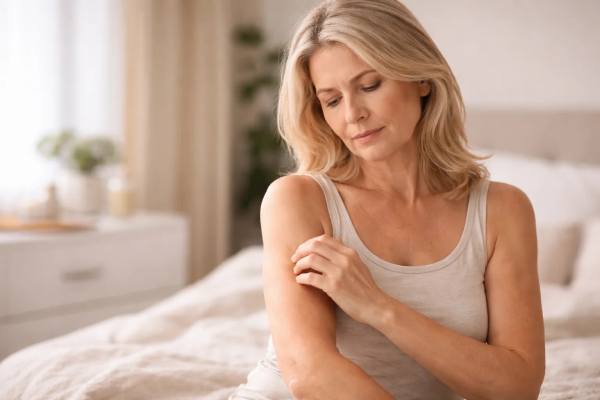
Itching is not usually the first menopause symptom people expect, which is one reason it can feel so strange when it arrives. The skin may suddenly feel drier, thinner, more reactive, or oddly “alive” in an uncomfortable way. Some women describe prickling, stinging, or a creepy-crawly sensation that seems worse at night or after a hot shower. Others notice vulvar itching, irritation, or burning that does not feel like a typical rash at all.
These symptoms are real, and they are often linked to hormonal change, especially falling estrogen. But menopause is not the only reason skin itches, and not every itchy vulva is simply “dryness.” That is where a clear, practical approach helps. The most useful question is not whether menopause can cause itching. It can. The better question is what kind of itching you have, what is driving it, and which remedies make sense before it becomes a cycle of scratching, worry, and poor sleep.
Quick Facts
- Falling estrogen can make skin drier, thinner, and more reactive, which can trigger generalized itch or a crawly skin sensation.
- Vulvar and vaginal itching in midlife is often related to genitourinary syndrome of menopause, which is treatable and not just something to endure.
- Gentle skin care, thick moisturizers, and avoiding fragrance and heat often help more than adding more products.
- Persistent itching with rash, discharge, bleeding, broken skin, or white vulvar patches should not be blamed on hormones alone.
- A practical first step is to separate body itching from vulvar or vaginal itching, because the best treatment is often different for each.
Table of Contents
- Why Menopause Can Trigger Itching
- When Itching Is Not Just Dry Skin
- Where Itching Shows Up Most
- What Helps at Home
- Medical Treatments That Can Help
- When to Get Checked
Why Menopause Can Trigger Itching
Menopause itching usually begins with estrogen loss. Estrogen helps support skin thickness, collagen content, natural oils, barrier strength, and water retention. As levels fall, skin tends to become drier and less resilient. That alone can produce itch. Dry skin is not a small cosmetic change. Once the barrier is weakened, water escapes more easily, irritants penetrate more readily, and the nerves in the skin may react more strongly to friction, sweat, and everyday products.
This is why the itch of menopause often feels different from a classic allergy. It may not start with a dramatic rash. Instead, the skin can feel tight, flaky, extra sensitive, or faintly irritated most of the time. Some women notice it on the arms, legs, chest, scalp, or back. Others describe a crawling, prickling, or lightly stinging sensation rather than a simple itch. That altered skin sensation is sometimes called formication, and while it can be alarming, it often reflects the same broader shift in skin and nerve sensitivity rather than a dangerous skin disease.
Several other menopause-related changes can intensify the problem. Hot flashes and night sweats increase heat and sweat exposure, which can irritate already fragile skin. Sleep disruption lowers the threshold for discomfort and makes nighttime itch feel much more intrusive. Stress, anxiety, and poor sleep can also make the brain pay more attention to itch signals, which turns a mild symptom into something hard to ignore.
Skin in midlife may also become more reactive to products that were tolerated for years. Soap, bubble bath, fragranced lotion, laundry detergent, hot water, wool, or tight synthetic fabrics can start to feel surprisingly harsh. In that sense, menopause does not always create an itch from nothing. It often lowers the skin’s margin for error.
This is also why not every treatment needs to be hormonal. Sometimes the main problem is barrier damage, not a specific skin disease. Rebuilding moisture, reducing triggers, and calming inflammation can go a long way. At the same time, it is still useful to recognize the hormonal backdrop, especially if the itch appeared alongside other signs of estrogen decline such as hot flashes, sleep changes, or vaginal dryness. A broader overview of how low estrogen can affect the body can make these skin shifts feel less random and more coherent.
When Itching Is Not Just Dry Skin
One of the most important things to know about menopause itching is that hormones do not explain everything. Menopause can absolutely make skin itchy, but it can also overlap with ordinary skin disease, vulvar conditions, infections, medication reactions, and internal medical problems that deserve a different response. The mistake is assuming every itch after 45 is “just menopause.”
On the skin, eczema, contact dermatitis, psoriasis, fungal infections, hives, and irritation from new products are all common possibilities. A menopause-triggered barrier change can make these more likely or make existing tendencies flare again. That means someone may have both hormone-related dryness and a treatable skin condition at the same time.
Generalized itching without a clear rash can sometimes point beyond the skin. Thyroid disease, iron deficiency, poorly controlled diabetes, kidney disease, liver disease, and certain medications can all contribute. That does not mean every itchy patch requires a long medical workup, but it does mean persistent or unexplained itch deserves a wider lens if simple measures are not helping.
Vulvar itching requires especially careful thinking. In midlife and after menopause, estrogen loss can lead to genitourinary syndrome of menopause, which commonly causes dryness, burning, irritation, and itching. But vulvar itching can also come from yeast infection, bacterial irritation, contact allergy, lichen sclerosus, lichen planus, eczema, sexually transmitted infections, or skin tears from fragile tissue. Some of these need prescription treatment, and some should not be treated repeatedly with over-the-counter antifungals unless infection is actually likely.
A few clues suggest it is time to think beyond simple dryness:
- The itch is intense, persistent, or waking you regularly at night
- There is a visible rash, hives, scaling, oozing, or cracked skin
- The vulva looks white, shiny, bruised, or scarred
- There is discharge, odor, bleeding, or pain with urination
- The itching is generalized and paired with fatigue, weight change, or jaundice
- A new medication or supplement started around the same time
This does not mean menopause is ruled out. It means the symptom should be interpreted carefully. The safest mindset is to treat menopause as one possible cause, not the only one. If itching is part of a larger cluster of body changes, it can help to step back and review how hormone-related symptoms overlap with other medical problems. That wider view is often what keeps a treatable problem from being dismissed as “just aging.”
Where Itching Shows Up Most
Menopause itching does not always appear in one predictable place. It can affect the face, scalp, ears, neck, chest, back, arms, legs, or the skin as a whole. The common thread is not the location. It is the combination of dryness, sensitivity, and reduced barrier strength that makes the skin easier to irritate. Areas that rub, sweat, or get exposed to hot water and fragranced products often become the most noticeable trouble spots.
The legs and arms are frequent offenders because dry skin often becomes most obvious there first. The chest and back can itch after sweating or hot flashes. The scalp may feel tight, flaky, or more reactive than usual, especially if hair products or shampoos are harsh. Around the ears and jawline, some women notice a prickly or burning sensation rather than classic itch. When the description is “it feels like my skin is crawling,” the symptom may be less about visible dryness and more about altered skin nerve sensation on top of barrier changes.
Vulvar and vaginal itching deserve their own category because the mechanism is often different. In the genital area, falling estrogen thins the tissue, lowers natural moisture, changes the vaginal environment, and makes the area more sensitive to friction and irritants. Women may describe itching, burning, soreness, tenderness, urinary discomfort, or pain during sex. The tissue may feel fragile rather than simply dry. Tight clothing, exercise, sex, soaps, pads, and wet wipes can all make symptoms worse.
That distinction matters because the best treatments are not identical. Thick body moisturizers may help dry shins or forearms but are not the right answer for internal vaginal dryness. Likewise, a product marketed for “intimate freshness” may worsen vulvar irritation because fragrance and cleansing agents can be exactly what the tissue no longer tolerates.
Itching can also cluster at night. Heat under bedding, reduced distractions, and the brain’s tendency to notice symptoms more in the quiet hours can make evening itch feel disproportionately intense. Once sleep is disrupted, the next day’s skin sensitivity often feels worse, which turns itching into a cycle rather than a one-time nuisance.
If itching is mainly genital, especially with dryness, burning, or discomfort during sex, it can be helpful to understand the overlap with midlife vaginal dryness and related tissue changes. Even when the symptom is described as itch, the underlying issue may be fragile, estrogen-deprived tissue rather than a simple external rash.
What Helps at Home
Home care works best when it is boring, consistent, and barrier-focused. Menopause itching usually does not improve because someone buys more products. It improves when the skin is exposed to fewer irritants and given a better chance to hold onto moisture. For many women, the most effective routine is simpler than the one they were using before the itch began.
The first step is usually to reduce stripping and friction. That means lukewarm rather than hot showers, shorter bathing time, and a gentle cleanser only where it is actually needed. Many people do better using a soap substitute or a fragrance-free, non-foaming wash rather than standard soap over the whole body. After bathing, a thick cream or ointment should be applied while the skin is still slightly damp. Lightweight lotions may feel pleasant, but they often do not do enough once the barrier is significantly dry.
Other practical steps often help:
- Choose fragrance-free moisturizers and laundry products
- Use cream or ointment twice daily on the itchiest areas
- Avoid rough exfoliation, scrubs, and harsh acids
- Wear breathable fabrics and avoid wool against sensitive skin
- Rinse sweat off after exercise or hot flashes
- Keep bedroom temperature cooler if nighttime itch is a problem
- Trim nails short to reduce skin damage from scratching
Cool compresses can calm short bursts of itch. A humidifier may help in dry indoor air, especially in winter. If the itch feels worse after caffeine, alcohol, or very hot environments, those triggers are worth noticing rather than pushing through.
Vulvar care should be even simpler. Avoid perfumed washes, wipes, douching, deodorizing sprays, and “feminine hygiene” products. Plain water or a gentle emollient cleanser is usually enough externally. Vaginal moisturizers used regularly can help internal dryness, while lubricants help specifically during sex. These are not the same product type, and many women need both if genital itching is tied to tissue dryness and friction.
It is also worth protecting sleep, because tired skin feels itchier. Nighttime itch is harder to tolerate when the nervous system is already overstimulated. A calm wind-down routine, cooler room, and gentler evening products can make a bigger difference than expected. For people whose sleep is already strained, understanding how hormones and sleep disruption feed each other can help explain why nighttime itching so quickly becomes more than just a skin issue.
Medical Treatments That Can Help
When home care is not enough, the right medical treatment depends on what kind of itching is happening. This is where separating body skin itch from vulvar or vaginal itch becomes essential. A bland moisturizer may help dry arms, but it will not correct genitourinary syndrome of menopause if the main problem is estrogen-deprived vulvovaginal tissue.
For generalized dry, itchy skin, treatment may include stronger emollients, targeted anti-inflammatory creams for eczema or dermatitis, and short-term itch relief when scratching has started to damage the skin. If the itch is being amplified by recurrent inflammation, a clinician may recommend a topical steroid for a limited time. The key is using the right treatment for the right diagnosis rather than layering random products over irritated skin.
For vulvar or vaginal symptoms related to menopause, nonhormonal moisturizers and lubricants are often first-line, especially if symptoms are mild or hormone use is not preferred. They can help with dryness, friction, and discomfort, but they are usually not the most effective option when symptoms are clearly estrogen-related and ongoing.
Local vaginal estrogen is generally the most effective treatment for genitourinary syndrome of menopause. It helps restore tissue quality, moisture, and comfort, and it often improves itching, burning, and irritation as the tissue becomes healthier. Creams and gels can be especially helpful when symptoms involve the vulva as well as the vagina, because a small amount can often be applied externally to the symptomatic skin under medical guidance. Improvement is not usually instant, but many women notice a meaningful shift over several weeks.
Systemic hormone therapy can also improve skin dryness and some menopause symptoms more broadly, especially when itch is part of a larger pattern that includes hot flashes, night sweats, sleep disruption, or other estrogen-loss symptoms. But systemic therapy is not usually prescribed just for a few itchy patches. It makes more sense when there is a broader menopausal symptom burden and no major reason to avoid it. A balanced overview of how estrogen therapy is used and what it can and cannot do is often helpful before assuming it is either a cure-all or something to fear.
Medical care also matters because some vulvar conditions, such as lichen sclerosus, require specific prescription treatment and follow-up. Recurrent infections, significant tearing, and persistent external irritation should not be self-treated indefinitely. If the itch keeps returning, the most helpful next step is often a proper examination rather than yet another product trial.
When to Get Checked
Menopause itching is common, but persistent itch should not be treated as trivial. It affects sleep, concentration, mood, sex, exercise, and the ability to feel comfortable in your own skin. The question is not whether you are “overreacting.” The question is whether the pattern suggests a straightforward menopause-related issue or something that needs examination and a more specific treatment plan.
A medical visit is especially reasonable when the itch is new, persistent, or resistant to basic care after a few weeks. That is even more true if genital symptoms are involved, because vulvar skin conditions are easy to misread at home. Many women assume the problem is yeast, dryness, or low estrogen alone, when the real issue may be dermatitis, lichen sclerosus, infection, or a combination of problems.
Red flags that deserve prompt attention include:
- Broken skin, bleeding, or signs of infection from scratching
- A new rash that is spreading, blistering, or painful
- White vulvar patches, skin thinning, or tearing
- Vaginal discharge, odor, bleeding, or pain with urination
- Intense whole-body itching without a clear skin cause
- Itching with jaundice, fever, weight loss, or marked fatigue
- Symptoms severe enough to disrupt sleep night after night
It is also worth getting checked if the symptom is described mainly as burning, crawling, tingling, or rawness rather than surface itch alone. Those descriptions can still fit menopausal skin change, but they can also point to nerve sensitivity, inflammatory skin disease, or tissue fragility that needs a closer look. When symptoms do not fit the usual “dry skin” pattern, guessing becomes much less useful.
A good evaluation may include a skin or vulvar exam, review of products and medications, and sometimes blood tests if the itch is generalized or unexplained. That broader view matters because itch can sometimes be the first clue to thyroid problems, iron deficiency, diabetes, liver disease, or another treatable issue that happens to appear during menopause rather than because of it.
If the itch is part of a bigger hormone or symptom picture, or if initial treatment is not helping, it may be time to decide when specialist input makes sense. Menopause can absolutely make skin feel dry, prickly, and strangely sensitive. But the best relief comes from taking the symptom seriously enough to ask what is really driving it.
References
- The AUA/SUFU/AUGS Guideline on Genitourinary Syndrome of Menopause 2025 (Guideline)
- Menopause and Common Dermatoses: A Systematic Review 2025 (Systematic Review)
- Update on Genitourinary Syndrome of Menopause: A Scoping Review of a Tailored Treatment-Based Approach 2024 (Scoping Review)
- Evaluation and treatment of vulvovaginal itching in postmenopausal women 2023 (Review)
- NG23 Menopause: Genitourinary (GU) symptoms associated with menopause: Visual summary 07/11/2024 2024 (Guideline Summary)
Disclaimer
This article is for educational purposes only and does not replace medical advice, diagnosis, or treatment. Menopause can contribute to itchy skin, vulvar irritation, and crawly skin sensations, but itching can also come from skin disease, infection, medication reactions, thyroid problems, iron deficiency, liver or kidney disease, and other medical causes. Seek medical care if symptoms are persistent, severe, involve the vulva or vagina, or are accompanied by rash, discharge, bleeding, broken skin, or systemic symptoms.
If this article helped you make sense of menopause-related itching, consider sharing it on Facebook, X, or another platform you use.