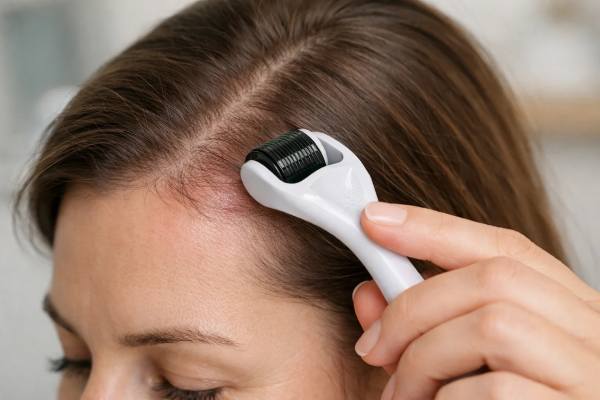
Microneedling has moved from skin clinics into hair-loss conversations with unusual speed. Part of the appeal is easy to understand: it is procedure-based, relatively quick, and often framed as a way to “wake up” the scalp without committing to a pill. But hair growth is rarely that simple. The more useful question is not whether microneedling can create tiny controlled injuries in the scalp. It can. The real question is whether those micro-injuries translate into better hair density, thicker shafts, or less visible thinning in the people most likely to try it.
The answer is promising, but not uniform. Microneedling appears to work best for pattern hair loss, especially when paired with topical treatments such as minoxidil. It is much less clearly proven as a stand-alone fix, and the ideal schedule is not one-size-fits-all. This guide explains where the evidence is strongest, how often sessions are usually done, what needle depth changes in practice, and when the scalp needs more caution than enthusiasm.
Core Points
- Microneedling has the strongest evidence as an add-on treatment for androgenetic alopecia rather than as a stand-alone cure.
- The best results usually come from steady use over months, not from a few aggressive sessions close together.
- Deeper or more frequent needling does not automatically mean better growth and can increase irritation.
- Active scalp inflammation, infection, and scarring hair loss are poor situations for self-directed microneedling.
- A practical starting approach is to match frequency to depth, with shallower sessions spaced closer together and deeper sessions spaced farther apart.
Table of Contents
- What the Evidence Actually Shows
- How Microneedling May Stimulate Growth
- Who Is Most Likely to Benefit
- How Often to Do It and at What Depth
- What a Session and Aftercare Look Like
- Risks, Limits, and When to Avoid It
What the Evidence Actually Shows
Microneedling for hair growth is one of those treatments that sits between excitement and uncertainty. The excitement is real because several clinical trials and recent reviews show measurable improvement in hair count, hair diameter, or photographic appearance, especially in androgenetic alopecia, the medical name for male and female pattern hair loss. The uncertainty remains because protocols vary widely. Studies do not all use the same needle depth, the same device, the same number of passes, or the same treatment interval. That makes the literature encouraging, but not perfectly standardized.
The strongest pattern in the evidence is this: microneedling tends to perform best as an adjunct therapy. In other words, it usually looks more convincing when paired with topical minoxidil than when used alone. Across newer meta-analyses, combination treatment generally outperforms minoxidil alone for hair count and, in some analyses, hair shaft thickness as well. This does not mean microneedling has no direct effect. It means the most reproducible benefit appears when it is layered onto an existing medical treatment rather than treated as a complete replacement.
That distinction matters because many people are drawn to microneedling precisely because it sounds more “natural” than medication. But biology does not reward marketing preferences. Pattern hair loss is a chronic process of follicle miniaturization. A treatment that improves product penetration, shifts local signaling, and stimulates repair may help, but it still works inside that larger disease process. That is why microneedling often fits best alongside other treatment options for pattern hair loss instead of standing alone.
The data on monotherapy are much less settled. Some reviews and small studies suggest stand-alone microneedling can improve hair count. Other research, including a randomized study in male pattern hair loss, found no clear benefit in density after isolated monthly sessions. That mixed picture is important. It tells readers to resist absolute claims in either direction. Microneedling is not useless, but it is also not strong enough to assume that every scalp will respond well without support from another therapy.
Two more points help keep expectations grounded:
- The best data are in mild to moderate pattern loss, not long-standing shiny bald areas.
- Most studies measure outcomes over 12 to 24 weeks or longer, not after a few sessions.
So, does microneedling work? Yes, it can. But the fairest evidence-based answer is more specific: it seems most useful for pattern thinning, particularly when combined with topical therapy, and its benefit is usually modest to moderate rather than dramatic. That is still meaningful. It just needs to be understood on clinical terms, not influencer terms.
How Microneedling May Stimulate Growth
Microneedling works by creating controlled micro-injuries in the skin. On the scalp, that sounds counterintuitive at first. Why would tiny punctures help hair? The answer lies in how follicles behave inside a living tissue environment. Hair does not grow in isolation. It depends on signaling pathways, blood supply, immune tone, and the local wound-healing response. Microneedling appears to influence several of those systems at once.
One proposed mechanism is the release of growth factors during the repair process. Controlled injury can trigger signals linked to tissue remodeling and regeneration. Researchers have also explored how microneedling may affect pathways involved in follicle cycling, including Wnt and beta-catenin signaling. These pathways matter because follicles do not simply turn on or off. They move through phases of activity, regression, rest, and re-entry into growth. A treatment that nudges more follicles toward anagen, or helps them stay there longer, can produce better density over time.
Another likely mechanism is improved delivery of topical therapy. The tiny channels created by needling may temporarily increase penetration of topical agents placed on the scalp, although that also has to be handled carefully because better penetration can mean more irritation if timing is poor. This helps explain why microneedling often looks strongest when paired with topical minoxidil. Part of the benefit may come from the scalp’s repair response itself, and part may come from getting more treatment into the right tissue layer.
There may also be an effect on perifollicular fibrosis and the broader scalp environment. In pattern hair loss, follicles do not just miniaturize in a vacuum. The tissue around them changes too. A more favorable scalp environment may help small, struggling follicles behave more like growing follicles again.
Still, mechanism is not destiny. A biologically plausible treatment can help some people and disappoint others. That is why the hair cycle matters so much. Visible improvement takes time because follicles are asynchronous. Even if microneedling begins influencing the scalp early, the cosmetic change appears later as hairs spend more time in growth and shafts become more noticeable. The process follows the pace of the hair growth cycle, not the speed of online testimonials.
A realistic summary is this:
- Microneedling may stimulate repair-related signaling.
- It may improve penetration of topical therapies.
- It may help miniaturized follicles function better.
- It does not instantly convert a bare scalp into a dense one.
This is why the treatment often looks best in early or moderate thinning. The follicles still exist. They need support, not resurrection. For that reason, microneedling is usually more about improving a struggling scalp ecosystem than performing a miracle. That framing may sound less flashy, but it is much closer to how the therapy likely works in real life.
Who Is Most Likely to Benefit
The best candidate for microneedling is not simply “someone losing hair.” It is someone whose hair-loss pattern matches the evidence base. That usually means androgenetic alopecia, with visible thinning but still enough living follicles to respond. Typical examples include a widening part, reduced density at the crown, thinning at the temples, or diffuse miniaturization over the top of the scalp rather than complete smooth baldness.
Microneedling tends to make the most sense when a person has:
- Mild to moderate pattern thinning.
- A desire to add something to topical treatment rather than replace it.
- The patience to follow a schedule for several months.
- A relatively calm scalp without active infection or severe inflammation.
It may be particularly appealing for people who dislike the idea of oral medication, want a procedure-based add-on, or feel that topical treatment alone has plateaued. In these cases, microneedling can act as a “multiplier” rather than a whole new category of care. That difference matters because many hair-loss plans improve when the goal shifts from hunting for one magic intervention to building a small, targeted combination.
The people less likely to benefit are just as important to define. Microneedling is a weaker fit for:
- Sudden diffuse shedding after illness, surgery, childbirth, or rapid weight loss.
- Patchy bald spots suggestive of alopecia areata.
- Scarring alopecias.
- Hair breakage from bleaching, heat, or tension.
- Painful, crusted, or clearly inflamed scalp disease.
Those patterns often require a different diagnosis and a different treatment pathway. A person with intense shedding from telogen effluvium, for example, may not need scalp injury at all. They may need time, trigger correction, or lab work. A person with breakage may need structural hair care rather than follicle stimulation. A person with patchy loss may need an autoimmune workup. This is why it helps to understand the difference between hair shedding and true hair loss patterns before deciding that a procedure is the answer.
Age and timing also matter. Earlier treatment usually works better than later treatment because follicles that are miniaturized can recover more easily than follicles that have been inactive for years. That does not mean older adults cannot benefit. It means the stage of follicle change matters more than enthusiasm.
A simple rule helps: the closer your story sounds to pattern thinning with living but weakened follicles, the more reasonable microneedling becomes. The farther your story moves toward inflammatory, autoimmune, scarring, infectious, or stress-shedding causes, the more cautious you should be.
The right candidate is not the most motivated buyer. It is the person whose diagnosis actually fits the tool.
How Often to Do It and at What Depth
This is the question most readers care about, and it is also where the literature becomes the least tidy. There is no single universal microneedling schedule proven best for everyone. Studies have used sessions as often as weekly and as infrequently as monthly, with needle depths ranging from about 0.5 mm to 2.5 mm in broader reviews. That wide spread is one reason advice online feels so inconsistent.
Even so, some practical patterns emerge. In professional settings, deeper sessions are usually spaced farther apart because the scalp needs time to recover. Shallower sessions can be repeated more often. A sensible general approach looks like this:
- Around 0.5 to 0.75 mm: often weekly or every 2 weeks.
- Around 1.0 to 1.5 mm: often every 2 to 4 weeks.
- Deeper than that: usually reserved for clinician-directed protocols, not casual self-use.
One useful trial found that 0.6 mm done biweekly with minoxidil performed better than 1.2 mm biweekly with minoxidil for hair count and thickness. That does not prove 0.6 mm is the best answer for every scalp, but it does push back against the common assumption that deeper is automatically better. Recent meta-analytic work also suggests that when microneedling is combined with minoxidil, variations in depth and duration have not consistently translated into clearly superior hair-count outcomes.
That leaves readers with a practical conclusion: frequency should be based less on bravado and more on recovery. The scalp needs time between sessions. Overdoing microneedling can increase irritation, tenderness, and dropout from the routine without delivering better growth. This is one reason very aggressive home schedules are not especially persuasive.
For people using microneedling alongside topical minoxidil, the most defensible message is moderation and consistency. A weekly or every-other-week rhythm with shallow to moderate depth is often more reasonable than frequent deeper injury. Office protocols may be spaced monthly if the treatment is more intense. Either way, results should be judged over 3 to 6 months, not two weekends.
A practical schedule for many users looks like this:
- Choose a depth appropriate to the setting and experience level.
- Match deeper sessions with longer recovery time.
- Keep the schedule steady for at least 12 weeks.
- Reassess at 4 to 6 months using photos, not memory alone.
- Reduce frequency or pause if irritation begins to accumulate.
The biggest mistake is treating microneedling like cardio, where more sessions automatically mean more benefit. Scalp tissue does not reward that mindset. Hair growth responds better to a balanced rhythm: enough stimulation to matter, enough recovery to heal, and enough patience to let the follicles catch up.
What a Session and Aftercare Look Like
Microneedling is often discussed as if the important part is only the device. In reality, the session structure and the hours after it matter almost as much. A well-run session is controlled, clean, and repeatable. A poorly run one is inconsistent, irritating, and hard to judge.
In clinic, the scalp is usually cleansed first, then the thinning areas are treated in a deliberate pattern. The endpoint is often visible redness and sometimes pinpoint bleeding, depending on the depth and the protocol. At home, people usually use shorter needles and more superficial treatment. The key difference is not just comfort. It is control. Clinical procedures are better suited to deeper needling, while home routines are easier to overdo or contaminate if technique slips.
What readers often miss is that microneedling is not just about the few minutes the needles touch the scalp. It is also about what happens afterward. The scalp barrier is temporarily disrupted. That means aftercare should be simple and low-irritation. Sensible steps include:
- Start with a clean scalp.
- Avoid heavy styling products right after treatment.
- Do not stack multiple harsh actives on the same day.
- Protect the scalp from friction and excessive sun exposure.
- Give the skin time to settle before repeating the session.
Timing around topical treatments is especially important. Many protocols pause topical minoxidil until the following day rather than applying it immediately after deeper microneedling, because the combination of microchannels and medication can increase burning and irritation. That does not mean everyone must follow the same rule, but it does mean aftercare should be deliberate rather than impulsive.
A few signs tell you the scalp is tolerating treatment reasonably well:
- Redness settles instead of lingering.
- Flaking is mild and short-lived rather than escalating.
- Tenderness fades between sessions.
- You do not develop bumps, crusting, or unusual pain.
If your scalp becomes progressively angry, you are no longer “pushing through.” You are likely over-treating. That is especially relevant if you already have dandruff, itching, burning, or other signs of scalp inflammation. Microneedling works more smoothly on a scalp that is stable to begin with.
A useful mindset is to think of microneedling as a treatment plan, not a stunt. You want repeatable sessions, boring aftercare, and a scalp that returns to baseline between treatments. People often focus on the moment of injury because it feels active. The real skill is creating a routine that is calm enough to sustain for months. Hair follicles respond to continuity. They do not care whether the procedure felt intense. They care whether the biology was supported long enough to shift the cycle in a better direction.
Risks, Limits, and When to Avoid It
Microneedling is usually described as minimally invasive, and that is fair. Compared with surgery, it is lighter. Compared with daily medication, it can feel more contained. But minimally invasive does not mean trivial. The scalp is skin, follicles, vessels, nerves, and a barrier system all in one. Repeatedly puncturing it without a good reason or a good schedule can create problems that are harder to fix than simple thinning.
The most common short-term issues are irritation, redness, soreness, and increased sensitivity. These are often temporary, but they become more relevant when sessions are too frequent, needle depth is too ambitious, or topical products are layered too aggressively right afterward. Infection risk is lower when hygiene is good, but it is not imaginary, especially with home devices that are reused or stored badly.
There is also a strategic risk: using microneedling on the wrong diagnosis. If the real problem is scarring alopecia, active seborrheic dermatitis, psoriasis, folliculitis, contact dermatitis, or an autoimmune form of hair loss, self-directed needling can waste time and sometimes worsen the local environment. A treatment that helps mild pattern thinning is not automatically a good idea on an inflamed scalp.
Microneedling should generally be avoided or postponed when:
- The scalp is infected, crusted, or broken.
- There is a flare of eczema, psoriasis, or severe dermatitis.
- You have a known tendency toward poor wound healing or problematic scarring.
- The diagnosis is unclear.
- You cannot keep the device and scalp hygienic.
It also helps to define the limits clearly. Microneedling is not a replacement for diagnosis, and it is not the best single tool for advanced baldness. It may improve density in thinning areas, but it does not reliably rebuild long-bare scalp. It is also not the fastest way to get a cosmetic change. That matters for people who want immediate visual improvement, because the better option may be camouflage, medication, or consultation about a more direct intervention.
Please escalate from self-treatment if any of these apply:
- Hair loss is sudden, patchy, or painful.
- Shedding is heavy and unexplained.
- The scalp burns, oozes, scales heavily, or forms pustules.
- You have been needling for months with no meaningful change.
- You are unsure whether you are losing hair from the root or breaking it mid-shaft.
Those are situations where the smarter move is understanding when to see a dermatologist for hair loss rather than doubling down on a device.
The best role for microneedling is targeted and disciplined. It can be useful, especially for pattern thinning and especially in combination with other therapy. But it works best when its limits are respected. The goal is not to force the scalp into submission. It is to support follicles without creating a second problem in the process.
References
- Evaluating the efficacy and safety of combined microneedling therapy versus topical Minoxidil in androgenetic alopecia: a systematic review and meta-analysis 2025 (Systematic Review and Meta-Analysis)
- Efficacy and safety of combined microneedling therapy for androgenic alopecia: A systematic review and meta-analysis of randomized clinical trials 2024 (Systematic Review and Meta-Analysis)
- Microneedling for Hair Loss 2022 (Review)
- Efficacy and Safety of Scalp Microneedling in Male Pattern Hair Loss 2023 (Randomized Study)
- Microneedling in androgenetic alopecia; comparing two different depths of microneedles 2021 (RCT)
Disclaimer
This article is for educational purposes only and is not medical advice, diagnosis, or treatment. Microneedling is not appropriate for every type of hair loss, and the right schedule depends on the diagnosis, scalp condition, device, depth, and whether it is being combined with other therapy. Deeper or more frequent treatment is not automatically safer or more effective. Seek medical care if hair loss is sudden, patchy, painful, inflammatory, scarring, or not improving with an appropriate plan.
If this article helped, please share it on Facebook, X (formerly Twitter), or your preferred platform so more readers can find clear, evidence-based guidance.