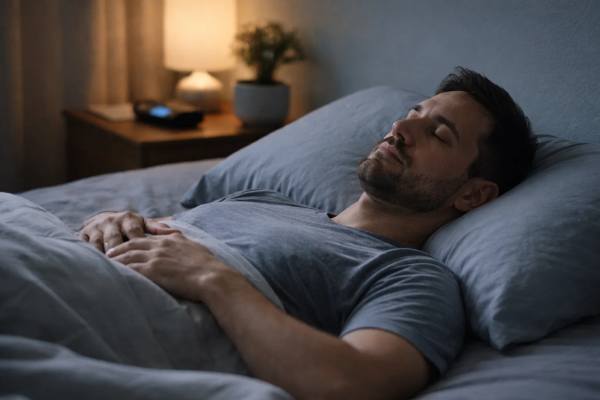
When you are exhausted but your brain refuses to power down, “just relax” is the least helpful advice. The military sleep method is popular because it offers something more concrete: a short sequence that relaxes the body on purpose and gives the mind a simple job, instead of letting it rehearse tomorrow. Used well, it can shorten sleep onset on nights when you are tense, overstimulated, or stuck in a loop of checking the clock. It also builds a repeatable pre-sleep routine, which matters because sleep responds to cues and consistency more than willpower.
That said, it is not a magic switch. The method works best as a practiced skill, not a one-time hack, and it cannot override major sleep disruptors like untreated insomnia, circadian mismatch, or certain medical conditions. This guide shows how to use it and how to know when you need more support.
Essential Insights
- A structured relaxation sequence can reduce pre-sleep arousal and make it easier to drift off without forcing sleep.
- The method is most effective when practiced regularly, not only on high-stress nights.
- Trying to “win” sleep quickly can backfire and increase alertness, especially in chronic insomnia.
- Pair the routine with one small habit change (consistent wake time or caffeine cutoff) for better results within 2 weeks.
Table of Contents
- What the military sleep method is
- The step-by-step routine
- Why it can help you fall asleep
- The real catch and common pitfalls
- Adaptations for anxiety and racing thoughts
- How to support it with sleep-friendly habits
- When fast-sleep methods are not enough
What the military sleep method is
The military sleep method is a short, structured routine meant to help you fall asleep by combining two proven levers: progressive physical relaxation and mental downshifting. It is often described as something you can do in a couple of minutes, but the real value is not speed alone. The value is that it gives your nervous system a clear signal: “We are safe, we are still, and we are done performing for today.”
At its core, the method has three parts:
- Body scan relaxation: You deliberately release tension from the face, shoulders, chest, arms, and legs. Many people carry “invisible effort” in the jaw, forehead, tongue, and shoulders, even while lying down.
- Breath and exhale emphasis: You slow the pace and make the exhale slightly longer than the inhale, which tends to reduce physiological arousal.
- A simple mental image or phrase: You replace open-ended thinking with a small, repetitive focus. This is not about emptying the mind perfectly. It is about giving your brain something boring enough that it stops scanning for problems.
This approach fits best for people who have trouble falling asleep because they feel “wired,” over-alert, or mentally busy. It can also help if you wake during the night and struggle to settle again. It is less reliable when the primary problem is not arousal but timing, such as trying to sleep far earlier than your body clock expects, or sleeping in an environment that is constantly disruptive.
A useful way to think about it is like this: sleep is not something you do; it is something that happens when the conditions are right. The military sleep method is a way to create those conditions more consistently. It lowers muscle tension, reduces internal chatter, and makes your bed a cue for letting go.
If you try it once and it does not work, that does not mean it is useless. It often takes repetition for your brain to associate the sequence with sleep. In that sense, it functions like training: you are practicing the skill of downshifting, not forcing an immediate outcome.
The step-by-step routine
You can do the military sleep method in any position, but it is easiest on your back or side with your arms supported. The sequence below keeps the original “whole-body relax plus mental cue” structure while making it more practical for everyday sleepers.
Before you start
- Set your room as calm as you reasonably can: dim light, phone face down, and a comfortable temperature.
- If you tend to watch the clock, turn it away. Time-checking is a strong arousal trigger.
The routine
- Unclench your face (10–15 seconds).
Let your forehead smooth. Unclench your jaw. Rest your tongue gently against the floor of your mouth. Soften the muscles around your eyes. - Drop your shoulders (10–15 seconds).
Lift them slightly toward your ears, then let them fall. Feel the weight of your arms sink into the bed. - Relax one arm at a time (15–20 seconds).
Start with your dominant arm. Release the upper arm, then forearm, then hand and fingers. Repeat on the other side. - Breathe out and soften your chest (20–30 seconds).
Take a slow inhale through the nose, then a longer exhale. On the exhale, imagine the ribcage “melting” downward. Repeat 3 cycles. - Release your belly and hips (20–30 seconds).
Many people hold tension here without noticing. Let your abdomen rise and fall naturally. Unclench glutes and hip flexors. - Relax one leg, then the other (30–45 seconds).
Let the thigh go heavy, then the knee, then the calf, then the foot. Uncurl your toes. Repeat on the other leg. - Give your mind one job (30–60 seconds).
Choose one of these and stay with it gently:
- Picture yourself lying in a canoe on still water, looking up at a quiet sky.
- Imagine a completely dark, featureless space, like velvet blackness.
- Repeat a simple phrase slowly, such as “Let go,” or “Not now,” on each exhale.
If thoughts interrupt, that is normal. The goal is not to fight them. The goal is to notice the interruption and return to the image or phrase without judging yourself.
How long to do it
Run the full sequence once. If you are still awake, repeat steps 4–7 rather than starting over completely. Most people do best when the routine feels calm and familiar, not like a test you must pass.
Why it can help you fall asleep
The military sleep method works when it reduces the two biggest barriers to sleep onset: physiological arousal and cognitive arousal. Many people think they cannot sleep because they are “not tired enough,” but in practice they are often tired and also activated. Sleep requires a shift toward safety, stillness, and lower effort.
Body relaxation changes the signals your brain receives
Your brain continuously interprets body input: muscle tension, breathing rate, and restlessness are read as clues about threat, urgency, or readiness. When you systematically relax the face, shoulders, chest, and legs, you reduce those “stay alert” signals. This is especially relevant if you hold tension in the jaw, forehead, and shoulders, which can quietly keep your nervous system on standby.
The exhale emphasis matters for a simple reason: a longer, slower exhale tends to reduce sympathetic activation. You do not need to force deep breathing. Gentle, steady breathing is enough to nudge the body toward a calmer state.
Mental focus reduces the “open loop” problem
At night, the mind often runs a problem-solving program: reviewing conversations, planning, worrying, or replaying mistakes. This is rarely productive at 1:00 a.m., but the brain does not care. It cares about unfinished business. A simple image or phrase gives the brain a small, repetitive task that interrupts the cycle without requiring intense concentration.
This is why many people find that sleep comes more easily when they listen to a calm story or repeat a mantra. The military sleep method uses the same principle, but without needing external audio or a device.
It becomes a conditioned cue
If you practice the same sequence consistently, your brain can learn the association: “This routine predicts sleep.” That conditioning effect is one reason it can start working faster over time. It also helps if your nights feel unpredictable, because a stable routine creates a sense of control that reduces anticipatory anxiety.
What it does not do
The method does not “knock you out.” It does not override caffeine, alcohol disruption, severe stress, or a misaligned schedule. It also will not treat every cause of insomnia. What it can do is reduce the common, modifiable friction points that keep many otherwise healthy sleepers awake: tension, restlessness, and mental acceleration.
The key is to approach it like a skill. When you practice a skill, you expect imperfect days. That mindset alone reduces pressure, which is often the hidden reason sleep becomes difficult in the first place.
The real catch and common pitfalls
The “real catch” of the military sleep method is not that it is fake. The catch is that many people try to use it as a two-minute emergency escape hatch on the very nights they feel most desperate. That is the worst moment to evaluate any relaxation technique, because pressure and sleep performance anxiety can keep the nervous system activated.
Here are the pitfalls that most often make it fail, and what to do instead.
Pitfall 1: Trying too hard to fall asleep fast
When you treat the method like a stopwatch challenge, you create a subtle threat signal: “If I do not sleep now, tomorrow is ruined.” That pressure increases alertness. A better cue is: “I am practicing downshifting. Sleep can come when it is ready.” Paradoxically, removing the demand often speeds up sleep.
Pitfall 2: Doing it only when you are already over-aroused
If the only time you practice is when you are stressed, your brain learns: “This routine means emergency.” Practice it on easier nights too. Even 3–4 nights per week for two weeks can build familiarity and reduce the sense that the technique is a last resort.
Pitfall 3: Skipping the face and jaw
People often relax the legs and forget the forehead, tongue, and jaw. These areas are strongly linked to stress arousal and bracing. If you do nothing else, soften the face and shoulders and slow the exhale.
Pitfall 4: Choosing imagery that is too interesting
If your image turns into a story with details, it can become stimulating. Keep imagery neutral, repetitive, and low-detail. “Black velvet” works because there is nothing to build.
Pitfall 5: Ignoring timing and sleep drive
No technique works well if you go to bed far earlier than your body is ready. If you are wide awake at bedtime most nights, the issue may be schedule, inconsistent wake times, long late naps, or too much time in bed. In that case, focus first on building sleep pressure and consistency, then use the method as a settling tool.
Pitfall 6: Using substances that sabotage sleep depth
Alcohol can make you drowsy, but it often fragments sleep later. Late caffeine can delay sleep onset. The method can help you feel calmer, but it cannot fully compensate for stimulants or sleep disruption.
The bottom line: the military sleep method is a solid tool, but it is not a cure for chronic insomnia by itself. Think of it as the “landing routine,” not the whole flight plan.
Adaptations for anxiety and racing thoughts
If your main obstacle is anxiety, the best version of the military sleep method is the one that reduces mental struggle. Anxiety turns sleep into a negotiation. Your job is to stop negotiating and start guiding.
Adaptation 1: Use a “worry container” earlier in the evening
If your brain saves all its concerns for bedtime, give it a scheduled outlet 2–3 hours before sleep:
- Spend 10 minutes writing down worries as bullet points.
- For each, write one “next action” (even a small one).
- End with a closing line like “I have parked this until tomorrow.”
This reduces the sense that bedtime is the last chance to solve everything.
Adaptation 2: Replace imagery with counting on the exhale
Some people find imagery activating or emotionally loaded. If that is you, use a simple pattern:
- Inhale gently.
- Exhale and count “one.”
- Next exhale, count “two,” up to “ten,” then restart.
If you lose track, restart at one. That is not failure; it is the practice.
Adaptation 3: Add a brief “release phrase” for intrusive thoughts
When thoughts arrive, do not argue with them. Use a short script:
- “Not now.”
- “Thank you, mind.”
- “I can think about this tomorrow.”
Then return to the body scan or exhale counting. The goal is to reduce friction, not to eliminate thoughts.
Adaptation 4: Use a gentler body approach if tension feels uncomfortable
If you have pain, injury, or trauma history, intense muscle focus can feel unpleasant. Try “softening” rather than tensing and relaxing:
- Feel one area (jaw, shoulders, hands).
- Imagine it warming and spreading.
- Let it sink into the mattress.
Adaptation 5: If you are awake too long, break the association
If you start to feel frustrated, shift strategy. A practical rule is: if you feel stuck and alert, do a quiet reset activity under dim light (reading something calm, gentle stretching, or a low-stimulation activity) until sleepiness returns, then go back to bed and run the method again. This reduces the bed-as-battleground pattern that fuels insomnia.
Anxiety and sleep share a common trap: they both worsen when you monitor them too closely. Adaptations work best when they reduce monitoring and increase steadiness.
How to support it with sleep-friendly habits
A fast-sleep technique works best when your day supports sleep pressure, circadian timing, and a calmer pre-bed nervous system. You do not need a perfect routine. Choose one or two changes that reduce the biggest friction in your schedule.
Start with one anchor: a consistent wake time
If you do only one thing, keep wake time within about an hour most days, including weekends. A stable wake time stabilizes sleep drive and makes nighttime sleepiness more predictable. It also reduces the temptation to “chase” sleep by going to bed very early.
Protect the late afternoon and evening from hidden stimulants
Common sleep disruptors include:
- Caffeine too late in the day (some people are sensitive even to mid-afternoon caffeine).
- Intense exercise right before bed (great for many people earlier, but activating late for others).
- Heavy meals close to bedtime, especially if reflux is an issue.
- Alcohol used as a sedative, which can fragment sleep later.
You do not have to eliminate these entirely. Start by adjusting timing. For example, set a caffeine cutoff and keep it consistent for two weeks.
Build a 30-minute wind-down that matches your nervous system
The military sleep method is a strong final step, but the runway matters. In the last 30–60 minutes before bed, choose calming cues:
- Lower light levels.
- Reduce emotionally intense content.
- Keep the bedroom cool and quiet.
- Put the phone out of reach if you tend to scroll.
If you cannot avoid screens, reduce brightness and avoid rapid-fire content. The bigger issue is often mental activation, not the screen itself.
Use a “two-layer” routine
Many people do best with a two-layer approach:
- Layer 1 (pre-bed): a predictable sequence (wash, brush teeth, set clothes out, brief stretching).
- Layer 2 (in bed): the military sleep method as the same final script every night.
That predictability reduces decision-making and makes bedtime less negotiable.
Do not confuse sleep hygiene with insomnia treatment
Basic habits can support sleep, but if you have persistent insomnia, the most effective care often involves structured behavioral strategies. If you have been “doing all the sleep hygiene things” and still lie awake most nights, that is a sign you may need a more targeted plan rather than more rules.
In short: let the military sleep method be your landing. Then support it with one anchor habit so your brain arrives at bedtime ready to land.
When fast-sleep methods are not enough
If the military sleep method helps occasionally but you still struggle frequently, the next step is not self-blame. It is identifying what is keeping your sleep system dysregulated. Some problems require a different tool than relaxation.
Consider a clinical evaluation if sleep problems are persistent
You should consider professional support if:
- Difficulty falling asleep, staying asleep, or waking too early happens at least 3 nights per week and lasts 3 months or longer.
- Sleep problems are affecting mood, concentration, work performance, or driving safety.
- You rely on alcohol, cannabis, or sedating medications to sleep most nights.
- You feel dread about bedtime or significant anxiety about not sleeping.
These patterns can indicate chronic insomnia, which often responds best to structured behavioral treatment rather than more bedtime techniques.
Watch for signs of sleep apnea and other sleep disorders
Fast-sleep methods do not treat breathing-related sleep disruption. Seek evaluation if you have:
- Loud snoring, choking or gasping during sleep, or witnessed breathing pauses.
- Excessive daytime sleepiness despite enough time in bed.
- Morning headaches or dry mouth.
- High blood pressure that is difficult to control.
Also consider evaluation for restless legs symptoms (an urge to move the legs at night) or periodic limb movements, which can fragment sleep even if you fall asleep quickly.
Know when the problem is timing, not relaxation
If you are alert until very late and then sleep well once you finally fall asleep, you may have a circadian timing issue. In that case, the best plan often involves consistent wake time and morning light exposure, not more effort at bedtime.
Be cautious with “quick fixes”
Over-the-counter sleep aids and sedating supplements can cause grogginess, interact with medications, and sometimes worsen sleep quality over time. If you are considering regular use, it is worth discussing with a clinician, especially if you have other medical conditions, take multiple medications, or are older.
A practical next step if you are stuck
If you want a clear progression:
- Practice the military sleep method 3–5 nights per week for 2 weeks.
- Add one anchor habit (consistent wake time or caffeine cutoff) for 2 more weeks.
- If you still struggle often, seek structured insomnia care and screening for common sleep disorders.
The method is a helpful skill, but chronic sleep problems deserve real treatment. Good sleep is not a luxury. It is a foundation for mood, cognition, and physical health.
References
- Behavioral and psychological treatments for chronic insomnia disorder in adults: an American Academy of Sleep Medicine clinical practice guideline 2021 (Guideline)
- Cognitive Behavioral Therapy for Insomnia (CBT-I): A Primer 2022 (Clinical Review)
- Systematic review and meta-analysis on fully automated digital cognitive behavioral therapy for insomnia 2025 (Systematic Review and Meta-Analysis)
- Systematic review and meta-analysis of effects of standalone digital mindfulness-based interventions on sleep in adults 2025 (Systematic Review and Meta-Analysis)
- Progressive muscle relaxation alleviates anxiety and improves sleep quality among healthcare practitioners in a mobile cabin hospital: a pre-post comparative study in China 2024 (Clinical Study)
Disclaimer
This article is for educational purposes and does not provide medical advice, diagnosis, or treatment. Sleep difficulties can be caused or worsened by medical conditions, medications, mental health concerns, and sleep disorders such as obstructive sleep apnea. Seek urgent medical care for severe daytime sleepiness that affects safety, sudden confusion, chest pain, or breathing problems during sleep. For persistent insomnia (especially if it lasts 3 months or longer or affects daily functioning), consult a qualified clinician or sleep specialist for evaluation and evidence-based treatment options.
If you found this helpful, please consider sharing it on Facebook, X (formerly Twitter), or any platform you prefer.