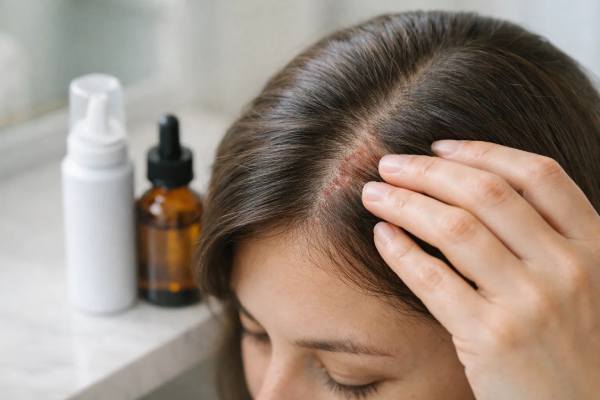
Choosing a minoxidil product sounds simple until your scalp starts to protest. One formula may leave you with less residue and fewer flakes, while another seems easier to place exactly where thinning is happening. For people with a sensitive or itchy scalp, that difference matters more than convenience. It can be the reason treatment becomes sustainable instead of frustrating.
The most important point is that “better” does not always mean stronger or faster. With minoxidil, the better product is often the one your scalp can tolerate well enough for consistent long-term use. Foam and solution can both support regrowth, but they differ in texture, ingredients, drying time, and how likely they are to trigger stinging, itching, or scaling.
That is why this comparison should focus on tolerability first, then practicality, and only then on hair results. If your scalp is reactive, the right vehicle can make the difference between staying on treatment for months and quitting after two weeks.
Core Points
- Minoxidil foam is usually the better choice for sensitive or itchy scalp because it commonly avoids propylene glycol, a frequent source of irritation in solutions.
- Solution can still be the better practical fit for some people with dense or longer hair because it is easier to place directly on the scalp.
- Foam is not automatically more effective than solution; the main advantage is often comfort, not dramatically stronger regrowth.
- Redness, burning, scaling, or rash that keeps worsening is not something to simply push through.
- Apply minoxidil to a fully dry scalp, use only the labeled amount, and reassess the formula if itching is still building after the first 1 to 2 weeks.
Table of Contents
- What Actually Differs Between Foam and Solution
- Why Sensitive Scalps React Differently
- Does Foam Work as Well as Solution
- Which One Is Better for an Itchy Scalp
- How to Apply Minoxidil With Less Irritation
- When to Stop and Seek Medical Advice
What Actually Differs Between Foam and Solution
Foam and solution are both topical minoxidil, but they do not behave the same way once they hit the scalp. The active drug may be similar, yet the vehicle around it changes how the product feels, dries, spreads, and irritates. For someone with a reactive scalp, those details are not minor. They often determine whether the treatment is usable at all.
The classic solution is a liquid. It is usually applied with a dropper or spray and then spread over the thinning area. Its biggest advantage is precision. If you have longer hair, dense hair, or a very specific thinning zone, a liquid can be easier to thread through the hair and place directly on the scalp. It is also often cheaper per month and familiar to many long-term users.
Foam behaves differently. It dispenses as a light mousse-like product that quickly collapses when warmed. Many people like it because it dries faster, feels less greasy, and leaves less visible residue on the hair shaft. It also tends to be cosmetically easier for people who style their hair in the morning or dislike the wet look a liquid can leave behind.
For sensitive scalp questions, though, the ingredient profile matters most. Liquid minoxidil solutions have traditionally included propylene glycol, which helps keep the drug dissolved and improves delivery. That same ingredient is also a common reason the solution feels itchy, drying, or irritating. Foam formulations are often chosen precisely because they avoid propylene glycol. That does not make foam irritation-proof, but it changes the odds in its favor for many users.
There are practical differences beyond ingredients:
- Solution is easier to target in thick, curly, or longer hair.
- Foam usually feels lighter and less messy once applied.
- Solution may drip onto the forehead or temples more easily.
- Foam can be harder to get onto the scalp if too much stays in the hair.
Another important nuance is dosing and labeling. Depending on the concentration, product labeling, and market, foam and solution are not always used on the exact same schedule. That makes head-to-head comparisons less neat than people assume. Many articles imply a simple “foam versus liquid” contest, but in real life the comparison may also involve different strengths or different application frequency.
This is why texture alone should not decide the choice. The real comparison is three-part: how easily it reaches your scalp, how well your scalp tolerates the vehicle, and whether you can stick with it long enough to see results. If the scalp is sensitive, that second point usually becomes the most important one.
Why Sensitive Scalps React Differently
A sensitive scalp is not one diagnosis. It is a description, and different people mean very different things by it. One person has mild stinging after showering. Another gets dry flakes within days of using a hair product. Another develops an itchy rash that keeps spreading. Minoxidil can interact with all of those patterns differently, which is why one user tolerates the solution easily while another cannot get past a week.
The most common reason the liquid solution irritates is not necessarily minoxidil itself. Often, it is the vehicle. Propylene glycol is a well-known culprit in irritant and allergic contact reactions. It can cause itching, redness, scale, and a feeling that the scalp is becoming raw or tight. This is the main reason foam is often recommended when the scalp becomes reactive on the solution.
Still, propylene glycol is not the whole story. Alcohol can also sting, especially if the scalp barrier is already compromised. If someone has active scratching, eczema, seborrheic dermatitis, psoriasis, or small cracks in the skin, even a propylene glycol-free product may burn on contact. In that situation, changing from solution to foam may help, but it may not fully solve the problem because the underlying scalp inflammation is still there.
This is where people often confuse three different problems:
- Irritant reaction: burning, dryness, tightness, or flaking from the formula.
- Allergic reaction: worsening rash, marked itch, redness, and sometimes swelling.
- Background scalp disease: dandruff, eczema, psoriasis, or folliculitis that minoxidil simply makes more obvious.
That distinction matters because the fix is different. A mild irritant reaction may improve with switching vehicles and refining application. An allergic reaction may require stopping the product entirely and discussing patch testing. Background scalp disease may need treatment first, especially when the issue resembles product allergy versus irritation rather than simple dryness.
Another overlooked point is hair type and styling behavior. If foam sits on the hair instead of the scalp, people may rub harder to get it in. That extra friction can make a reactive scalp feel worse, even if the formula itself is gentler. With solution, the problem may be the opposite: it reaches the scalp well but spreads beyond the target zone and irritates more surface area.
A useful rule is this: the scalp usually tells you more than the hair does. Mild transient tingling can happen. Persistent itch with visible redness, scaling, or soreness is more meaningful. Sensitive scalps react differently because the trigger may be the solvent, the barrier state of the skin, the presence of another scalp disorder, or a true allergy. Foam often lowers one of those risks, but it cannot erase all of them. That is why the best product is the one matched to the reason your scalp is reacting in the first place.
Does Foam Work as Well as Solution
For most readers, the real fear is not just irritation. It is this: “If I switch to foam, am I giving up results?” The short answer is usually no, but the fuller answer needs more precision than most summaries give.
Minoxidil works through the drug itself, not because it happens to be in a liquid. That means foam can absolutely be an effective hair-loss treatment. The question is not whether foam “works.” It does. The more useful question is whether it works as well as the solution in a specific real-world setup, with the same consistency, on the same scalp, using the same concentration and schedule. That is harder to answer cleanly because the studies do not always compare identical versions.
Some clinical comparisons suggest that foam can achieve similar regrowth while causing less local intolerance, particularly less itching and dandruff-like flaking in certain groups. That is important for sensitive scalp users because a product that is slightly easier to tolerate may become more effective in practice simply because it gets used more consistently. In other words, tolerability can improve outcomes even when raw efficacy differences are modest.
That is the key insight many comparisons miss: the strongest product on paper is not the best product if the scalp hates it. A solution can be excellent biologically and still fail practically because the user reduces frequency, skips doses, or quits entirely after ongoing irritation.
There are a few reasons people sometimes think the solution works better:
- It is easier to place precisely on very dense hair.
- The scalp feels wetter, which can create the impression that more product was delivered.
- Liquid application may feel more controlled when treating a narrow part line or small thinning zone.
There are also reasons people sometimes do better with foam:
- Less irritation makes long-term adherence easier.
- Faster drying interferes less with styling and daily routine.
- Reduced residue makes once- or twice-daily use more acceptable.
What is harder to support is the idea that foam is universally superior for regrowth in every user. That is too simple. A better way to frame it is this: foam is often superior for comfort, and comfort often improves consistency, which can preserve efficacy in the real world.
It is also important not to misread early shedding. Some people start a new minoxidil product and panic when they notice more hairs during the first weeks. That does not automatically mean the formula is wrong. It can reflect a treatment-related shift in the hair cycle rather than scalp injury, though it is still worth separating from worsening irritation. If you are trying to tell the difference, the pattern of shedding versus more meaningful hair loss can help you interpret what you are seeing.
So, does foam work as well as solution? Often yes, especially when it allows regular use. For a sensitive or itchy scalp, that usually matters more than chasing a theoretical edge from a formula you may not be able to tolerate for long.
Which One Is Better for an Itchy Scalp
If the main problem is scalp itch, foam is usually the better starting point. That is the practical answer most dermatologists give, and it is grounded in a simple reality: the liquid solution more often contains ingredients that trigger irritation, especially propylene glycol. For many users, switching from solution to foam reduces itch, flaking, and that persistent “my scalp never feels calm” sensation.
But “usually better” is not the same as “always better.” The best choice depends on what kind of itch you are dealing with.
Foam is often best when:
- the solution caused burning, stinging, or dandruff-like flaking,
- the scalp feels easily irritated by leave-on products,
- styling residue and greasiness make you touch or scratch the scalp more,
- you suspect the problem is the vehicle rather than the active drug.
Solution may still be worth considering when:
- you have long or dense hair and struggle to get foam onto the scalp,
- the thinning area is narrow and easier to target with a dropper,
- the scalp is not especially reactive and cost matters,
- you tolerate the solution well and have no meaningful itch.
There is also a third group: people whose scalp is already inflamed before minoxidil enters the picture. If you have active seborrheic dermatitis, psoriasis, eczema, or a raw excoriated scalp from scratching, the question may not be “foam or solution” yet. The better question may be “should I calm the scalp first?” A formula switch helps only so much if the skin barrier is already disrupted. In that situation, ongoing itch is often part of the broader pattern seen in itchy scalp causes that deserve closer attention.
One subtle but important limitation of foam is that it can underperform in people who never really get it onto the scalp. This is common with longer hair, textured hair, or hurried application. If most of the product stays on the hair shafts, the scalp may feel drier from styling friction while getting less of the intended medication. For those users, a carefully applied liquid may still be more practical despite the irritation risk.
A sensible decision framework looks like this:
- If solution already causes itch, switch to foam first.
- If foam still burns on contact, check whether the scalp is inflamed from another condition.
- If both are difficult to tolerate, do not keep escalating frequency in the hope that the scalp will simply adapt.
- If hair density or texture makes foam hard to deliver, technique may matter as much as formulation.
For truly sensitive scalp users, the goal is not to find a product that causes zero sensation every time. It is to find one that does not create worsening redness, scale, or constant itch. In that contest, foam usually wins. The exception is when scalp access, hair type, or another untreated scalp condition changes the calculation.
How to Apply Minoxidil With Less Irritation
Good application technique can make a meaningful difference, especially for people who are close to tolerating minoxidil but keep getting tipped into itch or dryness. Many irritation problems are not only about the formula. They are also about where the product lands, how much is used, and what the scalp is exposed to before and after.
The first rule is to apply minoxidil to the scalp, not the hair. This sounds obvious, yet it is where many users go wrong. If the product sits mostly on the hair shafts, people often compensate by rubbing harder, using more product, or applying it more often than directed. That combination increases irritation without improving delivery.
A lower-irritation routine often looks like this:
- Start with a fully dry scalp.
- Part the hair so the thinning areas are visible.
- Apply only the labeled amount.
- Spread gently with fingertips instead of vigorous rubbing.
- Wash hands after application.
- Let it dry fully before lying down, sweating heavily, or layering styling products.
For foam, one practical trick is to dispense a small amount onto a cool surface or fingertip and then press it into parted sections of the scalp. If you dispense too much at once, it can melt too quickly and spread onto the hairline, temples, or face. For solution, use the dropper to place small amounts directly on the scalp rather than flooding the entire area and chasing the runoff.
A few common mistakes make irritation much more likely:
- applying to a wet scalp after showering,
- using extra product because the first application felt like it “disappeared,”
- applying right after scratching, exfoliating, or using harsh scalp treatments,
- stacking it over several other leave-on products,
- blow-drying aggressively while the scalp is already irritated.
This is also where hair-care timing matters. If your scalp is already dry or compromised, minimize unnecessary friction and heat. A gentler styling routine, including the habits discussed in air-drying versus blow-drying damage, can reduce the background irritation that makes minoxidil harder to tolerate.
Do not assume more frequent use will overcome poor response. It usually only raises the risk of side effects. The label matters because formulations differ. Some foam and solution products are directed once daily, others twice daily, and product-specific instructions should take priority over a generic internet routine.
Finally, be careful about the temptation to fix every side effect with another product. Adding exfoliating acids, essential oils, fragranced serums, or “detox” scrubs to an already itchy scalp often worsens the situation. For a reactive scalp, fewer moving parts is usually the better strategy. If the formula still feels progressively harsher after a clean, simple routine and correct application, that is a signal to reconsider the vehicle rather than forcing the scalp to endure it.
When to Stop and Seek Medical Advice
Some discomfort with topical treatment can be mild and temporary. Persistent or escalating irritation is different. The hardest part for many users is knowing when to keep going, when to switch formulas, and when to stop altogether. Sensitive scalp users often wait too long because they assume every side effect is part of the adjustment period.
Mild early symptoms may include transient tingling, a brief sense of dryness, or light flaking that settles as the routine becomes more consistent. Those effects are annoying, but they do not automatically mean the treatment is unsafe or unsuitable. The red flags are the symptoms that intensify rather than fade.
Stop and reassess more quickly if you develop:
- persistent burning instead of mild brief stinging,
- visible redness that keeps returning after each use,
- worsening scale, crusting, or weeping,
- swelling around the scalp, face, or eyelids,
- a rash that spreads beyond the application area,
- dizziness, chest symptoms, hand or foot swelling, or unusual rapid heartbeat.
Those last symptoms are uncommon, but they are not symptoms to troubleshoot casually at home.
Medical advice is also important when the scalp was inflamed before you ever started minoxidil. If you have heavy dandruff, psoriasis-like plaques, folliculitis, marked tenderness, or repeated scratching, the main barrier to treatment may be the scalp condition itself. In that case, pushing through with foam or solution can confuse the picture and delay proper treatment. Some people need dandruff control, anti-inflammatory scalp therapy, or evaluation for contact dermatitis before topical minoxidil becomes tolerable.
There is another situation where guidance helps: when the itch is not the only problem. If the scalp also shows redness, pain, or signs of broader inflammation, it is worth considering the larger list of hair loss with scalp inflammation signs rather than assuming a simple product reaction.
A few practical thresholds justify professional input:
- itch or irritation that clearly worsens over 1 to 2 weeks,
- inability to tolerate either foam or solution,
- uncertainty about whether the reaction is allergy, dandruff, or overuse,
- active scalp disease plus ongoing hair thinning,
- no improvement in hair growth after a reasonable trial despite good adherence.
If you already know your scalp is very reactive, it is also reasonable to ask a dermatologist which vehicle is most sensible before you start. That can save weeks of trial and error.
The bottom line is straightforward. For sensitive or itchy scalp, foam is usually the better first choice because it is often better tolerated. But the moment irritation becomes persistent, visible, or progressive, the conversation should shift from “which minoxidil is better?” to “what is my scalp reacting to, and what needs to be treated first?” That shift is what keeps a manageable side effect from turning into a prolonged scalp problem.
References
- Male and female pattern hair loss 2025 (Review)
- Updates in Treatment for Androgenetic Alopecia 2025 (Review)
- Treatment of Androgenetic Alopecia: Current Guidance and Unmet Needs 2023 (Review)
- A randomized, single-blind trial of 5% minoxidil foam once daily versus 2% minoxidil solution twice daily in the treatment of androgenetic alopecia in women 2011 (Randomized Controlled Trial)
- Allergic contact dermatitis to topical minoxidil solution: etiology and treatment 2002 (Clinical Review)
Disclaimer
This article is for educational purposes only and is not a substitute for medical advice, diagnosis, or treatment. Hair loss and scalp irritation can have several overlapping causes, including dandruff, eczema, allergic contact dermatitis, psoriasis, and inflammatory scalp disorders. If minoxidil causes persistent burning, spreading rash, swelling, chest symptoms, or worsening scalp inflammation, stop using it and seek medical care.
If this article helped you compare minoxidil foam and solution more clearly, please share it on Facebook, X, or another platform where it may help someone else choose more safely.