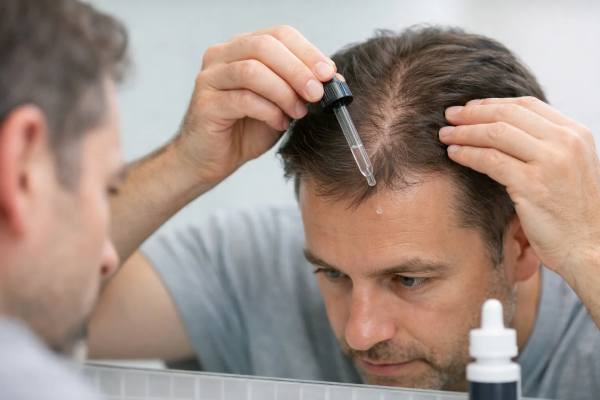
Minoxidil is one of the few hair-loss treatments that has moved from dermatology clinics into everyday bathroom routines. It is familiar, widely available, and often recommended early because it can help slow thinning and support regrowth without a prescription in its topical form. Even so, many people start it with the wrong expectations. They expect instant results, stop during the shedding phase, use too much, or apply it to the hair instead of the scalp.
A better approach begins with a clearer picture of what minoxidil actually does. It does not create a brand-new hairline in a few weeks, and it does not fix every cause of shedding. What it can do is help some follicles stay in growth longer, produce thicker hairs, and hold on to gains as long as treatment continues. That makes consistency more important than intensity. If you know where minoxidil fits, how to apply it, and when to reassess, it becomes much easier to use well.
Core Points
- Minoxidil can slow ongoing thinning and improve hair density in many people with pattern hair loss.
- Results build gradually, and most users need several months of steady use before judging success.
- A temporary early shed can happen and does not automatically mean the treatment is failing.
- Topical irritation, unwanted facial hair, and rare systemic symptoms should not be ignored.
- Apply minoxidil to the scalp rather than the hair, use the labeled amount every day, and continue it to maintain gains.
Table of Contents
- How minoxidil works at the follicle
- Who minoxidil helps most
- How to apply it correctly
- The shedding phase and timeline
- Side effects and safety checks
- When to add, switch, or stop
How minoxidil works at the follicle
Minoxidil began as a blood-pressure drug, but its most lasting reputation came from an unexpected effect: hair growth. That history matters because it explains both its strengths and its limits. Minoxidil is not a hormone blocker, not a vitamin, and not a one-time reset for thinning hair. It is a medication that seems to improve the growth environment around the follicle and help vulnerable hairs behave more like stronger, longer-growing hairs.
The exact mechanism is still not fully settled, which surprises many people. What clinicians know with more confidence is the outcome pattern. Minoxidil can help shorten the resting period of some follicles, extend the active growth phase, and enlarge miniaturized hairs so they come back thicker and more visible. In pattern hair loss, where follicles gradually shrink over time, that matters. A follicle does not have to return to its teenage state to make a meaningful cosmetic difference. It only has to produce a slightly thicker, longer-lasting hair often enough to improve coverage.
That is why minoxidil tends to work best where follicles are still alive but struggling. It is more effective at rescuing miniaturized hairs than replacing follicles that have been inactive for a long time. This is also why earlier use often leads to better cosmetic results than waiting until thinning is advanced.
A few practical points make the mechanism easier to understand:
- Minoxidil supports existing follicles more than it creates new ones.
- It can improve density, caliber, and visible coverage, but not always at the hairline degree people hope for.
- It works only while it is being used; it does not permanently cure pattern thinning.
- It does not treat every cause of shedding, especially when the trigger is inflammation, scarring, or a medical problem unrelated to androgen sensitivity.
This last point is where frustration often begins. People hear that minoxidil is “for hair loss” and assume it applies equally to every form of hair loss. It does not. It is most strongly associated with pattern thinning, though clinicians sometimes use it in other non-scarring conditions as an adjunct. If the problem is sudden diffuse shedding after illness, patchy autoimmune loss, or scalp disease, minoxidil may play only a supporting role or no useful role at all.
Understanding the hair growth cycle helps explain why patience is built into minoxidil. Hairs do not respond overnight because follicles move through growth in phases. Even when minoxidil is doing exactly what it should, you are still waiting for the follicle to shift, produce a new shaft, and grow enough visible length to notice.
That is why the best mindset is steady rather than dramatic. Minoxidil does not usually deliver a single “wow” moment. It works more like a slow correction in follicle behavior. The people who do best with it are often the ones who respect that pace from day one.
Who minoxidil helps most
Minoxidil is most useful when the diagnosis is reasonably clear. The strongest match is androgenetic alopecia, also called male pattern hair loss or female pattern hair loss. In that setting, follicles progressively miniaturize, the part widens or the crown thins, and the process usually unfolds gradually rather than overnight. Minoxidil fits this biology because it helps vulnerable follicles produce thicker hairs for longer.
In men, the classic targets are crown thinning and top-of-scalp recession with an ongoing pattern. In women, the pattern is often more diffuse, with a wider part and reduced density through the mid-scalp rather than a clearly receding front hairline. Minoxidil can help both groups, though the response is not identical and the styling goals are often different. A person who wants to preserve density early may be happier with the result than someone hoping to rebuild a long-absent hairline from scratch.
Minoxidil can also be considered in some other settings, but that is where nuance matters. Dermatologists may use it as an adjunct in chronic telogen effluvium, traction recovery, or other non-scarring conditions when they think faster re-entry into growth could help. That does not mean it is the first or most important treatment in those cases. Often the real job is still to find the trigger.
Minoxidil is less appropriate for self-treatment when any of these are true:
- the hair loss is sudden and unexplained
- the loss is patchy rather than patterned
- the scalp is red, painful, inflamed, or scarred
- there is significant eyebrow or eyelash loss
- the thinning started with a new medication, major illness, childbirth, or crash diet
- you are unsure whether the problem is shedding, breakage, or scalp disease
Those distinctions matter because minoxidil can delay the right evaluation if it becomes a substitute for diagnosis. Someone with a widening part and a family history of patterned thinning may be a straightforward candidate. Someone with sudden clumps of hair on the pillow, patchy bald spots, or burning scalp needs a wider workup before treating themselves.
Minoxidil also helps most when expectations are realistic. It is not the only option for pattern hair loss, and it may not be the best stand-alone choice for every person. Some people need combination treatment. Others care more about prevention than regrowth. A broader look at pattern hair-loss treatment options can be useful if you are comparing minoxidil with prescription therapies, light devices, or procedural treatments.
Age, sex, duration of thinning, scalp sensitivity, and routine all shape whether minoxidil is a good fit. So does adherence. A person who hates daily topicals, has scalp dermatitis, or cannot tolerate residue may technically be a candidate and still fail with it in real life. In those cases, the problem is not the science. It is the match between the treatment and the person.
The best candidate, then, is not simply “someone losing hair.” It is someone with a plausible diagnosis that minoxidil can actually influence, enough remaining follicles to rescue, and a routine that can support steady use.
How to apply it correctly
Many minoxidil disappointments begin with technique. The drug may be effective, but if it sits on the hair instead of reaching the scalp, gets washed off too soon, or is used too irregularly, the outcome rarely matches the label promise.
The first rule is simple: apply it to the scalp, not the hair shaft. Part the hair so the product reaches the thinning area directly. This matters most for longer hair, curly hair, and anyone using the solution form with a dropper. If most of the product ends up coating the strands, you waste medication and increase mess without improving results.
The second rule is to follow the exact directions on your specific product. Instructions differ by formulation and by how the product is labeled. Some solutions are labeled for twice-daily use. Some foams are labeled once daily. More is not better. Using extra product does not reliably speed growth, but it can increase irritation, residue, and the chance of unintended hair growth where the product runs or transfers.
A practical application routine looks like this:
- Start with a dry or nearly dry scalp.
- Part the hair in the thinning area.
- Apply only the labeled amount directly to the scalp.
- Spread it lightly with clean fingertips if needed.
- Wash your hands afterward.
- Let it dry fully before bed, hats, or styling products that might move it.
Foam and solution feel different in daily life. Foam is often easier for people who dislike dripping liquid or who react to propylene glycol, a common ingredient in some solutions. Solution can be easier to place precisely on smaller target areas, but it is also more likely to feel wet, travel onto the forehead, or irritate a sensitive scalp. The “best” version is usually the one you will keep using correctly for months.
A few common mistakes slow people down:
- applying it only when you remember
- skipping weekends or travel days
- using it right before sweaty exercise
- putting it on irritated, freshly sunburned, or broken scalp
- doubling the next dose after a missed one
- judging results based on two or three weeks of use
Hair washing does not cancel minoxidil, but it does make timing matter. Many people do best by anchoring it to the same point in their routine every day, such as after the morning shower or before evening skin care. If you wash frequently, it helps to understand washing frequency by scalp type so you are not building a routine that is either too stripping or too inconsistent.
Topical minoxidil is often described as simple, but simple is not the same as effortless. The people who get the best results are usually the ones who make it mechanical. They do not wait for motivation. They attach it to an existing habit and keep going long enough for the follicles to respond.
The shedding phase and timeline
The most emotionally difficult part of minoxidil is often the beginning. People start because they are worried about losing hair, then a few weeks later they notice more shedding and assume they made the problem worse. That reaction is understandable, but it is not always accurate.
A temporary early shed can happen after starting minoxidil. The simplest way to think about it is that the treatment may push some resting hairs out sooner so new growth can cycle in. In practical terms, that means hairs that were already near the end of their resting period can fall out around the same time, making the brush or shower look alarming for a while. Not everyone gets this phase, and not every increase in shedding is a “good sign,” but a short-lived early shed is common enough that it should not come as a surprise.
What makes it tricky is timing. Minoxidil works slowly, but the cosmetic fear appears quickly. People are asked to trust a treatment during the exact period when the mirror may look worse. That is why many stop too early and never reach the point where the treatment could help.
A more realistic timeline looks like this:
- first weeks: little visible improvement, possible irritation or early shed
- around months two to four: some users notice less shedding or subtle thickening
- around months four to six: early density changes become easier to judge
- around months six to twelve: the response is usually clearer
- beyond that: continued use is needed to maintain what you gained
New growth also does not look impressive at first. Early regrowth can be soft, fine, and lighter in color. Over time, responsive follicles may produce sturdier hairs, but this is gradual. Many people fail to notice improvement because they are looking only at their hairline in bright bathroom light. Better markers are the width of the part, the feel of the ponytail, crown coverage in photos, and how much scalp shows under the same lighting each month.
This is also where expectations need discipline. Minoxidil often helps more with maintenance and modest visible thickening than with dramatic restoration. A person with early thinning may feel thrilled because progression slowed. A person hoping for full reversal may feel disappointed, even if the treatment is working reasonably well.
If the increase in shedding is severe, prolonged, or paired with other red flags, do not assume it is simply a normal minoxidil phase. A guide to sudden shedding triggers that deserve medical attention can help separate expected adjustment from a different problem.
The most useful habit during the first six months is documentation. Take baseline photos from the front, top, crown, and both temples in the same light. Then repeat them monthly. Memory is unreliable when hair changes are slow. Good photos make it easier to tell whether you are truly worsening, stabilizing, or slowly improving.
Side effects and safety checks
Topical minoxidil is generally well tolerated, but “over the counter” should not be confused with side-effect free. Most problems are local and manageable, yet they still matter because irritation is one of the main reasons people quit.
The most common topical issues are itching, dryness, flaking, burning, and scalp redness. Sometimes the culprit is minoxidil itself. Often it is the vehicle, especially propylene glycol in some liquid solutions. This is one reason foam can feel easier for people with reactive skin. A person may say they are “allergic to minoxidil” when the real issue is irritation from the base, not the drug molecule.
Other predictable annoyances include sticky texture, hair that feels less clean, and unwanted facial hair from runoff or transfer. This can happen when product slides onto the forehead, reaches the pillow before it dries, or is applied too generously. Careful placement and patience with drying help more than people expect.
Topical minoxidil also deserves more caution when the scalp is not healthy to begin with. Avoid self-treating over a scalp that is inflamed, cracked, infected, painful, or heavily sunburned. In those settings, irritation risk rises and the real diagnosis may be getting missed.
A few warning signs call for stopping the product and getting advice:
- chest pain or pounding heartbeat
- faintness, dizziness, or unusual weakness
- sudden swelling of hands or feet
- rapid unexplained weight gain
- persistent scalp redness, rash, or severe burning
- unwanted facial hair that becomes cosmetically distressing
These are uncommon with topical use, but they matter because minoxidil is still a biologically active drug. Pregnancy and breast-feeding also call for caution. If you are pregnant, trying to conceive, or breast-feeding, it is better to review the plan with a clinician than assume over-the-counter status makes it harmless.
Oral minoxidil belongs in a separate category. It is increasingly used off-label for hair loss, often at low doses, but it is not the same as grabbing a foam from the pharmacy shelf. Oral minoxidil can be helpful, especially for people who fail topicals or cannot tolerate scalp application, but it carries more systemic risk. Hypertrichosis, headache, edema, lightheadedness, and blood-pressure-related effects are more relevant there. It is a medication that deserves clinician supervision, not casual experimentation.
If you are trying to figure out whether your scalp response is allergy, irritation, or another skin condition, a guide to product allergy versus simple irritation can help frame the difference. That distinction matters because the fix may be a formulation change, not abandoning the drug entirely.
The best safety rule is simple: treat side effects early, not after months of forcing yourself through them. Good adherence comes from tolerable use, not heroic persistence through a bad fit.
When to add, switch, or stop
Minoxidil works best when it is judged fairly. That means using it consistently, applying it correctly, and giving it enough time before deciding it failed. At the same time, fairness does not mean endless waiting. A treatment that is not helping, not tolerable, or not matched to the diagnosis should be reconsidered.
The first major decision point is usually around six months. By then, most people who are applying topical minoxidil well have enough information to answer three questions: Is shedding calmer, is coverage any better, and is the routine tolerable enough to continue? If the answer is yes to at least one of the first two and yes to the third, staying the course often makes sense. If the answer is no across the board, the next step is not automatically quitting everything. It is asking why.
Common reasons for disappointing results include:
- the diagnosis was wrong
- the medication was used inconsistently
- the product never reached the scalp well
- irritation led to poor adherence
- thinning is too advanced for minoxidil alone
- another untreated issue is overriding the response
That is also where combination treatment often enters the conversation. For pattern hair loss, minoxidil is frequently paired with another therapy rather than asked to do all the work. In men, that may mean combining it with a medication that addresses androgen signaling. In women, the additions depend more on age, pattern, hormonal context, and medical history. Procedures or devices may also be layered in selected cases.
Switching formulations is often more useful than people think. Someone who quits after a bad experience with solution may do well with foam. Someone who cannot keep up with topical use may discuss low-dose oral minoxidil with a clinician. Someone with a persistently inflamed scalp may need the scalp condition treated before any regrowth plan works.
Stopping minoxidil has its own rule: gains are usually not permanent without continued treatment. If the medication helped, discontinuing it typically allows the prior thinning pattern to resume over the following months. That does not mean you are “dependent” in a harmful way. It means the treatment was controlling an ongoing process, not curing it.
You should move faster toward medical evaluation when the pattern is not behaving like routine patterned thinning. Patchy loss, scalp pain, scarring, loss of brows or lashes, or heavy shedding that keeps escalating deserve a more careful assessment. If you are unsure when to escalate, signs that it is time to see a dermatologist can help you decide.
Minoxidil is a strong tool, but it is still only one tool. The best results come when it is used with a clear diagnosis, realistic goals, and enough flexibility to adjust the plan when the scalp, schedule, or biology says the current version is not the right one.
References
- Expanding the therapeutic landscape of minoxidil for androgenetic alopecia: topical, oral and sublingual formulations 2026 (Review)
- Efficacy and safety of oral minoxidil in the treatment of alopecia: a single-arm rate meta-analysis and systematic review 2025 (Systematic Review)
- Oral Minoxidil vs Topical Minoxidil for Male Androgenetic Alopecia: A Randomized Clinical Trial 2024 (RCT)
- DailyMed – 5% MINOXIDIL TOPICAL SOLUTION- minoxidil solution 2023 (Official Label)
- DailyMed – MINOXIDIL FOR WOMEN- minoxidil aerosol, foam 2026 (Official Label)
Disclaimer
This article is for educational purposes only and does not replace medical advice, diagnosis, or treatment. Hair loss can result from pattern thinning, shedding disorders, inflammation, nutritional deficiencies, medications, hormonal changes, and other medical conditions. Minoxidil may not be appropriate for everyone, and oral minoxidil should not be started without clinical guidance. Seek professional care if hair loss is sudden, patchy, painful, scarring, rapidly worsening, or accompanied by dizziness, swelling, chest symptoms, or significant scalp irritation.
If you found this article useful, please share it on Facebook, X, or another platform your readers prefer.